

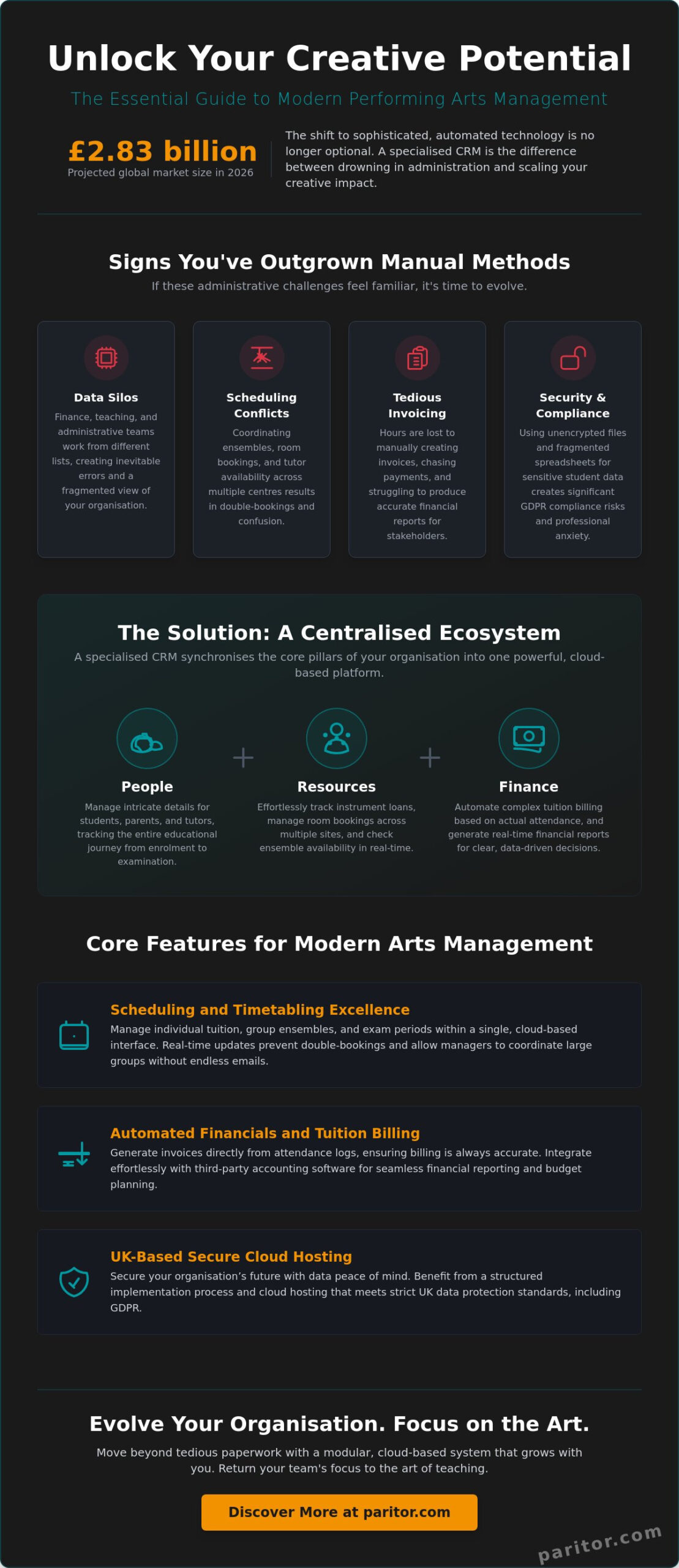
What if the hours you spend untangling scheduling conflicts and manual billing were suddenly restored to your teaching schedule? With the global theatre management software market projected to reach £2.83 billion in 2026, the shift toward sophisticated, automated technology is no longer optional for growing organisations. Selecting the right performing arts CRM is the difference between drowning in admin and scaling your creative impact.
We know you feel the daily pressure of managing instrument loans and ensuring student data meets strict GDPR standards, all whilst trying to keep parents engaged through fragmented communication. It’s tedious work that pulls you away from the music. This guide shows you how specialised software acts as your hard-working engine behind the scenes, automating your financial reporting and providing a single source of truth for every student journey. We’ll walk you through the essential features of modern management, from secure portals to modular systems that evolve alongside your conservatoire or music hub.
Key Takeaways
- Identify the crucial differences between standard ticketing platforms and a specialised performing arts CRM designed to manage the unique complexities of student and tutor journeys.
- Discover how to automate time-consuming administration, from complex ensemble scheduling to integrated financial reporting and automated invoicing.
- Learn why a student-first approach to data management outshines traditional marketing systems when tracking attendance, assessments, and exam progress.
- Secure your organisation’s future by understanding the benefits of UK-based cloud hosting and a structured implementation process for total data peace of mind.
- Explore how modular, cloud-based software allows your team to evolve and return their focus to the art of teaching rather than tedious paperwork.
What is a Performing Arts CRM and Why Does Your Organisation Need One?
At its core, a performing arts CRM is a specialised ecosystem designed to synchronise the complex relationships between students, tutors, and the physical resources they require. While basic Customer Relationship Management (CRM) systems focus on one-off transactions or sales leads, performing arts organisations require a platform that tracks a long-term educational journey. It’s the difference between simply selling a ticket and nurturing a ten-year musical career. This transition from audience-facing databases to education-focused management systems is vital for any organisation looking to scale.
Modern management relies on three core pillars to maintain office efficiency. First, People, which covers the intricate details of students, parents, and tutors. Second, Resources, involving the tracking of instrument loans, room bookings, and ensemble availability. Finally, Finance, which handles the complexities of tuition billing and automated financial reporting. When these pillars work together in a cloud-based environment, the administrative burden begins to lift.
The Evolution of Arts Administration
The move from legacy desktop software to modern SaaS platforms has fundamentally changed how music services operate. Many organisations previously tried to force general-purpose tools to fit their needs. These often feel clunky and unintuitive because they lack the specific logic required for instrument inventory or ensemble grading. A specialised system provides software that does the hard work, so you don’t have to. It’s a necessary step to evolve beyond the limitations of outdated tech. This shift allows UK music hubs to reduce tedious tasks and focus entirely on the quality of their tuition.
Signs You Have Outgrown Your Spreadsheets
Data silos are often the first warning sign that your current system is failing. If your finance team is working from one list whilst your teaching staff uses another, errors become inevitable. This fragmentation is more than just an inconvenience; it’s a risk to your professional reputation. In 2026, relying on unencrypted files or manual spreadsheets also creates significant GDPR anxiety. Security and compliance must be at the heart of your data strategy.
When you reach the point where scheduling a single ensemble or tracking a hundred instrument loans feels like a full-time job, you’ve outgrown manual processes. Transitioning to a dedicated performing arts CRM ensures everyone accesses a single source of truth in real time. This creates a collaborative atmosphere where data is secure and administrators feel empowered rather than overwhelmed. It’s about building a foundation of professional trust that allows your creative vision to shine.
Core Features of a Modern Performing Arts CRM
A modern performing arts CRM is far more than a digital filing cabinet. It serves as an active participant in your organisation’s daily life, connecting the dots between a tutor’s availability and a student’s progress. In an era where arts organisations must demonstrate their impact with data to stakeholders and local authorities, having these features centralised is essential. It moves you away from making do with fragmented tools toward a professional, integrated system that supports your long-term goals.
Scheduling and Timetabling Excellence
Managing tutor schedules across multiple locations requires absolute precision. A dedicated system handles individual tuition, group ensembles, and exam periods within a single, cloud-based interface. Real-time updates are the backbone of this module; they ensure that if a room booking changes in one centre, the information is instantly mirrored across the entire network. This prevents the frustration of double-bookings and allows ensemble managers to coordinate large groups, such as youth orchestras, without the usual flurry of emails and phone calls.
Financial Automation and Tuition Billing
Manual invoicing is often the most tedious task for any music service. A specialised performing arts CRM automates this process by generating invoices directly from attendance logs, ensuring that billing is always accurate and reflects the actual tuition provided. Many UK music hubs require integration with third-party accounting software used by local authorities; a modern system handles this effortlessly. You gain access to real-time financial reporting, which is invaluable for budget planning and identifying trends in student retention before the next academic year begins.
Instrument and Asset Management
Tracking a vast inventory of violins, brass, and woodwind is a significant logistical challenge. The instrument management module allows you to track loans, record maintenance history, and use barcodes for quick check-outs. This is critical for large-scale hubs managing thousands of pounds worth of assets. Having a digital paper trail for every instrument ensures accountability and helps you manage maintenance schedules proactively. Evolving your organisation starts with choosing the right modules for your team at Paritor.
Beyond these core pillars, secure portals provide a window into the system for those who need it most. Teachers can record attendance and track student behaviour on the go, whilst parents can check lesson times and pay invoices through a dedicated portal. This level of transparency improves engagement and significantly reduces the volume of routine enquiries hitting your admin desk, allowing your staff to focus on higher-value tasks.
Education vs Ticketing: Choosing the Right CRM for Your Specific Goals
Choosing the right performing arts CRM requires a clear understanding of your primary mission. Many ranking guides treat “CRM” as a synonym for “ticketing software”, but this narrow view ignores the complex needs of music education providers. A producing venue needs to sell seats; a music hub needs to manage a decade-long student journey. These are fundamentally different workflows that require different technological foundations. When you select a system, it must align with the daily reality of your staff rather than just the needs of the box office.
Marketing-heavy systems often struggle when asked to track weekly attendance or manage exam results. They’re built for the “Ticket Buyer” journey, which is largely transactional and ends once the performance starts. In contrast, the “Student” journey involves ongoing tuition, instrument loans, and grading assessments. Relying on a ticketing system to manage these education-specific tasks leads to clunky workarounds and administrative fatigue. It’s vital to choose a platform that understands the nuance of long-term learner engagement.
When to Prioritise a Ticketing CRM
If your organisation’s main focus is on producing shows, managing a theatre, or running a museum, a ticketing-first CRM is the logical choice. These platforms excel at seat mapping, audience segmentation, and high-volume fundraising. They’re designed to help you understand who is in your seats and how to get them back for the next production. According to Drexel University research on CRM for arts organizations, small arts groups often use these tools specifically for audience and donor development. For organisations that purely present works, the ability to map a venue and manage a box office is the priority.
When an Education Management System is Essential
For music hubs, conservatoires, and private teaching practices, an education management system is not just helpful; it’s essential. You don’t need a “web shop” as much as you need an Xperios Parent Portal where families can manage lesson times and pay for tuition effortlessly. Your teachers need a dedicated Xperios Teacher Portal to record attendance and behaviour in real time, rather than navigating a complex marketing database. Tracking progress, assessments, and exam results requires a specific logic that ticketing systems simply don’t possess.
This is where Paritor’s Xperios platform fills the gap between venue management and education. It provides a modular approach that allows you to add features as you grow. Whether you need Xperios Ensemble Management for your youth orchestra or the Xperios Exams and Assessments Module for end-of-term grading, the system scales with you. It’s software that does the hard work, so you don’t have to, providing a single source of truth that ticketing platforms can’t replicate. By choosing a system built on valuable user feedback, you ensure your technology supports your educational mission rather than just your ticket sales.
Implementing Your New System: Security and Data Peace of Mind
The transition to a new performing arts CRM is a pivotal moment for any music service or conservatoire. It marks the end of administrative fragmentation and the beginning of a streamlined, professional future. However, technology is only as effective as its implementation. A successful rollout requires more than just login credentials; it demands a structured approach to data migration and a commitment to staff onboarding. When the process is handled with care, the result is a resilient system that empowers your team rather than adding to their workload.
For UK-based organisations, the physical location of your data is a critical factor for both speed and compliance. Utilising Microsoft Azure servers located within the UK ensures that your platform remains responsive whilst adhering to local data residency requirements. This infrastructure supports high uptime Service Level Agreements (SLAs), meaning your staff can rely on the system being available whenever they need it. Mirrored servers provide an additional layer of reliability; if one server experiences an issue, another instantly takes over to prevent service disruption. This technical foundation provides the professional trust necessary to manage sensitive student records with absolute confidence.
Navigating the Data Migration Process
Moving away from legacy desktop software or a collection of spreadsheets can feel daunting. The key is a structured migration that preserves historical records whilst cleaning your database for future use. A dedicated onboarding programme ensures your administrative staff don’t just learn the buttons, but understand the new workflows. This collaborative approach reflects our philosophy of providing software that does the hard work, so you don’t have to. It ensures the transition feels like a step forward rather than a hurdle. Evolve your data management today at Paritor.
GDPR and Safeguarding in the Digital Age
Safeguarding is the highest priority for any organisation working with children and vulnerable adults. A modern performing arts CRM simplifies compliance by offering role-based access control. This means teachers only see the specific student data they need for their tuition, whilst parents access only their own child’s records through a secure portal. Automated backups and end-to-end encryption eliminate the risks associated with unencrypted spreadsheets or paper files. This “security first” architecture provides total peace of mind, allowing you to focus on the art of teaching while the system handles the complexities of GDPR.
By centralising your data in a secure, cloud-based environment, you eliminate the “data silos” that lead to errors and compliance breaches. Every record is updated in real time across the entire organisation, from the finance office to the rehearsal room. This level of transparency doesn’t just improve efficiency; it builds a culture of accountability and safety that protects your students, your staff, and your institution’s reputation.
Evolve with Xperios: The Paritor Approach to Performing Arts Management
Xperios is not just another performing arts CRM; it’s a specialised cloud platform born from the specific needs of the music education sector. We understand that your organisation is unique. That’s why our “Built by You” philosophy is at the heart of everything we do. Every module, from Tuition to Groups, has been refined through valuable feedback from users who manage the same daily headaches you face. This collaborative approach ensures the software handles the complexities of your office, allowing your staff to breathe a sigh of relief. It’s software that does the hard work, so you don’t have to.
The modular nature of Xperios means you only pay for what you need. You might start with Xperios Instrument Management to get your inventory under control, then add the Exams and Assessments module as your requirements grow. This flexibility allows you to evolve at your own pace without being overwhelmed by unnecessary features. By modernising your administration, you restore the focus to where it belongs: the art of teaching and the progress of your students. When the paperwork is automated, the music takes centre stage.
Xperios for Music Hubs and Conservatoires
Large-scale organisations face a distinct set of challenges when managing thousands of students across multiple sites. As an “Expert Facilitator”, Xperios provides the scale and stability required for these complex environments. The platform offers a single source of truth that synchronises data across financial, academic, and resource departments effortlessly. You can explore the specific benefits of our enterprise-level solutions through Xperios for Music Services. This ensures that even the largest music hubs can operate with the agility of a much smaller team, protected by robust security and high-uptime SLAs.
Empowering the Individual Teacher
We also believe that every teacher deserves a hard-working engine behind them, regardless of the size of their practice. The Xperios for Private Teachers version brings professional-grade tools to smaller studios and independent practices. With the mobile-friendly Teacher Portal, recording attendance and behaviour becomes a task that takes seconds rather than minutes. This real-time reporting keeps parents engaged and ensures that administrative tasks never spill over into lesson time. It’s about empowering you to grow your practice while the software manages the paperwork.
The journey from tedious manual tasks to modern efficiency starts with a single step. By choosing a partner that understands the nuance of the performing arts, you aren’t just buying software; you are investing in a more sustainable future for your organisation. Evolve your organisation with Paritor today and discover the freedom that comes when your technology does the hard work for you.
Evolve Your Organisation for a Modern Creative Future
Choosing a dedicated performing arts CRM is the most effective way to reclaim your time. It protects your organisation’s future. By moving away from fragmented spreadsheets, you establish a single source of truth that simplifies billing, scheduling, and instrument tracking. This shift doesn’t just improve office efficiency; it empowers your tutors to focus entirely on delivering high-quality education. Our modular design ensures that whether you’re a small practice or a large-scale music service, the software fits your exact requirements.
Trusted by UK Music Hubs since 1993, our platform provides the stability of a seasoned partner with the innovation of a modern SaaS provider. With data securely hosted on Microsoft Azure, you gain the peace of mind that comes from professional-grade security and compliance. It’s time to stop fighting with clunky systems and start using software that understands the nuance of the arts. Discover how Xperios does the hard work for you. We look forward to helping your organisation evolve and shine.
Frequently Asked Questions
What is a CRM in the performing arts sector?
A performing arts CRM is a centralised digital environment designed to manage the specific relationships between students, parents, and educators. Unlike general business tools, it handles the unique logic of musical education, such as grading, ensemble placement, and long-term student journeys. It acts as the hard-working engine that automates your administration, ensuring all data is accurate and accessible in real time.
How does performing arts software handle GDPR compliance?
Modern systems ensure compliance through role-based access, encrypted data storage, and UK-based hosting on secure servers like Microsoft Azure. This setup ensures that 100% of sensitive student records are protected according to current UK regulations. Automated backups and clear audit trails replace unencrypted spreadsheets, which significantly reduces the risk of data breaches and provides total peace of mind for administrators.
Can I manage instrument loans and inventory within a CRM?
Yes, specialised modules allow you to track every asset from initial purchase through to student loan and eventual return. You can manage maintenance schedules, record barcodes for quick check-outs, and maintain a digital paper trail for high-value items. This feature is essential for music hubs managing thousands of pounds worth of inventory, as it ensures accountability and prevents the loss of valuable resources.
Is it possible to integrate my CRM with accounting software like Sage or Xero?
Integration with third-party accounting platforms like Sage, Xero, or QuickBooks is a standard feature of advanced systems. This connectivity allows you to sync your financial reporting effortlessly, ensuring that tuition billing and automated invoicing are mirrored in your primary accounts. It eliminates the need for manual data entry, which typically reduces administrative errors by a significant margin for finance teams.
What is the difference between a ticketing system and a performing arts CRM?
Ticketing systems focus on the transactional journey of a ticket buyer, whilst a performing arts CRM manages the long-term educational journey of a student. While ticketing tools excel at seat mapping and audience segmentation, they lack the logic required for attendance tracking, exam management, and instrument inventory. A CRM provides the modular flexibility needed to support a student’s musical development over many years.
How long does it take to implement a new management system for a music hub?
Implementation timelines vary based on the complexity of your data, but a structured rollout typically takes between 8 and 12 weeks. This process includes data migration from legacy systems, staff onboarding, and system configuration. A dedicated implementation team ensures the transition is smooth, allowing your organisation to evolve without disrupting the daily tuition schedule or ensemble rehearsals.
Are parent and student portals included in modern arts management software?
Secure portals are a core component of modern management, providing a dedicated space for families to check lesson times and pay invoices. These portals improve engagement by offering 24/7 access to real-time information, which often reduces routine office enquiries by up to 40% according to user feedback. It’s a simple way to empower parents whilst letting your admin staff focus on more complex tasks.
Does the software work on mobile devices for visiting tutors?
Cloud-based teacher portals are designed to be fully responsive on mobile devices and tablets. This allows visiting tutors to record attendance, track student behaviour, and submit reports instantly from any location. It ensures that data is captured at the source, providing administrators with immediate visibility into daily activities across multiple centres or schools without the need for paper registers.