

What if a governor’s financial report could show the activity behind the figures, not just income and expenditure? Choosing financial management software for music services means looking beyond bookkeeping. A well-planned reporting workflow can help you connect financial information with the teaching and services it supports.
Financial figures can sit apart from lesson and service data, while preparing reports by hand takes staff time and can lead to inconsistent information. Governors need clear, relevant reporting to support effective oversight, without adding to the administration that competes with time for teaching.
This guide explains what to compare, from reporting capabilities and data workflows to cloud hosting, security and data protection. You’ll see how a specialist platform can bring financial administration into the wider music-service workflow and help reduce repetitive tasks. Xperios includes Finances and Reports alongside modules for Tuition, Contacts, Schedules and Resources. Use these capabilities to assess how a platform could fit your reporting process and support informed oversight.
Key Takeaways
- Give governors a concise view of financial position and service activity, with enough context to support useful questions.
- Compare financial management software for music services by how clearly it reports, fits existing workflows and connects financial records with service information.
- Accounting software can organise income and expenditure, while specialist service-management tools can bring operational context into the wider workflow.
- Assess cloud hosting, data protection, access and onboarding as part of your software evaluation, not as afterthoughts.
- Xperios brings Finances and Reports together with Tuition, Contacts, Schedules and Resources to support connected music-service administration.
What should financial reporting tools show school governors about a music service?
Governors need to understand a music service’s financial position, the activity it supports and the issues that may need further attention. They need enough detail to scrutinise decisions, but not so much that the main messages disappear in a mass of figures. Clear reporting keeps oversight focused and useful.
Financial reporting is the process of recording, categorising and analysing income and expenditure for an organisation. For governors, the aim is not to reproduce every operational detail. Staff may need management information to plan teaching, staffing and resources day to day. Governors need a concise view that helps them understand performance, ask informed questions and consider whether resources support the service’s aims. A Financial statement provides a useful foundation for understanding how financial information is presented.
Useful governor reporting is accurate, timely and relevant to the decisions governors need to make. Use that principle to assess whether financial management software for music services supports meaningful oversight, rather than simply producing more figures.
Which financial questions should a governor be able to explore?
Reports should group income and expenditure into categories that make sense for the service and its oversight. For example, governors may need to distinguish income from different types of service activity and understand how expenditure is allocated across delivery and resources. The right level of detail makes patterns visible without overwhelming readers with individual transactions.
Clear figures don’t make decisions for governors. They help identify where a variance, change or trend needs explanation, so governors can use their judgement and ask focused questions. Comparisons are most useful when reporting periods and category definitions stay consistent. If the basis changes, explain that before drawing conclusions about movement over time.
Why does a music service need operational context?
A financial figure is easier to interpret when considered alongside the teaching activity it supports. A change in expenditure, for instance, may prompt questions about how much teaching was delivered, which services were active or whether the period is comparable with the previous one. Without this context, a total can raise questions without helping governors understand what might explain it.
cost per student hour is a metric that calculates the total delivery cost divided by the number of teaching hours provided. It can help relate delivery expenditure to teaching activity when the figures use clear, consistent definitions. Treat it as one measure to interpret, not a verdict on quality or value by itself.
For your service, consider whether staff can review financial records alongside relevant operational information, while keeping each view clear and purposeful. Governors can then focus on the relationship between resources and delivery, and staff can spend less time assembling disconnected information for discussion.
How to compare financial reporting tools for school governors
Compare tools against the work your governors and staff need to do, not just the number of finance features listed. Ask whether information is understandable, how it moves through the service and whether the system fits the way teaching and administration are organised.
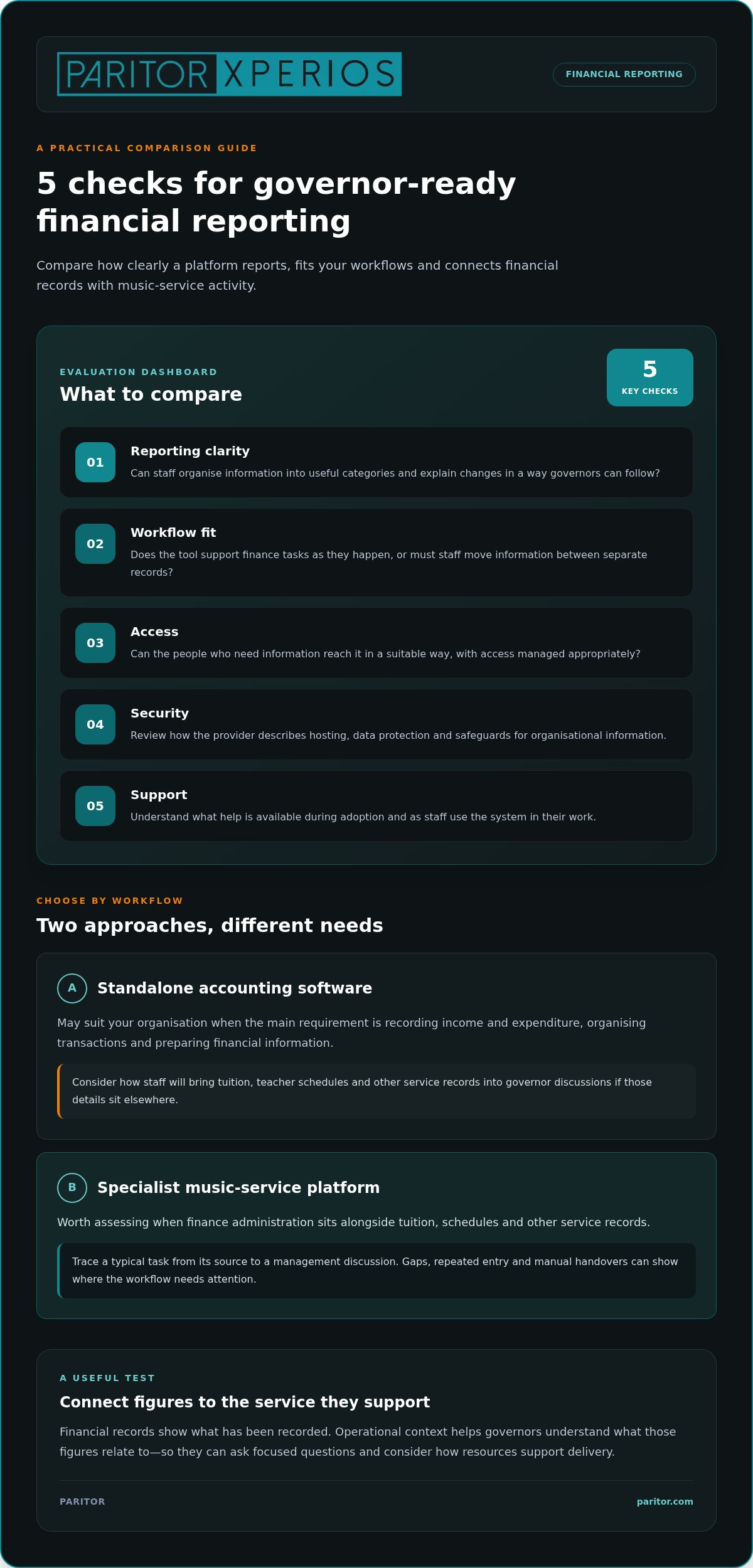
Financial records show what has been recorded; operational context helps governors understand what those figures relate to. Use the criteria below to compare standalone accounting tools with specialist platforms. Neither approach suits every organisation. The right fit depends on whether your priority is financial record-keeping alone or a connected view of finance and service activity.
| Criterion | What to assess |
|---|---|
| Reporting clarity | Can staff organise information into useful categories and explain changes in a way governors can follow? |
| Workflow fit | Does the tool support finance tasks as they happen, or will staff need to move information between separate records? |
| Access | Can the people who need information reach it in a suitable way, with access managed appropriately? |
| Security | Review how the provider describes hosting, data protection and safeguards for organisational information. |
| Support | Understand what help is available to staff during adoption and as they use the system in their work. |
When might accounting software be enough?
If your main requirement is recording income and expenditure, a standalone accounting tool may meet that need. It gives finance staff a place to organise transactions and prepare financial information. It may not cover tuition administration, teacher schedules or service records, so consider how staff would bring those operational details into governor discussions if they sit elsewhere.
When should a music service assess specialist software?
If finance administration sits alongside tuition, schedules and other service records, compare the effort needed to bring relevant information together. Ask staff to trace a typical task from its source to the point where it informs a management discussion. Gaps, repeated entry and manual handovers can reveal where the workflow needs attention.
A music-service platform can bring financial administration into the same wider system as service-management information. Xperios includes Finances and Reports, alongside Tuition, Contacts, Schedules and Resources. These modules provide a practical basis for assessing how finance and service workflows could sit within one platform.
As you compare financial management software for music services, focus on the information staff can maintain consistently and the context governors need to consider it. Map the workflows that matter across your service. The music service management software guide can help you explore that wider picture, while Paritor’s music service platform offers a starting point for considering a specialist approach.
Does accounting software alone give governors enough context?
Accounting software can keep financial records organised without explaining every part of a music service’s delivery. A tool designed to record income and expenditure may do that job well. The question is whether your governors can get the operational context they need through the wider reporting process, and how much staff effort it takes to bring that context together.
There’s no single model that suits every organisation. Your reporting responsibilities, existing systems and established ways of working all matter. If finance staff already have a reliable process for matching financial information with service activity, a standalone accounting tool may be a sensible fit. If staff regularly move between tuition records, schedules and finance workflows, a specialist platform may be worth assessing. The aim is to make necessary information easier to manage and interpret, not to add software for its own sake.
What context can be lost when systems are separate?
Suppose finance records show income for a teaching period, while tuition records hold information about lessons delivered. If these sit in separate workflows, staff may need to assemble and reconcile information before managers can consider them together. This can add administrative work or make it harder to check whether figures refer to the same period and activity. Map the handovers to identify where duplication or gaps arise.
How can a platform support connected administration?
A specialist platform can bring relevant functions into a shared service-management environment. Xperios includes Finances and Reports, alongside Tuition, Contacts and Schedules. It also supports automated invoicing, direct-debit support and integrated online payment processing. These functions support administration across a tuition service, while your team remains responsible for reviewing and interpreting the information.
When assessing financial management software for music services, trace a routine task from start to finish. For example, consider how staff manage an invoice, record the related financial information and refer to relevant service activity. Note where information is entered, who handles each step and whether a manual handover is needed. This practical walkthrough helps you judge workflow fit more clearly than a feature list alone.
If your organisation also manages performing arts activity, wider administration needs may shape the decision. The performing arts administration system guide explores that broader workflow context. For music services, consider how Xperios for Music Services fits the tasks your staff manage, so administration supports their work and leaves more time for teaching.
How to assess reporting workflows, security and implementation
A structured evaluation helps you choose financial management software for music services based on how your organisation works, rather than on a feature list alone. Follow these steps with the staff who manage finance, tuition and service records.
- Map your needs. Set out the information governors need, the tasks staff complete and the records involved. Note where the same information is entered more than once or where teams rely on manual handovers.
- Review workflows. Trace everyday processes such as recording financial activity and managing tuition administration. Check how information moves between people and systems, and identify where a clearer workflow could reduce repetitive administration.
- Assess security. Review how the platform is hosted, what data protection tools it provides and how access to information is managed. Consider whether its approach matches your organisation’s needs.
- Plan onboarding. Identify existing records, staff responsibilities and any data that needs to be migrated. Discuss the scale and complexity of this work, along with the time your team can set aside.
- Evaluate adoption. Decide how you’ll gather staff feedback and check whether the system fits daily tasks after rollout. Training, built-in help and available support can all shape how confidently people use it.
A cloud-based platform is a software solution hosted on remote servers, providing scalability and remote access. Data sovereignty means storing data within a specific national jurisdiction to meet legal requirements. These terms help frame practical questions about hosting and where data is stored. Data protection regulations are legal requirements governing the handling of personal and sensitive data, so include them in your organisation’s security assessment.
What should you check about security and access?
Xperios uses UK Microsoft Azure data centres, has ISO 27001 accreditation and includes GDPR compliance tools. The platform also includes AI anonymisation and automatic data deletion based on user-defined settings. Its 99.9% uptime SLA is a service-level commitment, not a promise that interruptions can never occur. Consider these features alongside how your organisation manages access to information.
How can you plan a manageable rollout?
Xperios implementation can take as little as three or four weeks, depending on organisation size, migration complexity and team availability. Treat this as a planning guide, not a fixed timetable. Before onboarding, agree who will prepare records, make decisions and support colleagues as they learn the system. Interactive training resources, built-in help and available support can help staff build confidence while balancing teaching and service responsibilities.
With a clear plan, you can assess security and adoption alongside reporting needs, and make the transition more manageable for your team. Explore Xperios for your music service and consider how its workflows fit your organisation.
How Xperios supports financial management for music services
Paritor’s Xperios is a cloud-based platform for music services and related education organisations. It brings financial administration into the wider system used to manage service delivery. This gives you a practical basis for considering whether specialist software fits your organisation’s work and reporting process.
For school governors, the value of a system depends on how staff maintain information and prepare it for oversight. Xperios brings together modules for Finances and Reports, Tuition, Contacts and Schedules. These modules cover finance administration and service activity. Assess how they fit your current workflows and identify any information staff still need to prepare for governance discussions.
Which confirmed Xperios capabilities are relevant?
The Finances and Reports modules support financial administration and reporting, whilst Tuition, Contacts and Schedules support day-to-day music-service management. Xperios also supports automated invoicing, direct-debit support and integrated online payment processing. These functions can reduce repetitive handling of financial tasks, leaving staff more time to focus on teaching and service delivery. Your team can review and interpret the resulting information.
Access for different people is part of the wider platform. Xperios includes a teacher portal, parent portal and student portal, giving teachers, parents and pupils relevant platform access. Consider how those roles fit your processes, who needs to maintain information and how operational records can inform management discussions. Set appropriate access for each user as part of your organisation’s information-management process.
As you assess financial management software for music services, distinguish between the capabilities a platform provides and the governance outputs your organisation prepares. This helps set realistic expectations and identify where staff workflows could benefit from joined-up administration.
How can you take the next step?
Start by listing the questions governors need to explore, then map each one to the records and processes your staff currently use. Note where finance information relates to tuition or schedules, where people have to transfer information manually, and what remains a separate reporting task. This gives you a grounded way to assess whether Xperios suits your service.
Include hosting, data protection and support in your evaluation. Xperios uses UK Microsoft Azure data centres, has ISO 27001 accreditation and includes GDPR compliance tools. Consider these alongside your organisation’s data-handling needs and the support staff may need as they adopt new workflows.
With your governance questions and workflow map in hand, explore Xperios for Music Services and see how its modules could support your music-service administration.
Make your next reporting decision with confidence
Before choosing financial management software for music services, turn your governance priorities into practical questions: what should governors be able to understand, which workflows support those answers, and where could staff spend less time bringing information together? This gives your evaluation a clear purpose and keeps the focus on oversight and teaching.
Xperios is shaped by more than 25 years of tuition-management experience and has supported the management of over a million lessons to date. This experience provides useful context as you consider how a specialist platform could fit your service and its day-to-day administration.
Take the next step by exploring the platform against your reporting needs and workflows. Explore Xperios for Music Services and consider how connected administration could help your team focus on the work that matters to learners.
Frequently Asked Questions
Can school governors use accounting software to review a music service’s finances?
Yes. Governors can use accounting software as one source for financial review when the organisation’s arrangements make the relevant information available for governance discussions. Before a meeting, agree the period under review, who can explain unusual entries and how follow-up questions will be tracked. This gives governors a practical route from a query to clarification, while allowing the organisation to choose tools that fit its processes.
What should a financial report for school governors include?
There’s no single template for every music service. Depending on the service, useful headings might distinguish tuition income, instrument-hire receipts, staffing and delivery resources. A short note can explain what each heading covers, identify any assumptions and state what decision or discussion the information supports. This makes the report easier to use in a meeting without adding detail that doesn’t help governors consider the issue.
How often should governors receive financial reporting?
Set the reporting rhythm around your organisation’s governance cycle and the decisions governors are expected to consider. Some information may be prepared for scheduled meetings, with a separate process for raising an unexpected issue that needs attention sooner. Agree who prepares each update and allow time for review before discussion. A consistent calendar helps staff plan the work and gives governors a predictable opportunity to consider relevant information.
Can financial reporting tools combine information from different systems?
To assess whether information can be brought together reliably, test a realistic task using representative records. Check whether the process preserves useful reference details, how duplicate entries or corrections are handled, and who reviews the result before it informs a report. Record any manual steps staff still need to complete. This practical test can reveal whether a proposed workflow is manageable, without assuming that every system exchanges information in the same way.
Is a cloud-based platform suitable for sensitive music-service information?
A cloud-based platform may suit your service if its safeguards and the way your team uses it match the sensitivity of the information involved. Consider who needs access, how permissions are managed, how long information is retained and what staff do when someone changes role. Include these points in your organisation’s assessment, and make sure responsibilities for day-to-day data handling are clear. Suitability depends on your needs and practices, not cloud hosting alone.
How can governors interpret cost per student hour?
Use cost per student hour as one indicator, not a standalone judgement about service performance. Compare it only across periods or activities that use consistent counting methods, and check whether changes in delivery explain movement in the figure. A result can prompt useful questions about how provision is organised, but it doesn’t show teaching quality, access or learner progress by itself. Governors should consider those wider factors before drawing conclusions.