
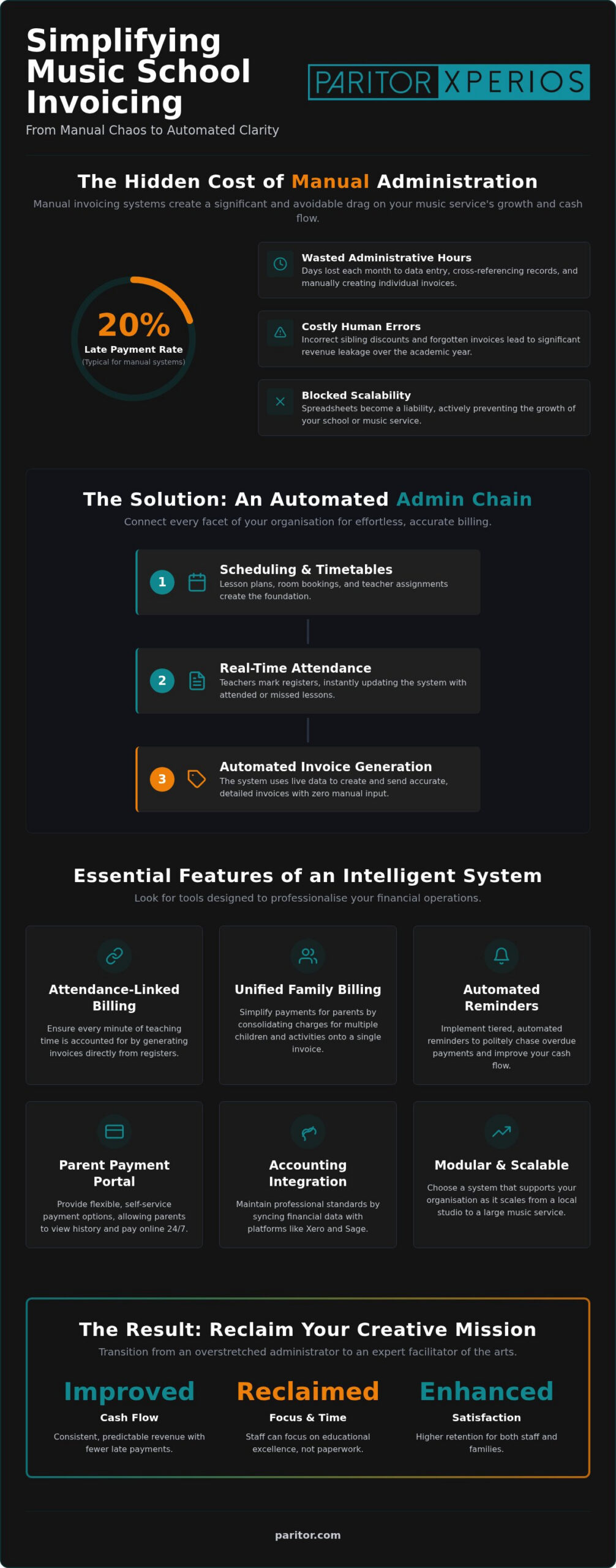
Did you know that manual invoicing systems in music schools typically suffer from late payment rates as high as 20%? It’s a frustrating reality for many administrators who find themselves trapped in a cycle of manual data entry, correcting financial discrepancies, and awkwardly chasing parents for overdue fees. You likely started your school to foster a love for the arts, not to spend your weekends wrestling with spreadsheets and complex sibling discounts.
We understand that the administrative burden can feel relentless, but it doesn’t have to be your standard operating procedure. This guide will show you how to simplify music school invoicing by moving towards a more intelligent, automated future. You’ll discover how to eliminate manual paperwork and reclaim hours of your time through seamless billing automation that links directly to your attendance records.
We’ll explore how modern tools like Xperios Financial Management can transform your cash flow with automated reminders and unified family billing. By the end of this article, you’ll have a clear roadmap to reduce overhead and restore your focus to what truly matters: your students’ creative journey.
Key Takeaways
- Understand how to link scheduling directly to billing to create a seamless administrative chain that eliminates repetitive data entry.
- Identify essential software features, such as deep integration with accounting platforms like Xero and Sage, to maintain professional financial standards.
- Discover how to simplify music school invoicing by moving away from risky manual spreadsheets towards intelligent, cloud-based automation.
- Master strategies to improve cash flow by implementing automated, tiered reminders and providing parents with flexible, self-service payment options.
- Learn how modular systems like Xperios Financial Management support your organisation as it scales from a local studio to a large-scale music service.
The Hidden Cost of Manual Music School Invoicing
Many music service directors fall into the “spreadsheet trap” without realising the long-term impact on their growth. Whilst a simple ledger might work for a handful of pupils, it quickly becomes a liability when managing hundreds or thousands of students across multiple venues. Manual data entry is the silent enemy of scalability. It consumes the very hours that should be spent on curriculum development or community outreach. For a large-scale music hub, these inefficiencies don’t just slow you down; they actively block your progress.
When you calculate the time lost to manual billing cycles, the numbers are often staggering. Administrators spend days each month cross-referencing attendance registers with payment records and manually typing out individual invoices. This repetitive labour is taxing and prone to exhaustion-led mistakes. Chasing parents for late tuition fees adds an emotional toll to the workload. It’s an uncomfortable task that can strain the vital partnership between your service and the families you support. According to research from Paritor, manual invoicing systems often see a late payment rate of 15% to 20%, which creates a constant, avoidable drag on your cash flow.
The Risk of Human Error in Billing
Performing arts scheduling is inherently complex. It often involves rotating timetables, varying lesson lengths, and shared family accounts. Manual systems struggle to keep pace with these fluid shifts. Common mistakes frequently occur when applying sibling discounts or multi-instrument bundles. A single missed tick-box or a forgotten attendance update results in a financial discrepancy that requires even more time to unpick and rectify.
These “forgotten” invoices lead to significant revenue leakage. For a professional music service, even a small error rate can result in thousands of pounds in lost income over an academic year. You need a way to simplify music school invoicing that removes the reliance on perfect human memory and replaces it with reliable, automated logic. This ensures every lesson is accounted for and every discount is applied accurately.
Reclaiming Your Mission from Paperwork
Adopting modern technology is about more than just efficiency; it’s about professionalising your music service. When administration is seamless, it creates a more stable, supportive environment for your music teachers. They can focus on their primary mission of educational excellence instead of worrying about whether their hours have been recorded accurately or if their pupils’ accounts are in arrears.
By choosing to simplify music school invoicing through intelligent automation, you’re making a clear statement about the value of your time. You transition from being an overstretched data entry clerk to an expert facilitator of the arts. This shift reduces administrative friction, leading to higher parent satisfaction and better staff retention. Ultimately, the software acts as your industrious ally, performing the heavy lifting behind the scenes so your creative mission can flourish.
The Mechanics of Automated Billing: How It Works
Automated billing is far more than a digital version of a paper invoice. It’s a dynamic system where financial documents are generated directly from real-time operational data. This creates a robust “Admin Chain” that connects every facet of your organisation. When your scheduling, attendance, and inventory are linked, the billing process becomes the final, effortless step in a connected journey. This is how you truly simplify music school invoicing for a growing service.
Whether you operate on flat-rate termly fees or variable attendance-based invoicing, the logic remains consistent. The system pulls data from across the platform to ensure accuracy. If you use a tool like Xperios Instrument Management, the hire costs for a violin or flute are automatically added to the correct account. There’s no longer a need to maintain separate lists or manually calculate monthly rentals; the software handles the consolidation for you. To see this in action, you can explore how integrated financial modules bridge the gap between the classroom and the back office.
Attendance-Linked Invoicing
Teaching schedules in the performing arts are rarely static. Lessons are rescheduled, teachers fall ill, and students miss sessions. With attendance-linked invoicing, these changes are captured at the point of contact. When a teacher marks a register on their tablet, it triggers the billing logic immediately. This ensures every minute of teaching time is accounted for without the administrator needing to perform manual adjustments. It also manages the complexity of make-up lessons by tracking credits and debits in real-time, providing a transparent audit trail for both the school and the parent.
Centralised Family and Household Accounts
Communication is often a major pain point when multiple siblings attend the same school. Automated systems group these students under a single billpayer, creating a centralised household account. This structure allows for the automatic application of complex discount rules, such as a reduction for a third child or a multi-instrument bundle. Parents receive a clear, itemised view of their total commitment, which reduces queries and improves the professional image of your service. By automating these calculations, you remove the risk of human error and ensure that your fee structure is applied consistently across your entire student body.
Key Features to Look for in Music School Invoicing Software
Selecting the right software is about building a foundation for sustainable growth. To truly simplify music school invoicing, your chosen system must communicate effortlessly with your existing financial tools. Seamless integration with accounting platforms like Xero and Sage is essential. It eliminates the need for double-entry and ensures your books are always accurate. You also need a secure payment gateway that supports a variety of methods, including credit cards and Direct Debits. Providing these flexible options makes it easier for parents to settle their accounts, which naturally improves your collection rates and stabilises your cash flow.
Automated communication is another vital pillar of administrative efficiency. Rather than manual follow-ups, the software should trigger SMS and email reminders for outstanding balances based on your predefined schedule. This removes the emotional burden and awkwardness of chasing fees. Pair this with robust reporting tools that track financial health in real-time. You’ll gain a clear, high-level view of your revenue trends and outstanding debts without ever having to open a spreadsheet.
Security and GDPR Compliance in 2026
Data safety is a non-negotiable requirement for professional music services. In 2026, cloud-based hosting on Microsoft Azure is the gold standard for institutional security. It provides the high-level encryption and data redundancy needed to protect sensitive student and parent information from digital threats. Meeting these rigorous standards is vital, especially for services that work alongside UK local authorities. A secure environment builds professional trust with your community and ensures your organisation remains fully compliant with the latest GDPR regulations.
The Importance of a Parent Portal
A self-service approach is the most effective way to reduce repetitive administrative queries. By providing a dedicated digital space, you allow parents to view and pay their invoices 24/7. This instant access eliminates the “where is my invoice?” emails that frequently clutter your inbox. Linking this feature to a comprehensive parent portal for music schools creates a unified experience for families. They can manage everything from lesson schedules to instrument hire in one place. When you simplify music school invoicing through self-service, you empower your parents whilst freeing your staff to focus on educational excellence.
Strategies to Reduce Late Payments and Improve Cash Flow
Improving your cash flow requires a shift in mindset from reactive chasing to proactive management. To simplify music school invoicing, you should implement an automated, tiered reminder schedule for overdue accounts. This system sends a gentle email nudge before the due date, followed by increasingly firm reminders if the balance remains outstanding. It removes the personal awkwardness from the transaction and ensures that your school is prioritised in the parent’s monthly budget.
Professional, branded invoices also play a significant psychological role in payment speed. When a billpayer receives a clearly formatted document with your school’s logo and itemised charges, it reinforces the value of the service you provide. You can further optimise this by using “Z-invoicing” or automated termly billing runs. This allows you to process thousands of invoices in minutes, ensuring that every student is billed correctly at the start of the term whilst you maintain central control over flexible payment plans.
Designing Effective Billing Cycles
Choosing between termly and monthly billing depends on your specific operational needs. Termly billing provides immediate capital for the months ahead, whilst monthly plans can be more accessible for families. Modern automation handles the complexity of mid-term enrolments by calculating pro-rata fees instantly. This ensures you don’t lose revenue from students who join after the initial billing run. Aligning these cycles with your staff payroll dates is a vital step toward long-term financial stability.
Leveraging Instrument Management for Revenue
Your instruments are valuable assets that should contribute directly to your bottom line. By integrating instrument inventory management software with your billing module, you can automate hire fees as part of the standard billing cycle. This ensures that rental income is never overlooked. You can also track maintenance and repair costs within the individual student account, providing a complete financial history for every instrument in your fleet.
Ready to transform your school’s financial health? Explore the Xperios Financial Management module today to see how we can help you reclaim your administrative time.
Transforming Your Music Service with Xperios Financial Management
Transitioning to Xperios Financial Management represents the final step in your organisational evolution. It’s more than just a software update; it’s a strategic move that allows you to move from administrative chaos to a streamlined, modernised organisation. For large-scale music hubs and services, the ability to scale is paramount. You need a platform that handles the transition from a handful of pupils to thousands without increasing your staff’s workload. Xperios was built specifically to address these unique needs of the performing arts sector.
The platform’s philosophy is rooted in simplicity and modularity. By choosing to simplify music school invoicing, you’re adopting a tool that was developed through direct collaboration with industry veterans. This isn’t a generic billing tool. It’s a dedicated ally that understands the specific frustrations of music tuition management. It performs the labour-intensive tasks that previously stole your weekends, restoring your focus to your primary creative mission. It acts as the industrious engine behind the scenes, allowing you to excel in your role as an expert facilitator.
A Partnership for Growth
Onboarding shouldn’t be a burden. The Xperios team ensures a smooth migration of your existing data, allowing you to transition without disrupting your current term. Once live, you benefit from ongoing security updates and professional support that keeps your service running smoothly. This reliability is why Xperios is the preferred choice for music service management software. It provides the stable foundation necessary for institutional safety and professional trust.
Next Steps: Modernising Your Finances
Evaluating the potential ROI of automated invoicing is a vital step for any forward-thinking organisation. Consider the hours reclaimed and the reduction in late payments discussed earlier. These efficiencies translate directly into financial stability and a better environment for your teachers. Requesting a bespoke demonstration allows you to see how the Xperios Financial Management module fits your specific workflows. It’s time to simplify music school invoicing and embrace a more industrious, technologically savvy future.
Organise your free Xperios demonstration today and take the necessary step forward in your professional journey.
Empowering Your Creative Mission through Automation
The transition from manual paperwork to intelligent automation is a necessary step for any modern performing arts service. By moving away from the risky “spreadsheet trap,” you protect your organisation from revenue leakage and administrative burnout. We’ve explored how a connected ecosystem allows you to simplify music school invoicing, ensuring that scheduling, attendance, and financial reporting work in perfect harmony.
This shift doesn’t just improve your cash flow; it professionalises your entire service. You can provide parents with a secure, transparent experience whilst freeing your staff to focus on teaching. Built on 30 years of industry experience and hosted on secure Microsoft Azure cloud infrastructure, Xperios is the trusted ally for UK music hubs and performing arts services across the country. It’s time to reclaim your time and restore your focus to the arts.
Organise your music service with Xperios today and start your journey toward a more efficient, empowered future. Your creative mission deserves nothing less.
Frequently Asked Questions
How does automated invoicing work for music schools?
It works by connecting your scheduling and attendance data directly to your financial ledger. When a teacher marks a register, the system identifies the fee associated with that student and generates an invoice automatically. This “admin chain” removes the need for manual data entry at the end of the term. It’s a reliable way to simplify music school invoicing by ensuring that every taught lesson is captured and billed without human intervention.
Can I manage sibling discounts automatically with music school software?
Yes, modern platforms allow you to group multiple students under a single household billpayer. Once you define your discount logic, such as a 10% reduction for a second child, the software applies these rules across the entire account. This automation ensures consistency and prevents the common errors found in manual spreadsheets. It provides families with a clear, itemised view of their total commitment whilst saving your staff hours of complex calculation.
Is it possible to integrate my music school billing with Xero or Sage?
Professional systems like Xperios offer deep integration with leading accounting platforms such as Xero and Sage. This means that once an invoice is generated and paid, the transaction data flows seamlessly into your main books. It eliminates the need for double-entry and provides your finance team with real-time visibility into the school’s health. This connectivity ensures that your music service maintains the same professional standards as any large-scale commercial organisation.
How do parent portals help reduce late payments?
Parent portals provide a self-service environment where families can view and pay their invoices 24/7. By offering instant digital access and integrated payment gateways, you remove the friction that often leads to delays. Parents can check their balances at their convenience, reducing the “lost invoice” excuse. When combined with automated reminders, these portals significantly improve collection rates, helping your service maintain a healthier and more predictable cash flow throughout the academic year.
Is student data secure in a cloud-based invoicing system?
Security is a top priority, especially when handling sensitive student and financial information. Systems hosted on Microsoft Azure benefit from institutional-grade encryption and rigorous data redundancy. This infrastructure ensures your organisation remains fully compliant with GDPR and the high standards expected by UK local authorities. Moving to the cloud provides a far more secure environment than local spreadsheets, protecting your community from data breaches and ensuring professional trust is maintained at all times.
Can I automate instrument hire fees alongside lesson billing?
You can certainly consolidate instrument hire and tuition fees into a single, unified bill. By linking your inventory management to the financial module, the system automatically tracks which student has which instrument and applies the relevant hire charge. This ensures that rental income is never missed or forgotten. It simplifies the experience for parents, who receive one clear document for all their household’s musical needs, from lessons to instrument maintenance.
What happens if a student misses a lesson; does the invoice adjust?
The system handles absences based on your school’s specific policies. If a lesson is marked as an excused absence, the software can automatically generate a credit or trigger a make-up lesson requirement. Because the billing is linked to the live register, any changes made by the teacher are reflected in the financial records immediately. This real-time adjustment ensures that your invoicing remains accurate and transparent, reducing disputes and the need for manual end-of-term reconciliations.
How long does it take to move from spreadsheets to an automated system?
The transition is typically managed in stages to ensure zero disruption to your current term. Whilst the initial data migration can be completed relatively quickly, the full onboarding process involves tailoring the system logic to your specific fee structures and discount rules. Expert support teams guide you through every step, from importing student records to setting up your payment gateways. Most services find they’re up and running with a professional, automated system within a few weeks.