

Did you know that nearly one in three organisations still spend over 31 hours every month on manual invoicing and payment entry? For a music educator, that is nearly an entire working week lost to “admin homework” instead of being spent in the studio or rehearsal hall. You likely started your school to foster talent, not to spend your Sunday evenings cross-referencing bank statements or having awkward conversations with parents about overdue fees.
We understand that manual reconciliation errors and unpredictable cash flow can feel like a heavy weight on your creative mission. This guide will show you how to implement automated payment collection for music schools to reclaim your time and secure your financial future. You’ll learn how to transition from chasing payments to a system that works silently and reliably in the background.
We’ll explore how modern self-service portals and automated financial syncing can transform your administration into a professional, hands-off engine. This guide provides a clear roadmap to modernise your school whilst ensuring your focus remains exactly where it belongs: on the music.
Key Takeaways
- Recognise how manual billing acts as a hidden “Admin Tax” that drains your school’s creative energy and teaching time.
- Master the strategic use of BACS Direct Debit for recurring tuition fees whilst utilising instant card payments for exam entries and one-off workshops.
- Discover how automated payment collection for music schools eliminates manual reconciliation errors by synchronising your registers directly with your financial records.
- Prioritise a professional Parent Portal and integrated instrument hire tracking to create a seamless, self-service experience for your families.
- Implement a secure, cloud-based system like Xperios Financial Management to act as the industrious engine behind your school’s growth and stability.
The Hidden Cost of Manual Billing in Music Education
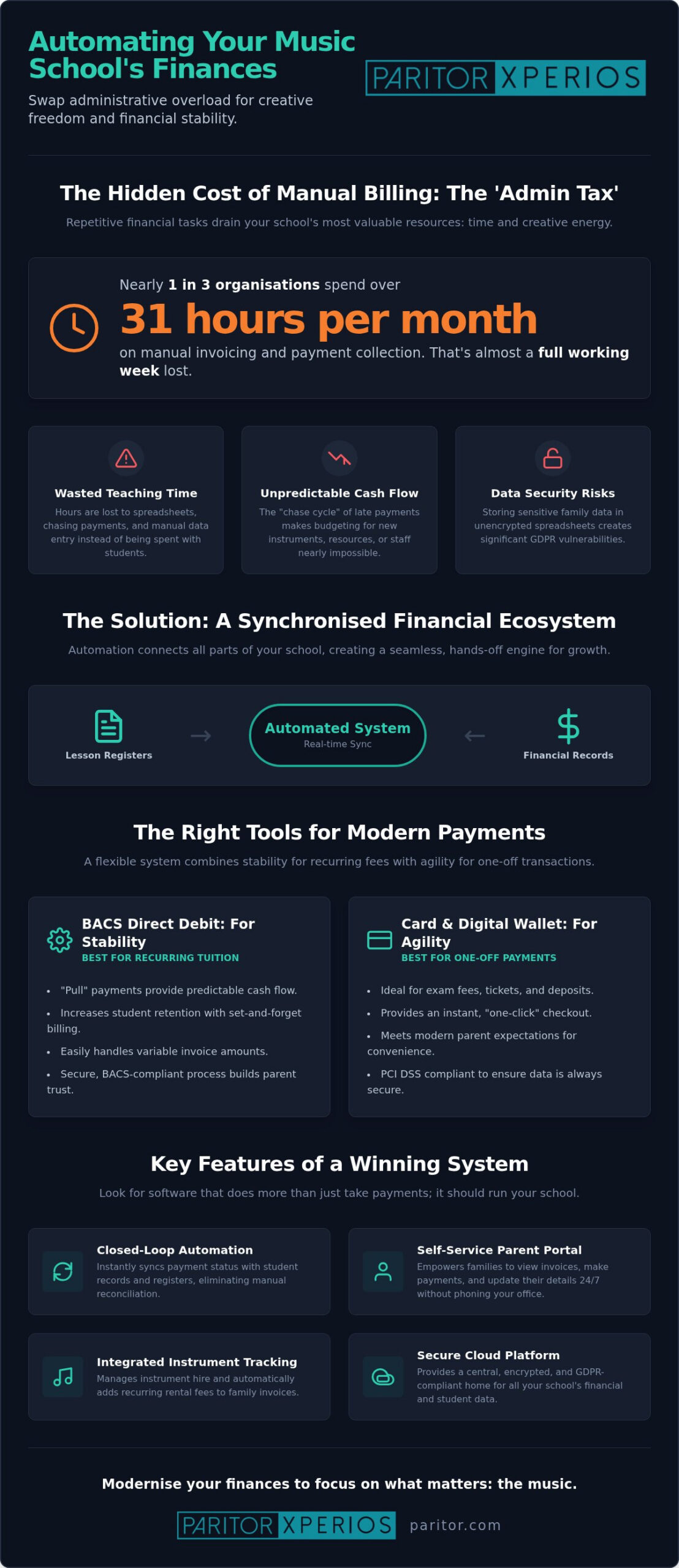
True automated payment collection for music schools is more than just a digital invoice with a link. It’s a synchronised ecosystem where your lesson registers, instrument hire records, and bank accounts communicate in real time. When these systems are disconnected, your school pays a hidden “Admin Tax”. This tax isn’t a financial levy from the government; it’s the hours of creative energy and teaching time stolen from your week by repetitive data entry and manual reconciliation.
A 2026 survey found that nearly 1 in 3 companies spend over 31 hours per month on manual invoicing and collections. For a music school director, that’s nearly a full working week lost to spreadsheets. Beyond the clock, there’s a heavy psychological burden. Chasing overdue fees from parents you see every week in the hallway creates a friction that sours the teacher-parent relationship. It’s difficult to transition from a professional discussion about a child’s musical progress to an awkward request for last month’s tuition fee. Modern electronic payment systems remove this burden by acting as a neutral, professional facilitator.
Why Spreadsheets are Failing Your Music Service
Managing pupil records in offline files or basic spreadsheets often leads to data duplication and version control errors. If a peripatetic teacher updates a register but the billing file isn’t adjusted, billable hours simply vanish. Spreadsheets are also a primary source of GDPR vulnerabilities in music schools. Storing sensitive contact details and payment histories in unencrypted, local files makes your school an easy target for data breaches. Scaling a music service becomes impossible when your financial data is trapped in files that don’t talk to each other. Leading schools like Rising Tones Music recognise that integrated systems are essential for maintaining professional standards as they grow.
The Impact of Late Payments on Cash Flow
Late payments trap schools in a “chase cycle” that makes term-time budget planning nearly impossible. You can’t commit to new ensemble scores or instrument repairs if you don’t know when funds will arrive. Using automated payment collection for music schools ensures that reminders are sent without you lifting a finger. This creates predictable, recurring revenue that allows you to focus on growth. Instead of worrying about bank statements, you can focus on providing the high-quality tuition your students deserve.
Understanding Automated Payment Methods: Direct Debit vs. Card Payments
Choosing the right mechanism for automated payment collection for music schools requires balancing cost, convenience, and student retention. In 2026, the landscape is dominated by two distinct paths: BACS Direct Debit for stability and card payments for agility. Whilst both reduce manual labour, they serve very different functions in a busy music department. A truly modern system doesn’t force you to choose one; it integrates both into a single, cohesive workflow.
The Benefits of Direct Debit for Recurring Tuition
Direct Debit is the engine of financial stability for music educators. It operates on a “pull” basis, meaning once a parent authorises a mandate through a secure portal, the school maintains control over the collection date and the amount. This is particularly useful for varying invoice totals, such as when a student adds a one-off theory class or an extra rehearsal. Retention rates are traditionally higher amongst students using Direct Debit because the payment becomes a background process, reducing the “pain of paying” every term. Furthermore, BACS compliance provides a robust safety net for parents whilst ensuring the school has a predictable, legally-backed revenue stream.
Integrating Card Payments for Flexibility
Card payments are the tool for agility. With digital wallet usage like Apple Pay and Google Pay growing by 40% since 2023, parents now expect an instant, “one-click” checkout experience. This method is ideal for spontaneous or time-sensitive transactions:
- Exam entry fees with tight deadlines
- Concert tickets and event bookings
- Deposits for instrument hire or sheet music
- Pay-as-you-go models for adult learners
To maintain trust, your checkout must be PCI DSS v4.0.1 compliant, ensuring that sensitive data is never stored on your local school computers but handled by secure, accredited processors.
The real breakthrough in 2026 is “Closed-Loop Automation”. This is where the payment status updates the student record instantly. If a card is declined or a Direct Debit fails, the system flags it against the lesson attendance record in real time. This level of integration ensures that your Xperios Financial Management module acts as a single source of truth. Whilst credit card processing fees typically range from 1.5% to 3.5%, the administrative time savings are immense. When you consider that manual processing can consume over 30 hours a month, the cost of automation is significantly lower than the salary cost of manual data entry.
Key Features to Prioritise in Music School Financial Software
General accounting software often fails to grasp the specific nuances of music education. Effective automated payment collection for music schools relies on more than just a basic checkout; it requires a suite of tools designed for the specific rhythm of the academic year. Your system must act as a bridge between your educational delivery and your financial health. This ensures that every lesson taught is a lesson paid for, without requiring manual intervention from your staff.
One critical feature is the integration between your financial module and your instrument inventory. In a busy music service, tracking which student has which violin is difficult enough. Ensuring the hire fee is correctly applied to their monthly bill is even harder. By linking your Xperios Instrument Management directly to your billing engine, you eliminate the risk of forgotten charges. The system recognises the assignment of an asset and triggers the appropriate fee automatically.
The Power of a Parent Portal
A dedicated Xperios Parent Portal transforms your administration into a self-service hub. Parents can view their full payment history, download past invoices, and update their bank details 24/7. This dramatically reduces the volume of “where is my invoice?” queries that typically flood inboxes at the start of term. Providing a centralised, branded hub also elevates the professional image of your school. It signals to your community that you prioritise their convenience and the security of their data.
Security, GDPR, and Cloud Reliability
Data safety is non-negotiable when handling pupil records and financial information. Hosting your platform on high-tier infrastructure like Microsoft Azure provides a level of security that local school servers simply cannot match. This ensures your automated payment collection for music schools remains GDPR compliant whilst providing administrators with secure remote access. Reliable cloud hosting also means your data is protected by automated redundancy and backups. Your financial history is too valuable to be stored in a single physical location or on an unencrypted hard drive.
Finally, prioritise a system that offers real-time financial reporting and robust audit trails. Whether you are reporting to school governors or preparing for a local authority audit, having instant access to accurate data is essential. Every transaction, reminder, and adjustment should be logged automatically. This level of transparency builds institutional trust and ensures your school’s financial foundation is as solid as its musical reputation.
A Strategic Plan for Implementing Automated Billing
Transitioning to a modern financial system is a significant step in your school’s professional journey. It requires more than just a software purchase; it needs a structured roadmap to ensure success. The first step isn’t technical; it’s organisational. You must audit your current financial data for accuracy before any migration begins. Inaccurate pupil records, outdated sibling discounts, or missing contact details will cause friction later. Cleaning your data now ensures your new system starts with a solid foundation.
Once your records are verified, choosing a “Cloud Management Standard” system like Xperios for Music Services provides the infrastructure you need. This choice moves your organisation away from fragmented files and into a unified environment built on three decades of industry expertise. To ensure a smooth transition, run a pilot programme with a specific ensemble or a single year group first. This allows you to test your workflows in a controlled environment before a full roll-out. After the first term, review and refine your automated processes to eliminate any remaining bottlenecks.
Communicating the Change to Parents
When you announce the shift to automated payment collection for music schools, focus entirely on the benefits for the family. Draft a “Welcome to the Portal” announcement that emphasises convenience, 24/7 account access, and the end of paper invoices. Provide clear, step-by-step instructions for setting up automated payment mandates whilst acknowledging that change can be daunting. Handle objections with empathy and facts. Explain how secure, encrypted systems like the Xperios Parent Portal protect their financial data more effectively than bank transfers or cheques.
Training Staff for the Digital Shift
Implementing automated payment collection for music schools requires your internal team to understand their new role in the financial ecosystem. Teachers must recognise that their attendance registers are now the primary trigger for billing. If a register isn’t marked accurately, the system cannot generate an invoice. Organise focused onboarding sessions for administrative staff to master the new dashboard and set clear internal policies for handling manual overrides or discounts. This alignment ensures the software acts as the industrious engine it was designed to be.
Start your journey toward a more efficient, professional school by exploring Xperios Financial Management today.
Modernising Your Finances with Xperios Financial Management
Xperios acts as the industrious engine behind your school’s success. It performs the labour-intensive tasks that usually consume your evenings and weekends. By automating the link between lesson scheduling and invoicing, the platform ensures that your financial data is always accurate and up to date. This allows you to restore your focus to your primary creative and educational mission whilst the system handles the background noise of administration.
The software was built on three decades of collaborative user input. It isn’t just a generic billing tool; it’s a sector-specific solution designed by people who understand the unique rhythm of music education. This person-centric approach ensures that every feature, from ensemble management to tuition fees, addresses a real-world frustration. Adopting automated payment collection for music schools through Xperios is a necessary step forward in your professional journey. It provides the scalability needed to support everyone from solo private teachers to large national music hubs.
Why Xperios is the Standard for Music Services
Since Paritor was founded in 1993, we’ve dedicated ourselves to the performing arts sector. This deep domain knowledge is baked into every module we develop. The system is entirely modular, allowing you to start with financial management and expand into instrument or exam management as your organisation grows. Security is non-negotiable. Hosting on Microsoft Azure ensures that your data remains safe, whilst automatic updates keep your school ahead of regulatory changes without any manual intervention required from your staff.
Next Steps: Booking a Consultative Demo
Adopting new technology shouldn’t feel like a solitary burden. We pride ourselves on being a dedicated ally through the entire onboarding process. Our team supports you through every stage of data migration, ensuring your transition from legacy spreadsheets is seamless, secure, and accurate. This partnership allows you to modernise your administration whilst protecting your school’s historical records and financial history.
Reclaiming your time starts with a simple conversation. You’ll find more detailed insights in our comprehensive resource, The Complete Guide to Music Service Management Software in 2026. We invite you to book a consultative demo to see how Xperios Financial Management can transform your school’s financial health and stability. Let our technology perform the repetitive tasks so you can focus on the music.
Elevating Your Music School’s Financial Future
Modernising your administration is no longer just about convenience; it’s a strategic move to protect your school’s creative mission. By implementing automated payment collection for music schools, you remove the psychological and temporal burden of manual fee collection. This shift ensures a professional, self-service experience for parents whilst providing you with the predictable monthly cash flow needed for long-term growth. You’ll finally have the freedom to focus on teaching instead of wrestling with spreadsheets.
Xperios provides the industrious engine required to drive this organisational change. Our platform is built on over 30 years of direct user collaboration and is trusted by music hubs across the UK to manage complex billing cycles. With high-tier security through Microsoft Azure hosting, your data remains protected by industry-leading standards. It’s time to stop doing the “admin homework” and get back to the studio. We’re here to help you navigate this digital transition with confidence and ease.
Discover how Xperios can automate your music school finances today
Frequently Asked Questions
How do I collect payments for music lessons automatically?
You collect payments by integrating your lesson scheduling with a dedicated financial module that triggers BACS Direct Debit or card transactions. This ensures that every register entry automatically generates a corresponding invoice. Parents authorise a mandate once; the system then handles the recurring collections on your behalf. This method of automated payment collection for music schools removes the need for manual bank transfers, creating a professional and hands-off revenue stream.
Is automated payment collection secure for my music school?
Yes, modern systems provide high-tier security by utilising encrypted, cloud-based infrastructure like Microsoft Azure. This ensures that sensitive financial data is never stored on vulnerable local computers or unencrypted spreadsheets. By adhering to PCI DSS v4.0.1 standards, the software protects both the school and the parents from data breaches. You gain a foundation of professional trust whilst benefiting from the same level of security used by major global financial institutions.
What are the benefits of using a parent portal for billing?
A parent portal reduces administrative friction by providing families with 24/7 self-service access to their financial records. Parents can download invoices, view payment histories, and update their bank details without contacting your office. This transparency builds trust and significantly lowers the volume of routine queries. It also elevates your school’s professional image, positioning you as a forward-thinking organisation that values parent convenience and modern, digital-first communication methods.
Can I still offer sibling discounts with an automated system?
You can easily maintain complex billing structures like sibling discounts within a specialised system like Xperios Financial Management. The software allows you to set specific rules for families with multiple students, applying percentage or fixed-amount deductions automatically. Once these rules are established, the billing engine calculates the correct total for every invoice. This eliminates the risk of manual calculation errors whilst ensuring that your fee policies are applied consistently across your entire student base.
How does automated billing help with GDPR compliance?
Automated billing improves GDPR compliance by centralising student data in a secure, encrypted environment instead of fragmented offline files. It eliminates the risk of sensitive contact details being left on unencrypted laptops or printed registers. The system provides clear audit trails and ensures that data is only accessible to authorised personnel. By using automated payment collection for music schools, you ensure that your data handling processes meet legal requirements whilst protecting the privacy of your students.
Will I need to change my bank account to use music school software?
You don’t need to change your existing bank account to implement automated billing. The software integrates with your current business banking through secure payment processors that handle the transfer of funds. These processors collect the payments from parents and deposit the net amounts directly into your chosen account. This setup allows you to modernise your financial workflows without the disruption of switching banks or altering your established institutional banking relationships.
How much time can I expect to save by automating my finances?
Many organisations save approximately 31 hours per month by eliminating manual invoicing, payment entry, and debt chasing. This is nearly an entire working week reclaimed for your administrative team. By automating the reconciliation between bank statements and lesson registers, you remove the most labour-intensive parts of your administrative burden. This time is better spent growing your ensemble programmes or focusing on the quality of your musical tuition.
Can I manage instrument hire fees through the same system?
You can manage instrument hire fees seamlessly by linking your inventory records directly to your financial module. When an instrument is assigned to a student in Xperios Instrument Management, the system automatically adds the hire charge to their next invoice. This ensures that no billable assets are overlooked and that hire income is collected consistently. It creates a unified financial record that covers tuition, ensemble fees, and equipment hire in a single transaction.