

Reliable reporting starts with connected records, not a last-minute spreadsheet. If attendance, staffing, finance and instrument details sit in separate places, preparing accurate reporting to Arts Council England for music hubs can become a time-consuming exercise in chasing figures and checking what they mean.
You may already know the pressure of gathering information against a deadline, especially when it’s unclear which guidance, template or reporting date applies. In 2026, Arts Council England continues to oversee the Music Hubs programme on behalf of the Department for Education. Checking the current requirements is therefore an essential first step. This guide explains how to confirm what applies before collecting or submitting information, then build a repeatable process for gathering, checking and explaining your evidence.
We’ll look at how everyday records can support reporting preparation, what to verify in current Arts Council England guidance and how to keep a clear trail from source information to submitted figures. You’ll also see where a cloud-based platform such as Xperios may help organise operational records, while reporting decisions and sign-off remain with your team. The aim is to reduce avoidable administration and leave more time for the work your hub exists to do.
Key Takeaways
- For reporting to Arts Council England for music hubs, check the current guidance, template, definitions and deadline before deciding what evidence to collect.
- Map each requested field to its source record, responsible owner and checking method. Include only evidence relevant to the current return.
- Check figures for completeness, consistency and supporting evidence. Investigate discrepancies rather than adjusting numbers to make them match.
- Set a repeatable workflow with a named owner and deputy for each data source and reporting task, from guidance review through to approval.
- Assess whether spreadsheets or a cloud-based platform better fit your processes. Software can organise records, but it cannot replace Arts Council England guidance or your team’s sign-off.
Reporting to Arts Council England for music hubs: start with the current requirements
Reporting can become a scramble when teams are unsure which return applies, what period it covers or how to interpret a field. A clear preparation process starts before anyone gathers figures. For reporting to Arts Council England for music hubs, use the current instructions to establish what your hub must submit, then connect each request to its evidence and an accountable reviewer.
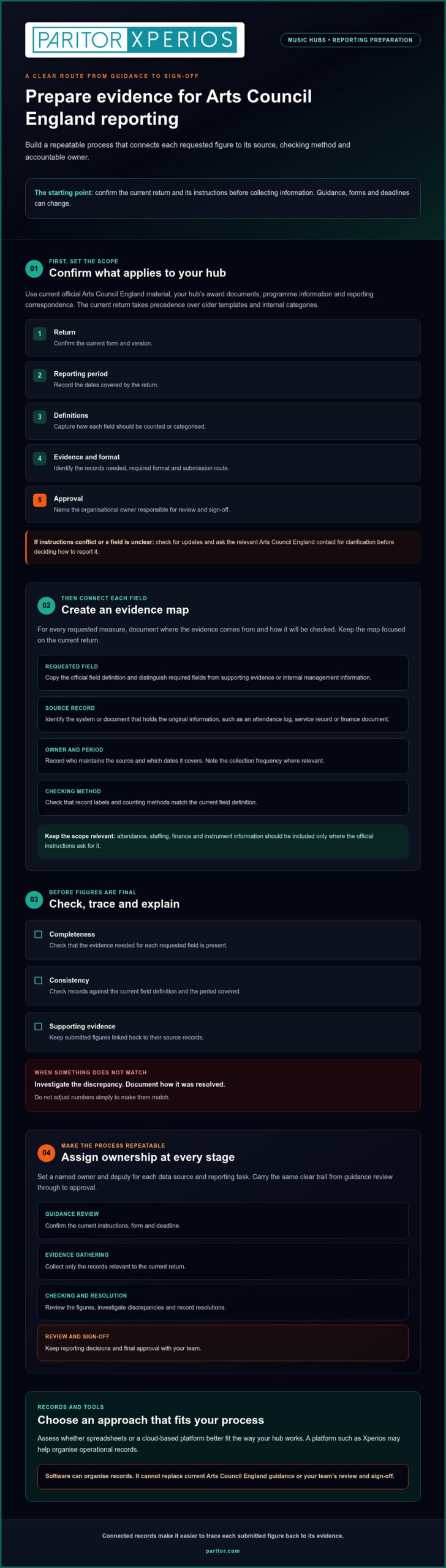
Begin by confirming five things: the return, reporting period, field definitions, evidence required and person responsible for approval. This helps prevent your team from collecting irrelevant information or relying on last year’s template. Guidance, forms and deadlines can change, so check every date and field against current official Arts Council England material before work begins.
How to confirm which Arts Council England return applies
Start with your hub’s current award documents, programme information and official reporting correspondence. Record the reporting period, required format, submission route and named organisational owner in one place. If instructions conflict or a field is unclear, check for updates and ask the relevant Arts Council England contact for clarification before deciding how to report it.
For general background on the organisation, you can read about Arts Council England. Use the current official return and its instructions, rather than background sources or older examples, to confirm what applies to your hub.
What to establish before collecting music hub evidence
Turn the current return into a working checklist. For every requested measure, copy the official definition and note whether it is a required field, supporting evidence or internal management information. Don’t assume that a measure included in a previous return is still required, or that a useful internal figure belongs in the submission.
- Return: confirm the current form and version.
- Period: record the dates the return covers.
- Definitions: capture how each field should be counted or categorised.
- Evidence: identify the records needed to support each response.
- Approval: name the person who will review and sign off the submission.
The current official return takes precedence. Use its definitions, requested fields and submission instructions, rather than treating previous templates or internal reporting categories as substitutes. Once these details are confirmed, you can gather relevant evidence with a clear purpose and give reviewers a consistent basis for checking it.
How to gather music hub reporting evidence from everyday service records
Once you’ve confirmed the return, connect each requested field to the records your hub already keeps. This makes reporting to Arts Council England for music hubs easier to trace back to its source, instead of relying on figures copied into separate spreadsheets without context.
An evidence map links each requested field to its source, owner, collection frequency and checking method. Keep it focused on the current return. Attendance, staffing, finance or instrument information should only be included where the official instructions ask for it. The National Plan for Music Education provides wider policy context, but the current return’s definitions determine which evidence you need to prepare.
Map attendance, teaching and participation records
For each relevant field, note which system or document holds the attendance or teaching record, who maintains it and which dates it covers. Check that record labels and counting methods match the current field definition. If entries are missing or conflict, assign someone to investigate and document the resolution before finalising the figure.
Keep four evidence types distinct:
- Source records: original attendance logs, service records or finance documents.
- Submitted figures: the values entered in the return, linked back to their sources.
- Narrative explanation: brief context that helps explain a figure or documented change.
- Internal analysis: management information that may help your team but isn’t automatically part of the return.
This separation helps reviewers see what was recorded, what was reported and where an explanation has been added. It also reduces the risk of treating an internal estimate or commentary as a source record.
Organise financial reporting and instrument evidence
For relevant financial reporting fields, identify the underlying income and expenditure records, then link them to the categories requested in the current return. Don’t assume E-codes or the CFR framework applies. Use them only if the applicable Arts Council England guidance confirms this. If instrument information is requested, connect the relevant asset records with maintenance history and keep source evidence and explanatory notes identifiable.
A connected record system may help keep attendance, bookings, invoicing and instrument information organised for reporting preparation. Xperios is a cloud-based platform with these operational record-management capabilities. Your team must still check the official field definitions and approve the figures. For an example of music service management software, consider how connected records could fit your hub’s needs.
How to check music hub figures before submitting a report
A figure can look plausible and still be incomplete, based on the wrong period or counted differently from the current return’s definition. A consistent checking process helps you spot these issues before sign-off. There isn’t one universal validation threshold for every Arts Council England return, so use the instructions for the return you’re preparing.
For reporting to Arts Council England for music hubs, check each requested figure against its definition and source. Use this framework to guide your review, adapting the checks to the fields and evidence the current return asks for.
| Check | What to ask | What to do if there’s an issue |
|---|---|---|
| Completeness | Does every required field have a value or an explained reason for being blank? | Contact the data owner to locate missing information or record why it isn’t available, following the return’s instructions. |
| Consistency | Do totals agree with relevant source records for the same dates and scope? | Check date ranges, filters, duplicates and omissions before deciding whether a correction is needed. |
| Definition | Does the figure use the meaning and counting method specified in current guidance? | Compare local practice with the official wording. Ask for clarification if it remains ambiguous. |
| Evidence | Can you trace the reported figure to an appropriate source record? | Retain the supporting record and note any limitation or explanation in line with your policies. |
Check completeness, consistency and supporting evidence
Give every required field an owner, even if the value is still being checked. For example, if a participation total differs from the underlying records, don’t change it simply to match another figure. Compare the period, inclusion criteria and source entries. Then ask the responsible person to investigate and document the outcome. Keep supporting records and, where your systems and policies allow, a clear audit trail of changes and decisions.
Resolve definitions and discrepancies before sign-off
Local labels may not mean the same thing as a field in the return. Check your counting practice against current guidance, and record any corrections, decisions or data limitations. Keep confirmed data distinct from estimates. If an estimate is permitted or requested, follow the return’s instructions and explain its basis and limits. Don’t present it as a confirmed count.
Before approval, record who reviewed the figures and who is responsible for sign-off. If a requirement is unclear, ask the relevant Arts Council England contact rather than treating an assumption as an official rule. This gives your approver a clear account of what was checked, what remains uncertain and how the submission follows current instructions.
How to organise a repeatable Arts Council England reporting workflow
A repeatable workflow makes reporting to Arts Council England for music hubs easier to coordinate, even when staff responsibilities change. The aim is to make each task, handover and decision clear, rather than relying on one person to remember how last year’s return was prepared. Start from the confirmed instructions and deadline, then work backwards to schedule collection, review and approval.
Create a reporting calendar and responsibility map
Record the submission date only after checking it against current Arts Council England instructions or official correspondence. Add the source of the date to your calendar so colleagues can verify it if guidance changes. Build in time for internal review and corrections, based on the confirmed deadline and your team’s capacity rather than an assumed standard lead time.
For each reporting task and source record, name a primary owner and a deputy. Make responsibilities visible to the people involved, and identify who will coordinate the return as a whole. A simple responsibility map could assign:
- Data collection: the person who supplies each source record or figure.
- Quality review: a colleague who checks that the information is complete and follows the return’s definitions.
- Narrative drafting: the person who prepares explanations where the return asks for them.
- Final approval: the authorised person who reviews the completed return before submission.
Where practical, schedule regular record checks during the reporting period. This helps you spot gaps while the relevant staff can still clarify them, instead of leaving every query until submission week. Keep the workflow flexible. If guidance changes, update the calendar and responsibilities to match.
Keep information secure and usable across the team
Record where each source is held, who may access or update it under your organisational policy, and how changes are tracked. Limit access to personal information in line with that policy and applicable data protection regulations. Clear ownership and handover notes also help a deputy continue a task without creating competing versions of the same record.
If you use a shared system, confirm that its access controls and record-keeping practices suit your organisation’s needs. Don’t claim data sovereignty based only on a provider’s location or general description. Verify the actual hosting arrangement before making a jurisdiction-specific statement. Keep an audit trail where your systems and policies allow, so reviewers can understand who changed a record and when.
A cloud-based platform such as Xperios can bring operational records, including attendance, bookings, invoicing and instrument information, into an organised working process. It can support preparation, but it doesn’t determine Arts Council England requirements or replace your team’s review and sign-off. Information about music service management guidance may help you consider how connected records could fit your reporting workflow.
When a cloud-based platform can support music hub reporting preparation
Spreadsheets may be sufficient when your records are limited, responsibilities are clear and staff can keep information current without repeated manual copying. A connected system may suit a hub with records spread across attendance, scheduling, finance and instrument management. The right choice depends on your scale, processes and reporting needs, not on a claim that one tool fits every hub.
For reporting to Arts Council England for music hubs, software can help organise source records and make everyday information easier to find. It doesn’t set reporting requirements, determine how a field should be interpreted or replace your team’s checks and approval. Always work from the current official instructions.
Assess software against your evidence workflow
Before choosing or reviewing a system, compare its confirmed capabilities with the records your hub actually needs to manage. Ask how staff can access relevant information, correct errors and retain supporting records. Check these capabilities directly with the provider before relying on them for reporting preparation:
- Records: Can the system manage the attendance, scheduling, financial reporting and instrument information relevant to your work?
- Review: Can staff find records, check their accuracy and correct errors through a process that suits your organisation?
- Evidence: Can you retain or access the supporting information you need for internal review?
- Controls: What export, audit trail, access-control and integration features are available?
Confirm details such as exports and integrations rather than assuming they’re included. Consider how the system handles access to personal information and supports your organisation’s approach to data protection regulations. A cloud-based platform can provide access to shared records, but check the provider’s specific security and hosting arrangements before relying on them.
Where Xperios may fit a music hub’s administration
Xperios is a cloud-based platform for music service administration, with capabilities including attendance tracking, scheduling, bookings, invoicing, and instrument and asset management. Where relevant to your return, these records may help your team locate source information. Instrument management also includes maintenance history, which can support record-keeping when instrument evidence falls within the current reporting scope.
Review the system against the tasks your staff perform and the records they need to maintain. Xperios can support the organisation of operational information, but it doesn’t automatically submit Arts Council England reports or map records to the return’s fields. Your hub remains responsible for checking current guidance and approving its submission.
For a wider view of system considerations, read The Complete Guide to Music Service Management Software in 2026. Information on how Xperios supports music service management can help you assess whether it fits your hub’s administrative workflow.
Make reporting preparation part of your everyday work
Accurate reporting to Arts Council England for music hubs begins with the current instructions, not last year’s assumptions. Confirm the return and its definitions, map requested fields to everyday records, then check figures against their sources and document any decisions before approval.
A repeatable process with clear owners and regular checks can ease deadline pressure and help your team spend less time chasing information. If separate systems make it difficult to organise attendance, finance and instrument records, consider whether connected software fits your needs. Xperios supports scheduling, bookings, attendance tracking and invoicing, alongside instrument and asset management with maintenance history. Xperios is hosted on Microsoft Azure and is GDPR compliant. Check the specific arrangements that matter to your organisation.
Software can help organise evidence, but your team must still follow current Arts Council England guidance and approve the return. With clear records and responsibilities in place, you can approach reporting with greater confidence and keep more time for teaching and music education. Explore how Xperios supports music service management to assess whether it suits your workflow.
Frequently Asked Questions
What does Arts Council England require music hubs to include in a report?
The current return and its instructions determine what your hub must submit. Depending on the applicable return, requested information may cover participation, staffing, activities, income or expenditure. Check the relevant award or programme documents, official correspondence, definitions and template before gathering data. Don’t assume last year’s form still applies or that every operational record belongs in the submission. If an instruction is unclear, ask the relevant Arts Council England contact.
How can a music hub prepare for reporting to Arts Council England?
Start by confirming the applicable return, reporting period, format, submission route and deadline from current official instructions. Then list each requested field, its definition, source record, responsible owner and checking method. Assign a reviewer and approver, and schedule time to resolve gaps before submission. This makes reporting to Arts Council England for music hubs a planned process, rather than a last-minute search through separate attendance, finance and staffing records.
What evidence should a music hub keep for Arts Council England reporting?
Keep records that support the fields requested in the current return, such as relevant attendance, staffing, activity or financial documents. The exact evidence depends on the instructions, so don’t collect or submit every record simply because it exists. For each figure, note its source, period covered and owner. If instrument information is requested, relevant asset records and maintenance history may help support the evidence. Follow your organisation’s record-keeping policies.
Can music hub management software create Arts Council England reports automatically?
Don’t assume that management software can create or submit an Arts Council England return automatically. A system may help organise source records, such as attendance, bookings, invoicing and instrument information, but your team still needs to check the current requirements, definitions and figures, then approve the submission. Before relying on specific export, report-mapping or audit trail functions, confirm directly with the provider which capabilities are available.
How should a hub check its figures before submitting a return?
Check that every required field has a value or an explanation for being blank, then compare figures with their source records for the correct reporting period. Confirm that local counting methods match the return’s definitions. Investigate differences, such as a total that doesn’t match attendance records, by checking dates, filters and missing or duplicate entries. Record any correction or limitation, and follow the return’s instructions rather than adjusting figures to make them agree.
Do music hubs need to use E-codes when reporting to Arts Council England?
Use E-codes only if the current guidance for your applicable return confirms that the CFR framework and those codes are relevant. Don’t assume they apply because they appear in an older template, another reporting process or your internal accounts. Check the latest official instructions and confirm how any requested financial categories should be recorded. If the guidance doesn’t make this clear, ask the relevant Arts Council England contact before classifying figures.
How can a music hub protect personal data used in reporting?
Follow your organisation’s data-handling policies and applicable data protection regulations. Limit access to personal information to staff who need it for their assigned work, and document where records are held, who may update them and how changes are tracked. Check what information the current return requests, and avoid including unnecessary personal detail. If you use a cloud-based platform, review its security and hosting arrangements with the provider before relying on them.