

Future-proofing your music service is not about the quantity of instruments in your store cupboard, but the digital infrastructure that protects your time and data. You likely started your career to inspire the next generation of musicians, yet you probably find yourself buried under a mountain of manual paperwork and fragmented spreadsheets. It’s a common frustration; managing instrument loans and student data often feels like a full-time job that detracts from your core educational mission. You want to focus on the music, but the administration keeps pulling you back.
With the UK Data Use and Access Act 2025 now in full effect and the EU AI Act enforcing strict transparency as of August 2026, the regulatory landscape has never been more demanding. This guide will show you how to build a resilient, scalable, and digitally-advanced service that thrives amongst these shifting educational requirements. We’ll explore how centralising your data and automating workflows can restore your focus to teaching. You’ll discover how to enhance parent engagement through digital portals and ensure long-term organisational stability by moving away from outdated, manual processes.
Key Takeaways
- Learn how to transition from fragmented spreadsheets to a centralised cloud-first architecture, creating a single source of truth for your entire organisation.
- Discover how automating financial workflows reduces manual errors and improves cash flow by streamlining invoicing and late payment recovery.
- Understand the 2026 regulatory landscape to ensure future-proofing your music service means staying compliant with evolving GDPR standards and safeguarding protocols.
- Empower your team and families through dedicated portals that improve communication whilst ensuring teachers only access essential student data.
- Master a phased five-step implementation strategy that secures staff buy-in and ensures a smooth transition to modernised administration.
What Does Future-Proofing Your Music Service Actually Mean?
In the evolving world of music education, Future-proofing is often misunderstood as simply buying the latest hardware. True resilience is much deeper. It represents your organisation’s ability to adapt seamlessly to technological, regulatory, and social shifts without interrupting the harmony of your tuition. For a music lead or administrator, future-proofing your music service means moving away from brittle, manual processes and adopting a flexible digital infrastructure that grows with you.
Legacy systems often rely on local servers or physical filing cabinets. These methods are vulnerable to data loss and lack the agility needed to meet modern standards. In contrast, cloud-first architectures provide a stable, secure foundation. By centralising your operations on a platform like Xperios, you ensure that every piece of information, from student medical notes to instrument serial numbers, is protected by enterprise-grade security whilst remaining accessible to those who need it. This digital stability is the essential bedrock for creative excellence; when the administration is silent and efficient, the music can take centre stage.
We must also recognise that parent expectations have fundamentally changed. The modern parent manages their life through their smartphone and expects 24/7 digital access to their child’s musical journey. They don’t want to wait for office hours to check a lesson time or pay an invoice. Providing a digital portal isn’t just a luxury anymore; it’s a requirement for staying relevant in a competitive educational market.
This demand for constant accessibility is mirrored in other service-based industries, where organisations like Contesto provide the operational support and out-of-hours management necessary to meet modern expectations for 24/7 reliability.
The Shift from Reactive to Proactive Management
Many music services operate in a state of constant “fire-fighting”. You might spend your mornings correcting scheduling clashes or chasing missing instrument loan forms. Moving to a proactive model allows you to use data to predict service demand and instrument needs well before a crisis occurs. Future-proofing is an operational strategy for 2026 that replaces reactive crisis management with a proactive, data-informed framework designed to withstand technological and regulatory shifts. By identifying trends in lesson uptake or instrument wear and tear, you can allocate resources more effectively and ensure your service remains viable for years to come.
Why Spreadsheets are the Enemy of Growth
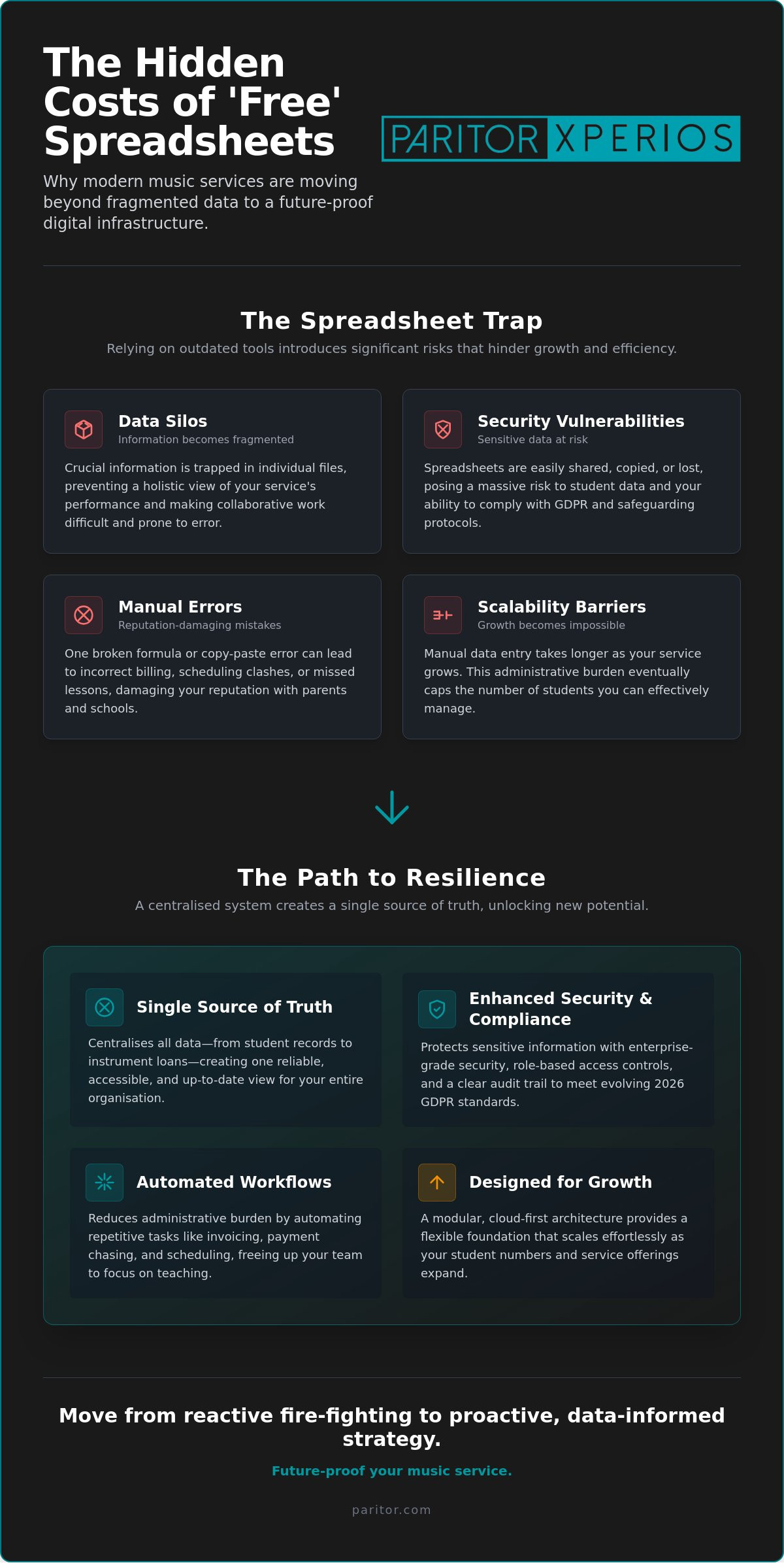
While tools like Excel are often viewed as “free”, they carry significant hidden costs that hinder your ability to scale. Fragmented data across multiple spreadsheets creates dangerous silos where information is easily lost or duplicated. Version control becomes a nightmare; you never quite know if you’re looking at the most recent version of a teacher’s availability or an outdated draft. This lack of a “single source of truth” makes future-proofing your music service nearly impossible. Consider these risks of staying spreadsheet-bound:
- Data Silos: Crucial information is trapped in individual files, preventing a holistic view of your service performance.
- Security Vulnerabilities: Spreadsheets are easily shared, copied, or lost, posing a massive risk to GDPR compliance.
- Manual Errors: One broken formula can lead to incorrect billing or missed lessons, damaging your reputation with parents.
- Scalability Barriers: Manual data entry takes longer as you grow, eventually capping the number of students you can effectively manage.
True growth requires a system that automates the repetitive labour, allowing your team to focus on what they do best: fostering a love of music in every student.
Building a Robust Digital Infrastructure for Music Education
A resilient service requires more than just high-quality tuition; it demands a technical foundation that can support growth without buckling under administrative weight. Cloud-based platforms have moved from being a modern convenience to the essential standard for centralising operations. By moving your data to a secure environment, you eliminate the risks associated with local hardware and create a “source of truth” that remains consistent across your entire organisation. This shift is a critical pillar in future-proofing your music service, ensuring that your data is not just stored, but active and useful.
Modular systems offer a strategic advantage by allowing services to adopt only what they need today. You don’t have to over-invest in a massive, all-encompassing suite from day one. Instead, you can start with core modules like scheduling and billing, then expand into ensemble management or event planning as your service scales. This flexibility protects your budget whilst providing a clear path for expansion. When your infrastructure is modular, your software evolves alongside your student numbers and curriculum changes. It’s about building a system that fits your current needs while leaving the door open for what comes next.
Centralising Music Service Management Software
The heart of a modern music hub is a unified database. When student records, parent contact details, and teacher schedules live in one place, the administrative burden evaporates. Our users report that moving to a centralised system can reduce the time spent on repetitive data entry by up to 70 per cent. This efficiency relies on maintaining high standards of Safeguarding and Data Integrity, ensuring that sensitive information is protected by enterprise-grade encryption. For a deeper look at the current landscape, read The Complete Guide to Music Service Management Software in 2026.
This centralisation is particularly vital for peripatetic teachers. These educators are often on the move, travelling between schools and centres. They need real-time access to student attendance and progress notes via mobile devices. When teachers can update records instantly, the entire service benefits from increased accuracy and immediate visibility. If you want to empower your staff with better tools, you might explore our specialist management modules to see how they fit your workflow.
Instrument Inventory: Protecting Your Physical Assets
Instruments are often a music service’s largest capital investment, yet tracking them is frequently a source of stress. Digital inventory management allows you to track loans, returns, and maintenance schedules with precision. Instead of chasing parents via email, automated reminders and dedicated portals can prompt returns or repair requests. This proactive approach prevents asset loss and ensures your inventory is always ready for the next term. For more detailed strategies on asset protection, consult The Ultimate Guide to Instrument Inventory Management Software for Music Services (2026). By integrating your inventory with your student data, you create a seamless loop where every loan is recorded against a live student record, making future-proofing your music service a practical reality.
Financial Resilience: Automating Revenue and Reducing Waste
Financial stability is the lifeblood of any music hub, yet it’s often the area most plagued by administrative leakage. We frequently hear the objection, “We cannot afford software,” but the real question for 2026 is: can you afford the manual errors? A single typo in a spreadsheet or a forgotten lesson charge can lead to hundreds of pounds in lost revenue. Over a term, these small discrepancies compound, creating a significant deficit that threatens your service’s viability. By future-proofing your music service with automated financial systems, you replace these vulnerabilities with a rigid, reliable framework for growth.
Automated invoicing does more than just save time; it fundamentally transforms your cash flow. Whether you’re managing 1-to-1 private tuition, small group classes, or large-scale ensembles, your billing system must handle varied tiers without manual intervention. A modern system calculates these rates instantly based on attendance records, ensuring that every minute of tuition is accounted for and billed accurately. This precision extends to your payroll. By tracking peripatetic teacher hours in real time, you eliminate the risk of overpayments and ensure your staff are compensated fairly and promptly for the work they actually perform.
As you streamline your internal billing, it is equally important to manage external operational costs. To help with this, Sonicsense allows you to learn more about monthly subscription fees for music streaming platforms and ensure your facility’s background music provision remains within budget.
Eliminating Late Payments with Automated Portals
The days of chasing paper cheques or bank transfers are over. Secure parent portals facilitate instant online payments, allowing families to settle their accounts at a time that suits them. This convenience significantly reduces the “debtor days” your organisation has to manage. Beyond the financial benefit, there is a psychological advantage; receiving a clear, professional invoice through a dedicated portal builds immense trust. It signals that your service is organised, modern, and professional. For a deeper look at how this technology bridges the gap between school and home, see The Ultimate Parent Portal for Music Schools: A 2026 Strategy Guide.
Data-Driven Financial Reporting
Understanding where your money goes is just as important as knowing where it comes from. Using Xperios Financial Management, you can identify which programmes are thriving and which are loss-making with a few clicks. This level of insight is essential when generating real-time reports for local authorities or boards of governors. You no longer have to spend days compiling data from disparate sources; the information is already there, ready to be analysed. Automated reporting provides the robust, evidence-based data required to justify future funding bids to local authorities and grant bodies. This transparency ensures that future-proofing your music service isn’t just about surviving today, but securing the investment you need for tomorrow.
Safeguarding and Data Integrity: Meeting 2026 Standards
Protecting the young people in your care is the absolute priority for any music lead. However, as digital footprints expand, safeguarding now includes the invisible world of data integrity. The legislative environment has shifted significantly with the UK Data Use and Access Act 2025, which reached full implementation in mid-2026. This reform demands higher standards for how student information is stored and accessed. When you commit to future-proofing your music service, you’re essentially committing to a higher standard of institutional safety that goes beyond simple locked cabinets.
Manual systems, such as physical registers or local spreadsheets, are inherently insecure. They’re easily lost, incorrectly shared, or accessed by unauthorised personnel. Modern cloud-first platforms solve this by applying the “principle of least privilege”. In practice, this means your Xperios Teacher Portal only displays the specific data a tutor needs, such as medical alerts or emergency contact details, whilst keeping financial records and sensitive home addresses restricted to administrative staff. This granular control is vital for maintaining professional trust and regulatory compliance. Hosting these records on the Microsoft Azure cloud platform adds another layer of security, providing enterprise-grade encryption and data redundancy that a local server simply cannot match.
GDPR Compliance by Design
Centralised systems eliminate the dangerous habit of emailing student lists between staff members. By using encrypted communication channels, you ensure that sensitive information never leaves your secure environment. Automated data retention and deletion policies also remove the burden of manual “spring cleaning” of your database. The system identifies when a student has left the service and, after the required period, securely archives or deletes their record. This “compliance by design” approach protects your organisation from the massive fines seen in 2025, where EU regulators issued over €1.2 billion in penalties for data mishandling. It’s a proactive way to build a foundation of professional trust.
Safeguarding in the Digital Age
Accurate attendance records are a core safeguarding requirement, especially for off-site tuition and large-scale performances. Real-time tracking allows administrators to know exactly which students are present at any given moment, providing peace of mind for both parents and schools. This is particularly crucial for complex schedules involving multiple venues. You can learn more about managing these logistics in our guide to Ensemble Management Software: Streamlining Administration for Modern Music Services.
Managing medical alerts and emergency contacts through a secure student portal ensures that the most up-to-date information is always available to the staff on the ground. If a parent updates a child’s allergy information at 8:00 am, the teacher sees it on their tablet by 9:00 am. This immediate synchronisation is a powerful tool for preventing incidents and responding effectively to emergencies. To see how these tools can protect your hub, book a demonstration of our secure management platform today.
Implementing Your Future-Proof Strategy with Xperios
Transitioning to a modernised system doesn’t have to be a disruptive overhaul. It’s a strategic evolution. By choosing a partner with over 30 years of deep sector knowledge, you benefit from a platform built on three decades of collaborative user insights. Paritor understands the unique frustrations of music hub management because we’ve spent years listening to the people on the front line. We don’t just provide software; we provide a partnership designed to reclaim your time. Future-proofing your music service begins with a clear roadmap that respects your current workload whilst steering you toward a more stable, automated future.
A phased implementation is almost always the most effective route to success. It ensures staff buy-in by delivering immediate relief from the most taxing tasks without overwhelming your team with too much change at once. Before you migrate to Xperios, it’s essential to conduct a thorough system audit. This process allows you to map out your existing data and identify exactly where the “friction points” lie in your current workflow. It’s about cleaning the slate so your new digital infrastructure can perform at its peak from day one.
Step 1: Audit Your Current Administrative Burdens
Start by identifying the primary “time-sinks” that currently drain your resources. Is your team spending days every month on manual invoicing? Are scheduling clashes a weekly crisis? You should also gather direct feedback from your peripatetic teachers. They often feel the weight of administrative labour most acutely and can provide invaluable insights into daily frustrations. Once you’ve identified these burdens, define clear KPIs for your new system. Aiming for a 50 per cent reduction in time spent on invoicing is a realistic and highly impactful goal that provides a measurable return on your investment.
Step 2: Choose a Modular Solution That Scales
The beauty of a modular approach is that you only adopt the tools you need right now. You might choose to solve your immediate billing and scheduling pain points first using Xperios Financial Management and our core scheduling modules. As your organisation grows, you can seamlessly add Xperios Instrument Management or Event Management. This strategy prevents you from over-investing early whilst ensuring your infrastructure is ready for future expansion. For a more detailed breakdown of this selection process, consult The Definitive Guide to Choosing a Performing Arts School Administration System in 2026.
The final steps of your journey involve secure data migration, staff training, and ongoing review. By following this structured path, future-proofing your music service becomes a manageable, rewarding process that finally allows you to put the music first. It’s time to move away from the repetitive grind and embrace a system that works as hard as you do.
Secure the Future of Your Music Hub
Reclaiming your time starts with a decision to move beyond the limitations of legacy systems. We’ve explored how a robust digital infrastructure and automated financial management provide the resilience needed to meet the strict regulatory and social standards of 2026. By prioritising data integrity and parent engagement, you create a professional environment where tuition can flourish without the constant distraction of manual administrative errors. This isn’t just about software; it’s about restoring focus to your creative and educational mission.
Future-proofing your music service is a collaborative journey that transforms your daily operations into a streamlined, scalable engine for growth. Paritor acts as your dedicated ally, offering a platform built on 30 years of direct music service collaboration and enterprise-grade security via Microsoft Azure. We provide comprehensive support and onboarding tailored specifically for UK music hubs to ensure your transition is smooth and successful. Discover how Xperios can future-proof your music service today and return your focus to the primary goal of inspiring the next generation of musicians.
Frequently Asked Questions
What are the first steps to future-proofing a music service?
The journey begins with a comprehensive audit of your current administrative “time-sinks” to identify where manual labour is most taxing. You should prioritise centralising your student data and scheduling into a single cloud-based system to eliminate fragmented spreadsheets. Defining clear performance indicators, such as reducing the time spent on monthly invoicing, ensures that future-proofing your music service delivers a measurable return on investment.
How does cloud software improve GDPR compliance for music schools?
Cloud platforms like Xperios improve compliance by replacing insecure email chains and paper records with encrypted, centralised data storage. The system applies the principle of least privilege, ensuring teachers only see the specific student information they need for tuition whilst sensitive financial data remains restricted. Automated retention policies also help you stay aligned with the UK Data Use and Access Act 2025 by securely deleting records when they’re no longer required.
Can music service management software help reduce administrative costs?
Yes, modern management software reduces costs by eliminating the revenue leakage caused by manual billing errors and forgotten lesson charges. By automating repetitive data entry, organisations can reduce administrative labour by up to 70 per cent, allowing staff to focus on higher-value tasks. Accurate tracking of peripatetic teacher hours also prevents payroll overpayments, ensuring that every penny of your budget is used effectively.
What features should I look for in an instrument inventory system?
You should look for a system that provides digital tracking of loans, returns, and maintenance schedules linked directly to student records. Automated reminders sent through parent portals are essential for prompting the return of instruments at the end of term. Effective inventory modules also allow you to track the repair history of each asset, helping you make informed decisions about future capital investments.
Is it difficult to migrate data from spreadsheets to Xperios?
Migrating your data is a structured, supported process that doesn’t have to be overwhelming for your team. Our onboarding experts work alongside you to audit your existing files and ensure a clean, accurate transfer into the cloud environment. We treat this as a partnership, providing the training and technical support needed to move from fragmented silos to a unified, future-proof infrastructure without interrupting your daily service.
How do parent portals improve communication in music services?
Parent portals provide families with 24/7 self-service access to lesson schedules, attendance records, and instant online payment options. This transparency builds institutional trust and significantly reduces the number of routine enquiries your office team has to handle. When parents can update medical alerts or emergency contact details in real time, it also ensures that teachers have the most current information for student safeguarding.
What is the role of Microsoft Azure in music service data security?
Microsoft Azure provides the enterprise-grade security foundation that protects your sensitive student and financial data from external threats. By hosting Xperios on this platform, we ensure high levels of data redundancy and encryption that meet the strictest institutional safety standards. This cloud-first approach means your service is protected by the same level of security used by global financial institutions, providing a foundation of professional trust.
Can software help manage peripatetic teacher timetables more effectively?
Software allows peripatetic teachers to access their live timetables and student notes from any mobile device, which is essential for staff travelling between venues. Automatic clash detection prevents scheduling errors before they happen, whilst real-time attendance marking gives administrators immediate visibility of service delivery. Future-proofing your music service with these tools ensures that your staff can spend more time teaching and less time managing their own paperwork.