

What if the greatest obstacle to your expansion isn’t a lack of talent or funding, but a manual spreadsheet that’s finally reaching its breaking point? You likely started your organisation to nurture creativity and inspire the next generation of performers, not to spend your evenings chasing unpaid invoices or tracking instrument inventory across multiple sites. When you’re focused on scaling a performing arts business UK, it’s easy to feel like you’re drowning in administrative debt whilst trying to maintain the professional standards your parents and students expect.
We understand that growth shouldn’t come at the cost of your creative mission. This article provides a definitive 2026 framework for expanding your reach without the risk of operational collapse. You’ll discover how to implement a digital-first foundation that automates the heavy lifting of management, from ensemble scheduling to financial reporting. We’ll preview a clear roadmap for regional expansion that frees up your time and ensures your organisation operates with the precision and security of a professionalised, modern institution.
Key Takeaways
- Transition from grant-dependency to commercial sustainability whilst avoiding the “organic growth” trap that leads to administrative fatigue.
- Discover why a single version of truth is the essential foundation for scaling a performing arts business UK across regional boundaries.
- Compare franchising and multi-site management to determine which expansion model best protects your creative standards and operational control.
- Secure your future by integrating robust safeguarding and GDPR compliance directly into your digital infrastructure from day one.
- Master the power of modularity to automate repetitive labour, allowing your team to focus on instruction rather than paperwork.
The UK Performing Arts Landscape in 2026: Why Scaling is Essential
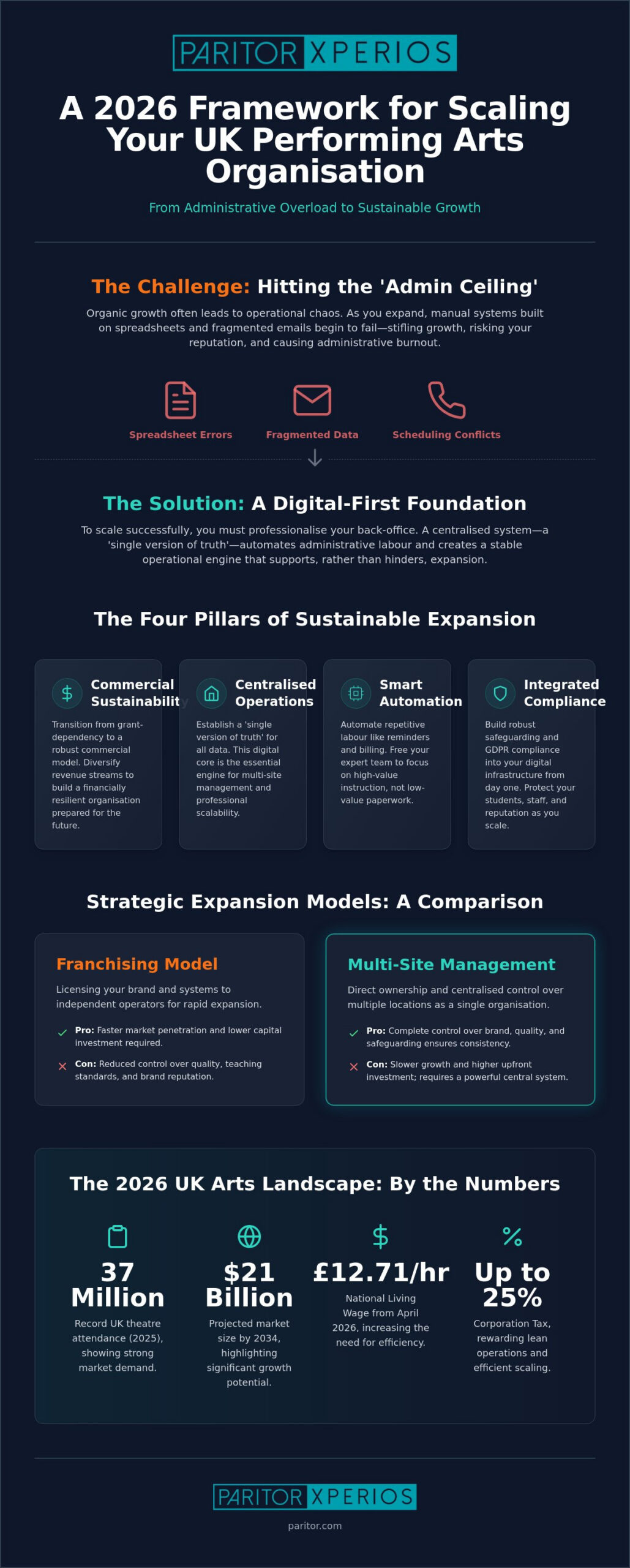
The UK performing arts sector is undergoing a profound structural shift. Whilst the UK’s vibrant tradition of theatre continues to draw record attendance, surpassing 37 million in 2025, the financial foundations are changing. Public grants are no longer the primary safety net they once were. Instead, successful organisations are moving towards diversified, commercial revenue models. For many, scaling a performing arts business UK is no longer an optional ambition; it’s a necessity for survival in a high-cost environment.
The market is projected to reach over $21 billion by 2034, but this growth comes with increased complexity. Many founders find themselves trapped in a cycle of “organic growth” where each new student or venue adds a disproportionate amount of paperwork. Without a structured plan, the very success you’ve worked for can lead to administrative burnout. You’re no longer just a teacher or a creative lead; you’re managing a complex logistical operation.
Economic Realities of the 2026 Arts Sector
Current economic pressures are reshaping how we think about expansion. With the National Living Wage rising to £12.71 per hour in April 2026 and Corporation Tax rates reaching up to 25% for larger profits, the margin for error has narrowed. Organisations must now balance tuition revenue with “savvy” consumer habits. We’re seeing a “smaller basket” trend where audiences book fewer tickets per transaction, meaning you need a larger, more engaged student and parent base to maintain profitability. Sustainable scaling in 2026 is the process of expanding your reach whilst ensuring that your operational overheads grow at a significantly slower rate than your income through automated infrastructure.
The ‘Admin Ceiling’ and How to Break It
Every growing organisation eventually hits the “Admin Ceiling.” This is the point where manual systems, usually built on spreadsheets and fragmented email chains, begin to fail. You’ll recognise it by the frantic Sunday evenings spent cross-referencing attendance lists or the sinking feeling when an instrument goes missing across locations. Breaking this ceiling requires a psychological shift. You must transition from being a “Teacher-Owner” who touches every task to an “Organisation Director” who oversees systems.
Professionalising your back-office is the essential first step to regional expansion. It isn’t just about efficiency; it’s about brand protection. As you scale, your reputation depends on consistent, professional communication and bulletproof safeguarding. If your parent communication feels fragmented, your brand feels unprofessional, regardless of the quality of your tuition. Digital transformation allows you to centralise these functions, creating a stable foundation that supports growth rather than hindering it. This mirrors trends in other high-touch sectors, where platforms like Encore Salon & Spa Software are used to professionalise client touchpoints and ensure operational consistency.
Building the Operational Engine: Efficiency as a Growth Driver
Success in scaling a performing arts business UK depends on your ability to decouple growth from administrative labour. In the early days, a founder can manage twenty students using a diary and a few spreadsheets. When that number reaches two hundred across three different venues, those manual processes become a liability. You need a “single version of truth” where every piece of data, from student medical notes to teacher availability, lives in one centralised location accessible to your entire team.
Efficiency isn’t just a buzzword; it’s the primary driver of your profit margin. Recent UK arts sector data highlights how rising operational costs are squeezing traditional organisations. By automating repetitive tasks like lesson reminders and attendance tracking, you reduce the “cost-per-pupil” admin burden. This allows your organisation to expand its reach whilst keeping your back-office team lean and focused on high-value support rather than data entry.
Centralised Scheduling and Attendance
Managing peripatetic teacher timetables is one of the most complex logistical puzzles in the sector. When teachers move between schools and community centres, a single scheduling error can damage your reputation with parents and partner venues. Real-time attendance tracking solves this by providing instant visibility across all sites. This doesn’t just improve billing accuracy; it ensures you meet the rigorous safeguarding standards required for modern UK music and drama services. If you’re currently evaluating your options, consult The Definitive Guide to Choosing a Performing Arts School Administration System in 2026 to see how these features integrate into a larger growth strategy.
Instrument and Asset Management at Scale
For music services, your instrument inventory represents a significant capital investment. As you scale, the risk of “lost” assets increases exponentially if you’re relying on paper forms or memory. Implementing a digital tracking system for loans, repairs, and routine maintenance is vital for protecting your bottom line. Automated inventory tracking ensures that every asset is accounted for and maintained in peak condition, preventing costly last-minute replacements that eat into your expansion budget.
Building this operational engine allows you to step back from the daily grind of paperwork. Many founders find that adopting a modular platform like Xperios provides the relief they need to return to their creative mission. By letting the software handle the heavy lifting of scheduling and asset tracking, you create the headspace necessary to lead your organisation into its next phase of growth.
Strategic Expansion Models: Franchising vs. Multi-Site Management
Choosing how to grow is a defining moment for any artistic director. Scaling a performing arts business UK typically follows one of two paths: the rapid footprint of franchising or the controlled growth of multi-site management. Both models require a move away from founder-led decision-making towards robust Standard Operating Procedures (SOPs). These procedures ensure that whether a student attends a class in Cornwall or Cumbria, the quality of instruction remains identical. This commitment to quality aligns with Arts Council England’s new strategy, which places renewed emphasis on artistic excellence as a condition for long-term success.
Modern cloud software acts as the bridge between these distant locations. It provides the remote oversight needed to monitor performance without micromanaging your team. For many founders, the goal is to ensure a consistent parent experience regardless of which branch a student attends. When a parent logs into a portal to check a rehearsal schedule or pay an invoice, they should encounter the same professional interface every time. This digital consistency builds trust and reinforces your brand’s authority in a competitive market.
The Franchise Route: Rapid Growth and Shared Risk
Franchising allows you to expand your reach quickly by leveraging the capital and local passion of individual franchisees. However, this model only works if your business is packageable. You need to provide a business in a box that includes everything from curriculum guides to marketing templates. A central management system becomes the vital link in this network. By using a centralised Xperios Teacher Portal and Xperios Parent Portal, you maintain oversight of brand standards without needing to be physically present. It ensures that the professionalised experience you’ve built isn’t diluted as the network grows, allowing you to scale whilst sharing the operational risk.
Multi-Site Management: Retaining Full Control
If you prefer to retain full ownership and creative direction, multi-site management is the logical choice. This path offers higher profit potential but carries a significant logistical burden. You must organise staff travel and resource allocation amongst various locations, often in real-time. The financial complexity also increases; you’re no longer managing a single bank of invoices but a web of location-specific accounts. Scaling your financial management through automation is the only way to handle this without hiring a massive administrative team. Xperios Financial Management allows you to monitor the health of each branch from a single dashboard, ensuring that no location falls behind the others whilst keeping your central overheads low.
Compliance and Safeguarding: Scaling Safely in the UK
Scaling brings risk. It’s that simple. Whilst your database expands, the legal responsibility to protect sensitive pupil information becomes a primary operational concern. In the UK, the stakes are high; UK GDPR maximum fines can reach up to £17.5 million or 4% of your organisation’s worldwide annual turnover. When you are scaling a performing arts business UK, you can no longer rely on informal data handling. You need a digital-first infrastructure that treats compliance as a core feature rather than an afterthought.
Managing a larger workforce also means tracking a complex web of certifications. You must ensure that every teacher, whether permanent or peripatetic, holds a valid Disclosure and Barring Service (DBS) check. With statutory fees for 2026 set at £21.50 for Basic or Standard checks and £49.50 for Enhanced checks, the administrative burden of verifying these documents across multiple sites is significant. Centralising this data ensures you never miss a renewal date, protecting both your students and your reputation.
GDPR and Data Security at Scale
Many growing organisations fall into the trap of using “unsecured” communication methods. Personal email accounts and WhatsApp groups might feel convenient, but they are a liability for student data. Professionalising your back-office means moving towards centralised portals where data is only accessible to authorised personnel. We host our systems on Microsoft Azure to provide high-tier UK data security and redundancy. This ensures your business continuity and guarantees that sensitive information remains within a secure, UK-based cloud environment, meeting the highest standards of regulatory compliance.
Safeguarding and Duty of Care
Your duty of care becomes more complex as you move into multi-site management. You must ensure that every staff member has instant access to essential safeguarding information, such as medical alerts or emergency contacts, via mobile portals. This is particularly vital for peripatetic teachers who may work across different ensembles and venues. Implementing “Safeguarding by Design” means these details are always at their fingertips. To see how this works in practice, explore The Ultimate Parent Portal for Music Schools: A 2026 Strategy Guide. By professionalising the way you handle pupil data, you build a foundation of trust that is essential for sustainable growth.
Ready to secure your organisation’s future? Learn how Xperios can automate your compliance and safeguarding workflows today.
Leveraging Xperios to Future-Proof Your Growth
Scaling a performing arts business UK requires more than just artistic ambition; it requires a platform built on decades of industry insight. Xperios for Performing Arts acts as your organisation’s industrious engine. It handles the complex, repetitive tasks that usually consume your evenings. By adopting a digital-first approach, you position your business as a modern, tech-savvy leader. This isn’t just about efficiency. It’s about reclaiming your creative time and focusing on the high-level strategy that drives regional expansion.
The power of the platform lies in its modularity. We understand that every growth journey is unique. You might begin by centralising your rehearsals through Xperios Ensemble Management. As your inventory grows, you can seamlessly integrate Xperios Instrument Management to track assets across multiple sites. This modular philosophy ensures your systems evolve alongside your organisation, providing a stable foundation that never feels bloated or restrictive.
Automated Financial Management
Manual invoicing is often the first process to break during expansion. Xperios Financial Management eliminates this friction by automating the entire booking and billing cycle. You can say goodbye to chasing late payments; automated reminders and secure online payment portals do the work for you. This system doesn’t just improve cash flow. It generates the detailed financial reports required to secure expansion loans or private investment. By integrating these tools into your existing accounting workflows, you gain a level of professional oversight that manual spreadsheets simply cannot match.
Professionalising the Stakeholder Experience
Your brand’s reputation is built on the daily interactions between teachers, students, and parents. Xperios Teacher Portal and Xperios Student Portal reduce administrative friction at every touchpoint. Teachers can update attendance and lesson notes in real-time from their mobile devices. Students gain a sense of ownership over their progress through dedicated portals.
Building trust with parents is equally vital. The Xperios Parent Portal serves as a professional, secure communication hub where families can manage schedules, view assessments, and settle invoices. This level of transparency professionalises your brand and reduces the volume of routine enquiries hitting your inbox. It creates a seamless experience that reflects the excellence of your tuition.
This drive for high-quality, automated booking experiences is a cross-industry trend; for a look at how AI-driven customer apps are being used to enhance the beauty and wellness sector, you can visit Panema for further inspiration.
Growth shouldn’t be a burden. With the right operational foundation, you can expand your reach whilst staying true to your creative mission. Discover how Xperios can help you scale your performing arts business today.
Building Your Legacy on a Digital Foundation
Scaling a performing arts business UK is a journey of transition from manual oversight to strategic leadership. By centralising your data and automating the repetitive labour of scheduling and invoicing, you protect your organisation from administrative collapse. This digital transformation ensures that your growth is sustainable; it allows you to maintain the high standards of excellence and safeguarding that your students deserve whilst you expand into new regions.
You don’t have to carry the burden of administrative debt alone. We’ve built Xperios on 30 years of UK industry expertise to act as the industrious engine behind your expansion. Our modular system grows with your organisation, providing Microsoft Azure-backed security that gives you and your parents total peace of mind. It’s time to step away from the spreadsheets and return to the creative work that inspired you to start this journey. Take the first step towards a more professionalised, efficient future today.
Book a Consultative Demo of Xperios for Your Growing Business
Frequently Asked Questions
What is the biggest challenge when scaling a performing arts business in the UK?
The primary obstacle is administrative debt, where manual processes fail to keep pace with increased student numbers. Scaling a performing arts business UK requires a shift from founder-led paperwork to automated systems. This transition prevents the “admin ceiling” that often leads to burnout and operational collapse during regional expansion.
How does cloud software help with managing multiple school locations?
Cloud software provides a centralised hub that acts as a single version of truth for all your venues. It allows you to monitor attendance, schedules, and billing in real-time from any location. This ensures that your brand standards and safeguarding protocols remain consistent, whether you’re managing two sites or twenty.
Do I need to hire more admin staff when I open a second location?
You don’t always need to increase your administrative headcount when expanding. By implementing automated workflows for repetitive tasks like invoicing and lesson reminders, your existing team can manage a much larger student base. Technology performs the labour-intensive tasks, allowing you to keep your central overheads low.
Is it better to franchise my theatre school or open new branches myself?
Franchising offers rapid growth through shared risk, whilst opening branches yourself provides total creative and financial control. If your business model is easily packageable and you’re comfortable with remote oversight, franchising is effective. However, multi-site management is better for founders who want to maintain direct influence over every location.
How can I ensure GDPR compliance whilst growing my student database?
You must move away from unsecured data handling like personal emails or messaging apps as your database grows. Centralised portals ensure that sensitive pupil data is only accessible to authorised personnel. Using a system backed by Microsoft Azure provides the high-tier security and data redundancy required for professional business continuity.
What features should I look for in a performing arts management system for 2026?
Look for a modular system that allows you to add features like instrument management or financial modules as you need them. Essential features include secure parent portals, real-time teacher timetabling, and automated financial reporting. Ensure the platform is built on direct industry collaboration to handle the specific nuances of the arts sector.
How do I manage peripatetic teacher schedules across different sites?
Digital timetabling allows you to coordinate peripatetic staff across multiple sites from a single dashboard. Teachers can view their updated schedules and log attendance instantly via a dedicated teacher portal. This reduces the need for fragmented phone calls and ensures that every lesson is accounted for across your entire network.
Can automated invoicing really reduce late payments for my music school?
Automated invoicing significantly reduces late payments by removing manual errors and forgotten bills. Secure portals allow parents to settle fees instantly, whilst automated reminders handle the awkward task of chasing arrears. This professionalises your financial management and ensures a steady cash flow to support your expansion plans.