

Imagine it is the peak of the 2026 Spring booking window. You are currently cross-referencing peripatetic teacher schedules against examiner availability whilst simultaneously chasing parents for a £96 Grade 5 practical fee. It is an exhausting cycle where a single manual data entry error can lead to a missed assessment or a frustrated family. You likely started your career to foster musical talent, not to become a full-time logistics coordinator. Effective music exam administration should be the invisible engine that supports your students, not a barrier that keeps you chained to your desk.
We understand that the complexity of modern assessments, from digital performance submissions to face-to-face practicals, requires more than just a clever spreadsheet. This guide will show you how to transform these fragmented tasks into a streamlined, automated process that restores your focus to education. We will explore how to build a centralised data ecosystem using the Xperios Exams and Assessments Module, ensuring that automated notifications and seamless invoicing through the Xperios Parent Portal finally put an end to administrative stress.
Key Takeaways
- Understand how the shift to digital and multi-modal assessments is redefining the scope of music exam administration beyond simple bookings.
- Learn how to synchronise student data between teacher portals and central databases to eliminate manual errors and scheduling conflicts.
- Identify the hidden costs and security risks of relying on manual spreadsheets for sensitive student information and exam logistics.
- Discover a practical roadmap for managing exam seasons, including pre-entry audits and internal deadline strategies to ensure student readiness.
- Explore how the Xperios Exams and Assessments Module centralises scheduling, billing, and results within a secure cloud platform.
What is Music Exam Administration and Why is it Changing?
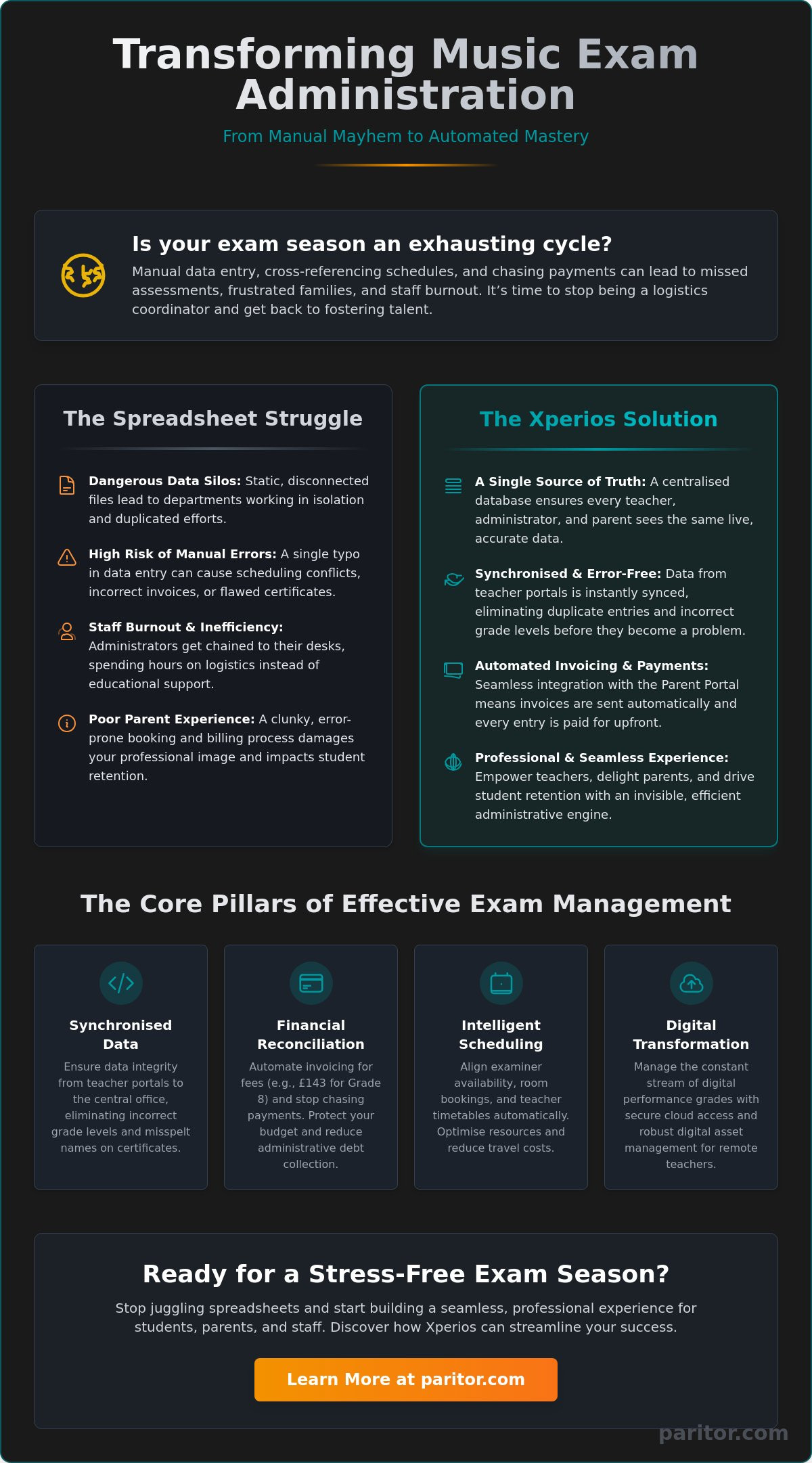
Modern Music examinations are no longer isolated events occurring once a term. In 2026, music exam administration encompasses a continuous cycle of data management, financial tracking, and digital logistics. It isn’t just about selecting a date on a calendar. It is about managing the entire student journey from the first mock assessment to the final certificate. For large music hubs, relying on manual spreadsheets has become a significant operational liability. These static files create dangerous data silos, increase the risk of entry errors, and lead to staff burnout. When the administration is clunky, the student experience suffers. A seamless booking and billing process is a quiet but powerful driver of student retention. If a parent finds the process difficult or receives an incorrect invoice, they are less likely to re-enrol their child for the next grade. Efficiency creates the professional environment that parents expect and students deserve.
The Complexity of Multi-Board Management
Coordinating requirements for ABRSM, Trinity College London, and Rockschool simultaneously is a logistical puzzle. Each board has unique entry windows, varying fee structures, and specific digital submission requirements. For example, managing ABRSM paper-based theory exams for Grades 6 to 8 alongside Trinity’s digital-only theory options requires precise timing. Without a centralised system, different departments often work in isolation. This leads to duplicated efforts and conflicting room bookings. You need a single source of truth for all student achievements. This ensures that every teacher, administrator, and parent is looking at the same data. It eliminates the nightmare of coordinating peripatetic teacher schedules with examiner availability, as everyone operates from a unified, live database.
The Impact of Digital Transformation on Assessments
The rise of digital performance grades has fundamentally changed the rhythm of the academic year. Unlike traditional practical exams with fixed dates, digital assessments are often available on demand. This shift has increased the frequency of administrative cycles. You are no longer managing one big exam season; you are managing a constant stream of entries. This requires robust digital asset management for recorded submissions and secure cloud-based accessibility. Peripatetic teachers working remotely need to upload results and feedback instantly. A modern music exam administration strategy must provide these educators with the tools to work flexibly whilst maintaining institutional data security. Cloud-based systems allow teachers to update student progress in real-time, ensuring that the central office is always ready for the next booking window.
The Core Pillars of Effective Music Exam Management
Effective music exam administration relies on four foundational pillars. It starts with data. When your teacher portals and administrative databases are perfectly synchronised, the risk of duplicate entries or incorrect grade levels evaporates. This creates a reliable foundation for every other administrative action. You don’t want to discover a misspelt name or a wrong grade level only after the certificates have been printed. A centralised system ensures that the student information entered by the teacher is the same data used for the booking and the final invoice.
Financial reconciliation is often the most stressful pillar to manage manually. Chasing parents for a £143 Grade 8 practical fee or a £60 Grade 5 theory payment takes hours of staff time. By integrating your exam bookings with a dedicated financial module, you can automate invoices and ensure every entry is paid for upfront. This shift protects your budget and reduces the administrative burden of debt collection. You can learn more about streamlining your financial workflows to prevent these common bottlenecks before they disrupt your schedule.
Scheduling and Resource Optimisation
Scheduling is a complex jigsaw puzzle. You have to align examiner availability with student time slots, room bookings, and teacher timetables. Intelligent systems take the guesswork out of this process. They can automatically group local assessments to reduce examiner travel time, which is both cost-effective and professional. Resource management is equally vital. You must ensure that specific instruments, such as high-quality pianos or percussion kits, are available and serviced for every candidate. This level of detail is difficult to maintain in a spreadsheet but becomes simple when your inventory is linked to your exam schedule. Aligning these resources with broader NAfME’s assessment practices helps maintain a professional standard that benefits both students and staff. Understanding how to create a music school timetable that synchronises teacher availability, room bookings, and instrument access is essential to ensuring your exam scheduling runs without conflict.
Communication and Stakeholder Engagement
Automated communication is the final pillar. Keeping parents and teachers informed shouldn’t require manual emails. Automated triggers can notify parents of upcoming deadlines, venue changes, or result announcements. This transparency builds trust. When parents have access to a dedicated portal, they don’t need to call your office to ask about certificate delivery or exam times. Teachers also benefit from real-time visibility. They can track their students’ status, confirm that fees have been paid, and ensure that all digital assets are uploaded on time. By automating these communication loops, you transform music exam administration from a manual hurdle into a streamlined, professional service.
Manual Spreadsheets vs. Dedicated Exam Modules
Many music services still rely on the familiar spreadsheet to manage their seasonal bookings. Whilst Excel feels accessible, this familiarity often masks a series of growing operational risks that can compromise your service’s reputation. In the context of music exam administration, a single misplaced cell or an accidental deletion can derail months of student preparation. Relying on manual data entry doesn’t just waste time; it creates a culture of reactive firefighting rather than proactive education management. Transitioning to a dedicated module allows your team to move away from these repetitive burdens and reclaim their focus for more strategic tasks.
The Spreadsheet Trap: A Risk Assessment
The hidden costs of manual systems are often found in the hours spent correcting avoidable errors. A simple typo can lead to an examiner being booked for the wrong instrument or a student being entered for a grade they aren’t ready for yet. These mistakes are particularly common during peak spring and summer seasons when the volume of data becomes overwhelming. Beyond simple errors, there is the critical issue of security. Storing sensitive student data, including names, dates of birth, and assessment needs, in unencrypted Excel files is a significant GDPR risk. Sharing these files via email only compounds the problem, making it nearly impossible to maintain a secure audit trail or ensure version control. Effective strategies for assessing music students require a foundation of stable, secure data that spreadsheets simply cannot provide.
The Power of Integrated Cloud Solutions
Moving your records into a dedicated cloud ecosystem ensures total data integrity. By linking exam entries directly to the student profile within the Xperios Exams and Assessments Module, you eliminate the need for duplicated data entry. Every piece of information, from previous results to current teacher notes, is stored in one secure location. We utilise hosted solutions like Microsoft Azure to provide high levels of data redundancy and institutional safety, ensuring your records are always available when you need them. This integrated approach also streamlines your financial cycles. Automated invoicing through the Xperios Financial Management system reduces the gap between an exam entry and the parent’s payment, protecting your cash flow and reducing the need for manual debt collection.
Real-time reporting is perhaps the greatest advantage for music service leads and trustees. Instead of waiting days for a staff member to compile a spreadsheet report, you can access live dashboards that show entry numbers, pass rates, and projected revenue instantly. This visibility allows for more informed decision-making and provides a clear narrative of progress to your stakeholders. It’s about moving from a state of administrative stress to one of empowered, data-driven leadership. For music hubs operating across multiple sites, managing multiple school locations software can unify these dashboards across every branch, eliminating the data silos that often deepen as your organisation grows.
A Roadmap for a Stress-Free Exam Season
Successfully navigating a music exam season requires more than just meeting the board’s final deadline. It requires a structured internal timeline that begins months in advance. By establishing a clear roadmap, you can transform music exam administration from a panicked scramble into a predictable, manageable process. This proactive approach ensures that every student is truly ready and every logistical detail is accounted for before the pressure builds. Start early. Build a buffer into your schedule to account for the unexpected.
A vital first step is the pre-entry audit. Instead of relying on verbal confirmations, use automated teacher reports to verify student readiness. This is also the ideal time to collect data on special requirements. Automating the request for access arrangements ensures that you meet regulatory standards whilst keeping sensitive medical or educational data secure within your central system. It prevents the last-minute rush to find evidence for extra time or modified papers just days before the cut-off.
Phase 1: Preparation and Data Collection
Identifying the right candidates is simple when teachers can flag students directly through the Xperios Teacher Portal. Once the entry list is confirmed, the Xperios Financial Management module can trigger automated invoices. Collecting fees via the Xperios Parent Portal before the booking is made eliminates the risk of the music service being left out of pocket. You should also use this phase to confirm venue suitability. Ensure that instrument maintenance schedules are up to date. A Grade 8 candidate deserves a piano that is perfectly in tune and a room that is free from outside distractions. Checking these details early removes the stress of last-minute repairs.
Phase 2: Execution and Scheduling
As the session approaches, the focus shifts to the “jigsaw puzzle” of scheduling. You need to generate clash-free timetables that account for multiple rooms and examiner travel times. Providing your stewards with digital check-in lists on the day ensures a smooth flow of candidates. It also allows for real-time updates if a student is delayed by traffic or illness. If you are ready to modernise your approach and eliminate these manual hurdles, you can explore our exams and assessments module to see these features in action. Managing last-minute cancellations becomes far less disruptive when you have a live system that can reassign slots instantly.
The process doesn’t end when the examiner leaves. Post-exam follow-up is essential for maintaining student momentum. Use your system to track the arrival of results and distribute digital certificates immediately. This allows you to update student records automatically, feeding directly into their future learning plan. It ensures that your data remains a live reflection of their musical journey, rather than a static record of the past.
Streamlining Your Success with Xperios Exam Solutions
The transition from a manual, spreadsheet-based system to a modern digital ecosystem is the single most effective way to master music exam administration. We built the Xperios Exams and Assessments module specifically for the unique needs of music services and performing arts organisations. It isn’t just a database; it’s a dedicated partner that manages the heavy lifting of your seasonal logistics. By integrating this module into your daily operations, you replace fragmented paperwork with a unified cloud platform. Hundreds of UK music hubs already trust Xperios as their administrative backbone, allowing them to scale their services without increasing their staff workload.
One of the most significant advantages of Paritor’s cloud platform is the 360-degree view it provides of the student journey. You can track a pupil’s progress from their very first trial lesson through to their final Grade 8 performance. This longitudinal data allows you to identify trends, celebrate successes, and provide targeted support where it’s needed most. When every assessment result, fee payment, and teacher note is linked to a single student profile, you eliminate the risk of data silos that often plague larger organisations. It’s a level of oversight that transforms how you manage your educational mission. Organisations expanding across multiple campuses will find that software for managing multiple school locations extends this same 360-degree visibility across every site, ensuring consistent data integrity regardless of how many branches you operate.
Reclaiming Time for Musical Excellence
Some industry professionals report that moving to an automated system can reduce administrative overhead by up to 60%. This reclaimed time is invaluable. Instead of being buried in data entry, your senior leads can return their focus to pedagogy and teacher development. Automation also improves the professional image of your service. Polished, automated communications through the Xperios Parent Portal ensure that families receive consistent, timely information. This transparency reduces the volume of “where is my result?” enquiries and builds a stronger sense of trust amongst your community. You aren’t just saving time; you’re elevating the standard of your entire service.
Implementation and Support from Industry Experts
We understand that the prospect of migrating years of legacy data can feel daunting. Paritor’s onboarding team is here to ensure your data is moved safely and accurately. Our UK-based support team consists of experts who understand the music education sector, providing a level of empathy and insight that generic software providers cannot match. Security is our priority. Our platform is built on Microsoft Azure, providing the high-level data redundancy and regulatory compliance that institutional safety requires. If you’re ready to see how automation can transform your next exam season, Organise a demonstration of the Xperios Exams module today and discover the relief of a truly streamlined workflow.
Modernise Your Workflow for a Creative Future
The transition to efficient music exam administration is no longer just an operational choice; it’s a necessary step forward for any growth-oriented music service. We’ve seen how a centralised “source of truth” eliminates the hidden costs of manual entry. It provides the institutional safety your students deserve. By adopting a structured roadmap and moving your data into a secure cloud ecosystem, you can finally put an end to the seasonal scramble. You don’t have to manage these complex logistics alone.
Paritor has been a trusted partner for UK music hubs for over 30 years. Our software is built on secure Microsoft Azure cloud infrastructure and was designed in direct collaboration with music education professionals who understand your daily frustrations. It’s time to let technology handle the repetitive burdens so you can focus on your primary educational mission. Discover how Xperios can revolutionise your music exam administration and experience the relief of a truly streamlined process. Your students are ready for their next grade. Now, your administration can be too.
Frequently Asked Questions
How do I manage multiple music exam boards in one system?
You can manage multiple boards by using a centralised Exams and Assessments Module that consolidates different entry requirements into one interface. This allows you to track ABRSM, Trinity, and Rockschool deadlines simultaneously without switching between various board portals. By housing all data in one place, you ensure that student records remain consistent across every assessment type. It simplifies the transition between digital performance grades and traditional practical exams.
Can music exam administration software help with GDPR compliance?
Yes, dedicated software significantly improves GDPR compliance by replacing unencrypted spreadsheets with secure, cloud-based storage. Storing sensitive student data on Microsoft Azure ensures high-level encryption and robust data redundancy. You can control access levels for staff and teachers, ensuring only authorised users see personal information. This creates a secure audit trail that manual email chains simply cannot provide, protecting both your service and your students.
What is the best way to schedule music exams for a large hub?
The most efficient way to schedule exams for a large hub is to use intelligent scheduling tools that automatically group assessments by instrument and location. This reduces examiner travel time and ensures that specialised resources, such as grand pianos or percussion kits, are utilised effectively. Music exam administration becomes much simpler when the system automatically identifies potential clashes between teacher timetables and room availability, allowing for a seamless, conflict-free session.
How can I reduce late payments for music exam fees?
You can reduce late payments by integrating your booking process with an automated Financial Management module. This system triggers invoices the moment a teacher confirms a student’s readiness, allowing you to collect fees via a secure Parent Portal before the entry is finalised. Automated reminders ensure that parents stay informed of deadlines without your staff needing to make manual phone calls. This upfront approach protects your budget and stabilises cash flow.
Is it possible to automate student progress reports alongside exams?
It is entirely possible to automate progress reports by linking your Teacher Portal directly to the student’s exam history. Teachers can update lesson logs and mock exam results in real-time, which the system then compiles into a professional report for parents. This integration provides a 360-degree view of the student’s musical journey. It ensures that every assessment is supported by a clear record of their previous achievements and learning goals.
Can peripatetic teachers manage their own students’ exam entries?
Peripatetic teachers can take ownership of the process through a dedicated Teacher Portal. They can flag students for entry, upload necessary digital assets for performance grades, and verify that all personal details are correct. This decentralised approach reduces the administrative burden on your central office whilst ensuring that the data is entered by the person who knows the student’s progress best. It empowers teachers to manage their own workflows effectively.
What happens if we need to change an exam time at the last minute?
If you need to make a last-minute change, a live cloud-based system allows you to update the timetable instantly and notify all stakeholders. Automated triggers send immediate alerts to parents and stewards via the Parent Portal or email, ensuring everyone is aware of the new time slot. This real-time flexibility is essential for managing illness or travel delays. It prevents the confusion that often occurs when using static, printed schedules or manual spreadsheets.
How does cloud-based software improve communication with parents?
Cloud-based software improves communication by providing parents with a single, transparent “source of truth” through a dedicated portal. They can check exam dates, download preparation materials, and view results without needing to contact your office directly. This self-service model reduces the volume of routine enquiries and provides a more professional experience for families. Music exam administration feels much more supportive when parents have instant access to their child’s assessment status and history.