
What if the hours spent wrestling with fragmented spreadsheets and manual data entry could be reclaimed for the music room or the dance studio? For many arts educators, adopting online progress reports for students is the catalyst that transforms a chaotic administrative cycle into a streamlined, celebratory experience. You likely feel the weight of managing hundreds of pupils whilst trying to maintain consistent feedback across a diverse team of peripatetic teachers. It is a common struggle that often leaves parents feeling out of the loop regarding their child’s creative milestones.
We believe your primary mission should be education, not paperwork. This article demonstrates how digital reporting tools can reduce your administrative burden whilst strengthening the vital connection between teachers, parents, and pupils. You will discover how a centralised system for all student data creates a more professional, reliable environment for everyone involved. We will explore the shift toward real-time feedback, the benefits of integrated portals, and how modern software allows you to prioritise actual teaching over repetitive data entry.
Key Takeaways
- Learn how online progress reports for students replace static paper summaries with real-time, secure, cloud-based achievement tracking.
- Identify the critical features of reporting platforms that allow peripatetic staff to provide consistent feedback from any teaching centre.
- Discover how automated data integration from registers eliminates repetitive manual entry and reclaims time for creative instruction.
- Master a phased implementation strategy to ensure a smooth transition from manual paperwork to a modern digital reporting ecosystem.
- See how tools like the Xperios Teacher Portal empower your team with mobile-friendly reporting that keeps parents and pupils fully engaged.
What are Online Progress Reports for Students in 2026?
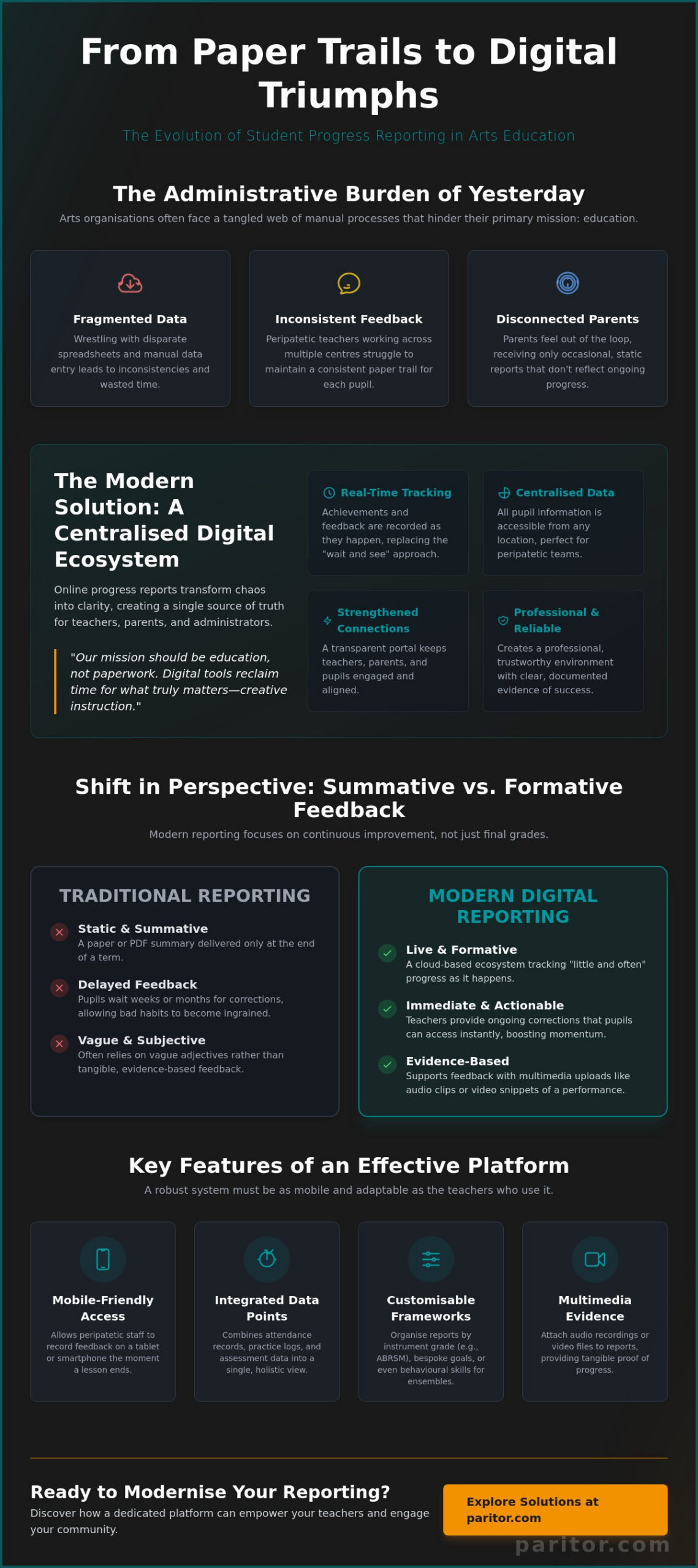
By 2026, the concept of a report card has been completely reimagined. It’s no longer a static piece of paper handed out at the end of a term or a PDF that sits unread in an inbox. Instead, online progress reports for students have become secure, cloud-based ecosystems where achievement is tracked as it happens. These platforms provide a real-time window into a student’s development, replacing the old-fashioned “wait and see” approach with immediate, actionable data.
When we look at the history of student progress reports, the evolution from manual ledger entries to digital interfaces represents a massive leap in educational transparency. For modern music hubs and performing arts schools, this “live” nature is vital. It moves reporting away from vague adjectives and towards evidence-based feedback. Teachers can now upload short audio clips of a student’s latest piano recital or video snippets of a dance routine, creating a rich portfolio that celebrates creative growth whilst ensuring technical accuracy.
The Shift from Summative to Formative Feedback
Modern reporting has moved beyond the final grade. Whilst summative assessments still have their place, the real value lies in formative tracking. This is the “little and often” approach to feedback. In arts education, technique is everything. If a student is practising violin scales with poor posture, they shouldn’t wait for an annual review to find out. Digital systems allow teachers to provide ongoing corrections that students can access immediately. This continuous loop keeps momentum high and prevents bad habits from becoming ingrained between lessons.
Why Arts Educators are Modernising Their Systems
The unique nature of arts education presents specific challenges that traditional school systems often miss. Peripatetic teachers often work across multiple centres and schools, making it difficult to maintain a consistent paper trail. Modernising with online progress reports for students ensures that data is centralised and accessible from any location. This information travels with the student, whether they are in a one-to-one instrumental lesson or a weekend ensemble rehearsal. Additionally, having this data at your fingertips is essential for proving the impact of arts programmes, helping organisations secure vital funding through clear, documented evidence of student success.
Key Features of Effective Progress Reporting Platforms
Effective online progress reports for students must do more than just record a grade. In the arts, progress is fluid and multi-faceted; it requires a platform as mobile and adaptable as the teachers themselves. Many peripatetic staff move between several different schools and centres in a single day. They need a system that functions seamlessly on a tablet or smartphone, allowing them to record feedback the moment a lesson ends. This immediacy ensures that no nuance of the student’s performance is lost to the passage of time or the clutter of a busy schedule.
A robust platform should integrate various data points into a single, cohesive view. When attendance records, digital practice logs, and assessment data flow into one report, the result is a holistic picture of student engagement. This level of transparency creates a sense of professional trust. It allows administrators to see exactly how a student is performing without having to chase individual teachers for updates. Organisations looking to unify these features often find that specialist tuition management software provides the necessary flexibility for creative subjects.
Customisable Assessment Frameworks
The best reporting systems recognise that a piano lesson and a musical theatre rehearsal require different metrics. You should be able to organise reports by instrument grade, such as ABRSM or Trinity levels, or by bespoke artistic goals unique to your service. It’s also vital to track “behaviour” and soft skills, particularly for rehearsals and ensembles where teamwork is as important as technical skill. A truly framework-independent system allows a drum tutor to track rudiment speed whilst a drama coach monitors stage presence, all within the same unified interface, without forcing either into a rigid, one-size-fits-all structure.
Multimedia Evidence and Performance Portfolios
Capturing the ephemeral nature of a performance is a major advantage of modern online progress reports for students. Attaching audio recordings directly to a report provides a tangible record of progress that words alone cannot convey. Teachers can also upload photos of sheet music annotations to demonstrate a student’s theoretical understanding or technical adjustments. These multimedia elements quickly become a favourite feature for parents. They offer a window into the music room that was previously closed, turning a simple report into a digital portfolio that celebrates every creative milestone.
Reducing the Administrative Burden of Student Reporting
The biggest hurdle to consistent reporting isn’t a lack of care; it’s a lack of time. Many teachers view feedback as a secondary task that competes with their primary mission of instruction. This friction often leads to a backlog of paperwork that feels overwhelming by the end of term. However, modern online progress reports for students change this dynamic by turning data entry into a background process rather than a manual chore. It’s about working smarter, not harder, to ensure that every pupil receives the recognition they deserve.
Cloud technology allows for a level of mobility that was previously impossible. Peripatetic teachers can update records whilst travelling between schools or during those small gaps between lessons. This “on-the-go” capability ensures that feedback is fresh and accurate. For administrative staff, the benefits are equally significant. Instead of chasing hundreds of individual reports, they have a centralised view of all student progress. This bird’s-eye view makes it easier to spot trends, identify students who need extra support, and ensure that professional standards are being met across the entire service. It removes the stress of the end-of-term rush, replacing it with a steady, manageable flow of information.
Using Comment Banks to Personalise Feedback
Efficiency doesn’t have to mean a loss of personality. Pre-set comment banks allow teachers to quickly select common observations for specific instruments or disciplines, which can then be tailored for the individual pupil. This hybrid approach ensures that every report feels personal whilst saving hours of repetitive typing. Built-in spell-checkers protect your organisation’s reputation, ensuring that every piece of outward-facing communication is polished and professional. It’s a simple way to maintain high standards without adding to the teacher’s cognitive load.
Automating Attendance and Achievement Data
The true power of automation lies in the connection between everyday tasks. When a teacher marks a register, that data should flow directly into the student’s progress dashboard. This eliminates double-entry and ensures that attendance and achievement are always linked. Real-time alerts can notify parents the moment a student reaches a specific milestone, such as mastering a difficult piece or completing a grade level. This instant gratification keeps pupils motivated and parents engaged with the musical journey. For a deeper look at how these systems integrate across your entire organisation, consult the complete guide to music service management software in 2026.
How to Implement Online Progress Reports Successfully
Moving from a paper-based system to a digital one is a journey of professional growth. It requires more than just new software; it requires a shift in how your team communicates and records achievement. A clear roadmap is essential for success. Start with a small pilot group of peripatetic teachers to refine your assessment frameworks and identify potential friction points before a full-scale launch. This gradual transition builds staff buy-in and ensures that no one feels overwhelmed by the change. It allows you to prove the value of the system on a small scale before rolling it out across the entire organisation.
Training and support are the foundation of a smooth onboarding process. Your team needs to feel empowered, not burdened. Providing short, discipline-specific training sessions ensures that a drum tutor and a dance coach both understand how to use the system effectively. When staff see the immediate relief of reduced paperwork, the adoption of online progress reports for students becomes a shared goal rather than a top-down mandate. Ongoing support, such as peer-to-peer mentoring or access to a dedicated knowledge base, ensures that technical questions don’t become barriers to teaching.
Organising Access for Parents and Pupils
A centralised hub for viewing progress is a game-changer for parental engagement. A secure portal allows parents to view reports at their convenience, removing the need for physical handovers or lost emails. It’s important to manage access levels carefully; guardians may need to see financial data or attendance histories, whilst students might only focus on their technique feedback and practice logs. This tailored approach ensures everyone gets the information they need without unnecessary clutter. For more detailed advice on selecting the right interface, read our guide on choosing the best student portal for performing arts.
Ensuring GDPR Compliance and Data Security
Data security is a non-negotiable priority in 2026. Transitioning to a digital system is actually a significant security upgrade for most arts organisations. Unlike paper files that can be misplaced in a staffroom or lost in transit, online progress reports for students are stored in highly secure environments. We utilise Microsoft Azure for data storage, providing robust redundancy and high-level encryption. For local authorities and large music services, using UK-based data centres is essential for strict GDPR compliance and institutional safety. It builds a foundation of professional trust that paper records simply cannot match. To understand the full regulatory landscape your organisation must navigate, our guide on GDPR compliance for music schools UK provides a comprehensive 2026 management framework.
Ready to modernise your feedback? Explore our specialist management solutions today to see how we can support your digital transition.
Elevating Arts Education with Xperios Reporting
Xperios is more than just a software platform; it’s a dedicated ally built specifically for the arts. We developed this system amongst music and performing arts educators who understand the unique frustrations of managing complex schedules and peripatetic staff. By choosing a specialist solution, you move away from the limitations of general-purpose school software. Instead, you adopt a tool designed to celebrate artistic achievement whilst automating the labour-intensive tasks that pull you away from your core mission.
The Xperios Teacher Portal serves as the industrious engine behind your daily operations. It provides a mobile-friendly environment where staff can record online progress reports for students immediately after a lesson or rehearsal. This efficiency ensures that feedback is accurate and timely, fostering a stronger connection between the teacher and the pupil. By empowering your staff with tools that actually work for them, you create a culture of progress and excellence that resonates throughout your entire organisation.
Beyond the classroom, our system bridges the gap between instruction and administration. By integrating Xperios Financial Management with our educational modules, you ensure that every student’s journey is documented and accounted for. This connection provides administrators with the data they need to demonstrate the value of their services to stakeholders and funding bodies. It’s a professional, forward-thinking approach that replaces guesswork with clear, documented evidence of growth.
A Unified Ecosystem for Music and Arts
The true power of the system lies in its ability to synchronise disparate data points. When registers, reports, and billing exist in one place, the administrative relief is palpable. You no longer need to cross-reference multiple spreadsheets to ensure that a student’s progress matches their enrolment status. This unified ecosystem scales effortlessly, whether you are a private teacher managing a small studio or a large hub overseeing thousands of pupils across multiple centres. We offer modular solutions tailored to your specific needs, including:
- Xperios for Music Services and Performing Arts: Comprehensive management for large-scale organisations.
- Xperios for Private Teachers: Streamlined tools for independent tutors.
- Xperios Ensemble and Event Management: Specialist modules for group learning and performances.
Next Steps for Your Organisation
Modernising your approach to online progress reports for students is a significant step forward in your professional journey. We believe in a consultative approach, working closely with you to ensure the software fits your specific organisational needs. Our team provides tailored onboarding and ongoing support to ensure your transition is seamless and successful. It’s time to reclaim your focus and prioritise the creative growth of your students over repetitive paperwork. Explore our solutions today to discover how Xperios can transform your arts education service.
Modernise Your Mission Through Digital Feedback
Adopting a digital approach to feedback is a vital step toward reclaiming your time and prioritising your students’ creative journey. By implementing online progress reports for students, you move away from the repetitive stress of manual data entry and toward a more transparent, evidence-based model of achievement. This shift doesn’t just benefit your administration; it empowers your teachers and provides parents with the real-time updates they value. You’ve seen how centralised data and automated registers can transform a chaotic end-of-term rush into a steady, manageable flow of professional communication.
We’ve built Xperios on 30 years of industry experience, creating a platform trusted by leading UK music hubs and performing arts schools. Your data is securely hosted on Microsoft Azure, providing the institutional safety and reliability your organisation requires. It’s time to let technology handle the paperwork so you can focus on the music and the arts. We’re here to support your transition every step of the way, ensuring your team feels empowered and your pupils remain inspired.
Discover how Xperios transforms student reporting; book a demo today
Frequently Asked Questions
Can online progress reports for students be customised for specific instruments?
Yes, online progress reports for students are fully customisable to reflect the unique technical requirements of any instrument or arts discipline. You can build bespoke assessment frameworks that track grade-specific milestones, technique, or ensemble behaviour. This flexibility ensures that a piano tutor and a dance coach can both provide meaningful, relevant feedback within the same centralised system, rather than being forced into a generic template.
How do digital reports improve communication with parents in music schools?
Digital reporting provides parents with instant, real-time access to their child’s achievements through a secure portal. It replaces the traditional end-of-term paper report with a continuous stream of feedback, ensuring guardians are never out of the loop. This transparency builds professional trust and allows parents to support their child’s practice more effectively between lessons. It removes the friction of lost emails or physical documents that never make it home.
Are online student reports secure and GDPR compliant?
Modern reporting platforms prioritise institutional safety through robust encryption and secure cloud hosting on platforms like Microsoft Azure. These systems are designed to be fully GDPR compliant, offering role-based access to ensure sensitive pupil data is only visible to authorised staff. For music schools navigating the evolving regulatory landscape, understanding the full scope of GDPR compliance for music schools UK is essential for building a robust data protection framework. It is a significantly more secure method of data management than using paper files or unencrypted spreadsheets, providing peace of mind for both administrators and parents.
Can teachers update progress reports on their mobile phones?
Teachers can update online progress reports for students directly from their mobile phones or tablets using a dedicated, mobile-friendly Teacher Portal. This capability allows peripatetic staff to record feedback immediately after a lesson, whilst the details of the performance are still fresh. It eliminates the need for after-hours paperwork and ensures that no student milestone is forgotten in the rush of a busy schedule across different teaching centres.
Do online reports allow for video or audio evidence of student performances?
Yes, effective reporting platforms allow teachers to attach audio recordings and video clips directly to a student’s progress record. This multimedia evidence provides a tangible portfolio of growth that words alone cannot capture. Parents and students can listen to past recitals or view technical improvements, turning the report into a celebratory archive of their artistic journey. It makes the feedback process much more engaging and evidence-based for everyone involved.
How much time does it take to set up an online reporting system for a music service?
The setup time for a music service depends on the size of the organisation and the complexity of existing data. Most services benefit from a consultative onboarding process that includes a phased rollout over a few weeks. This approach ensures that staff are properly trained and assessment frameworks are correctly configured before the system goes live. It is a structured journey that prioritises staff buy-in and technical accuracy.
Is it possible to import existing student data into a new reporting platform?
It is entirely possible to import existing student data from your current databases or spreadsheets into a new centralised platform. Our technical team facilitates this transition to ensure that no historical information is lost during the modernisation process. This synchronisation allows your administrative staff to hit the ground running without the burden of manual data re-entry. It provides an immediate sense of relief by unifying all your records instantly.
Can students access their own progress reports to track their goals?
Students can access their own feedback and track their artistic goals through a dedicated Student Portal. This access encourages pupils to take ownership of their learning by viewing practice logs, technical corrections, and upcoming milestones. It transforms the report from a passive document into an interactive tool that keeps young performers motivated. Students feel empowered when they can see their own progress documented in such a professional and accessible way.