
How much of your annual budget is currently walking out the door because of unreturned cellos or forgotten clarinets? It’s a frustrating reality for many UK music hubs and schools where manual logs and spreadsheets fail to keep pace with a busy term. If you’re tired of the financial drain caused by missing assets, it’s time to consider how specialised instrument maintenance and repair tracking software can transform your operations.
We understand that your primary mission is education, not chasing paperwork or worrying about GDPR compliance under the Data Use and Access Act 2025. You deserve a system that acts as a silent partner, handling the heavy lifting of inventory management whilst you focus on teaching. In this 2026 guide, you’ll learn how to establish a centralised, real-time view of every asset you own. We will show you how to automate hire invoicing, improve communication with parents regarding repairs, and ultimately eliminate the administrative fatigue that holds your department back.
Key Takeaways
- Eliminate “spreadsheet rot” by moving to a centralised digital system that prevents financial loss from unreturned or missing assets.
- Learn why professional instrument maintenance and repair tracking software is essential for managing the complex relationship between student records, hire schemes, and peripatetic timetables.
- Discover how modern barcoding and Microsoft Azure cloud hosting provide enterprise-grade security whilst streamlining the physical check-out process for staff.
- Follow a practical five-step framework to audit your current inventory and clean legacy data for a seamless migration to a modern platform.
- Understand the power of modularity, allowing your organisation to start with inventory management and scale into finance or ensemble modules as your service grows.
Why Manual Instrument Tracking Fails Modern Music Services
Managing a fleet of musical instruments across dozens of schools is a logistical challenge that simple spreadsheets can no longer handle. Many organisations still rely on fragmented lists that quickly succumb to “spreadsheet rot,” where data becomes outdated as soon as it’s entered. To truly protect your assets, you need specialised instrument maintenance and repair tracking software. This isn’t just a digital list; it’s a dedicated educational ERP system designed to manage the lifecycle of every flute, violin, and drum kit in your care.
At its core, this technology functions as a specialised Computerized Maintenance Management System (CMMS), but it’s tailored for the unique workflows of music hubs. Unlike generic hire software used for power tools or events, these systems connect the instrument to a specific pupil, a teacher, and a billing schedule. Without this connection, your data remains fragmented. This lack of clarity makes it nearly impossible to provide the accurate asset reports required for local authority funding or Arts Council England audits.
The Financial Impact of Asset Loss
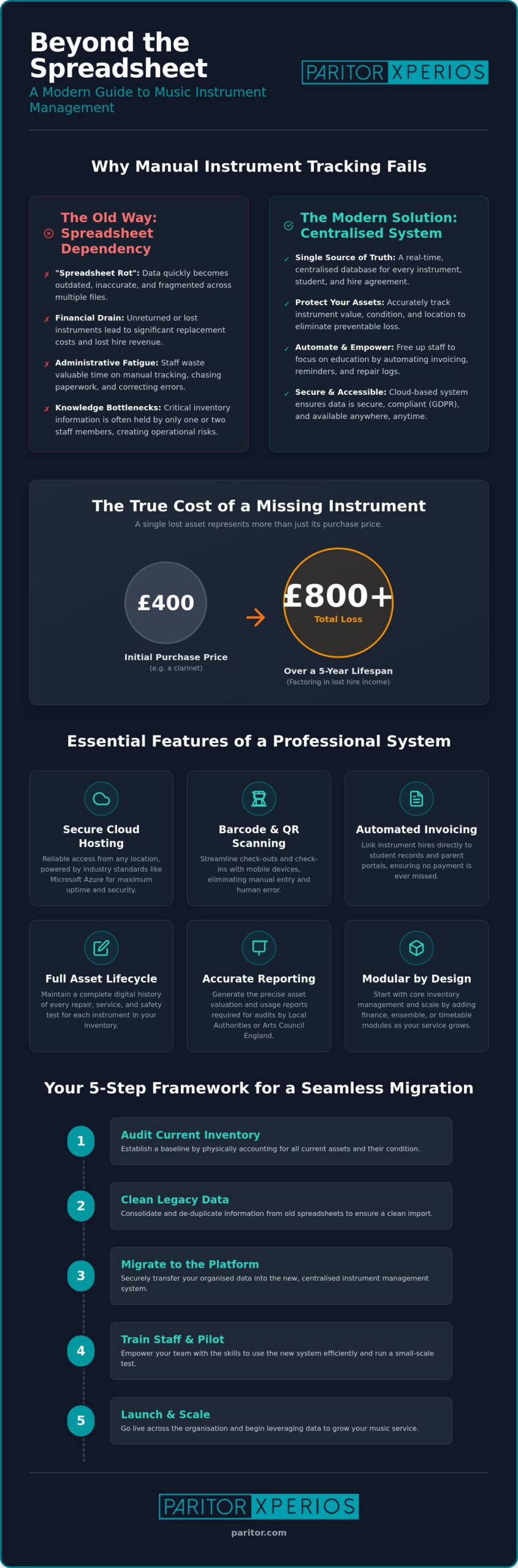
The true cost of a missing instrument isn’t just the initial purchase price. When you lose track of a £400 clarinet, you also lose the potential hire income it would have generated over its lifetime. Over a five-year period, a single unreturned instrument can represent a total loss of over £800 when you factor in replacement costs and lost revenue. Without real-time visibility, many departments find themselves repurchasing stock they already own because they simply can’t find it in their current inventory. Professional software provides the accurate valuations you need for insurance purposes and ensures your budget is spent on new opportunities rather than replacing lost assets.
Administrative Fatigue and the Human Element
Manual systems create a dangerous bottleneck where vital inventory knowledge sits with just one or two staff members. If that person is absent, the entire system grinds to a halt. This often leads to duplicate bookings, billing errors, and a general sense of anxiety amongst the team. We believe technology should act as an industrious engine behind the scenes. By automating the repetitive tasks of tracking repairs and sending hire reminders, you allow your staff to reclaim their time. This shift in focus is vital; it empowers your team to return to their core mission of music education whilst the software manages the paperwork.
Essential Features of a Professional Instrument Inventory System
Moving beyond the “spreadsheet rot” mentioned earlier requires a robust digital foundation. In 2026, Microsoft Azure has become the industry standard for cloud stability, ensuring your instrument maintenance and repair tracking software is accessible from any school or hub location without the risk of local server downtime. This reliability allows administrators to feel a sense of relief, knowing their data is secure and always available when they need to make quick decisions during a busy term.
Modernising the physical handling of instruments is just as vital as the digital backend. By using QR codes and barcoding, staff can perform instant check-outs and check-ins using a mobile device. This eliminates the chance of human error during hectic periods. Much like the findings in the University of Michigan case study, moving to a centralised system removes the friction of manual paper trails and creates a single, trustworthy source of truth for the entire organisation.
Automated invoicing takes this efficiency a step further. When an instrument is assigned to a student, the system should automatically trigger the relevant billing cycle. Whether you manage termly fees or annual hire schemes, the software syncs directly with student records and parent portals. This ensures that no hire fee is ever missed and significantly reduces the time spent chasing late payments manually.
Digital Asset Lifecycle Management
A professional system tracks an instrument from the moment it enters your inventory until it is eventually decommissioned. This includes recording every repair, string change, and annual PAT test. By maintaining these integrated repair logs, you build a complete history that helps justify future procurement budgets. It also ensures that every piece of equipment in a student’s hands is safe and in good working order. If you’re looking to streamline these complex processes, exploring specialised management tools can provide the clarity your department needs.
Safeguarding and GDPR Compliance in the UK
Protecting pupil data is non-negotiable for modern music services. Hosting your instrument maintenance and repair tracking software on UK-based Azure data centres is essential for meeting the rigorous requirements of the Data Use and Access Act 2025. Role-based access control ensures that peripatetic teachers only see the pupil information necessary for their specific lessons, protecting privacy across the board. Automated retention policies further simplify compliance by ensuring data is only kept as long as local authority standards require, removing the administrative burden of manual data cleansing.
Educational vs Commercial Hire: Choosing the Right Tool
Commercial hire software is typically built for high-volume transactions. It tracks how much revenue a drill or a marquee generates per day. However, loaning a cello to a seven-year-old is a relationship, not just a transaction. Professional instrument maintenance and repair tracking software must account for the pedagogical journey. It needs to know which school the student attends, who their peripatetic teacher is, and whether they’ve actually shown up for their lessons. This “pupil-instrument-teacher” data triangle is what separates educational tools from generic rental platforms.
When a violin is sent for repair, a commercial system simply marks it as “unavailable.” A dedicated educational system goes further by alerting the teacher and the parent, whilst potentially arranging a temporary loan so the child doesn’t miss a vital week of practice. This integration between the instrument status and the peripatetic timetable is what sets specialised tools apart. It ensures that the administrative engine supports the creative mission rather than obstructing it.
Managing the Assisted Instrument Purchase Scheme (AIPS) is another area where generic tools fall short. Within Xperios, you can manage the complex VAT rules and eligibility criteria of AIPS alongside standard hire agreements. This creates a unified environment where the finance office and the music room finally speak the same language. By bridging this gap, you eliminate the need for separate spreadsheets and reduce the risk of costly billing errors that often plague manual systems.
The Pupil-Centric Tracking Model
A student’s musical growth often involves physical changes, such as moving from a 1/4 size to a 1/2 size violin. A pupil-centric system tracks these transitions seamlessly, ensuring the inventory remains accurate whilst the child’s record shows their progression. Using a parent portal for music schools allows families to sign hire agreements digitally and view maintenance history from their own devices. This transparency builds trust and reduces the volume of administrative enquiries hitting your inbox every morning. When choosing instrument maintenance and repair tracking software, the focus must remain on the pupil’s long-term progress.
Ensemble and Event Integration
Music services don’t just operate in classrooms. Regional festivals and school concerts require the bulk movement of hundreds of assets at once. Your ensemble management software should communicate directly with your inventory system to ensure that every double bass and percussion kit is accounted for during transit. Whether you’re managing a weekend workshop or a short-term music course, having a unified view of your loan pools prevents the frantic last-minute search for missing equipment. It provides the stability needed to run high-pressure events with complete confidence, knowing exactly where every asset is located.
Implementing Your Tracking System: A 5-Step Framework
Moving from a chaotic system of paper files and fragmented lists to a professional digital platform is a significant step forward for any music service. Whilst the transition might feel daunting, a structured approach ensures you don’t just move your problems from a drawer to a screen. Adopting instrument maintenance and repair tracking software is most successful when it follows a logical, phased framework that prioritises data integrity and staff confidence.
- The Physical Audit: Start by verifying every asset in your possession. This ensures your digital migration begins with accurate data, preventing the “ghost inventory” issues that plague manual systems.
- Data Cleansing: Before importing records, standardise your naming conventions and serial numbers. This creates the “single source of truth” needed for reliable reporting.
- Internal Champions: Identify tech-savvy staff members to lead the change. These champions provide peer-to-peer support and drive software adoption across different departments.
- The Pilot Phase: Don’t try to migrate everything at once. Start with a single department, such as Strings or Brass, to iron out your specific workflows before a full rollout.
- Staff Training: Ensure every user understands how the system simplifies their day. When teachers see the immediate benefit to their workload, resistance to new technology disappears.
Data Migration and System Configuration
The technical phase involves mapping your existing legacy data into a professional instrument inventory management software database. This is the time to configure your specific business rules, such as tiered rental rates and automated discount triggers for families on low incomes. You can also set up automated email and SMS reminders for overdue items. These industrious features perform the labor-intensive tasks that previously drained your team’s time, providing instant relief to your administrative staff.
Securing Stakeholder Buy-In
To ensure long-term success, you must demonstrate the value of the new system to those holding the purse strings. Show senior management and local councillors the “time-saved” metrics and the reduction in asset loss. Teachers will appreciate how mobile access allows them to update repair logs during lessons without returning to the office. Finally, parents enjoy a much smoother experience through the portal, which reduces friction and improves the reputation of your service. If you’re ready to modernise your department, you can explore our implementation support to help you get started with confidence.
Xperios: The Future of Instrument Management
Paritor has spent more than 30 years refining technology specifically for the music education sector. Xperios isn’t just another generic asset tracker; it’s a platform built from the ground up to handle the nuances of UK Music Hubs and local authorities. Whether you’re managing a small collection or thousands of instruments across a county, our instrument maintenance and repair tracking software scales with your organisation. This person-centric approach ensures the system adapts to your specific workflows, rather than forcing you to change how you teach or manage.
The true power of the platform lies in its modularity. We believe organisations should only pay for the tools they actually use. You might start with Xperios Instrument Management to solve your immediate inventory crises, then later add Xperios Financial Management or the Xperios Exams and Assessments Module as your service evolves. This flexibility provides a clear path for professional growth without the overwhelming complexity of a corporate rental system. It allows you to build a bespoke solution that fits your specific budget and operational needs perfectly.
Meeting the reporting standards of Arts Council England or your local authority used to take weeks of manual data mining. With Xperios, real-time reporting is built into the core of the system. You can generate accurate asset valuations and student participation reports with a few clicks. This transparency builds institutional trust and ensures your funding remains secure based on verifiable, up-to-date data. Every feature we develop is the result of collaborative user feedback, ensuring the software solves the real-world frustrations of the music community.
A Partner, Not Just a Provider
Choosing a software platform is the beginning of a long-term partnership. Our structured onboarding process and dedicated UK-based support team ensure your migration is smooth and your staff feel confident from day one. We work closely with you to customise workflows and integrate Xperios with your existing local authority systems. Paritor’s mission is to eliminate the burden of repetitive administrative tasks, allowing music educators to reclaim their time and focus entirely on the creative success of their students.
Next Steps for Your Organisation
As you plan for the coming academic year, evaluating your current needs for music service management software is a vital step toward modernisation. We invite you to see the platform in action through a tailored demonstration that addresses your specific pain points. Our team is ready to show you how a centralised, cloud-based system can transform your service and provide the relief your administrative team deserves. You can book a discovery call with Paritor to modernise your music service and take the first step toward a more efficient, focused future.
Empower Your Music Service for the Future
Protecting your musical assets is more than just a financial necessity; it’s about ensuring every student has the tools they need to succeed. By moving away from manual spreadsheets and adopting specialised instrument maintenance and repair tracking software, you eliminate the constant anxiety of missing stock and fragmented data. You gain a centralised view of your inventory whilst automating the repetitive billing tasks that drain your team’s energy. This transition provides the relief needed to focus on teaching rather than paperwork.
With over 30 years of educational software expertise, Paritor has designed Xperios specifically for UK Music Hubs. Our platform provides Microsoft Azure enterprise-grade security, giving you peace of mind that your pupil data remains protected under the latest regulations. It’s time to stop chasing unreturned instruments and start focusing on the creative mission that defines your service. We’re ready to help you modernise your operations with a system built on collaborative user insights.
Streamline your music service with Xperios today and join a community of educators who have reclaimed their time. We look forward to supporting your journey toward a more organised and sustainable future.
Frequently Asked Questions
Is instrument rental tracking software difficult to set up for a small music school?
Setting up Xperios is a straightforward process even for smaller organisations because the system is inherently modular. You only adopt the components you need, which prevents the interface from becoming cluttered or overwhelming. Our UK-based support team provides structured onboarding to help you migrate your initial records, ensuring you feel confident and supported from day one of your digital transition.
Can I track the full repair and maintenance history for each individual instrument?
You can track the complete maintenance and repair history for every individual asset within the system. This includes recording everything from routine string changes and bow re-hairing to significant structural repairs or annual PAT testing. Having this detailed log in your instrument maintenance and repair tracking software helps you maintain accurate valuations for insurance and justifies future procurement budgets through clear evidence of wear and tear.
How does the software handle automated invoicing for student hire schemes?
The software automates invoicing by linking an instrument’s hire status directly to the student’s record and the parent’s billing profile. Once you assign an asset to a pupil, the system generates the relevant invoice based on your predefined termly or annual rates. This automation removes the need for manual data entry, ensuring that hire fees are collected accurately and on time without administrative friction.
Is pupil and parent data secure and GDPR compliant within Xperios?
Pupil and parent data is exceptionally secure within Xperios because it is hosted on Microsoft Azure data centres. This enterprise-grade infrastructure ensures your organisation remains compliant with the Data Use and Access Act 2025 and standard GDPR requirements. Role-based access controls further protect privacy by ensuring that staff members only see the specific information they need to perform their roles.
Can parents sign hire agreements and pay for rentals digitally through a portal?
Parents can sign hire agreements and make payments digitally through the dedicated Xperios Parent Portal. This modern approach allows families to handle paperwork and fees from their own devices at any time. By providing a seamless digital experience, you reduce the volume of phone enquiries and eliminate the need for physical forms to be sent home in instrument cases.
Does the software integrate with our existing accounting or local authority systems?
Xperios is designed to integrate effectively with various accounting platforms and existing local authority systems used across the UK. This interoperability ensures that financial data flows smoothly between your music service and the central finance department. By creating this digital link, you reduce the risk of duplicate entries and ensure your reporting remains consistent across all institutional levels.
Can I manage multiple school hubs or locations from a single central account?
You can manage multiple school hubs or regional locations from a single, centralised administrator account. The cloud-based nature of the instrument maintenance and repair tracking software allows you to view inventory levels and repair statuses across your entire network in real time. This visibility is vital for large music services that need to move stock between different areas to meet changing student demands.
What happens if an instrument is reported as lost or stolen in the system?
If an instrument is reported as lost or stolen, you can instantly update its status within the inventory module. This action triggers your predefined workflows, such as notifying your insurance provider or generating a replacement fee invoice for the parent. The system maintains a record of the incident, helping you track loss patterns and provide accurate data for local authority audits.