
What if your digital tools did more than just store files, and actually reclaimed ten hours of your administrative week? You likely recognise the frustration of manual scheduling conflicts or the endless cycle of chasing parents for lesson resources whilst trying to maintain a professional image. A modern student portal for performing arts shouldn’t just be a digital filing cabinet; it should be a proactive engagement tool that eliminates repetitive labour and secures your student data.
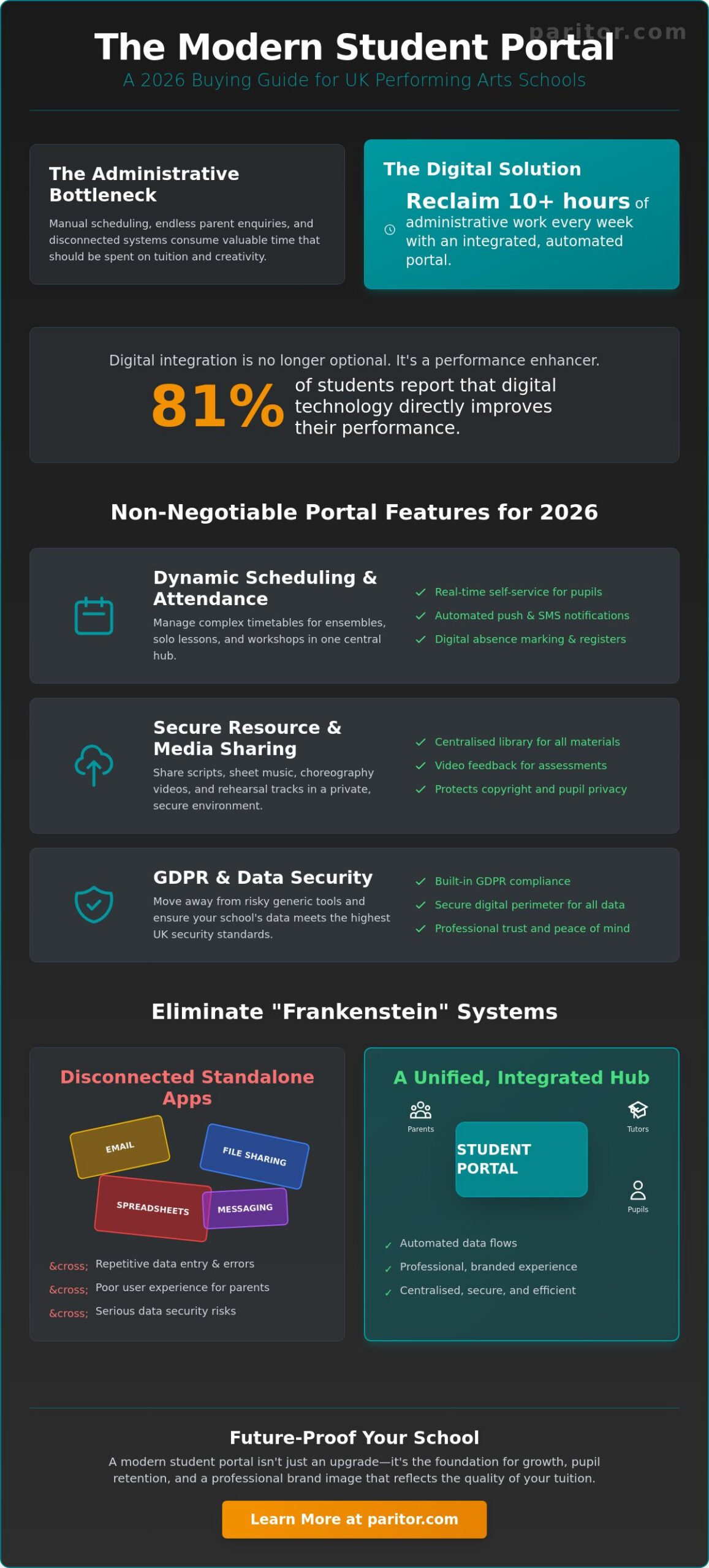
We understand that your focus should be on the stage and the studio, not on data entry or repetitive enquiries. In this 2026 buying guide, you’ll discover how to select a system that centralises student activity and automates the heavy lifting of school management. We will examine the essential features that drive growth, especially as 81% of students now report that digital technology directly improves their performance. You’ll learn how to move away from disconnected systems towards a unified hub that empowers both your teachers and your pupils whilst professionalising your brand.
Key Takeaways
- Learn why transitioning from manual registers to real-time self-service is essential for UK performing arts schools to remain competitive in 2026.
- Identify the non-negotiable features for a student portal for performing arts, from automated notifications to seamless resource sharing.
- Understand the operational risks of “Frankenstein” standalone apps and how integrated data flows eliminate repetitive office tasks.
- Master a phased rollout strategy that ensures a smooth transition for pupils whilst maintaining the highest standards of data security.
- Discover how a modular administrative hub allows you to scale your school’s capabilities without adding to your daily workload.
The Evolution of the Student Experience in Performing Arts
The landscape for UK performing arts schools has shifted dramatically. By 2026, digital infrastructure isn’t just a “nice-to-have”; it’s the backbone of a successful institution. We’ve moved away from the era of dog-eared paper registers and misplaced sheet music. Today, a student portal for performing arts serves as the central nervous system of your school, connecting tutors, pupils, and parents in a single, secure environment. This transition isn’t merely about digitising paperwork; it’s about creating a modern space where the creative and administrative aspects of learning coexist harmoniously.
The shift to real-time self-service is driven by a fundamental need for organisational efficiency. Research from March 2026 indicates that whilst 95% of artists recognise digital archiving, only a fraction have mastered the administrative side of digital integration. A robust Learning Management System or portal allows students to manage their own journeys. This autonomy isn’t just about convenience; it’s about long-term retention. When students have immediate access to their progress, upcoming rehearsals, and feedback, they feel a greater sense of ownership over their development.
Meeting the Expectations of Gen Z and Gen Alpha
Today’s pupils are “mobile-first” by nature. They don’t wait for a weekly lesson to receive feedback or practice materials. They expect self-service options where schedules and resources are available at a tap. This instant access keeps the momentum alive between rehearsals, ensuring that the creative spark doesn’t fade due to a lack of information. Motivation is a fragile thing; it thrives on clarity and accessibility. By providing these tools, you are meeting your students where they already live: on their devices.
Moving Beyond the “Login Page” Mentality
Differentiating between a basic file-share and a true interactive portal is crucial for your school’s prestige. A simple login page that leads to a messy folder of PDFs feels dated and unprofessional. Your student portal for performing arts should be a branded, seamless interface that reflects the excellence of your tuition. It acts as a digital centre for your community, fostering inclusion. Considering that 91% of performing artists believe technology is essential for reaching marginalised audiences, your portal becomes a tool for accessibility, ensuring every pupil has the same level of support. This professional polish builds trust with parents and reinforces your school’s standing as a forward-thinking leader in the arts.
Essential Features: A Buying Guide for Your Student Portal
Selecting the right student portal for performing arts requires looking beyond basic login screens. It involves finding a system that understands the unique, often non-linear rhythm of a creative school. Unlike generic educational software, a specialised portal must handle the specific chaos of rehearsals, the sensitivity of artistic resources, and the complexities of multi-disciplinary timetabling. A well-chosen system acts as a silent administrative partner, performing the heavy lifting so you can focus on tuition.
Dynamic Scheduling and Attendance Tracking
Scheduling in the arts is rarely static. You may manage a mix of large ensemble rehearsals, individual solo lessons, and intensive weekend workshops. A portal must offer dynamic updates that reflect these changes instantly. Automated push notifications or SMS alerts are essential; they prevent the need for manual emails when a drama rehearsal is moved or a tutor is delayed. Students should have the ability to mark absences or request lesson swaps directly through the interface, which automatically updates your central registers and keeps your records accurate without manual data entry.
Secure Resource and Media Sharing
Resource management is a critical pillar of artistic development. You need a secure environment to host choreography videos, rehearsal tracks, and scripts without infringing on copyright or compromising pupil privacy. Current research on technology-enhanced learning in the arts highlights how digital tools facilitate essential feedback loops. For instance, video feedback for dance or drama assessments allows students to review their performance alongside tutor notes. This creates a more immersive learning experience whilst ensuring that sensitive media remains within your school’s secure digital perimeter.
GDPR and Data Security Standards
In the UK, data security is a non-negotiable priority. Using non-specialised file-sharing sites or generic cloud storage for student data poses significant GDPR risks. Professional portals utilise UK-based hosting on robust platforms like Microsoft Azure to ensure high-level encryption and compliance. Managing student consent for photography, filming, and data usage should be an integrated feature, not a separate spreadsheet. This level of institutional safety builds trust with parents and protects your school’s reputation. Schools navigating the complexities of GDPR compliance for music schools UK will find that an integrated portal transforms data protection from a source of anxiety into a streamlined management framework. If you are looking to streamline these complex workflows, you might explore how our modular portals integrate these security features into your daily administration.
Finally, financial transparency is the key to reducing “chasing” enquiries. Parents should be able to view their full invoice history and payment status at any time. When billing information is accessible via the student portal for performing arts, it eliminates the repetitive “did you receive my payment?” phone calls that drain your office staff’s time.
Integrated Management vs Standalone Portals
A student portal for performing arts should never exist in isolation. Many organisations fall into the trap of building “Frankenstein” systems; a patchwork of disconnected apps, spreadsheets, and generic file-sharing sites. Whilst these standalone tools might seem cost-effective initially, they carry a heavy hidden cost in administrative hours and human error. When your student portal isn’t talking to your main database, your staff are forced to act as the manual bridge between the two, duplicating data and increasing the risk of mismatched records.
True efficiency comes from a single source of truth. In an integrated environment, data flows seamlessly from the administrative office directly to the student’s screen. When a rehearsal time is adjusted in the main system, the update reflects instantly in the portal. There is no need for a secondary update or a manual email blast. This deep integration ensures that every pupil, parent, and tutor is looking at the exact same information at the exact same time, eliminating the confusion that often plagues busy performing arts schools.
The Problem with Data Silos
Updating a timetable in two different places is a recipe for disaster. If a room change is recorded in your office spreadsheet but forgotten in a standalone portal, students will inevitably end up in the wrong place. These data silos create frustration for everyone involved. Xperios eliminates this risk by automatically syncing changes across the entire platform. Whether it’s a change in tutor, a rescheduled exam, or a new set of rehearsal notes, the information remains consistent across every touchpoint. This level of reliability is what transforms a simple app into a professional institutional tool.
Efficiency Gains for the Administration Team
The most immediate benefit of integration is the reclamation of time. Your team can stop answering “where is my lesson?” enquiries and start focusing on growth. By automating the distribution of online progress reports for students and exam results through the portal, you remove a massive manual burden from your end-of-term workflow. Linking portal activity directly to your music service management software creates a closed-loop system where attendance, resources, and communication are all handled by one industrious engine. This doesn’t just reduce paperwork; it empowers your staff to provide a higher level of support to your students without increasing their daily workload.
How to Implement a Portal Without the Administrative Headache
Adopting a student portal for performing arts doesn’t have to be an ordeal. The key lies in a structured, phased rollout that prioritises long-term stability over a rushed launch. Before you invite a single pupil to log in, you must ensure your underlying data is clean and your teachers are fully aligned with the new digital workflow. This preparation turns a potential headache into a smooth transition that empowers your entire community. Cleaning your data is the non-negotiable foundation; if your registers or contact details are out of date in your main database, those errors will simply be mirrored in the portal. It is far easier to fix these records in the back-end than to deal with login failures on launch day.
Step 1: Audit Your Current Administrative Processes
Start by identifying the most frequent enquiries that drain your office staff’s time. If you’re constantly answering questions about rehearsal times or lost sheet music, these should be the first functions you automate. Mapping how information moves through your school allows you to spot bottlenecks and data silos. The audit phase is the critical first step for 2026 implementations, providing the blueprint for a system that truly serves your unique organisational needs. By understanding the current flow of data, you can configure the portal to act as a proactive solution rather than just another digital tool to manage.
Step 2: Onboarding and User Training
Success depends on user adoption. Create simple “how-to” guides that help students navigate the interface with ease. It’s equally vital to empower your teachers; they should feel confident uploading resources directly to the portal rather than relying on the office. This distributed workload is what makes the system truly scalable and efficient. Your administrative team should act as facilitators during this period, providing support whilst the new digital habits take root amongst your staff and students alike. When teachers see the relief of not having to resend the same rehearsal track ten times, they become your strongest advocates for the system.
Step 3: Monitoring Engagement and Feedback
Once the portal is live, use built-in analytics to see which resources are being accessed most frequently. This data provides invaluable insight into student behaviour and learning needs. Gather feedback from your pupils to refine the user experience and adjust settings to find the right balance between student autonomy and administrative oversight. Setting clear expectations from day one is essential; let parents and students know that the portal is now the primary hub for all school communication. This consistency reduces the temptation for people to revert to old, manual habits. If you’re ready to start this journey, you can book a consultation to see how Xperios simplifies implementation.
Future-Proofing Your School with Xperios Student Portal
The Xperios platform represents the culmination of decades spent within the UK music and performing arts sector. We don’t just build software based on developer assumptions; we build it on the lived experiences of school leaders and tutors. A student portal for performing arts should grow alongside your organisation. Our modular philosophy allows you to start with what you need today and expand tomorrow. Whether you require Ensemble management, Instrument tracking, or a comprehensive Financial module, each component integrates seamlessly into your central hub. This industrious engine works behind the scenes, providing a stable and professional presence in the cloud that pupils and parents can rely on.
Security and reliability are the cornerstones of our infrastructure. By utilising high-level cloud standards, we ensure your data remains redundant and protected against the unexpected. This professional foundation does more than just secure information; it elevates your school’s brand. When parents log in to a sleek, functional environment to manage their child’s artistic journey, it reinforces the quality of your tuition. The Paritor promise is simple: we perform the labour-intensive tasks so you can focus on the creative mission that defines your school.
Built Through Direct User Collaboration
Our development process is a partnership. User feedback directly shapes every feature of our student portal, ensuring the tools we provide solve real-world administrative frustrations. We remain deeply committed to the UK performing arts and music service sector, constantly evolving our platform to meet new regulatory and educational standards. Many organisations have already transformed their daily operations by adopting Xperios, moving from fragmented paperwork to a unified digital centre. These success stories are built on a system that prioritises the user’s time and the student’s experience above all else.
Ready to Modernise Your Student Experience?
There has never been a better time to upgrade your school’s digital infrastructure. As we move through 2026, the expectation for seamless, self-service access is only increasing. Investing in a scalable, professional management system provides long-term value that far outweighs the cost of manual inefficiency. You can reclaim your evening hours and restore focus to your students by choosing a platform built for your specific needs. Take the next step in your professional journey and discover how Xperios can organise your student portal today.
Reclaiming Your Focus for Artistic Excellence
Transitioning to a digital-first model is about more than just software; it’s about restoring the balance between your creative mission and administrative necessity. By moving away from disconnected “Frankenstein” apps and adopting a centralised student portal for performing arts, you eliminate the data silos that lead to scheduling errors and wasted hours. We’ve explored how a modular, integrated system empowers your pupils whilst providing the professional polish your school deserves. This shift doesn’t just reduce your workload; it builds a stronger, more engaged community of performers.
With over 30 years of industry experience and a platform securely hosted on Microsoft Azure, Paritor is the trusted partner for leading UK music services and performing arts schools. We understand the unique pressures of arts management and have built our tools to perform the heavy lifting for you. It’s time to stop chasing paperwork and start focusing on the stage. Your school’s future is digital, and we are ready to help you lead the way with confidence and ease.
Explore Xperios for Performing Arts and start your digital transformation
Frequently Asked Questions
What is a student portal for performing arts and why does my school need one?
A student portal for performing arts is a secure, centralised digital hub that connects your school’s administration directly with pupils and parents. Your school needs one to eliminate the repetitive labour of manual scheduling and the risk of data silos. By providing a single point of access for registers, resources, and communication, you professionalise your brand and reclaim hours of administrative time every week.
Can a student portal help with BTEC or Trinity exam preparation?
Yes, the portal is an ideal tool for syllabuses like BTEC, Trinity, or ABRSM. Teachers can upload specific rehearsal tracks, digitised scripts, and performance videos directly to the relevant pupil groups. This ensures students have 24/7 access to the exact materials they need for their assessments, fostering a more disciplined and independent approach to practice between sessions.
Is student data safe in a cloud-based portal?
Student data is highly secure when hosted on robust, UK-based cloud infrastructure such as Microsoft Azure. These platforms provide enterprise-level encryption and redundancy, ensuring your school remains compliant with GDPR regulations. Unlike generic file-sharing sites, a dedicated portal is designed specifically to handle sensitive pupil information and parental consent with the highest level of institutional safety.
How much does it cost to implement a student portal for a performing arts school?
Implementation costs typically depend on the size of your organisation and the specific modules you choose to activate. Most professional systems offer a scalable structure, ranging from entry-level versions for smaller studios to comprehensive enterprise solutions for large music services. This modular approach allows you to invest only in the features you need, ensuring the system grows alongside your school’s enrolment.
Will a student portal work on mobile phones and tablets?
Modern portals are designed with a mobile-first mindset to suit the habits of today’s students. The interface is fully responsive, meaning it works seamlessly on smartphones, tablets, and desktop computers. This accessibility ensures that pupils can check their rehearsal schedules or review choreography videos whilst on the move, keeping them engaged with their studies outside the classroom.
Can I manage instrument loans and hire through the student portal?
You can certainly manage instrument loans by integrating specific modules like Xperios Instrument Management. This allows the portal to track the location, condition, and hire history of your inventory. Students or parents can view their current loans and return dates directly through their login, which reduces the administrative burden of manual tracking and chasing overdue equipment.
How do I encourage students and parents to actually use the portal?
The most effective way to drive adoption is to make the portal the “single source of truth” for your school. Stop sending schedules or resources via email and instead host them exclusively on the platform. Once parents and students realise that the portal is the only place to find real-time updates and essential materials, they will naturally incorporate it into their weekly routine.
Does a portal integrate with my existing accounting or invoicing software?
Integration is a core feature of a professional student portal for performing arts. It allows your school to link student activity directly with financial modules for seamless invoicing and payment tracking. This connectivity ensures that when a student enrols in a new ensemble or requests a lesson swap, the change is reflected in your accounting records without the need for manual data entry.