

What if the hours you spend chasing late payments and tracking down lost violins across different school locations could be reclaimed for actual music education? It’s a common frustration for music hub managers who want to focus on tuition and ensembles but find themselves buried in spreadsheets and manual data entry. You likely feel that administrative friction does more than just waste time; it creates a professional barrier between your services and the families you support. Choosing the right cloud-based software for music hubs is the first step in removing that barrier.
This 2026 guide explores how modern systems can transform these burdens into a streamlined, automated ecosystem. You will discover how a centralised system provides real-time access to pupil data whilst ensuring total UK GDPR compliance and robust security. We’ll preview the shift towards automated billing that reduces late payments and show how professional portals can restore your focus to the art of teaching. It’s time to evolve with software that does the hard work, so you don’t have to.
Key Takeaways
- Understand the shift from local servers to centralised platforms and why real-time accessibility is vital for peripatetic staff.
- Discover how to automate tedious billing tasks and manage complex group tuition through a single, integrated system.
- Learn to compare the total cost of ownership for cloud-based software for music hubs against the hidden maintenance costs of legacy hardware.
- Explore the security benefits of Microsoft Azure hosting to ensure your hub remains fully compliant with UK GDPR standards and data protection laws.
- Identify how a modular system allows you to evolve your administration at your own pace, paying only for the specific features your service requires.
What is Cloud-Based Software for Music Hubs?
At its simplest, cloud-based software for music hubs is a centralised digital environment designed to handle the intricate, multi-location workflows of modern music services. Unlike traditional systems that tether you to a specific office computer, this technology uses cloud computing to make every piece of data accessible through a web browser. It represents a move away from the data silos of the past towards a unified ecosystem where tuition, instrument loans, and billing coexist seamlessly.
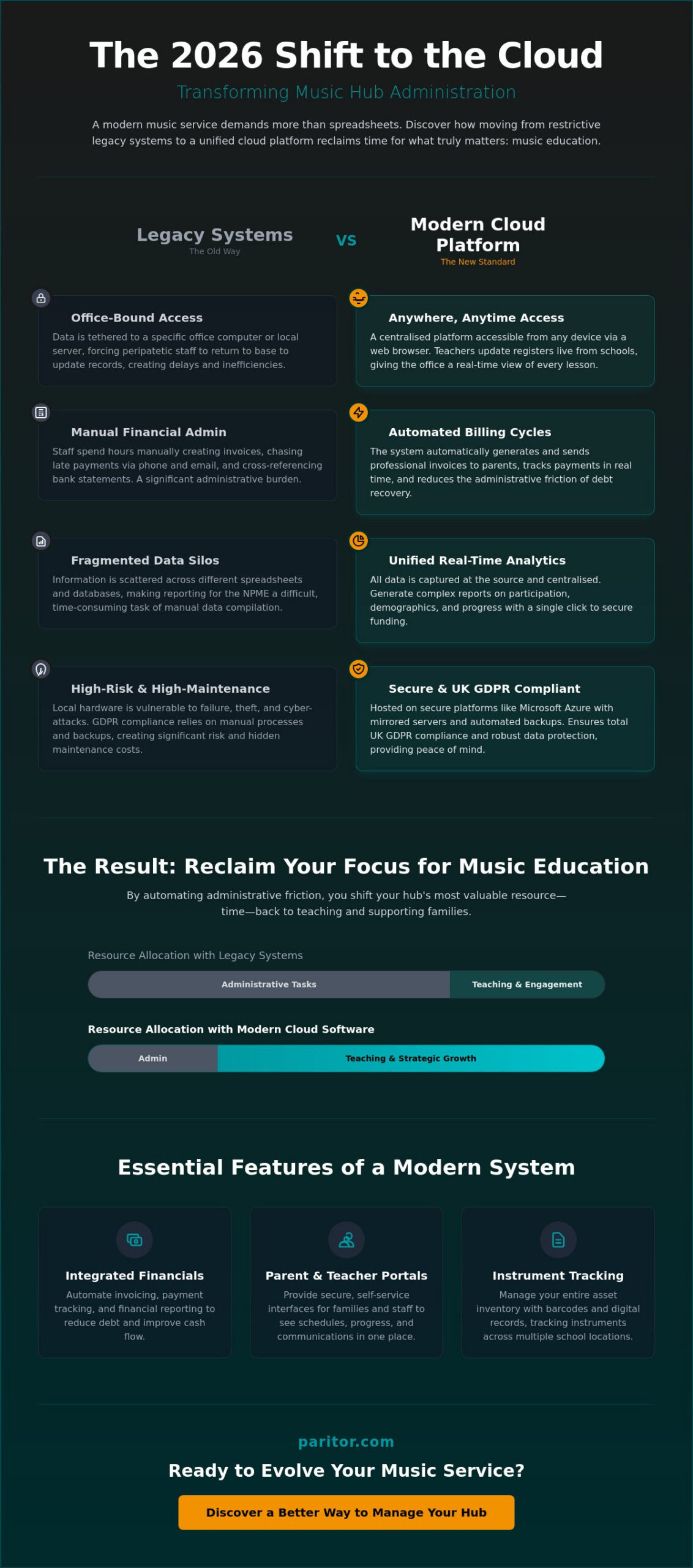
The transition from local servers to Software as a Service (SaaS) represents a fundamental shift in how music hubs operate. For peripatetic teachers moving between fifteen different schools a week, having to return to a central office just to update an attendance register is an outdated burden. Modern cloud systems allow these educators to log in from any device, ensuring that the central office has a live view of every lesson as it happens. This evolution isn’t just about convenience; it’s about office efficiency. It’s software that does the hard work, so you don’t have to.
As we move through 2026, the National Plan for Music Education (NPME) sets high standards for reporting and accessibility. To meet these requirements, hubs must demonstrate clear progress and participation data across diverse demographics. A cloud-based model makes this reporting effortless by capturing data at the source. This allows managers to generate complex reports with a single click, providing the transparency needed to secure future funding and support.
The Core Components of a Hub Management System
A robust system like Xperios is built on modularity. You might start with a core lesson scheduling module to manage individual tuition and ensembles, then add Xperios Financial Management for automated billing and invoicing. These components are tied together by secure interfaces, such as the Xperios Teacher Portal and Xperios Parent Portal. These portals ensure that everyone, from the office manager to the family at home, sees the same real-time information, reducing the need for endless phone calls and emails.
Why Cloud Accessibility is Essential in 2026
In 2026, the office is wherever your teachers are. Real-time attendance tracking is no longer a luxury; it’s a safeguarding and financial necessity. Cloud systems provide peace of mind through mirrored servers, meaning your pupil data is backed up automatically and remains safe even if local hardware fails. As your hub grows or joins a larger multi-academy trust, a cloud platform scales with you effortlessly. This ensures your administrative capacity never limits your educational reach or the quality of the family experience.
Essential Features for Modern Music Hub Administration
Modern administration is defined by its ability to turn fragmented data into decisive action. When selecting cloud-based software for music hubs, the priority should be on features that actively reduce the tedious workload of your office team. It isn’t just about storing names and addresses; it’s about creating a system where comprehensive tuition management for individual and group lessons happens effortlessly. Research into CRM in small arts organizations highlights how integrated systems allow for better relationship management and strategic growth by centralising information that was previously scattered. This allows your team to move away from reactive firefighting and towards proactive, data-driven planning.
Automated financial reporting is a cornerstone of this modern approach. Instead of manually cross-referencing bank statements, cloud systems track revenue and late payments in real time. This allows for automated billing cycles that send professional invoices directly to parents, significantly reducing the administrative friction of debt recovery. By utilising integrated communication tools, hubs can move away from manual emailing. Updates regarding ensembles or term dates are triggered automatically based on your database, ensuring families stay informed without adding to your daily to-do list.
Real-time analytics provide the final piece of the puzzle. By having an instant overview of participation rates and demographic data, you can make strategic decisions that align with your educational goals. This level of insight ensures that every pound is spent where it will have the most impact on pupil outcomes.
Instrument Inventory and Asset Tracking
Managing a vast collection of violins, cellos, and brass instruments across multiple school locations is a logistical challenge that many generic systems ignore. A dedicated module for instrument management allows you to track every asset through barcodes and digital loan agreements. This ensures that maintenance schedules are never missed and that the lifecycle of expensive assets is maximised. It’s about having a clear, real-time view of where every instrument is, reducing loss and ensuring your hub’s resources are always working for the pupils.
The Power of Integrated Portals
The true value of a modern system lies in its ability to connect people. Teacher portals allow tutors to manage their favourite ensembles and registers from their own devices, whilst parent portals simplify the payment process and provide instant access to progress reports. This creates a professional family experience that reflects the quality of the tuition you provide. If you’re looking to modernise your music service, focusing on these integrated touchpoints is essential for building long-term engagement and trust with your community.
Comparing Cloud Platforms vs. Legacy Systems
Choosing between a legacy server and modern cloud-based software for music hubs is a choice between stagnation and evolution. Legacy systems often hide their true cost behind a veil of physical maintenance, electricity for cooling, and the constant need for manual security patches. In contrast, a cloud subscription shifts the burden of infrastructure to the provider. This move transforms unpredictable IT expenses into a manageable, transparent operating cost that includes automatic updates and world-class security as standard. It allows your budget to focus on instruments and education rather than server hardware.
Reliability is another area where the cloud outshines the old-school server room. A local backup is only as good as the last time someone remembered to run it; a mirrored cloud server, however, ensures your data is duplicated in real time across multiple secure locations. Most modern SaaS providers offer high uptime SLAs (Service Level Agreements), guaranteeing that your tuition and billing data is available whenever you need it. This stability provides institutional safety that a standalone office PC simply cannot match. You gain the peace of mind that comes from knowing your data is protected by the same level of technology used by global financial institutions.
User experience also plays a vital role in office morale. Legacy interfaces are often clunky and require extensive staff training to navigate. Modern cloud platforms prioritise intuitive design, which significantly reduces the time it takes for new team members to become productive. This ease of use is a direct result of software built on valuable feedback from the people who use it every day. When the interface feels familiar and simple, the “tedious” tasks of administration start to feel effortless.
Efficiency Gains in the Office
The transition to a centralised system allows hubs to report a reduction in manual data entry by up to 70% through clever automation. By eliminating “data silos,” where information is trapped in separate spreadsheets or paper files, you ensure that a change made in one module reflects across the entire organisation instantly. Cloud software creates office efficiency by acting as a single source of truth that connects every administrative process in one central location.
Supporting Collaborative Workflows
In 2026, the office is a fluid concept. Cloud systems ensure that administrators and peripatetic teachers stay synchronised whilst working remotely, with registers and student notes updating instantly on a central dashboard. Managing multiple school locations becomes a simple task rather than a logistical nightmare. For the finance team, integrating with third-party accounting software ensures that revenue data flows smoothly from the parent portal to your ledgers without a single manual keystroke. This is software that does the hard work, so you don’t have to.
Implementation, Security, and GDPR Compliance
Protecting sensitive pupil data is a non-negotiable responsibility for any modern educational institution. When you choose cloud-based software for music hubs, the underlying infrastructure is just as important as the user interface. Hosting on Microsoft Azure provides world-class security that small, local servers simply cannot match. This enterprise-grade platform ensures that your data is protected by multi-layered security protocols and advanced threat detection. It’s about providing institutional safety so you can focus on teaching.
Compliance with the UK GDPR and the Data Protection Act 2018 is a core requirement for music hubs in 2026. This includes robust data processing agreements and ensuring all information is stored and processed within high-security environments. By using an accredited system, you ensure that every student record and financial transaction is handled with the highest level of professional care. This isn’t just about ticking a box; it’s about the peace of mind that comes from a dedicated partner who understands the legal landscape. We’ve built our systems to ensure that compliance is a natural outcome of your daily routine, not an extra burden.
The transition to a new system often feels daunting. You might worry about losing years of valuable history trapped in old spreadsheets or legacy databases. A professional implementation process includes a structured data migration that cleanses and organises your records as they move. You can expect a dedicated SLA (Service Level Agreement) that guarantees high uptime and provides ongoing support. This ensures that your office efficiency remains high from day one. It’s software that does the hard work, so you don’t have to.
Data Security and Peace of Mind
Data security is built on layers of protection. This includes encrypted data transfers and secure user authentication to prevent unauthorised access. Mirrored servers are essential; they ensure that if one hardware component fails, another instantly takes over without any loss of data. Regular security audits and adherence to accredited software standards provide the final layer of institutional safety, ensuring your hub remains a secure environment for all users.
Streamlining the Transition
Modernisation should improve your daily routine, not complicate it. Migrating from legacy databases can be a smooth process when managed by experts who understand the specific workflows of a conservatoire or music hub. You can customise modules to fit your unique needs, from ensemble management to financial reporting. Training staff to embrace these new tools is the final step in your journey to evolve. If you’re ready to start this journey, you can book a consultation with our team to discuss your specific migration needs.
Evolving Your Music Service with Xperios
Xperios isn’t just a digital tool; it’s a reflection of the music education sector’s collective experience. Over several decades, we’ve listened to the specific challenges faced by hub managers, ensemble leaders, and peripatetic tutors. This continuous feedback loop has allowed us to refine our cloud-based software for music hubs to address real-world administrative friction. By choosing a system designed by people who understand the difference between a complex peripatetic schedule and a standard classroom timetable, you ensure your organisation is built on a foundation of genuine industry expertise.
One of the most significant advantages of the Xperios platform is its modular nature. We understand that every music service is unique; some may require intensive instrument management whilst others focus heavily on large-scale ensemble coordination or private tuition. This modularity means you only pay for the features you actually use. Whether you need the Xperios Financial Management module to handle automated billing or the Xperios Exams and Assessments Module to track student progress, you can scale your system to match your current needs and budget. It’s an adaptable approach that allows your hub to grow without being weighed down by unnecessary costs or complexity.
Positioning your hub as a forward-thinking institution is essential in 2026. Families expect a professional, seamless digital experience that matches the high quality of the music education you provide. Transitioning to a centralised, cloud-based system signals to parents, schools, and local authorities that your service is modern, secure, and efficiently managed. It moves your administration out of the shadows and turns it into a professional asset that supports every student’s journey.
A Partner in Music Education
At Paritor, we see ourselves as more than just a software provider. We act as an Expert Facilitator, providing the hard-working technological engine that allows your teaching staff to shine. Our commitment to the sector means we provide regular updates that reflect changing educational standards and valuable user feedback. This proactive approach ensures your hub stays ahead of the curve. For a deeper dive into the strategic landscape of the sector, you can read The Complete Guide to Music Service Management Software in 2026. We are here to ensure your transition to a modern system is smooth, stable, and rewarding.
Ready to Modernise?
The transition to a digital-first approach is about more than just office efficiency; it’s about reclaiming your mission. By reducing the tedious tasks of administration through intelligent automation, you can redirect your most valuable resources back to where they belong: with the pupils. A modern parent portal and streamlined communication tools don’t just save time; they enhance the reputation of your hub amongst the community you serve. It’s time to stop fighting with spreadsheets and start focusing on the art of teaching. You can Evolve your music hub with Xperios today by requesting a personalised consultation to see our software that does the hard work, so you don’t have to.
Evolve Your Administration for the Future
Modernising your music service is about more than just digital storage; it’s about creating a unified ecosystem that empowers your team. By adopting cloud-based software for music hubs, you eliminate the friction of manual data entry and fragmented records. We’ve explored how centralised billing reduces late payments and how secure portals improve the family experience. These tools provide the institutional safety you need whilst restoring your focus to the art of teaching.
Xperios by Paritor is built on 30 years of valuable industry feedback and is hosted on secure Microsoft Azure infrastructure. It’s a platform trusted by leading UK music hubs and conservatoires to handle the complex logistics of modern music education. Our modular approach ensures you only pay for the features you need, providing a scalable solution that grows with your organisation. It is software that does the hard work, so you don’t have to.
Ready to reclaim your time and prioritise education over paperwork? Evolve your music hub administration with Xperios today and join a community of forward-thinking educators. We’re here to support your journey every step of the way.
Frequently Asked Questions
Is cloud-based software secure enough for sensitive student data?
Cloud-based platforms are often far more secure than traditional local servers. By hosting data on Microsoft Azure, we provide enterprise-grade protection that includes multi-layered security protocols and advanced threat detection. Your sensitive pupil data is protected by encrypted transfers and secure user authentication. This infrastructure ensures institutional safety; it allows your staff to focus on education rather than worrying about hardware vulnerabilities or manual security patches.
How does cloud software help with instrument inventory management?
Modern systems use dedicated modules to track every violin, cello, or brass instrument through unique barcodes and digital loan agreements. You can monitor repairs and maintenance schedules across multiple school locations from a single dashboard. This level of oversight reduces asset loss and extends the lifecycle of expensive musical equipment. It’s software that does the hard work, ensuring your hub’s resources are always working for the pupils.
Can we integrate our existing accounting tools with a music hub system?
You can effortlessly link your financial workflows with leading payment gateways. Xperios integrates with Worldpay, Stripe, and Sage Pay to ensure that revenue data flows smoothly from the parent portal to your ledgers. This eliminates the need for manual data entry and reduces the risk of human error. For organisations with unique requirements, custom integrations are also possible, ensuring your cloud-based software for music hubs fits perfectly into your administrative ecosystem.
What are the main benefits of a parent portal for music services?
A parent portal provides a professional, centralised touchpoint for families to manage their child’s music journey. Parents can settle invoices through integrated systems like Schooble Pay, view real-time progress reports, and update contact details without calling the office. This transparency significantly improves the family experience and reduces late payments. It empowers parents to stay engaged with their child’s learning whilst removing the tedious task of manual communication for your staff.
How long does it typically take to implement a new cloud-based management system?
The implementation timeline varies based on your hub’s size and the complexity of your current records. A structured onboarding process typically includes data migration to move your history from legacy spreadsheets into the new centralised system. We also provide dedicated training to ensure your team is confident using the new modules. This transition is managed by experts who understand your specific workflows, ensuring your office efficiency remains high from the very first day.
Does the software support peripatetic teachers who work across multiple locations?
Mobile accessibility is a core feature for modern peripatetic staff. Teachers can manage registers and lesson notes on the move using dedicated apps for iOS (requires version 15.0 or later) and Android. This allows for real-time attendance tracking across fifteen or more school locations without the need to return to a central office. It ensures that the administration team always has an up-to-date view of tuition activity, regardless of where the teacher is working.
What happens if our internet connection goes down whilst using the software?
If your office connection fails, you can still access your data through mobile networks on smartphones or tablets. Because the system is cloud-based, your information is stored on mirrored servers rather than a single local machine. This means your data is always safe and backed up automatically in the background. Once your connection is restored, any updates made via mobile devices synchronise instantly with the central hub database to maintain a single source of truth.
Is the software compliant with current UK GDPR regulations for 2026?
All cloud-based software for music hubs used in the UK must adhere to the UK GDPR and the Data Protection Act 2018. Our systems are built to meet these 2026 standards, including robust data processing agreements and secure storage within the UK or EU. We conduct regular security audits to ensure compliance is a natural part of your daily routine. This provides the institutional safety required to protect sensitive student information and financial records.