
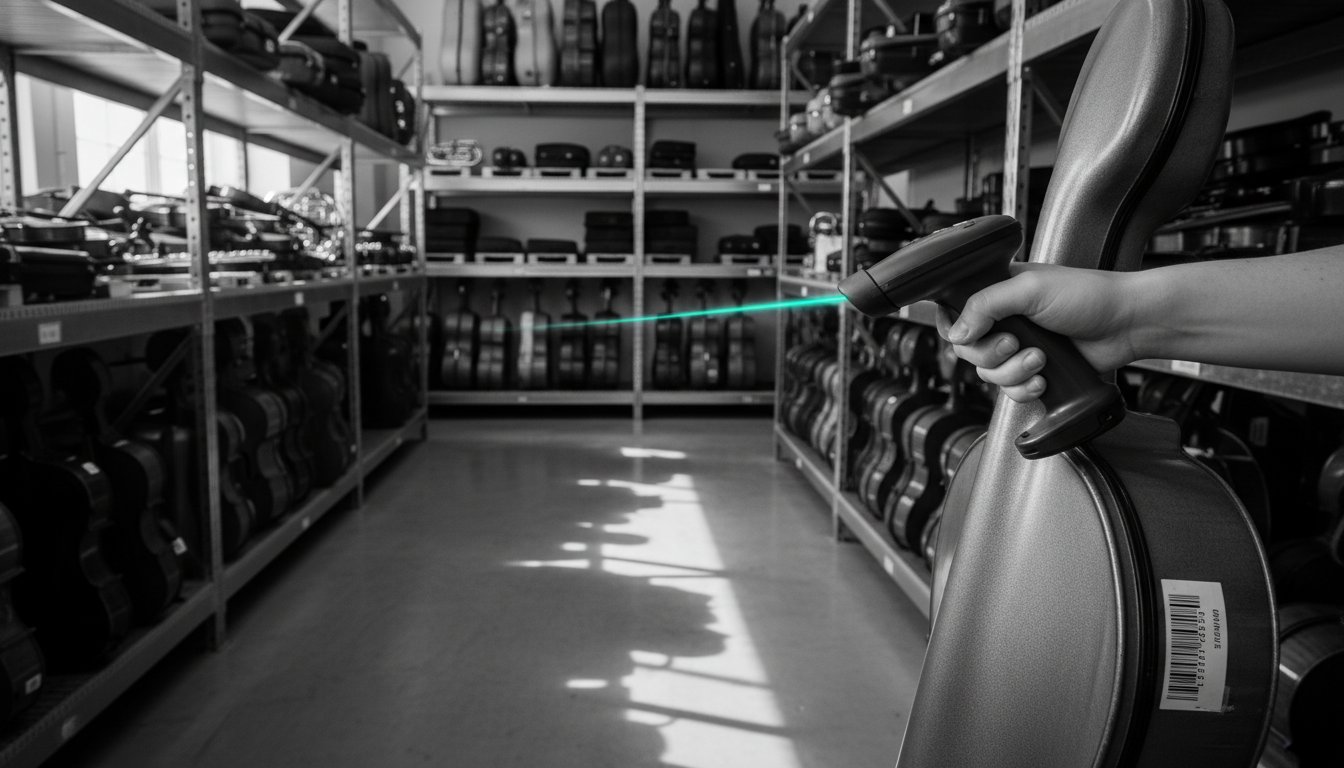
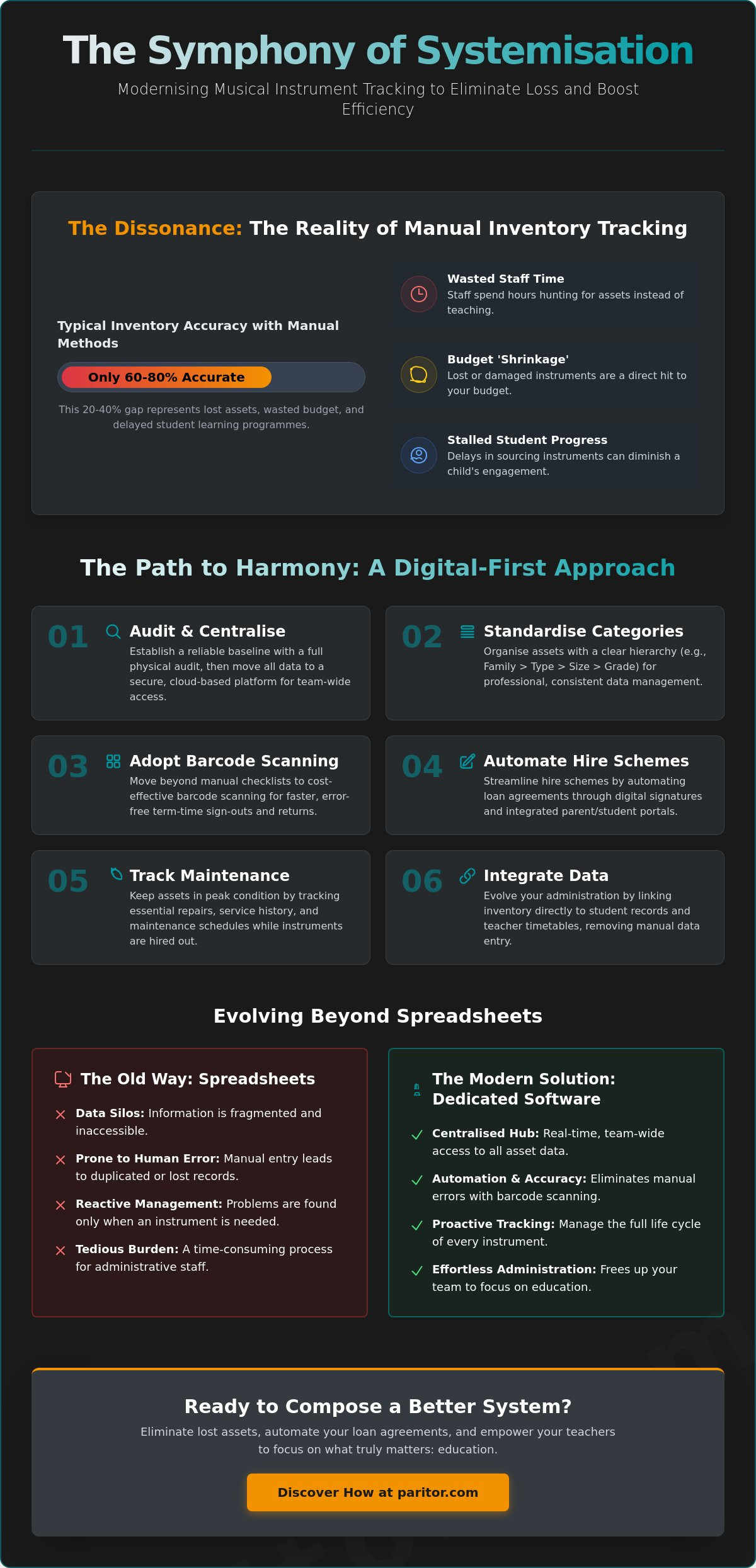
Imagine the start of a new term where you aren’t dreading the stocktake. Instead of staring at a spreadsheet that says you have forty violins whilst the cupboard only holds thirty-two, you have total clarity. For many music services, the reality is often less harmonious; manual instrument inventory tracking methods typically achieve only 60 to 80 per cent accuracy. This leaves staff to hunt for missing assets instead of focusing on the art of teaching.
We know that the administrative burden of managing a hire scheme can feel like a tedious, full-time job. It’s frustrating when ‘missing’ instruments drain your budget and manual audits pull your team away from the classroom. You deserve a system that does the hard work, so you don’t have to. In this guide, you’ll learn how to build a robust, digital-first tracking system that eliminates lost assets and automates your loan agreements. We will preview how a centralised view of your assets improves student accountability and ensures your programme runs smoothly from day one.
Key Takeaways
- Establish a reliable baseline for your musical assets by following a structured physical audit and adopting a standardised categorisation system.
- Discover why modern instrument inventory tracking requires moving beyond manual checklists to cost-effective barcode scanning for faster term-time sign-outs.
- Streamline your hire schemes by automating loan agreements through digital signatures and integrated portals to ensure accountability amongst parents and students.
- Keep your assets in peak condition by tracking essential repairs and maintenance schedules whilst instruments are out in the field.
- Evolve your administration by linking your inventory directly to student records and teacher timetables, removing the hard work of manual data entry.
What is Instrument Inventory Tracking and Why is it Essential?
Instrument inventory tracking is the systematic process of recording, monitoring, and managing the location, condition, and status of every musical asset in your collection. It is much more than a simple list of serial numbers. A modern tracking system provides a dynamic record of an instrument’s journey, from the moment it enters your stores to its sign-out by a student and its eventual return for maintenance. By using dedicated inventory management software, music services can move away from the chaos of paper files and embrace a digital-first approach that ensures no asset is ever truly ‘missing’.
Modern music services are evolving. They’re shifting from reactive ‘finding’ missions, which usually occur only when a student needs an instrument, toward proactive tracking. This proactive stance ensures you aren’t just reacting to gaps in your stock but actively managing the life cycle of every violin, trumpet, and drum kit. When you have a real-time view of your assets, you can make informed decisions about procurement and repairs before a crisis occurs.
Many organisations still rely on complex spreadsheets to manage their hire schemes. Whilst they might seem like a cost-effective starting point, they quickly become a tedious burden for growing hubs. Spreadsheets often lead to data silos where only one person knows the ‘true’ status of the stock. This lack of transparency leads to human errors, duplicated records, and missed return deadlines. The core goal of effective instrument inventory tracking is simple: ensuring that every pupil has immediate access to a high-quality, well-maintained instrument so their musical journey can begin without delay.
The Financial Impact of Poor Inventory Management
Missing instruments represent more than just a gap in the cupboard; they’re a direct hit to your budget. ‘Shrinkage’, which is the loss of assets through theft, damage, or poor record-keeping, can cost music services thousands of pounds every term. Accurate tracking protects your capital investment and demonstrates professional stewardship of public resources. When you can prove your assets are well-managed and accounted for, you’re in a much stronger position to secure future funding from local authorities or arts councils. The Total Cost of Ownership for a student violin or cello includes the initial purchase price, insurance premiums, and the cumulative cost of annual bridge adjustments, string replacements, and bow rehairing over its ten-year life cycle.
The Educational Cost of Missing Instruments
Administrative delays in hire schemes do more than just frustrate the office team; they stall student progress. If a child has to wait several weeks into the term for their instrument to arrive, their initial spark of engagement often fades. Having ‘ready-to-play’ stock available for new term intakes is vital for maintaining momentum in tuition. Centralising asset data also lifts the burden from peripatetic teachers. They should be focused on the art of teaching, not acting as amateur detectives trying to track down a missing flute amongst their pupils.
How to Organise Your Musical Instrument Inventory from Scratch
Establishing a reliable baseline is the first hurdle in modernising your music service. You can’t track what you haven’t properly identified. Conducting a comprehensive physical audit might feel like a tedious task, but it’s the only way to ensure your instrument inventory tracking starts with absolute accuracy. This process involves opening every cupboard and checking every storeroom to record the exact make, model, and condition of every asset you own. Once you have this baseline, you can move away from reactive ‘finding’ and toward a proactive, digital-first management style.
After the audit, the next step is to centralise your data. Relying on paper files or local spreadsheets creates silos that hinder efficiency. By moving your records to a secure, cloud-based platform, your entire team gains real-time access to the collection. This visibility is essential for coordinating hire schemes across multiple schools or hubs. If you’re looking for a way to simplify this transition, our Xperios Instrument Management module is designed to handle the heavy lifting of data organisation for you.
Creating a Taxonomy for Musical Assets
A standardised categorisation system is the backbone of any professional inventory. You should organise your assets using a clear hierarchy: Family, Type, Size, and Grade. For example, a entry might look like: Strings > Cello > 3/4 > Beginner. This structure allows staff to filter stock effortlessly when a student needs a specific instrument. It’s also vital to track ‘kit’ components, such as cases, bows, and mouthpieces, as a single unit to prevent parts from going missing. You should also define clear status categories, such as ‘In Stock’, ‘On Loan’, ‘In Repair’, or ‘Retired’, to maintain a clear picture of your operational capacity. Many educators find that refining these categories is a key part of successful instrument inventory management for band programs and wider music services.
Assigning Unique IDs and Asset Tags
Whilst every instrument has a manufacturer serial number, these are often insufficient for large-scale instrument inventory tracking. Serial numbers can be long, difficult to read, or even duplicated across different brands. Instead, assign each asset a unique, internal ID that follows a logical naming convention. A code like ‘VN-44-001’ (Violin, 4/4 size, number 1) is much easier for non-technical staff to understand at a glance. Use durable, weather-resistant asset tags for physical identification. For high-value items, you might even consider discreet internal markings. These physical tags, when linked to your digital system, turn a manual sign-out process into a quick, professional transaction that students and parents respect.
Choosing the Right Technology for Tracking and Auditing
Selecting the right tools for instrument inventory tracking is what transforms a chaotic office into an efficient hub. Whilst some organisations might feel that free apps or paper checklists are ‘good enough’, these methods often buckle under the pressure of a growing music service. Manual checklists are prone to human error and offer no real-time visibility across multiple sites. In a modern performing arts environment, you need technology that scales with your ambition and provides a stable foundation for your hire scheme.
Barcode scanning remains a popular and cost-effective solution for speeding up sign-outs. It’s a reliable middle ground between manual entry and high-cost RFID systems. Barcode systems can achieve 95 to 98 per cent accuracy, which is a significant leap from the 60 per cent often seen with manual methods. QR codes are also gaining popularity because they’re easy to generate and scan with standard mobile devices. For high-value orchestral assets, RFID systems can reach over 99 per cent accuracy. Although the initial investment is higher, the automation and speed they provide are unmatched for large-scale facilities.
Cloud-based accessibility is non-negotiable for peripatetic teachers. They are often on the move between schools and hubs and need to check asset status from their mobile devices. On-premise systems create bottlenecks by locking data in a single office. A cloud-first approach ensures that information is available wherever the music is happening. This real-time connectivity allows your team to work smoothly without being tied to a desk.
The Benefits of Barcode Integration
The first week of term is notoriously stressful for administrative teams. Barcode integration turns the ‘Mass Sign-Out’ process into a smooth, professional operation. Instead of typing long serial numbers, staff simply scan a tag to link an instrument to a student record. This mobile scanning technology virtually eliminates data entry errors. It also facilitates rapid annual audits. You can scan instruments in their current school location without needing to transport every cello to a central hub, which saves your team hours of physical work.
Security, GDPR, and Cloud Reliability
Security is often overlooked when searching for simple tools, but for UK music services, GDPR compliance is a legal necessity. You aren’t just tracking brass and wood; you’re managing sensitive student and parent data. We ensure that every piece of information linked to your instruments is stored on secure platforms like Microsoft Azure. This architecture provides peace of mind through accredited data security standards. Our infrastructure uses mirrored servers to guarantee high uptime, which is essential for services operating across multiple sites. We do the hard work of managing technical compliance so you can focus on tuition.
Managing the Instrument Hire Life Cycle Effortlessly
Managing the life cycle of a musical asset involves much more than a simple barcode scan. It’s about the ongoing relationship between the music service, the student, and the instrument. Effective instrument inventory tracking ensures that this relationship remains transparent and professional from the first lesson to the final return. When you automate the tedious administrative tasks involved in a hire scheme, you create room for what really matters: high-quality music education. Digital systems do the hard work of record-keeping, allowing your team to focus on supporting young musicians.
The return process at the end of a term often creates an administrative bottleneck. Automated reminders sent via email or SMS prompt parents to return instruments on time, reducing the need for manual follow-ups. Condition reporting upon return helps you identify which assets need immediate attention before they are hired out again. Over time, your tracking data becomes a valuable planning tool. You can identify which brands of clarinets require the most frequent repairs or which sizes of cellos are in highest demand. This insight allows you to plan future procurement and budget more effectively based on real-world usage patterns.
Streamlining Sign-Outs and Hire Agreements
Paper forms are easily lost and difficult to file. By moving to digital loan agreements, you establish clear accountability from day one. Parents can sign agreements through a dedicated portal, which immediately links the specific instrument to their student record. Integrating these hire charges directly with your music service management software ensures that billing is accurate and automated. You can also set automated alerts for expiring loan periods or overdue returns. This proactive approach ensures that your collection stays in circulation rather than sitting forgotten in a student’s home.
Maintaining Instrument Health and Safety
Instruments ‘in the field’ are subject to constant wear and tear. A robust system allows you to track instrument repairs and maintenance in real time. You can record every bridge adjustment or valve oiling, creating a complete digital history for every asset in your collection. For electronic equipment, scheduling routine PAT testing is a vital safety requirement that shouldn’t be left to chance. A comprehensive maintenance log is vital for insurance claims and asset valuation because it provides a documented history of the care and investment made into each instrument. If you want to simplify your hire life cycle today, our Xperios Instrument Management module offers the tools you need to manage your assets with total confidence.
Evolving Your Administration with Integrated Instrument Management
Standalone inventory tools often create more hard work than they solve. When your asset list lives in a separate app from your student records, you’re forced to duplicate data manually. This creates silos. It leads to errors. True instrument inventory tracking should be an invisible part of your daily workflow, not a separate chore that requires constant attention. By integrating your inventory with your core management system, you ensure that every change in a student’s status is reflected in your asset records instantly.
Imagine the efficiency of linking your assets directly to student records and teacher timetables. When a peripatetic teacher opens their schedule, they can see exactly which student has which violin. They can flag a repair during a lesson, which immediately alerts the office team. This level of connectivity restores focus to the art of teaching. It removes the tedious administrative friction that often slows down term-time progress. Your team can stop acting as data entry clerks and start acting as facilitators of musical excellence. For music leads who also coordinate groups and rehearsals, pairing this with dedicated ensemble management software for schools creates a truly unified administrative infrastructure across your entire department.
Integrated data also solves the common headache of hire billing. When an instrument is linked to a student, the system can automate hire charges based on the specific loan term. There’s no need to cross-reference spreadsheets or hunt for paper agreements. Our platform is designed to scale with your organisation. Whether you manage a local ensemble or a national music hub, the system adapts to the complexity of your operations. It provides a stable, modern foundation that evolves as your service grows.
The Xperios Advantage: Built for Music Services
The Xperios Instrument Management module wasn’t built in a vacuum. It was built on valuable feedback from music hubs and conservatoires across the country. They told us they needed a modular approach where Tuition, Groups, and Instruments lived in one place. This integration is a game-changer for annual audits. In one recent case study, a music service reported saving valuable hours during their audit because they could generate reports by school, instrument family, or student in just a few clicks. This efficiency allows staff to focus on student engagement rather than paperwork.
Software That Does the Hard Work
Choosing professional-grade software is a necessary step forward for modern music services. It marks the transition from simply ‘managing’ your collection to ‘evolving’ your entire organisation. Paritor provides the stability and innovation you need to grow without being held back by tedious tasks. We pride ourselves on being the engine behind the scenes that allows your educators to shine. It’s time to leave the manual updates behind and embrace a system built for the future of music education. We do the hard work, so you don’t have to.
Evolve your instrument tracking with Xperios today
Evolve Your Music Service with Professional Asset Management
Transitioning from manual spreadsheets to a digital-first approach is the single most effective way to protect your collection. By establishing a clear taxonomy and embracing barcode technology, you eliminate the tedious task of searching for missing assets. Linking these instruments directly to student records doesn’t just improve accountability; it ensures that your office team can focus on supporting education rather than chasing paperwork. Effective instrument inventory tracking is the foundation of a modern, efficient programme that puts student progress first.
Paritor has been trusted by UK Music Hubs for over 30 years to provide stable, forward-thinking solutions. Our platform is built on Microsoft Azure for institutional-grade security, ensuring your data remains safe and compliant. We provide software that does the hard work, so you don’t have to. It’s time to move away from administrative burdens and restore your focus to the art of teaching. Evolve your music service with Xperios instrument management today and give your team the relief they deserve.
Frequently Asked Questions
What is the best way to track musical instruments in a school?
The most effective method is adopting a cloud-based management system that utilises barcode or QR code scanning. Manual tracking often achieves only 60 to 80 per cent accuracy, whereas barcode systems reach up to 98 per cent. This digital approach ensures that every asset is visible to both office staff and peripatetic teachers in real time. It eliminates the tedious task of hunting through paper files during the busy term-time rush.
How do I manage a large-scale instrument hire scheme for a music hub?
Managing a hub collection requires a centralised view that links assets directly to student tuition records. You should use a system that automates the hire life cycle, including digital loan agreements and return reminders. This prevents instruments from being forgotten in school cupboards or student homes. By using modular software, you can effortlessly scale your operations from a few dozen instruments to several thousand across multiple sites.
Can I use barcodes for instrument inventory tracking?
Barcodes are a highly efficient solution for modern instrument inventory tracking. They provide a cost-effective way to speed up mass sign-outs during the first week of term. Mobile scanning technology allows your team to audit stock quickly without moving every cello to a central hub. This method significantly reduces human error compared to typing long serial numbers into a spreadsheet, ensuring your data remains reliable and professional.
How does GDPR affect instrument tracking and student data?
GDPR compliance is essential because tracking systems often link physical assets to sensitive personal information. You must ensure that student and parent data is stored on secure, accredited platforms. Paritor uses Microsoft Azure and mirrored servers to provide institutional-grade protection. This setup gives your music service peace of mind that all data remains secure and fully compliant with current UK data protection regulations.
What should be included in a musical instrument loan agreement?
A professional loan agreement should include the instrument’s unique ID, its current condition, the return deadline, and clear liability terms for loss or damage. Moving to digital signatures through a parent portal improves accountability amongst families. It also ensures that the office team has a permanent, easily accessible record of the agreement. This digital-first approach removes the hard work of filing and tracking physical paperwork.
How often should a music service perform a physical inventory audit?
You should perform a comprehensive physical audit at least once per academic year, typically during the summer break. However, a digital system allows for ‘rolling’ audits throughout the term. This proactive approach ensures your baseline data remains accurate without requiring a massive, time-consuming stocktake. Frequent digital checks help you identify missing assets early, protecting your capital investment and ensuring stock is ready for new pupils.
Is there a way to automate instrument hire billing and invoicing?
Automation is possible by integrating your inventory module with a financial management system. This allows the software to generate hire invoices automatically based on the loan status of each instrument. It removes the need for tedious manual cross-referencing between hire lists and billing spreadsheets. Automated billing ensures that your music service maintains a steady, accurate revenue stream whilst reducing the administrative burden on your office staff.
What happens if an instrument is lost or damaged whilst on loan?
Your tracking system should allow you to flag an instrument as ‘In Repair’ or ‘Lost’ immediately. This update triggers the necessary administrative steps, such as notifying the insurance provider or invoicing the parent for repairs. Having a complete digital history of the instrument is vital for insurance claims and asset valuation. It ensures that your service can quickly replace lost items, maintaining educational continuity for the student.