

Imagine a parent submits a Subject Access Request on a Monday morning. Your heart sinks. Pupil data is scattered across three spreadsheets, two paper registers, and a peripatetic teacher’s personal phone. It’s an exhausting reality for many administrators who feel that GDPR compliance for music schools UK has become a taxing, full-time job rather than a simple safety measure. You’re dedicated to protecting your students; however, the fear of a £17.5 million fine or a breach of the Children’s Wellbeing and Schools Act 2026 feels like a constant, heavy weight on your shoulders.
We understand that your primary mission is education, not endless paperwork. This guide will show you how to transform data protection from a source of anxiety into a streamlined management framework that actually reduces your administrative burden. We’ll explore the 2026 regulatory landscape, including the latest ICO guidance on safeguarding and “data protection by design,” to provide a clear roadmap to achieving total accountability whilst reclaiming your time for the music. From secure staff data sharing to proving your compliance to the ICO, you’ll discover how to build a resilient system that supports your school’s growth.
Key Takeaways
- Identify the specific data risks unique to performing arts and learn how to protect your school from the 2026 regulatory changes.
- Discover a clear framework for maintaining GDPR compliance for music schools UK whilst ensuring your enrolment and marketing processes remain lawful and transparent.
- Resolve the “joint controller” challenge and eliminate the security risks associated with staff using personal accounts or fragmented spreadsheets to store pupil info.
- Master the 2026 compliance checklist, from conducting essential impact assessments to crafting privacy notices that are truly concise and intelligible for parents.
- Learn how adopting a “privacy by design” strategy with Xperios centralises your data and provides secure, role-based access to your entire teaching team.
Understanding UK GDPR in the Music Education Context
For music services and performing arts providers, the legal framework isn’t just a bureaucratic hurdle; it’s a commitment to the families you serve. Following the General Data Protection Regulation (GDPR), which remains the foundation of UK law, ensures that pupil data is handled with the same care as their musical development. In 2026, the Information Commissioner’s Office (ICO) has shifted its focus. It’s no longer enough to simply have a privacy policy gathering dust in a drawer. The primary metric for success is now “accountability.” This means you must be able to demonstrate your compliance through active, documented processes that prove you are protecting student interests every day.
Music schools operate in a much more fluid environment than standard academic classrooms. Whilst a traditional school might have centralised, static records, a music service often manages a distributed network of staff, venues, and resources. This decentralisation creates specific vulnerabilities. Whether you’re managing audition recordings or tracking the progress of hundreds of students across various boroughs, the risks are magnified by the sheer variety of data touchpoints. Ensuring GDPR compliance for music schools UK requires a bespoke approach that acknowledges these creative complexities rather than trying to force a one-size-fits-all solution.
Why Music Services Face Unique Compliance Hurdles
Managing data for peripatetic teachers is a significant challenge. These educators often work across multiple locations, sometimes accessing pupil info on personal devices or via physical registers. This “data on the move” is a high-risk area for potential breaches. Additionally, arts organisations frequently handle “special category” data. If you’re running a residential music course, you’re likely collecting sensitive health and dietary information that requires higher levels of protection under the law. The overlap of educational data with financial records, such as instrument loan history and billing details, creates a complex ecosystem where a single error can lead to a significant data leak.
Key Terminology for Arts Administrators
Understanding the difference between a Data Controller and a Data Processor is essential. Your music school is the Controller because you decide how and why data is used. A software provider like Xperios acts as the Processor, managing that data on your behalf. In our sector, “Personal Data” extends far beyond names and addresses; it includes practice logs, exam results, and even video recordings of performances. To manage this safely, modern administration relies on “Privacy by Design.” This means building data protection into your workflows from the very beginning. It’s about creating a secure environment where GDPR compliance for music schools UK happens automatically as part of your daily routine, allowing you to focus on the music.
The Six Core Principles of Data Protection for Music Schools
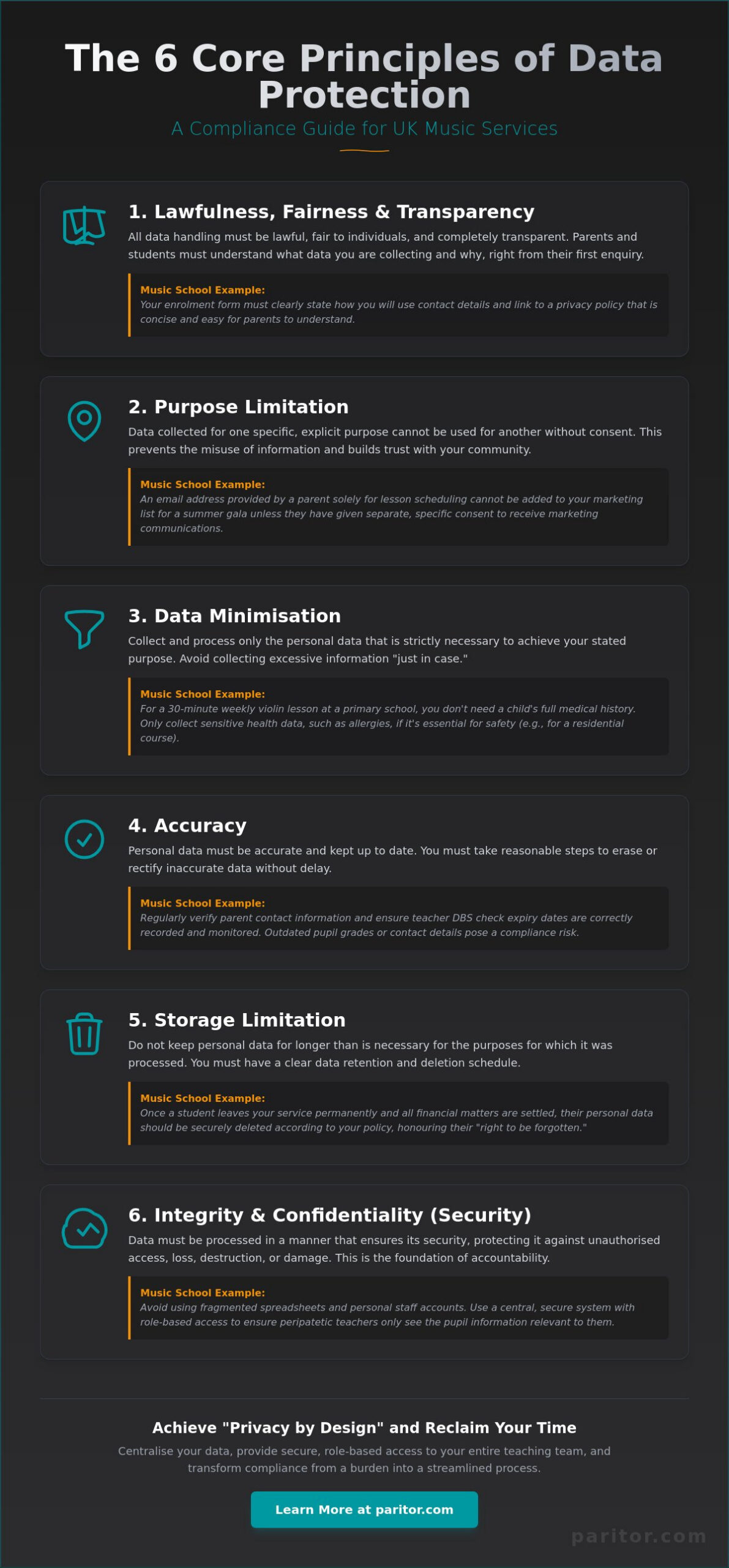
Adhering to the foundational principles of data protection is about more than avoiding fines; it’s about building a culture of respect and security within your musical community. When parents enrol their children in your programmes, they’re trusting you with sensitive information that goes far beyond simple contact details. To maintain GDPR compliance for music schools UK, your administrative processes must align with the official data protection guidance for schools. This means ensuring every piece of data you collect is handled with lawfulness, fairness, and absolute transparency from the very first enquiry.
Purpose limitation and data minimisation are particularly vital in a creative setting. You shouldn’t collect a child’s full medical history if they’re only attending a thirty-minute weekly violin lesson at their primary school. Similarly, a parent’s email address provided for lesson scheduling cannot be used for marketing your summer gala unless they’ve given specific, separate consent. Keeping records accurate is equally essential. Outdated pupil grades or expired teacher DBS checks don’t just hinder your administration; they represent a compliance risk. Finally, storage limitation requires you to have a clear deletion schedule. Once a student leaves your service, you must respect their “right to be forgotten” unless you have a legal obligation to retain the records.
Establishing a Lawful Basis for Processing
You must identify a specific legal reason for every data processing activity you undertake. For most music services, “contractual necessity” covers the basics, such as processing names and bank details to deliver the tuition parents have paid for. However, “legitimate interests” might apply when you contact parents about an upcoming concert their child is performing in. For marketing or using student photography on social media, “consent” remains the gold standard. It must be freely given, specific, and easy to withdraw. Managing these varying permissions is much simpler when you organise your records through a centralised system that tracks consent in real-time.
Managing Special Category and Children’s Data
The 2026 landscape places a heavy emphasis on protecting minors, especially those under the age of 13. Processing data for these younger students requires even more stringent safeguards and often necessitates parental verification. When you’re organising orchestral tours or weekend workshops, you’ll inevitably handle “special category” data, such as allergies or physical health requirements. This information needs high-level encryption and restricted access. For recording student performances, you must obtain “explicit consent,” which is a clear, documented statement from the parent or guardian that specifically authorises the recording for a defined purpose. This proactive approach ensures GDPR compliance for music schools UK remains a strength of your organisation rather than a burden.
Managing Data Across the Music Service Ecosystem
The management of data within a music hub or performing arts centre is rarely a linear process. It’s a complex ecosystem. When a peripatetic teacher visits a partner school to deliver woodwind lessons, a “Joint Controller” relationship is formed. Both the music service and the school hold legal responsibilities for the pupil’s information. Without a formal agreement and a shared, secure platform, it’s difficult to determine who is accountable for data security at any given moment. This ambiguity is a significant hurdle for GDPR compliance for music schools UK, often leading to fragmented records and increased risk during audits.
A major threat to this ecosystem is “shadow IT.” This occurs when well-meaning teachers use personal WhatsApp groups to coordinate rehearsals or Dropbox folders to share sheet music and pupil lists. Whilst these tools are convenient, they exist outside your school’s security perimeter. They don’t meet UK security standards for data processing, and they make responding to Subject Access Requests nearly impossible. To protect your students and your reputation, you must centralise this information within a system that offers role-based access controls. This ensures that a guitar teacher only sees their own students’ details, whilst the senior management team retains the full administrative overview. It’s about creating a secure, industrious engine behind the scenes that allows everyone to focus on their creative roles.
Secure Communication with Peripatetic Staff
Moving away from paper registers and emailed spreadsheets is the first step toward a modern, compliant framework. These traditional methods are prone to loss and unauthorised access. Instead, providing staff with a dedicated space to manage their work is essential. You can offer real-time, secure access to schedules and pupil notes without exposing your entire database. This is where the importance of a secure teacher portal becomes clear. It acts as a controlled gateway, ensuring that data stays within the system and teachers have exactly what they need to deliver high-quality instruction without the risk of data leakage.
Parent and Student Portals: Compliance via Self-Service
Data accuracy is a core principle of UK GDPR, yet keeping hundreds of contact records up to date is an administrative nightmare. Self-service portals solve this by allowing parents to manage their own information directly. This shifts the labour of data entry away from your office staff and ensures your records are always current. A parent portal for music schools also dramatically reduces the risk of data breaches caused by unencrypted email communications, as sensitive information is exchanged only within a secure, authenticated environment. Security is also improved when you provide online progress reports through a secure login rather than sending unencrypted emails. Additionally, adopting a student portal for performing arts empowers older pupils to engage with their own learning journey. This transparency directly supports the “right to access,” making GDPR compliance for music schools UK a seamless, integrated part of the student experience.
A 2026 Compliance Checklist for UK Music Services
Moving from theory into daily practice requires a structured, actionable approach. In 2026, the ICO expects more than just a signed policy; they want to see evidence of active risk management. Before you adopt any new management tool or change your enrolment process, you must conduct a Data Protection Impact Assessment (DPIA). This process identifies and minimises risks to pupil privacy before they occur, serving as a vital shield for your organisation. Your Privacy Notice also needs a refresh. It must be concise, transparent, and intelligible, ensuring parents and older students can actually understand how their data is being processed. Don’t forget your team. Even a part-time drum tutor needs to understand their role in maintaining GDPR compliance for music schools UK, especially when handling student contact info or performance notes on the go.
Accountability is a shared journey. Training should be specific to the music education context, covering everything from secure login habits to the dangers of sharing student data via unencrypted messaging apps. When every staff member understands the “why” behind the rules, compliance stops being a burden and becomes a professional standard. Preparing for the unexpected is also essential. You need a clear procedure for responding to data breaches, including how to notify the ICO within 72 hours if the breach poses a risk to students’ rights and freedoms.
The Annual Audit: Keeping Your House in Order
An annual audit is your best defence against “data bloat.” Start by reviewing your data retention periods. If a student graduated three years ago and you no longer have a legal or financial reason to keep their record, it’s time to delete it. You should also check your ICO registration status and ensure you’re paying the correct fee category based on your organisation’s size. Don’t overlook your instrument loan agreements. These often contain unnecessary personal data that has been sitting in a filing cabinet or a legacy spreadsheet for years. Cleaning up these records reduces your risk profile and makes your entire administration more efficient.
Handling Subject Access Requests (SARs) Efficiently
What would you do if a parent asked for “all data held on my child” tomorrow? For many schools, this request triggers a week of frantic searching through emails, registers, and paper files. However, the 30-day timeline is non-negotiable. “I was too busy teaching” is not a valid excuse for a delay. Modernising your approach is the only way to stay ahead. An integrated performing arts school administration system can generate comprehensive SAR reports in seconds, pulling data from every module into a single, secure document. This ensures GDPR compliance for music schools UK whilst protecting your staff from the administrative burnout of manual data retrieval. To see how you can automate these taxing tasks, you should modernise your compliance framework with a system built specifically for the arts.
Achieving “Privacy by Design” with Xperios
The transition from fragmented spreadsheets to a secure, integrated system is the single most effective step you can take toward 2026 standards. Xperios for Music Services and Xperios for Performing Arts are built on the principle of “Privacy by Design.” This means data protection isn’t an afterthought; it’s the foundation of the architecture. By centralising your information, you eliminate the dangerous “data silos” that lead to security breaches and administrative confusion. Instead of pupil info living on various teacher phones or local hard drives, everything resides in a secure, encrypted environment. This provides a level of institutional safety that legacy systems simply cannot match.
Security is further strengthened by our reliance on Microsoft Azure for cloud hosting. Unlike a local server or a physical filing cabinet, Azure offers world-class data redundancy and accreditation. It ensures your records are protected against both cyber threats and physical loss. Within this secure environment, Xperios utilizes role-based access control. This feature ensures that staff only see the specific data required for their roles. A drum tutor can access their student’s progress notes through the Xperios Teacher Portal, but they cannot view sensitive financial records or the full school database. This granular control is a cornerstone of GDPR compliance for music schools UK, providing peace of mind for administrators and parents alike.
Removing the Administrative Burden of Compliance
We believe that compliance should empower your school, not drain your resources. Xperios automates the most labour-intensive tasks, such as collecting explicit consents during the online booking process. When a parent registers, their permissions are recorded directly into the system, creating an instant audit trail. Managing payments is equally secure. With Xperios Financial Management, you can handle invoicing and billing without ever storing sensitive card details locally. This reduces your liability whilst providing a seamless experience for families. Paritor acts as your industrious engine behind the scenes, serving as an expert partner that understands the unique pressures of arts administration.
Future-Proofing Your Music School for 2026 and Beyond
Data regulations will continue to evolve, but your school shouldn’t have to struggle to keep up. Xperios is updated automatically to reflect the latest UK data protection requirements, ensuring your framework remains resilient against new legal challenges. This allows you to reclaim your time and restore focus to your core mission: providing exceptional music education. By adopting a system that handles automated data hygiene, such as archiving graduated student records based on your specific retention rules, you ensure GDPR compliance for music schools UK is a permanent, effortless state. To take the next step in your professional journey, you should organise a consultation with Paritor to secure your school’s data and modernise your administration for the future.
Securing Your School’s Digital Future
Maintaining GDPR compliance for music schools UK doesn’t have to be a source of constant administrative anxiety. By moving away from fragmented spreadsheets and adopting a centralised management framework, you can protect pupil data whilst significantly reducing your daily workload. This guide has explored how secure teacher portals and automated data hygiene ensure your school meets the 2026 accountability standards with confidence. You can now manage peripatetic staff access securely and handle Subject Access Requests in seconds rather than days.
Our platform is built specifically for UK music and arts services and is hosted on a secure Microsoft Azure infrastructure to guarantee institutional safety. With expert UK-based support and implementation, we act as your dedicated ally in modernising your administration. Discover how Xperios makes GDPR compliance effortless for your music service. You’ve built an organisation dedicated to creativity; let us handle the industrious engine behind the scenes so you can keep the music playing.
Frequently Asked Questions
Do independent music teachers in the UK need to be GDPR compliant?
Yes, any individual processing personal data for business purposes must comply with the law. This includes private tutors who store student names, contact details, or lesson notes on digital devices. Even if you’re a sole trader, you’re considered a data controller. You must register with the ICO and pay the relevant data protection fee, which is a legal requirement for anyone processing personal information in a professional capacity.
What is a Data Processing Agreement (DPA) and why does my school need one?
A Data Processing Agreement is a legally binding contract between a data controller and a data processor. Your school needs one to ensure that any third-party software or service you use handles pupil data according to UK law. It outlines the processor’s responsibilities, such as maintaining security standards. Without a DPA in place, you cannot demonstrate the accountability required for GDPR compliance for music schools UK.
How long are music schools allowed to keep student data after they leave?
You should only keep data for as long as it’s necessary for the purpose it was collected. For example, financial records for instrument hire might need to be kept for six years for tax purposes. Conversely, sensitive medical info for a specific tour should be deleted once the trip concludes. You must document these periods in your retention policy and ensure graduated student records are archived or deleted systematically.
Is it GDPR compliant to use a paper register for music lessons?
Using paper registers is technically compliant, but it’s significantly harder to secure than a digital system. Physical documents are easily lost, stolen, or viewed by unauthorised people, which increases the risk of a data breach. If you use paper, you need strict physical security measures, such as locked filing cabinets. Most modern services have moved to digital portals to ensure data is encrypted and access is restricted.
Do I need a designated Data Protection Officer (DPO) for my music school?
You must appoint a DPO if your school is a public authority or if you carry out large-scale systematic monitoring of individuals. Most local authority music services will require one. Smaller private music schools might not have a legal obligation to appoint a formal DPO, but you should still designate a senior staff member to oversee data protection. This ensures someone is always accountable for maintaining GDPR compliance for music schools UK.
How does GDPR affect the way we manage musical instrument loans?
Managing instrument loans requires you to apply the principles of data minimisation and accuracy. You should only collect the personal data necessary to track the asset and manage the financial agreement. This information must be kept up to date and secured against unauthorised access. Using a dedicated module like Xperios Instrument Management allows you to link loan history directly to student records within a secure environment, avoiding unprotected spreadsheets.
What should a music school do if there is a data breach?
If a breach occurs, your first step is to contain it and assess the risk to the affected students. You must record all breaches internally, regardless of their size. If the breach is likely to result in a risk to individuals’ rights and freedoms, you must notify the ICO within 72 hours of becoming aware of it. In high-risk cases, you’re also required to inform the parents or guardians without undue delay.
Can I still email parents about concerts and events under GDPR?
Yes, you can still contact parents, but you must have a valid lawful basis for doing so. For existing students, you might rely on legitimate interests to send information about rehearsals or performances that are part of their musical education. However, for general marketing or newsletters, you usually need clear, affirmative consent. It’s best practice to provide an easy unsubscribe option in every email to respect the parent’s right to object. Implementing a compliant parent portal for music schools can help you manage these communication preferences securely and transparently in one place. For broader guidance on keeping parents informed within a compliant framework, exploring best practices for student progress reporting for music schools can help you build a transparent reporting ecosystem that meets both educational and regulatory standards.