

Recently, a music hub manager discovered a lead cellist’s instrument was still sitting in a workshop fifty miles away because a paper trail went cold just days before a Grade 8 exam. It is a stressful, all-too-common scenario that many music services face when they lack a robust system to track instrument repairs and maintenance across a large inventory. When you are managing hundreds of assets, losing sight of a single repair status can disrupt an entire term of rehearsals and leave students without the tools they need to succeed.
We know your focus should be on musical excellence, not chasing external repairers or wrestling with unexpected £750 repair bills that blow your annual budget. You deserve a system that provides total visibility and peace of mind. By modernising your approach, you can restore focus to the classroom and ensure your administrative processes are as finely tuned as your instruments themselves.
This guide provides a structured approach to managing your musical assets, ensuring every instrument is procedure-ready whilst reducing administrative fatigue. You will discover how to establish a clear audit trail, implement automated reminders for routine servicing, and use digital tools to reduce downtime for your students. We will show you how to evolve your inventory management into a seamless process that does the hard work for you.
Key Takeaways
- Understand the full asset lifecycle to ensure every instrument is managed effectively from initial procurement through to final disposal.
- Establish a structured approach to track instrument repairs and maintenance, balancing routine preventative servicing with reactive fixes to protect your annual budget.
- Identify the hidden risks of the ‘Spreadsheet Trap’ and learn how centralising your data prevents information silos during busy exam periods.
- Optimise your service’s efficiency by aligning maintenance schedules with school holidays and using historical data to forecast future expenditure accurately.
- Discover how modernising your inventory with Xperios automates tedious administrative tasks, providing real-time visibility and a clear audit trail for every asset.
What Does it Mean to Track Instrument Repairs and Maintenance?
Tracking isn’t merely a log of what is broken. It’s the strategic management of a musical asset’s entire journey, from the moment it’s purchased to the day it’s decommissioned. To effectively track instrument repairs and maintenance, music services must look beyond the immediate fix and consider the long-term health of their inventory. This involves a shift from simple bookkeeping to a comprehensive lifecycle management approach.
Most organisations fall into the trap of reactive repairs, which means fixing an instrument only when it becomes unplayable. However, true efficiency lies in preventative maintenance. Regular servicing, such as a £90 ultrasonic cleaning for a trumpet or a £65 playing condition check for a student flute, often prevents the need for a £400 full repad later. It’s about staying ahead of the wear and tear that naturally occurs in a busy music hub. By scheduling these checks, you extend the life of the asset and ensure better value for money.
Unlike the scientific or medical sectors where assets remain in controlled environments, musical instruments are nomadic. They’re loaned to students, transported in school buses, and stored in varying temperatures. This unique environment requires a specialised approach to instrument conservation and restoration that accounts for frequent movement and heavy usage. A digital paper trail ensures accountability amongst staff and students; it makes it clear who had the instrument last and what condition it was in when it left the store. This transparency removes the guesswork that often leads to administrative fatigue.
The Core Components of an Asset Record
Every instrument needs a unique identity to be managed effectively. While serial numbers are a start, internal barcodes or QR codes are more efficient for rapid scanning during school visits or ensemble rehearsals. By recording the current condition at procurement, you establish a baseline that makes it easier to spot accelerated wear or student neglect. An asset record serves as the digital CV of a musical instrument, documenting every service, repair, and loan history in one place.
Why ‘Procedure-Ready’ Matters in Music Education
Instruments must be procedure-ready for ABRSM exams and ensemble performances. If a cello is unavailable due to a snapped bridge, it doesn’t just affect one student; it disrupts the entire ensemble’s balance. High-quality, well-maintained instruments also directly impact student retention. Students who struggle with a leaky clarinet or a sticking valve are more likely to lose interest and drop out of tuition. Keeping your fleet in peak condition ensures that the focus remains on the music, not the hardware.
The Ultimate Musical Instrument Maintenance Checklist
Managing a vast inventory across multiple schools and hubs is a heavy administrative lift. Without a structured framework, small issues like a sticking valve or a loose bridge quickly escalate into expensive emergencies. To effectively track instrument repairs and maintenance, your service needs a standardised checklist that moves beyond sticky notes and verbal updates. This structure ensures that no instrument is forgotten in a workshop or left in a cupboard in an unplayable state.
A robust checklist ensures that every asset is treated with the same level of care. Start by grouping your inventory by family, as maintenance needs vary significantly. For example, orchestral strings typically require restringing (£40) and bow re-hairing (£65) every 6 to 12 months, whilst woodwinds need their pads and keywork play-tested annually to ensure they remain airtight. Implementing these routines prevents the “summer rush” where repairers often face three to six-week lead times.
Your checklist should include these essential administrative steps:
- Formal Check-In: Every instrument returning from student hire must undergo a documented inspection before being returned to stock.
- Standardised Request Forms: Use digital forms to capture specific fault descriptions, such as “leaky G# key” or “buzzing on the C string,” rather than vague notes.
- Technician Verification: Ensure your external luthiers are not only skilled but also carry valid professional insurance to cover your assets while in their care.
- BER Audit: Conduct an annual review to identify Beyond Economic Repair (BER) assets. If a student clarinet requires a £400 full repad but its replacement value is lower, it’s time to decommission the asset.
Step 1: Establishing the Maintenance Cycle
Don’t wait for things to break before taking action. Differentiate between termly visual inspections conducted by tutors and annual professional servicing. High-value assets, such as conservatoire-level cellos or professional brass, should be prioritised on your schedule based on their usage levels. Tracking consumables is equally vital; keeping a digital log of when strings or pads were last replaced helps you predict future expenditure and prevents mid-concert failures. By organising your workflow with Xperios, you can set these recurring tasks to trigger automatically.
Step 2: Formalising the Repair Workflow
When an instrument leaves your centre, its status must be updated in real time. Logging an asset as ‘Out for Repair’ prevents the administrative team from accidentally assigning it to a new student or ensemble. This digital history allows you to identify recurring issues with specific brands or models, helping you make smarter procurement decisions. Always capture digital photo evidence of damage before sending an item to a workshop. This provides a clear audit trail for insurance claims and ensures accountability if further damage occurs during transit.
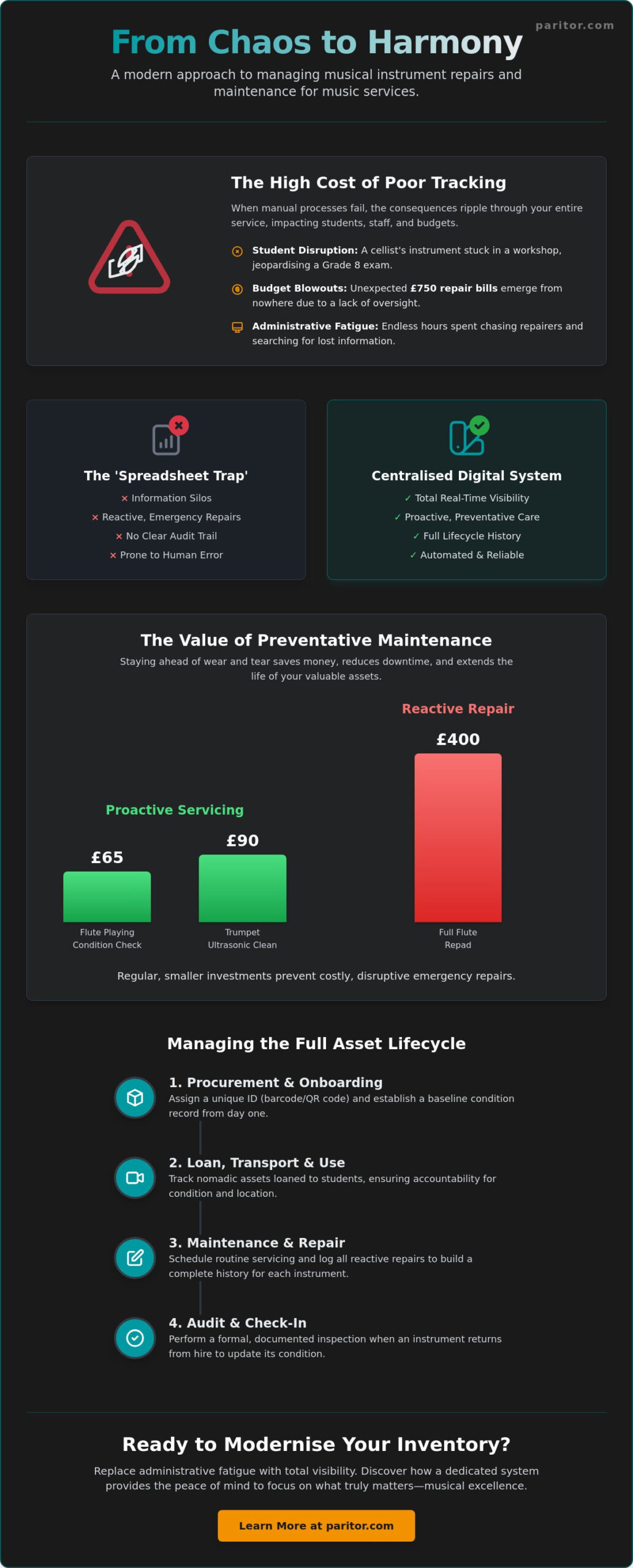
Manual vs. Digital: Identifying Common Pitfalls in Tracking
Many music services still rely on legacy systems to track instrument repairs and maintenance, often without realising the hidden institutional costs involved. Paper logs, disconnected files, and local folders create a mountain of administrative friction. It’s a tedious cycle of double-entry that pulls your team away from their core mission of delivering high-quality music education. When information is scattered across different desks, accountability vanishes, and instruments simply disappear from the radar.
Information siloing is a significant risk for growing hubs. If the one person who traditionally manages repairs is on leave or leaves the organisation, the entire history of that instrument fleet often goes with them. You’re left with a cupboard full of violins and no record of which ones were professionally serviced last month. This lack of continuity doesn’t just cause immediate stress; it leads to duplicated work, wasted budget, and a breakdown in professional trust between the office and the teaching staff.
Why Spreadsheets Fail Large Music Hubs
A spreadsheet is a static list, whilst a database is a living history. Excel cannot provide real-time updates when instruments move between multiple school sites or external workshops. Generating a financial report on repair spend over a three-year period becomes a manual task that takes hours, rather than a single click. Version control issues mean staff often work from outdated lists, leading to instruments being marked as ‘available’ when they’re actually in pieces on a luthier’s bench fifty miles away. Without an automated system, you lose the ability to spot patterns, such as a specific brand of student flute that requires a £375 repad far too frequently. Robust instrument inventory tracking practices are essential to eliminate these costly blind spots and give your team the real-time accuracy they need.
Security and Compliance in Instrument Tracking
Data protection is a non-negotiable requirement for modern music services. Linking repair history to student loan records often creates a ‘GDPR hurdle’ that manual systems can’t clear safely. You must ensure that sensitive student information isn’t accidentally shared with external technicians when sending an instrument for a £90 trumpet flush. Professional cloud-based systems, such as those built on Microsoft Azure, provide institutional-grade security that paper files or local spreadsheets simply can’t match. This centralisation makes local authority reporting effortless, providing a secure, accredited foundation for your service’s data. It restores focus to teaching by ensuring compliance is handled automatically behind the scenes.
Building a Sustainable Maintenance Schedule for Your Service
A sustainable maintenance schedule is the backbone of a resilient music hub. It moves your team away from the stress of last-minute panics and towards a predictable, managed workflow. To successfully track instrument repairs and maintenance, you must align your administrative cycles with the natural rhythm of the academic year. This proactive approach ensures that your inventory remains in peak condition without overwhelming your staff during busy term times.
Budgeting for repairs shouldn’t be guesswork. By analysing historical data from previous years, you can predict future expenditure with high accuracy. If your records show that 15% of your brass fleet requires an ultrasonic cleaning (£90) every two years, you can ringfence those funds in advance. Establishing clear Service Level Agreements (SLAs) with a network of trusted local luthiers ensures you get priority during peak periods and guaranteed turnaround times. This professional partnership transforms your repairers from simple service providers into valuable stakeholders in your students’ success.
Empowering your peripatetic teachers is another vital step. By training peri staff to perform basic first-line checks, such as identifying a loose screw or a dry cork, you can resolve minor issues before they require a trip to the workshop. This reduces the administrative burden on the central office and keeps instruments in the hands of students for longer.
Seasonal Maintenance Planning
Summer is the traditional surge period for repairers, with lead times often jumping from one week to six weeks. A ‘Summer Deep Clean’ protocol ensures the fleet is ready for the new academic year in September. Conversely, winter presents unique challenges for woodwinds. Central heating reduces humidity, which can lead to cracks in wooden oboes or clarinets. Tracking these seasonal trends allows you to issue preventative care advice to students before the damage occurs. For concert seasons, establish an emergency protocol that identifies ‘hot-swap’ instruments ready for immediate deployment if a primary asset fails.
Integrating Maintenance with Hire Schemes
Integrating maintenance with your hire schemes creates a self-sustaining ecosystem. By using music service management software, you can automatically trigger a service check the moment an instrument is returned by a student. This ensures no asset is re-hired without being verified as ‘procedure-ready.’ You can even link a portion of hire fees directly to a dedicated maintenance fund, ensuring the inventory pays for its own longevity. Empowering parents with digital care guides via a secure portal reduces the frequency of avoidable damage, such as improper assembly or lack of swabbing. To see how these modules work in practice, you can explore our instrument management solutions.
Modernising Your Inventory with Xperios
Transitioning to a digital system is the final step in professionalising your service. Whilst the theory of maintenance schedules and checklists is vital, the practical execution requires a robust engine to drive it. Xperios Instrument Management is designed as the professional standard for the sector, built on valuable feedback from music hubs across the United Kingdom. It is software that does the hard work, so you don’t have to, allowing your team to step away from the filing cabinet and back into the classroom.
When you track instrument repairs and maintenance through a centralised module, you gain real-time visibility across every school site and workshop in your network. You no longer need to wonder if a specific violin is in a student’s home or on a luthier’s bench. This clarity empowers your administrative team, providing them with the tools to manage thousands of assets with the same precision as a single instrument. By integrating your inventory with your financial workflows, automated invoicing and repair tracking work in tandem. This ensures that every penny spent on maintenance is accounted for and linked directly to the relevant asset’s history.
The Xperios Advantage: Evolve Your Administration
The flow of information in Xperios moves effortlessly from barcodes to billing. When a repair is completed, the system updates the asset record and prepares the necessary financial documentation in one smooth motion. This eliminates the double-entry that often leads to errors in manual systems. Hub leads can generate one-click reports for governors or local authorities, providing instant data on total inventory value and depreciation. Furthermore, the Xperios Teacher Portal allows peripatetic tutors to report faults instantly from the classroom. This immediate feedback loop ensures that a broken string or a leaking valve is logged before the student even leaves the room, preventing small issues from being forgotten.
Getting Started with Digital Tracking
We understand that the prospect of migrating years of data can feel daunting. Our onboarding process is designed to be supportive, helping you move your messy spreadsheets into a structured, secure system without the stress. Because Xperios is cloud-based and hosted on accredited servers, your data is safe, compliant, and accessible from anywhere. This modern approach provides the institutional-grade security your service requires whilst offering the flexibility your staff need. It’s time to leave the “Spreadsheet Trap” behind and embrace a system built for the future of music education. Discover how Xperios transforms instrument management and see how a dedicated partner can help your service shine.
Evolve Your Instrument Management
Managing a vast inventory shouldn’t feel like a constant battle against paperwork and lost assets. By implementing a structured schedule and moving away from the static lists that lead to errors, you ensure your fleet remains procedure-ready for every exam and ensemble. You have the power to transform your music service into a proactive, efficient organisation where every asset is accounted for in real time.
Modernising how you track instrument repairs and maintenance is about more than just digital records; it’s about reclaiming your time for the art of teaching. Paritor has been a trusted partner to UK Music Hubs for over 30 years, providing software that does the hard work, so you don’t have to. Our Xperios platform is fully GDPR compliant and hosted on secure Microsoft Azure servers, ensuring your data remains safe whilst you focus on student success.
Book a demo of Xperios Instrument Management today to see how we can simplify your administrative journey. Together, we can build a more sustainable future for your music service and help your students shine.
Frequently Asked Questions
How often should musical instruments be professionally serviced?
Professional servicing should occur at least once every 12 months to prevent minor wear from becoming a major failure. High-usage woodwind instruments often require a playing condition service every six months to ensure pads remain airtight. Regular maintenance, such as annual trumpet flushes at approximately £90, significantly extends the lifespan of your hub inventory.
What is the best way to label instruments for tracking purposes?
QR codes or durable barcodes are the most efficient labelling method for large fleets. These allow staff to scan instruments using mobile devices for instant data entry. Whilst serial numbers provide a factory baseline, custom barcodes help you manage internal asset IDs and speed up the check-in process during busy school visits.
Can I track repairs for instruments that are currently out on loan to students?
You can and should track repairs for instruments on loan by linking the repair record to the student hire account. This provides a clear audit trail of who had the instrument when the damage occurred. It also ensures the office knows the asset is at a workshop rather than sitting in a student home.
What information should be included in an instrument maintenance log?
A comprehensive log must include the service date, technician details, specific parts replaced, and the final cost. Recording the before and after condition helps you track instrument repairs and maintenance effectively across the asset entire lifecycle. This data is invaluable for identifying recurring faults in specific brands or models.
How do I calculate the Beyond Economic Repair (BER) threshold for an instrument?
The BER threshold is reached when the cost of repair exceeds the depreciated value of the instrument. For example, if a student clarinet requires a £400 repad but a new replacement costs £450, it is considered beyond economic repair. Most hubs set this threshold at 60% to 70% of the replacement cost to maintain a healthy budget.
Is it possible to automate maintenance reminders for a large inventory?
Automating reminders is a core feature of modern inventory modules, allowing you to set recurring alerts for every asset in your fleet. Instead of manually checking dates, the system notifies you when an instrument is due for its annual professional check. This proactive approach reduces the administrative burden on your team whilst ensuring every instrument is procedure-ready.
How does GDPR affect how we track instrument repairs?
GDPR requires you to protect the personal data of students whilst managing their assigned instruments. When sending items to external technicians, you must ensure that only the instrument technical history is shared, not the child home address or contact details. Professional software handles this by siloing sensitive information, providing institutional-grade security that manual logs lack.
What are the benefits of using cloud-based software over a local spreadsheet?
Cloud-based systems provide real-time visibility and automated backups that local spreadsheets simply cannot match. Spreadsheets are static lists that quickly suffer from version control issues and data silos. Moving to a secure, cloud-hosted platform ensures your inventory history is accessible to authorised staff anywhere, restoring focus to teaching rather than chasing lost files.