

Imagine it is Sunday evening. Whilst your students are still buzzing from their weekend rehearsals, you are sat at a kitchen table buried under a mountain of spreadsheets and unpaid invoices. It is a familiar scene for many principals, but it doesn’t have to be your reality. You didn’t start a performing arts business to become a full-time debt collector or a data entry clerk. You want to be in the studio, not chasing late payments or manually calculating exam fees.
Effective theatre school financial management should be the engine that powers your growth, not the anchor that holds you back. We understand the administrative weight of tracking instrument loans and managing complex billing cycles amongst a growing student body. By modernising your approach, you can master your school’s finances and reclaim your time for your creative mission. This guide will show you how to implement a 2026 strategy that replaces manual labour with automated billing and real-time financial reporting. We will explore how to create a professional, secure payment experience that builds trust with parents whilst ensuring your organisation remains stable and scalable.
Key Takeaways
- Learn how to navigate the unique complexities of performing arts billing by moving beyond standard tuition models to a more flexible, scalable approach.
- Discover the steps to transition from exhausting manual “invoice days” to a continuous, automated billing cycle that ensures a professional parent experience.
- Understand the security risks of relying on traditional spreadsheets and how a dedicated cloud-based system protects sensitive pupil and financial data.
- Master your theatre school financial management by centralising diverse income streams, including instrument hire, costume rentals, and assessment fees.
- Reclaim your creative time by adopting a management strategy built on collaborative industry insights and modern automation tools designed for the arts.
The Unique Landscape of Theatre School Financial Management
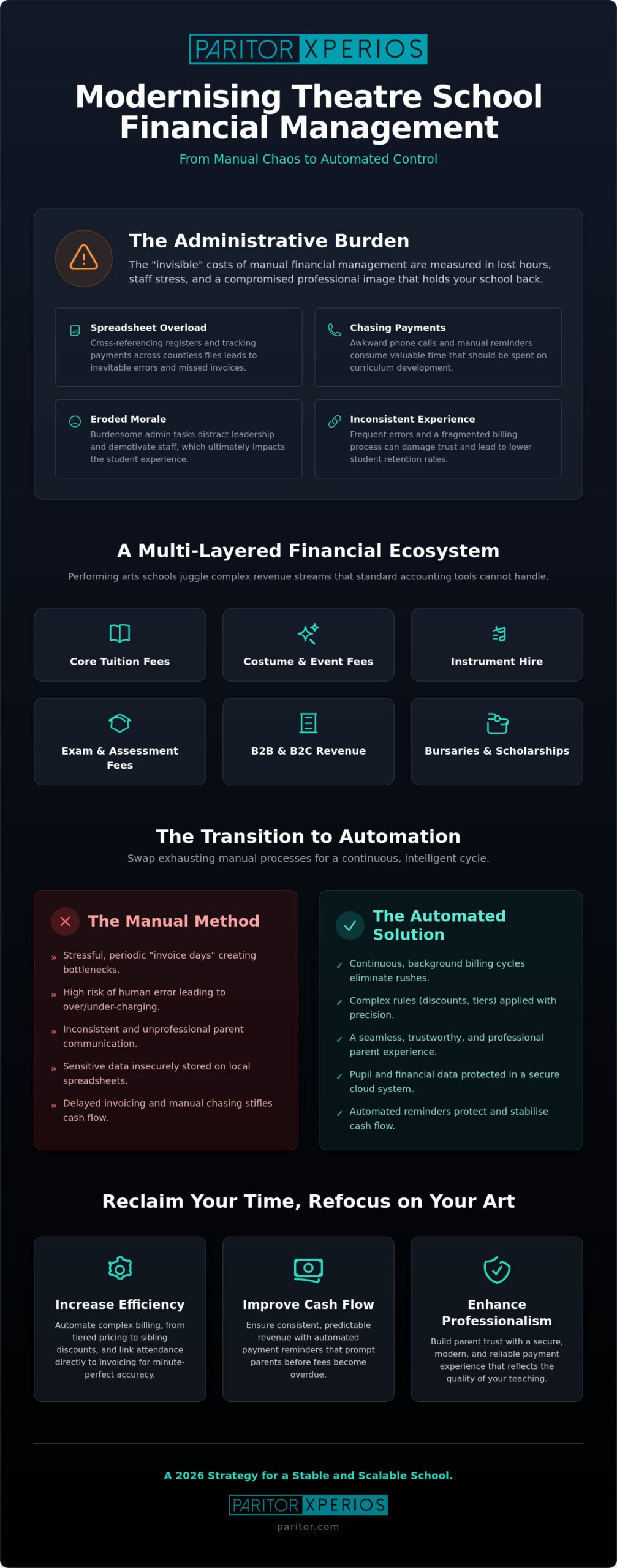
Theatre school financial management is the centralisation of billing, payroll, and asset tracking. Unlike a standard tuition business that might charge a flat hourly rate, performing arts organisations operate within a multi-layered financial ecosystem. You aren’t just selling a 45-minute lesson; you are managing a complex web of ensemble fees, costume deposits, and graded exam assessments. This complexity requires a firm grasp of arts administration principles to ensure the creative mission remains sustainable and scalable.
When your administrative processes are fragmented, your professional image suffers. Parents expect a seamless, secure experience that mirrors the high quality of the instruction their children receive. If invoicing is inconsistent or errors are frequent, student retention can decline. Trust is built in the ledger just as much as it is in the rehearsal room. Establishing a robust financial strategy is the first step toward reclaiming your time and focusing on the stage.
Balancing B2C and B2B Revenue Streams
Managing a theatre school often involves juggling diverse income sources. You might collect direct payments from parents whilst simultaneously navigating funding from local authorities or music hubs. Organising these B2C and B2B streams within a single ledger is essential for clarity. You must also account for bursaries and scholarships, ensuring they are applied accurately without disrupting your cash flow projections. Separating core tuition fees from auxiliary income, such as merchandise sales or programme fees, allows you to identify which areas of your business are truly driving growth. It’s about having a clear view of where every penny originates.
The “Invisible” Costs of Manual Administration
The true cost of manual theatre school financial management is rarely seen on a balance sheet. It is measured in the hours your staff spend cross-referencing spreadsheets or chasing late payments through awkward phone calls. These hidden burdens erode teacher morale and distract your leadership from curriculum development. Administrative friction also impacts the student experience. If a principal is bogged down by payroll delays or instrument tracking, it eventually filters down to the classroom. Manual systems are prone to human error; this leads to missed invoices that stifle your seasonal cash flow and prevent reinvestment in new equipment or facilities. Moving toward automation isn’t just a technical upgrade. It is an act of empowerment for your entire team.
Streamlining Tuition Fees and Automated Invoicing
Traditional “invoice days” are often the most stressful dates in a principal’s diary. You spend hours cross-referencing registers and manually typing out amounts for hundreds of students. Transitioning to a continuous automated cycle changes this dynamic entirely. Instead of a frantic quarterly rush, your theatre school financial management system performs these tasks in the background. It ensures that every student is billed correctly based on their specific enrolment without you needing to lift a pen.
Automation allows you to set complex rules for tiered pricing. Whether you charge based on age groups, skill levels, or the number of classes taken, the software handles the logic. It can automatically apply sibling discounts or early-bird offers, removing the risk of human error that often leads to awkward conversations with parents about overcharging. These efficiencies are not just about convenience; they reflect broader theatre management curriculum standards that highlight the necessity of robust financial operations in the performing arts. When you professionalise your billing, you are aligning your school with industry best practices.
The Power of Automated Billing Cycles
Automated billing cycles provide a level of precision that spreadsheets simply cannot match. This is particularly vital when managing peripatetic teachers who work variable hours. By linking attendance tracking directly to your invoicing, you ensure that billing remains accurate to the minute. If a student misses a session or a teacher adds an extra rehearsal, the system adjusts the next invoice automatically. This transparency reduces the “chase” for late fees, as parents are less likely to dispute clearly documented charges. Setting up automated reminders further protects your cash flow, ensuring payments are prompted before they become overdue.
Modernising the Parent Payment Experience
A modern parent payment experience is built on transparency and ease. Utilising a secure online portal allows parents to view their balance and payment history in real-time. Offering multiple payment methods through a central record ensures that your theatre school financial management remains tidy whilst giving families the flexibility they need. Professional invoicing builds a bridge of trust between your school and your community. It shows that you value their time as much as you value their child’s talent. Schools looking to modernise their approach can see how Xperios Financial Management simplifies these administrative cycles.
Overcoming the Burden of Manual Performing Arts Bookkeeping
Many traditional drama schools feel a deep attachment to their established ways of working. There is often a lingering fear that “digital transformation” might be too complex or cold for a creative environment. However, modernising your theatre school financial management is actually an act of preservation. It protects your most valuable assets: your time and your data. Moving away from paper ledgers or basic files isn’t about losing the human touch; it’s about removing the repetitive administrative static that prevents you from focusing on your students.
Cloud-based systems enable a level of flexibility that traditional offices cannot match. They allow your administrative team to work remotely whilst maintaining a single, “live” version of your accounts. This centralisation is vital when you are preparing for audits or applying for project-based funding. Instead of a last-minute scramble to gather proof of income or expenditure, you can generate comprehensive reports with a few clicks. It turns a stressful, weeks-long ordeal into a routine task.
Moving Beyond the Spreadsheet
Every growing organisation eventually hits a breaking point where manual systems fail. Spreadsheets are often the first tool we reach for, but they are inherently fragile. A single accidentally deleted formula can throw your entire term’s projections into chaos. Fragmented data is another significant risk; when student registers, teacher hours, and payment records live in separate files, errors are inevitable. To see how other creative disciplines are solving this, you can explore Music School Financial Management: Automate Billing. Transitioning to a unified system ensures that your data remains consistent across every department.
Ensuring GDPR Compliance in the UK
Integrated Asset and Event Financial Management
A thriving performing arts organisation is more than just a collection of classes. It is a hub of activity involving school productions, graded exams, and specialised equipment. If your theatre school financial management strategy only focuses on tuition, you are missing a significant portion of your operational reality. Integrating asset tracking and event budgeting into your central system prevents the administrative overlap that often leads to lost revenue or overlooked expenses. It ensures that every costume rental, instrument hire, and exam fee is accounted for without requiring a separate set of spreadsheets.
Managing the financial side of a production or a concert involves complex venue hire costs and ticket sales projections. When these figures live in the same environment as your student data, you gain a holistic view of your school’s health. You can see exactly how event costs impact your seasonal cash flow. This clarity allows you to link asset depreciation directly to your balance sheet, giving you a realistic understanding of when equipment needs replacing or when a costume inventory requires reinvestment. It is about moving from reactive spending to proactive financial planning.
Managing Instrument and Asset Hire
Tracking a vast inventory of physical assets is a labour-intensive task that is ripe for automation. By utilising digital hire agreements, you can trigger recurring rental payments automatically as soon as an item is checked out. This ensures a steady stream of auxiliary income that supports your maintenance budgets. If you are managing a large volume of equipment, you may find The Ultimate Guide to Instrument Inventory Management Software particularly useful for refining your processes. Tracking repair costs alongside hire history allows you to identify which assets are becoming a financial burden, helping you make smarter procurement decisions for the next academic year.
Financial Reporting for Future Planning
Real-time data is the most powerful tool for any principal looking to scale. Professional financial reporting allows you to forecast student numbers and revenue with high accuracy. You can quickly identify your most profitable classes whilst seeing which specialised workshops might require a subsidy from your core tuition income. This level of detail is essential when preparing reports for stakeholders, investors, or boards of governors. It demonstrates a level of institutional stability that builds confidence in your leadership. To see these reporting tools in action, explore how Xperios Financial Management can provide the data-driven insights you need to grow.
Future-Proofing Your School with Xperios Financial Management
Xperios Financial Management is more than a software package; it is a dedicated ally designed to eliminate the repetitive burdens of arts administration. By centralising every financial touchpoint, from initial enrolment fees to final production costs, it provides a single source of truth for your organisation. This system was developed through direct collaboration with industry veterans. This ensures the tools you use daily are built on real-world insights rather than developer assumptions. Adopting this platform is a necessary step forward in your professional journey, allowing you to transition from manual oversight to strategic growth.
Scalability is a core pillar of the Xperios philosophy. Whether you are operating out of a single studio or managing multiple locations across the country, the system grows alongside you. It handles the labour-intensive tasks of billing and payment tracking, which significantly reduces staff burnout and restores focus to your primary creative mission. When your team is no longer buried under paperwork, they can dedicate their energy to instruction and student development. This shift is essential for any organisation looking to master theatre school financial management in a competitive landscape.
Furthermore, if your strategic vision includes expanding your organisation into new territories, you can discover Pactum Global for professional support with international legal structuring and company formation.
Tailored Solutions for Performing Arts
Our modular approach means you only pay for the specific financial tools your organisation requires. This flexibility ensures that Xperios remains accessible for schools of all sizes. Transitioning to a new system can feel daunting, but Paritor provides comprehensive support throughout the onboarding and migration process. We help you move your data securely and ensure your team is confident using the platform before your first automated billing cycle begins. For more information on finding the right fit for your school, read The Definitive Guide to Choosing a Performing Arts School Administration System.
Next Steps for Financial Modernisation
The journey toward a more efficient school starts with a consultative demonstration. This allows us to identify your specific administrative frustrations and show you exactly how our modules can solve them. Setting a clear timeline for implementation before the next academic term ensures a smooth transition for both your staff and your parents. It is time to move beyond the kitchen table spreadsheets and embrace a professional, automated future. When you choose to organise your theatre school finances with Xperios today, you reclaim the time you need to lead your school toward its full potential. Master your theatre school financial management and let your administrative engine run silently in the background whilst your students take centre stage.
Empowering Your Creative Growth Through Modern Finance
Mastering your theatre school financial management is about more than just balancing the books; it’s about reclaiming the mental space needed to lead your organisation. We’ve explored how transitioning from manual spreadsheets to automated billing cycles can eliminate administrative friction and secure your cash flow. By centralising your tuition, asset hire, and event budgeting, you build a professional foundation that parents trust and your staff appreciate.
As a UK-based company trusted by music and arts services since 1993, Paritor understands the unique pressures of the performing arts sector. Our Xperios platform is securely hosted on Microsoft Azure and built on collaborative industry insights to ensure it meets your specific needs. It is time to stop spending your weekends on paperwork and start investing in your school’s future.
Discover how Xperios transforms theatre school administration
Your students deserve your full attention, and your business deserves a system that works as hard as you do. Embrace the tools that allow your creativity to take centre stage.
Frequently Asked Questions
How can I reduce late payments in my theatre school?
Reducing late payments is best achieved by implementing automated reminders and providing a secure, integrated payment gateway. By removing the need for manual chasing, you ensure parents receive prompts well before deadlines. Offering a streamlined checkout process within a portal encourages immediate settlement; this stabilises your monthly cash flow and reduces administrative friction.
Is it worth investing in financial software for a small drama school?
Investing in specialised software is highly beneficial for small drama schools because it provides the scalability needed to grow without increasing your administrative overhead. Even with a small student body, manual theatre school financial management can consume hours of your week. Automation allows you to focus on recruitment and teaching whilst ensuring your billing is professional and accurate from day one.
How does cloud-based software improve theatre school security?
Cloud-based software improves security by utilising enterprise-level encryption and hosting on secure platforms like Microsoft Azure. Unlike local spreadsheets, cloud systems provide data redundancy and strict access controls. This ensures your school remains compliant with UK GDPR regulations, protecting sensitive pupil and parent information from unauthorised access or hardware failure.
Can I manage instrument hire and tuition fees in one system?
You can manage both instrument hire and tuition fees within a single, centralised system using modular software like Xperios. This integration prevents data silos and allows you to see a student’s full financial history in one place. Automated hire agreements can trigger recurring rental payments alongside standard termly fees; this ensures no auxiliary income is missed.
What are the benefits of a parent portal for financial management?
A parent portal modernises your school’s image by offering real-time transparency and a secure environment for fee payments. It empowers parents to view their own balance and download invoices without contacting your office. This self-service model significantly reduces the volume of administrative enquiries, allowing your team to focus on core educational missions.
How do I transition from manual spreadsheets to a financial management system?
Transitioning from manual spreadsheets to a theatre school financial management system involves a structured data migration supported by the software provider. You start by cleansing your existing records and mapping them to the new system. Paritor offers consultative support to ensure a smooth onboarding process, allowing you to set a clear timeline for going live before your next academic term begins.