

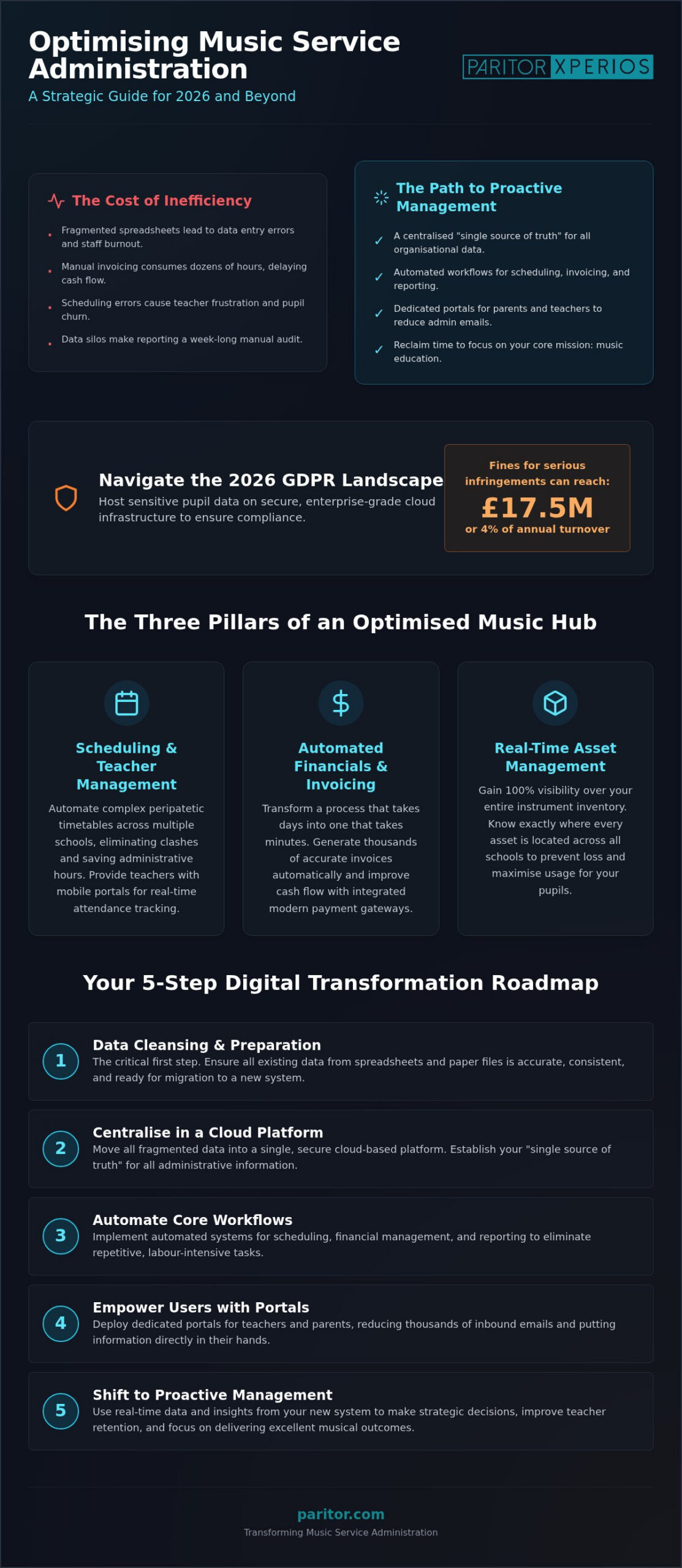
What if the hours spent wrestling with fragmented spreadsheets were suddenly returned to your creative mission? For many leaders, the path to growth starts with optimising music service administration to remove the manual bottlenecks that stifle progress. Most services find themselves buried under a mountain of scheduling and inventory tracking; often fearing that a single data entry error could lead to a significant GDPR breach. With UK GDPR fines for serious infringements now reaching up to £17.5 million or 4% of annual turnover as of 2026, the stakes for your data security have never been higher.
We understand that you started this journey to inspire students, not to act as a full-time debt collector or inventory manager. By adopting a modern, cloud-based approach, you can transform your organisation from a paperwork-heavy office into a streamlined centre of excellence. This 2026 strategic guide explores how adopting a “single source of truth” for your data and automating your invoicing can eliminate administrative fatigue and significantly improve teacher retention. We will show you how to reclaim your time and focus on the music.
Key Takeaways
- Shift from reactive firefighting to proactive management by moving your fragmented spreadsheets into a centralised cloud-based platform.
- Master the essential pillars of optimising music service administration, focusing on automated scheduling and seamless financial workflows that connect bookings to your bank account.
- Follow a proven five-step roadmap for digital transformation, starting with the critical data cleansing phase to ensure a smooth software migration.
- Navigate the 2026 GDPR landscape with confidence by hosting sensitive pupil data on secure, enterprise-grade cloud infrastructure.
- Reduce administrative pressure by using dedicated portals for teachers and parents, effectively eliminating thousands of unnecessary inbound emails.
What is Music Service Administration Optimisation?
Optimisation isn’t simply a matter of working faster; it’s about fundamentally changing how your organisation breathes. When we talk about optimising music service administration, we are describing the transition from a state of constant “firefighting” to a proactive, automated ecosystem. For years, many services have relied on a patchwork of disconnected spreadsheets and paper files. This manual approach is no longer just an inconvenience. It’s a significant barrier to growth that drains your staff’s energy and puts your data at risk. Understanding What is Music Service Administration? in a modern context requires looking at it as a strategic data-management function rather than a back-office burden.
The status quo of manual data entry is perhaps the greatest threat to a music service’s future. When information is trapped in static documents, it remains invisible to those who need it most. Modernisation means moving towards a centralised cloud-based platform where every lesson, instrument, and payment is tracked in real time. UK Music Hubs are currently leading this charge, setting national standards for administrative excellence by proving that better systems lead to better musical outcomes for pupils. By automating the repetitive, labour-intensive tasks, leaders can finally restore focus to their primary educational mission.
The High Cost of Inefficient Administration
Manual processes carry hidden costs that rarely appear on a balance sheet but felt by everyone in the organisation. Chasing late payments for lessons often consumes dozens of hours every month; time that could be spent on curriculum development or community outreach. When scheduling errors occur due to outdated spreadsheets, the result is more than just a missed lesson. It leads to teacher frustration and eventually pupil churn. Data silos also make reporting to local authorities or stakeholders a nightmare. Without a single source of truth, compiling a simple report on instrument usage or student demographics becomes a week-long manual audit rather than a three-second click.
To address these challenges, many teams adopt a comprehensive management platform like Sonico OS to help them track and share their work in one centralised location. This provides the clarity needed to make data-driven decisions across the entire service, ensuring that internal projects remain as organised as the music lessons themselves.
Key Objectives for a Modern Music Service
To future-proof your service, your administrative systems must meet specific, high-level objectives. First, you need 100% visibility over your instrument inventory. Knowing exactly where every cello or cornet is located across multiple schools prevents loss and ensures assets are working for you. Second, scheduling must be streamlined. Many services report that they can reduce the time spent on peripatetic teacher scheduling by a vast margin once they move away from manual coordination. Finally, gold-standard GDPR compliance is non-negotiable. With serious UK GDPR infringements carrying fines of up to £17.5 million as of 2026, hosting student data on secure, enterprise-grade cloud servers is the only way to ensure both safety and accessibility.
The Three Pillars of an Optimised Music Hub
Many organisations attempt to fix administrative strain by simply hiring more staff. This is often a reactive solution to a systemic problem. True efficiency in optimising music service administration comes from building three resilient pillars that work in harmony: scheduling, financials, and asset management. When these elements are siloed, staff spend their days bridge-building between disconnected data sets. When they are integrated, the organisation gains a single, cohesive workflow that empowers every teacher and administrator. By optimising music service administration, you transform a series of chores into a strategic advantage.
Scheduling and Peripatetic Teacher Management
Scheduling is the heartbeat of any performing arts organisation. Coordinating peripatetic teachers across dozens of school locations is a logistical puzzle that manual systems cannot solve without errors. Modern systems automate these complex timetables, ensuring that room bookings and teacher availability align perfectly. Real-time attendance tracking via mobile teacher portals allows for immediate visibility. This means no more chasing paper registers at the end of the term. Whether you’re managing weekly individual lessons or large ensemble rehearsals, an automated system prevents clashes and ensures every minute of teaching time is accounted for.
Automated Financials and Invoicing
Financial administration often represents the heaviest burden for music hub staff. Generating thousands of invoices manually can take days, if not weeks. By automating this journey, you can produce accurate billing in minutes. Integrating with modern payment gateways reduces late fees and improves cash flow significantly. Linking this financial data directly to student records ensures that every penny is tracked against the correct learner. This level of precision is essential for maintaining Data Security and GDPR Compliance, as financial records and student identities must be handled with extreme care. You might find that Xperios Financial Management provides the exact relief your accounts team needs.
Instrument Inventory and Hire Schemes
Protecting your investment in instruments is vital for long-term sustainability. You need to track the entire lifecycle of an asset, from the initial purchase to the final repair or disposal. Managing hire agreements shouldn’t be a manual task. Automated billing for loaned assets ensures that hire fees are collected consistently without extra effort from staff. Utilising specialised instrument inventory management software prevents loss and damage by ensuring every item is assigned to a specific student or location. This level of oversight turns a chaotic storage room into a managed, revenue-generating resource.
How to Organise Your Digital Transformation
Digital transformation isn’t a single event; it’s a strategic shift that moves your organisation from manual survival to automated excellence. When optimising music service administration, you’re not just installing software. You’re rebuilding the operational engine of your service. Many hubs fall into the trap of thinking they can hire their way out of administrative bottlenecks, but more staff often just means more people managing the same broken spreadsheets. A structured, five-step roadmap provides a sustainable path to efficiency and growth.
Step 1: Auditing Your Current Workflows
You can’t fix what you haven’t measured. This initial phase involves identifying the specific bottlenecks where your team loses the most manual time. Map the journey of a single data point from the moment a parent makes an enquiry on your website through to the final lesson of the term. You’ll likely discover that data is being re-entered manually across three or four different systems. It’s also vital to consult with your teachers. They’re on the front lines and can identify the administrative pain points that distract them from their primary mission of instruction.
Step 2: Choosing a Scalable Cloud Platform
Generic CRMs often fail music services because they don’t understand the unique requirements of peripatetic scheduling or instrument hire. You need a platform built by industry veterans who understand these specific burdens. Security is a non-negotiable factor in 2026. Choosing a system built on Microsoft Azure ensures enterprise-grade data safety and redundancy. Your platform must be modular and robust enough to handle ensemble management and complex, tiered billing structures without requiring manual workarounds.
The Critical Role of Data Cleansing
Before you migrate to a new system, you must prioritise data cleansing. This is the most critical phase of any digital transformation. Moving “dirty data”—such as duplicate student records or outdated contact info—into a new platform only migrates your existing problems. Accurate data is also a legal requirement. According to the official ICO Guide to the GDPR, maintaining accurate and up-to-date personal information is a core principle of data protection. Taking the time to scrub your records now prevents compliance headaches later.
Training and Measuring Success
Training staff to embrace new workflows whilst maintaining daily operations requires a phased, empathetic approach. It’s about empowerment, not just instruction. Once the system is live, focus on the KPIs that truly reflect organisational health. Monitor the reduction in late payments, the time saved on monthly invoicing, and teacher satisfaction scores. These metrics prove that optimising music service administration delivers a tangible return on investment, freeing up your team to focus on the music rather than the paperwork.
Data Security and GDPR Compliance in 2026
The regulatory environment in 2026 demands more than just a signed policy document; it requires a technical infrastructure that actively prevents breaches. When optimising music service administration, your approach to data security must shift from passive storage to active protection. Relying on local servers or office-based hard drives is now considered a significant institutional liability. These systems lack the sophisticated redundancy and encryption found in enterprise-grade environments. By hosting your data on a secure cloud platform like Microsoft Azure, you benefit from multi-layered security protocols that most individual music services simply cannot replicate on their own. It’s about building a foundation of professional trust that protects both your pupils and your reputation; this trust also applies to the integrity of online assessments, where platforms like Aiseptor help ensure that certification exams remain secure from AI-assisted cheating.
Managing user permissions is another vital component of a modern security strategy. Your staff should only see the data they need to perform their specific roles. A peripatetic teacher needs access to their student’s medical notes and emergency contacts, but they don’t need to see the family’s full financial history or billing status. Centralised systems allow you to define these roles precisely, ensuring that sensitive information remains compartmentalised. This granular control is essential whilst managing large teams across multiple locations, as it ensures that data remains accessible to the right people without being exposed to unnecessary risk.
Protecting Sensitive Student Information
Encryption at rest and in transit are non-negotiable standards for 2026. Every piece of student data must be scrambled as it moves between a teacher’s mobile device and your central database. Automated systems play a crucial role here by removing the risk of human error. We’ve all heard the horror stories of unencrypted spreadsheets being sent to the wrong recipient or lost on a USB stick. Automation eliminates these manual touchpoints entirely. However, technology is only half the battle. You must also foster a “culture of security” amongst your staff, ensuring that everyone understands their personal responsibility in protecting pupil privacy during their daily routines.
Reporting and Audit Trails
Compliance shouldn’t be a source of anxiety. In the event of an enquiry from a local authority or a Subject Access Request (SAR), you need to be able to generate comprehensive reports at the touch of a button. Modern platforms maintain a rigorous digital paper trail for every action taken within the system. Whether it’s a change to a safeguarding record or a financial transaction, you have a permanent record of who accessed the data and when. This transparency is particularly helpful for meeting the strict 72-hour notification window required by the ICO for data breaches. Instead of spending days manually trawling through files, you can identify and report issues in minutes.
Protect your service and your students by choosing a platform built on professional trust and institutional safety. Discover how Xperios secures your student data today.
Future-Proofing Your Service with Xperios
Xperios has established itself as the cloud management standard for organisations dedicated to optimising music service administration. It isn’t a static tool; it’s a living product that receives continuous updates to meet the evolving needs of the UK arts sector. By centralising your operations into a modular ecosystem, you gain the flexibility to start with the features you need most and scale as your service grows. This approach moves you away from the “one-size-fits-all” generic CRM and into a professional partnership built on decades of industry expertise. You aren’t just adopting software; you’re joining a community of UK music hubs that actively shape the platform through collaborative user input.
Empowering Parents and Students
The administrative burden often stems from thousands of inbound emails regarding lesson times and payment queries. You can eliminate this friction by providing parents and students with a secure, real-time window into your service. A dedicated parent portal for music schools allows families to view schedules, track progress reports, and renew instrument hire agreements without pick up the phone. This transparency builds deep institutional trust and loyalty. When parents can manage their own billing and renewals online, your office staff are finally freed from the repetitive labour of manual coordination.
Supporting the Teaching Workforce
Teacher retention is often directly linked to the quality of the systems they use daily. When peripatetic staff feel bogged down by paper registers and clunky reporting, their focus on music instruction suffers. Xperios provides teachers with instant mobile access to student notes and digital registers, allowing them to record attendance in seconds between lessons. This reduction in “admin load” is an act of empowerment. It sends a clear message that you value their time and their professional expertise. By optimising music service administration with teacher-centric tools, you create a more stable, professional environment that attracts and keeps the best talent.
Next Steps for Your Organisation
Moving from manual spreadsheets to a data-driven centre of excellence is a significant journey, but you don’t have to walk it alone. Paritor has been providing deep domain expertise to the UK music sector since 1993, and our onboarding process is designed to be as supportive as the software itself. We offer a consultative demonstration to help you understand how our modular system fits your specific workflows. From the initial data cleansing phase to staff training and go-live support, we act as a dedicated ally in your digital transformation. Discover how Xperios can transform your music service administration today.
Restore Your Focus to Musical Excellence
The transition from a paperwork-heavy organisation to a streamlined, data-driven centre of excellence is no longer a luxury; it’s a necessity for growth. By optimising music service administration, you eliminate the repetitive manual tasks that drain your staff’s energy and lead to costly errors. You’ve seen how a centralised cloud platform can automate your financials, protect your instrument inventory, and provide a secure environment for sensitive pupil data. This shift doesn’t just improve your operational efficiency; it restores your capacity to focus on the creative and educational missions that matter most.
Paritor has been a dedicated ally to the sector since 1993, providing tools expertly designed for UK Music Hubs and Performing Arts Schools. Our Xperios platform is securely hosted on Microsoft Azure, ensuring your data remains safe and redundant in an evolving regulatory landscape. You don’t have to manage these burdens alone. Join the community of forward-thinking leaders who’ve already modernised their systems to empower their teachers and students alike.
Book a Consultative Demo of Xperios today and discover the relief of a truly automated music service. It’s time to let the technology handle the labour so you can lead the music.
Frequently Asked Questions
How can software specifically help in optimising music service administration?
Software centralises your data into a “single source of truth”, eliminating the need for disconnected spreadsheets and paper files. By automating repetitive tasks like scheduling and billing, it frees your team to focus on educational delivery. This process of optimising music service administration reduces manual errors and ensures that every student, teacher, and instrument is tracked in real time. It transforms a reactive office into a proactive, data-driven centre of excellence.
Is it difficult to migrate our existing student data into a new system?
Migrating student data is a straightforward process when managed through a structured “data cleansing” phase. Our team provides dedicated onboarding support to help you scrub duplicate records and outdated information before the transfer takes place. This ensures your new system starts with accurate, high-quality data. Most organisations find the transition provides a welcome opportunity to standardise their records and improve overall data hygiene across the service.
Can cloud-based music school software help with GDPR compliance?
Cloud-based platforms significantly enhance your compliance by hosting sensitive pupil data on secure, enterprise-grade servers like Microsoft Azure. These systems provide automated audit trails and granular user permissions, ensuring staff only access the information necessary for their roles. Since UK GDPR fines for serious infringements can reach £17.5 million as of 2026, moving away from local, unencrypted files is a critical step in safeguarding your organisation’s reputation.
What features should I look for in an instrument inventory management system?
A robust system must track the entire lifecycle of an instrument, from its initial purchase and unique serial number to its repair history. Look for features that allow for automated hire agreements and integrated billing for loaned assets. This ensures you never lose track of inventory across multiple school locations. Effective management prevents asset loss and ensures your musical equipment remains a well-maintained and revenue-generating resource for your students.
How does a parent portal reduce the workload for office administrators?
A parent portal reduces administrative strain by allowing families to manage their own schedules, progress reports, and payments online. This self-service model eliminates thousands of inbound emails and phone calls regarding lesson times or invoice queries. When parents can renew instrument hire or update contact details directly, your office team can reclaim hours of time previously spent on manual data entry and coordination. It builds trust through transparency.
What is the cost benefit of automating music service invoicing?
The primary cost benefit lies in the dramatic reduction of labour hours required to generate and chase thousands of individual invoices. Automation allows you to produce accurate billing in minutes and integrates with payment gateways to reduce late fees. By optimising music service administration through automated financials, you improve cash flow and ensure that every penny is accounted for without the need for hiring additional administrative staff to manage the volume.
Does Xperios support both small private teachers and large national music hubs?
Xperios is designed with a modular architecture that scales to meet the needs of any organisation size. Whether you are an individual educator using Xperios for Private Teachers or a large national organisation requiring complex ensemble management, the platform adapts to your specific volume. This flexibility allows you to adopt the specific modules you need today whilst maintaining the infrastructure to grow your service and add more complex functionality in the future.
How does scheduling software handle peripatetic teachers working across multiple schools?
Modern scheduling software coordinates complex timetables by aligning teacher availability with specific school locations and room bookings. It prevents double-bookings and provides peripatetic staff with instant access to their registers via mobile portals. This real-time visibility ensures that teachers always have the most up-to-date information, regardless of which school they are visiting. It creates a professional, organised experience for both the teaching workforce and the host schools they serve.