

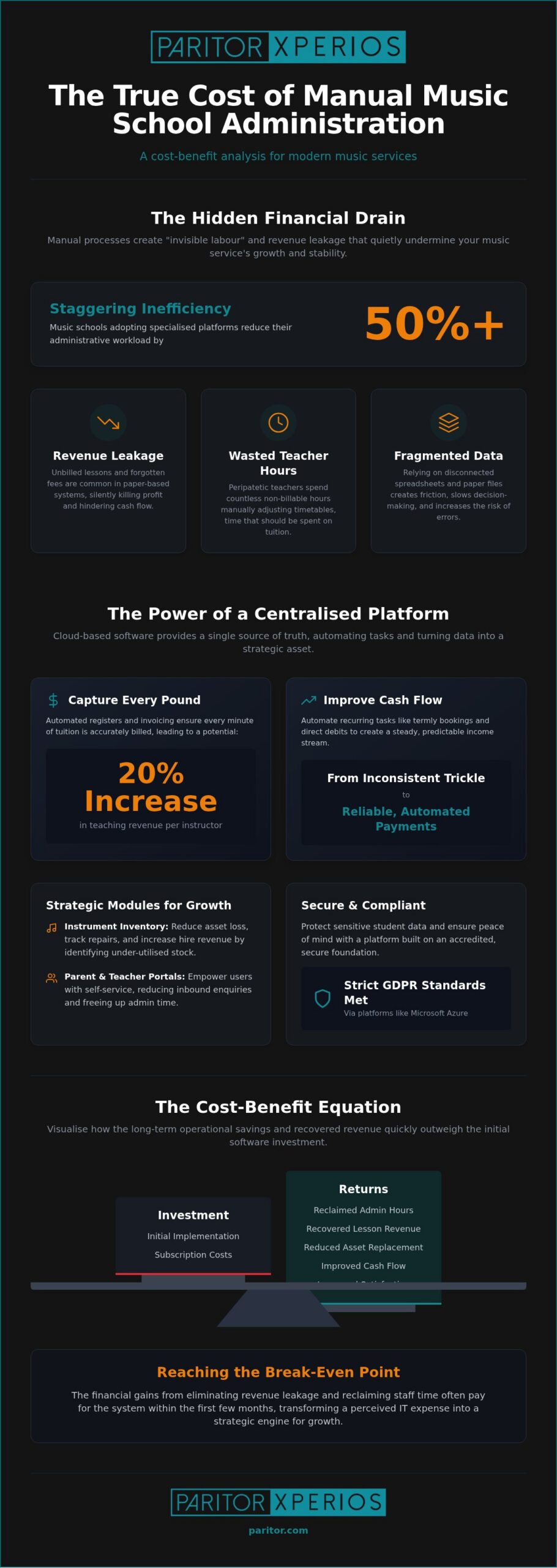
Did you know that music schools adopting specialised management platforms typically reduce their administrative workload by 50% or more? It is a staggering figure, yet many music service leads still feel trapped by manual spreadsheets, unbilled lessons, and the constant pressure of “paperwork fatigue.” You likely recognise the frustration of losing precious hours to complex scheduling conflicts whilst your instrument inventory remains a mystery and GDPR compliance feels like a moving target.
We understand that every pound spent must be justified. This 2026 guide provides a comprehensive music school software cost benefit analysis to help you move beyond guesswork. You’ll discover how to quantify the true financial and operational ROI of modernising your administration, turning a perceived IT expense into a strategic engine for growth. We’ll explore how automated invoicing improves cash flow, the ways centralised data supports better decision-making, and exactly how to present a clear financial justification to your stakeholders. By the end, you’ll see how reclaiming your time allows your team to focus on their primary creative and educational mission instead of being buried by repetitive paperwork.
Key Takeaways
- Identify the hidden costs of “invisible labour” within your music service, from manual scheduling to revenue leakage caused by unbilled lessons.
- Discover how cloud-based automation and self-service portals can drastically reduce inbound enquiries whilst improving institutional cash flow.
- Learn how to conduct a professional music school software cost benefit analysis to quantify time savings and justify your investment to stakeholders.
- Understand the “break-even” timeline where reclaimed administrative hours successfully offset initial implementation and subscription costs.
- See how specialised modules for instrument and financial management transform software from a simple tool into a strategic partner for growth.
The Hidden Financial Drain of Manual Music School Administration
Many music service leaders view administration as a fixed cost of doing business. In reality, manual processes create a significant financial drain that often remains hidden until a formal Cost-benefit analysis is performed. This “invisible labour” encompasses the hours spent on scheduling, tracking attendance, and managing parent enquiries. When these tasks are handled via fragmented data silos like paper files and disconnected spreadsheets, the friction slows down the entire organisation. Relying on outdated music service management software or manual entries is the single biggest barrier to scaling your tuition programmes. Switching between different files to find a student’s medical record or a parent’s updated email address doesn’t just waste minutes; it erodes the focus of your team.
Calculating the Cost of Manual Scheduling
Scheduling is the heartbeat of any music service, yet it’s often the most inefficient process. Peripatetic teachers frequently spend several hours each week adjusting timetables to accommodate school trips, exams, or absences. A 2021 study indicated that administration accounts for an average of 3.1% of total music expenditures, but this figure swells when manual errors are factored in. If you apply standard UK administrative hourly rates to the time teachers spend on logistics rather than tuition, the annual drain on your budget becomes apparent. Beyond the direct financial cost, scheduling conflicts lead to student frustration. Poorly managed timetables are a primary cause of student churn, which directly impacts your long-term revenue and teacher satisfaction.
Revenue Leakage and Unbilled Lessons
Revenue leakage is a silent profit killer in music education. In paper-based systems, missed billing cycles and forgotten lesson entries are remarkably common. Research indicates that the use of specialised software can lead to a 20% increase in teaching revenue per instructor simply by ensuring every minute of tuition is accounted for. Automated registers eliminate the “memory tax” on teachers, ensuring that invoicing is accurate and immediate. This professionalism also addresses the issue of late payments. When billing is delayed or inconsistent, parents are less likely to pay on time, creating a cash flow bottleneck that hinders your ability to invest in new instruments or staff. Conducting a thorough music school software cost benefit analysis reveals that these recovered fees often pay for the system itself within the first few months of operation.
Quantifying the Tangible Benefits of a Cloud-Based System
Whilst manual systems rely on memory and luck, cloud platforms provide a single source of truth. Automation of recurring tasks like termly bookings and monthly direct debits ensures a steady cash flow. It’s about empowerment. Real-time financial reporting allows for precision budgeting, which is vital for local authority compliance. By conducting a music school software cost benefit analysis, managers can see how these efficiencies stack up. Data from high-level organisations shows that cloud adoption leads to long-term operational savings. This is achieved through data centralisation and the elimination of fragmented workflows. Security is equally critical. Using an accredited platform like Microsoft Azure ensures your sensitive student data meets strict GDPR standards, providing peace of mind for both staff and parents. This robust foundation is essential for any modern music school software cost benefit analysis.
Instrument Inventory and Asset Recovery
The financial return on instrument inventory management software is often the most immediate. Manual tracking frequently leads to lost assets and uncollected hire fees. Digital logs provide a clear repair history and automated loan tracking, which significantly reduces replacement costs. You can also increase hire revenue by identifying under-utilised instruments in your store. This proactive approach turns your physical inventory into a more productive financial asset.
Teacher and Parent Portal Efficiency
Portals eliminate the administrative middle-man. When parents can update contact details or pay fees online, inbound enquiries drop. This frees up your office team for higher-value work. Teachers benefit too. Mobile access to registers and student progress reports means they spend less time on paperwork and more time on pedagogy. It’s a collaborative ecosystem built on user insights. If you want to see these benefits in action, exploring how to optimise your instrument inventory is an excellent starting point.
Direct Investment vs Long-Term Operational Savings
Transitioning from manual processes to a digital framework requires a shift in perspective. You aren’t just buying a tool; you’re reallocating resources to ensure long-term sustainability. Most modern SaaS subscription models use tiered licensing based on student or user volume, which provides a predictable cost structure that scales with your organisation. When Conducting Your Own Music School Software Cost Benefit Analysis, it’s essential to look beyond the monthly invoice. The “break-even” point often occurs much sooner than expected, as the cumulative time saved by your administrative team quickly offsets the initial implementation and onboarding fees.
Scalability is where the financial argument becomes truly compelling. Manual labour costs tend to grow exponentially as you add more students, teachers, and instruments. Each new enrolment adds a layer of complexity to scheduling and billing that eventually requires more staff. In contrast, software costs grow linearly. A cloud-based system handles 1,000 students with the same automated precision as it handles 100. This shift allows you to avoid the “hiring trap” and focus on opportunity cost analysis. If your senior staff weren’t spending 10 hours a week on data entry, they could be developing new ensemble programmes or securing additional funding. Reclaiming this time is a core pillar of a robust music school software cost benefit analysis.
The Implementation and Onboarding Phase
The initial phase involves a one-time investment in data migration and system configuration. Whilst this represents an upfront cost, it’s a critical safeguard against future errors. Professional setup ensures that your existing student records and financial histories are structured correctly from day one. Structured training for your team is equally vital. Proficiency prevents the “workaround” culture that leads to data silos, ensuring that the entire organisation uses the system to its full potential. This structured approach builds a foundation of institutional safety that pays dividends for years.
SaaS Fees vs Staff Overheads
To understand the true ROI, compare the monthly cost of a software licence to the cost of just five hours of administrative labour at current UK rates. In most cases, the software is significantly cheaper. You also need to factor in the reduction of physical overheads. Moving to a digital-first model eliminates substantial costs related to paper, postage, and physical storage space. These small, recurring expenses often go unnoticed in manual systems but add up to thousands of pounds annually. Predictable, recurring software fees make annual budgeting simpler and more accurate, removing the “hidden surprises” of manual administration.
Conducting Your Own Music School Software Cost Benefit Analysis
In the same way that precision is required when calculating these overheads, financial professionals often rely on specialised tools for accuracy; for example, those looking to translate option prices can click here to use an SPX to SPY strike price conversion tool.
Performing a structured music school software cost benefit analysis allows you to move from anecdotal evidence to concrete data. It’s about visualising the “cost of doing nothing” versus the potential for future expansion. To build a compelling case for modernisation, follow these four logical steps:
- Step 1: Audit current workflows. Record the exact time your team spends on core administrative tasks like timetable adjustments and parent communications.
- Step 2: Identify revenue gaps. Quantify unbilled lessons, missing instrument hire fees, and the cost of replacing lost assets.
- Step 3: Estimate the “Growth Ceiling.” Determine how many additional students your current staff could manage if their manual workload was halved.
- Step 4: Compare total costs. Contrast your current administrative spend, including hidden inefficiencies, against the cost of an Xperios subscription and implementation.
Internal Workflow Audit
Start by interviewing your staff to identify which manual processes cause the most daily friction. You should track the “paper trail” of a single student from their initial enquiry through to the final invoice of the term. This exercise often reveals redundant data entry points where information is copied from one spreadsheet to another. Industry data suggests that automating a single invoice cycle typically reduces the time spent on manual data entry by up to 75% compared to paper-based methods. This reclaimed time represents a direct saving that can be reinvested into educational delivery or ensemble development.
Defining Key Performance Indicators (KPIs)
Once you have identified the time and revenue leaks, set clear targets for the post-implementation phase. Focus on measurable outcomes like debt reduction and improved student retention rates. You should also measure the “admin-to-teaching” ratio; a lower ratio indicates a more efficient organisation where resources are focused on tuition rather than paperwork. When presenting these findings to a board or local authority, use these KPIs to demonstrate institutional safety and financial responsibility. Showing a clear path to improved cash flow makes the approval process much smoother. To begin mapping your own digital transition, you can explore our complete guide to music service management software for more detailed workflow benchmarks.
Maximising ROI with Xperios: A Partnership for Growth
Choosing the right platform is about more than just finding a technical solution. It’s about finding an ally that understands the specific nuances of music and performing arts administration. Xperios is designed to be that industrious engine behind the scenes, performing labour-intensive tasks so your team can focus on their primary educational mission. Unlike generic management tools, our features are built on collaborative user input. This means the system addresses the real-world frustrations of peripatetic scheduling and complex billing because it was shaped by the people who manage them every day. When you perform a music school software cost benefit analysis, the value of this industry-specific expertise becomes a primary factor in long-term success.
Our commitment to partnership extends beyond the initial setup. The music education sector is constantly evolving, with changing funding models and shifting service standards. Xperios evolves alongside it. Regular updates and ongoing support ensure that your system remains a high-ROI asset rather than a static expense. By adopting a platform built on user insights rather than developer assumptions, you’re investing in a tool that truly empowers your staff. This supportive relationship allows your educators to excel in their roles, confident that the administrative foundation beneath them is stable, organised, and technologically savvy.
Tailored Modules for Every Organisation
One of the most significant ways to improve your music school software cost benefit analysis is to ensure you only pay for what you need. Modularity is a core philosophy of the Xperios ecosystem. Whether you are managing large ensembles, coordinating national exams, or overseeing private tuition, you can select the specific components that fit your workflow. This prevents the financial waste associated with “bloated” all-in-one systems. Specialised financial management modules provide the institutional stability required for local authority audits and long-term budgeting. We invite you to explore Xperios for Music Services to see how these bespoke modules can be configured to meet your unique organisational requirements.
Security as a Financial Asset
Data security is often overlooked in traditional cost assessments, but the financial impact of a data breach can be catastrophic. GDPR compliance is a non-negotiable requirement for modern music services. By hosting sensitive student and teacher data on the Microsoft Azure cloud platform, Xperios provides a level of security and reliability that manual systems simply cannot match. This reduces the risk of costly downtime and protects your institutional reputation amongst parents and governors. High-level data redundancy and professional accreditation serve as a foundation of trust. In the context of a modern music service, professional-grade security isn’t just a technical feature; it’s a critical financial asset that safeguards your future growth.
Moving Forward with Financial Confidence
Reclaiming time from the “invisible labour” of manual scheduling and invoicing is not just an operational win; it’s a financial necessity. By performing a structured music school software cost benefit analysis, you can transform your administration from a hidden drain into a strategic engine that supports institutional growth and teacher satisfaction. Modernising your service ensures that every lesson is billed accurately whilst student data remains protected behind professional-grade security. This transition allows your team to shift their focus away from fragmented spreadsheets and back to their primary mission of delivering exceptional music education.
Since 1993, we’ve partnered with UK organisations to provide modular, secure solutions hosted on Microsoft Azure. Our system is tailored to your specific scale, ensuring you only pay for the features you actually use. Book a consultative demo of Xperios today to see how we can help you reclaim your time and secure your service’s future. Your journey towards a more efficient, empowered organisation starts with a single step forward.
Frequently Asked Questions
How do I calculate the ROI of music school software?
ROI is calculated by comparing the total administrative hours saved and revenue recovered against the subscription and implementation costs. A thorough music school software cost benefit analysis should factor in the reduction of unbilled lessons and the elimination of manual data entry errors. By quantifying the time staff spend on repetitive logistics versus tuition, you can establish a clear financial justification. Most organisations find that recovered revenue from accurate billing quickly offsets the annual licence fee.
What are the hidden costs of manual music school administration?
The hidden costs include “invisible labour” spent on scheduling, revenue leakage from unbilled tuition, and the high cost of manual human error. Fragmented data silos, such as disconnected spreadsheets and paper files, force staff to spend hours on redundant data entry. These inefficiencies create a “growth ceiling” where your team cannot take on more students without increasing headcount. Additionally, poor visibility of instrument inventory often leads to unrecovered assets and unnecessary replacement expenses.
Is cloud-based software more cost-effective than on-premise systems?
Yes, cloud-based systems are generally more cost-effective because they eliminate the need for expensive on-site server maintenance and dedicated IT support. Platforms like Xperios provide tiered pricing based on your organisation’s size, whilst ensuring you don’t pay for unused capacity. Hosting on Microsoft Azure also ensures high-level security and GDPR compliance without the overheads of physical data centres. This model allows your costs to grow linearly whilst your revenue potential expands through automation.
Can software really help reduce late payments from parents?
Automated invoicing and integrated payment portals significantly reduce late payments by providing parents with immediate, professional billing and easy online payment options. Systems that support recurring direct debits ensure that fees are collected on time without manual intervention. This professional approach improves institutional cash flow and reduces the time staff spend chasing arrears. When parents have 24/7 access to their account history through a portal, payment disputes and administrative enquiries also decrease.
How much time can staff save by using a parent portal?
Staff can save several hours each week by allowing parents to self-manage contact updates, lesson bookings, and fee payments. A parent portal acts as a 24/7 self-service hub, which drastically reduces the volume of inbound phone calls and emails regarding basic administrative queries. This shift allows your office team to focus on higher-value tasks like ensemble coordination and student recruitment. By centralising communication, you also ensure that important updates reach families instantly and securely.
What is the cost of implementing a new management system like Xperios?
Implementation costs vary depending on the scale of your organisation and the specific modules required, such as instrument or financial management. The process typically involves a one-time fee for data migration, system configuration, and structured staff training. This investment ensures your historical student data is securely transitioned and your team is proficient from day one. Because the system is modular, you avoid paying for features that don’t fit your current operational needs or scale.
Does instrument tracking software actually pay for itself?
Instrument tracking software often pays for itself by reducing asset loss and identifying under-utilised inventory that can be hired out to generate more revenue. Automated loan tracking ensures that every instrument is accounted for, significantly lowering the annual cost of replacements. Additionally, repair history logs help you manage maintenance schedules proactively, extending the lifespan of your physical assets. By turning your inventory into a transparently managed resource, you maximise the financial return on your initial capital investment.
How does automated scheduling impact teacher retention and costs?
Automated scheduling improves teacher retention by reducing the administrative burden on instructors, allowing them to focus entirely on pedagogy. When peripatetic teachers no longer have to manage complex timetable adjustments manually, their job satisfaction increases. From a cost perspective, a specialised music school software cost benefit analysis shows that automation reduces the time teachers spend on non-teaching tasks. This efficiency ensures that your budget is spent on high-quality tuition rather than repetitive logistics and scheduling conflict resolution.