

Imagine spending your Monday morning cross-referencing messy spreadsheets against bank statements whilst a pile of unreturned brass instruments sits unlogged in the corner. You’ve likely felt the frustration of manual data entry leading to costly invoicing errors or the exhaustion of chasing late payments from hundreds of different parents. It’s a repetitive cycle that pulls focus away from your core mission of music education. By implementing dedicated instrument rental billing software, you can transition from these taxing administrative hurdles to a professional, automated workflow that restores your capacity to lead in 2026 and beyond.
We understand that your instruments are more than just assets; they’re the tools that empower the next generation of musicians. In this article, you’ll discover how to reclaim your time by automating complex hire schemes and eliminating the billing errors that plague manual systems. We’ll explore the benefits of a centralised platform built on collaborative user input, providing you with real-time visibility of every violin or cello in your fleet. From seamless recurring payments to a dedicated Parent Portal that reduces enquiries, we’re previewing a future where your back-office runs as an industrious engine, leaving you free to focus on the music.
Key Takeaways
- Understand why generic accounting tools fall short and how specialised instrument rental billing software manages the unique nuances of educational hire schemes.
- Discover how serialised tracking and automated recurring payments eliminate manual errors whilst providing real-time visibility of your entire instrument fleet.
- Learn the vital differences between retail-focused systems and educational platforms designed to support multi-year student relationships and music hub workflows.
- Identify the core features required in 2026 to integrate your inventory management seamlessly with lesson scheduling and ensemble coordination.
- Explore how the Xperios platform provides a scalable, secure foundation that frees your staff from administrative burdens to focus on music education.
What is Instrument Rental Billing Software for Education?
For music hubs and educational institutions, instrument rental billing software is a specialised digital ecosystem designed to manage the entire lifecycle of a musical asset whilst automating the complex financial transactions associated with its hire. Unlike basic retail tools, this software doesn’t just process a sale; it tracks the movement, maintenance, and multi-year billing cycles of hundreds of instruments across a diverse student population. It’s the industrious engine that ensures a student has a working flute for their first lesson whilst simultaneously ensuring the parent is billed accurately for that specific term’s hire fee.
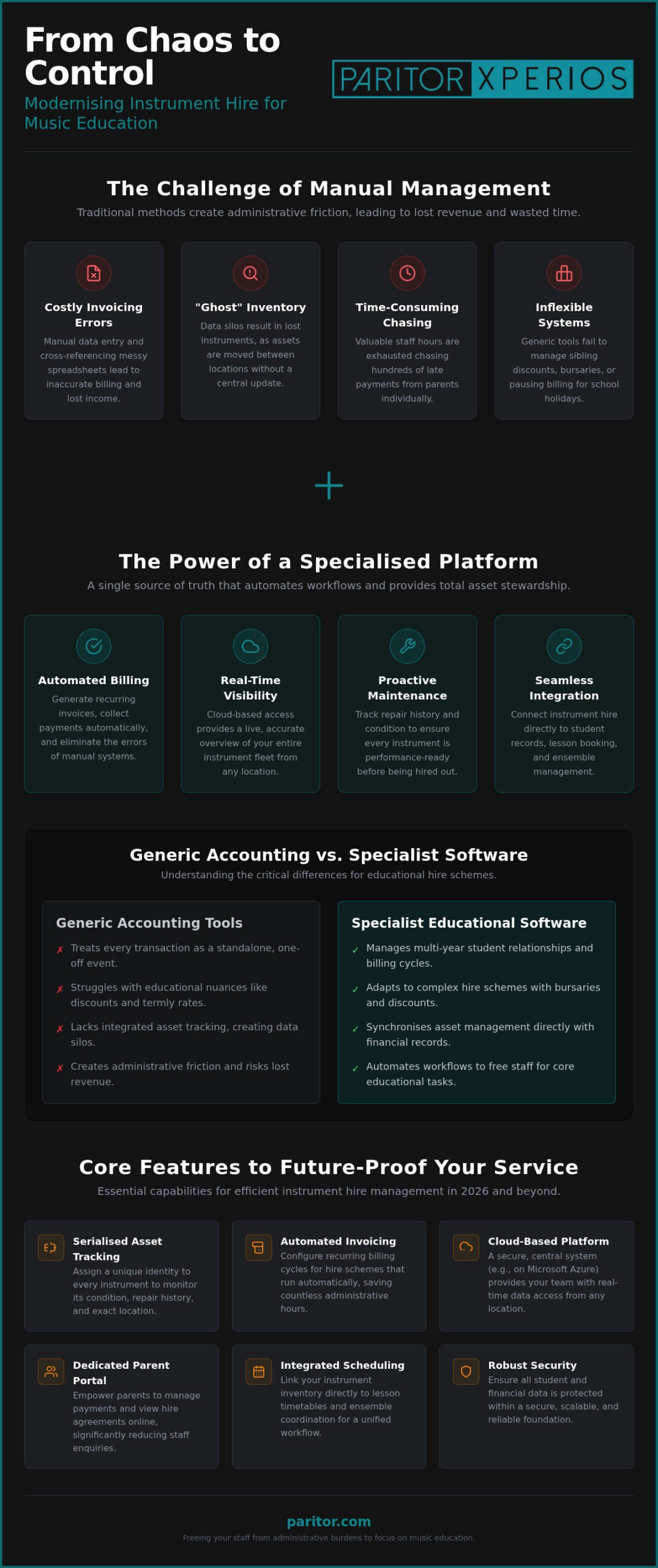
Generic accounting software often fails because it treats every transaction as a standalone event. In the world of music education, however, a rental is rarely a simple “one-off” interaction. Traditional accounting tools struggle with the nuances of educational hire, such as applying sibling discounts, managing bursary-supported subsidised rates, or pausing billing during school holidays. Specialist systems understand these equipment rental business models and adapt to them, preventing the administrative friction that leads to lost revenue and frustrated parents. Integrated billing is the automated synchronisation of asset tracking and financial transactions.
By linking your billing directly to student records and lesson bookings, you create a seamless flow of information. If a student stops their tuition, the system can automatically flag the outstanding instrument return and adjust the final invoice. This level of connectivity ensures that no asset is forgotten and no payment is missed, providing a stable foundation for your service’s growth.
The Shift from Spreadsheets to Cloud-Based Systems
Managing high-value assets like cellos or saxophones on manual spreadsheets is a high-risk strategy. Data silos often lead to “ghost” inventory, where instruments are lost in the system because a peripatetic teacher moved them between schools without a central update. Moving to a cloud-based platform like Xperios provides a single version of truth for your entire organisation. Because it’s hosted on Microsoft Azure, your team can access real-time data from any location, ensuring that administrators and teachers stay perfectly aligned. It’s about moving from reactive crisis management to proactive, organised oversight.
Who Benefits Most from Specialist Billing Software?
The transition to professional software empowers various stakeholders across the sector:
- Music Hubs and Services: Organisations managing large-scale loan schemes benefit from automated bulk invoicing and simplified asset recovery.
- Conservatoires and Arts Schools: These institutions can track diverse equipment inventories with precision, ensuring every specialist tool is accounted for and maintained.
- Private Teachers: Individual educators use these tools to professionalise their invoicing, using the Xperios Parent Portal to reduce the time spent on manual payment chasing.
The Core Mechanics of Modern Instrument Rental Billing
The music instrument rental market is evolving rapidly, requiring music services to move beyond basic ledger entries and manual payment chasing. Efficient instrument rental billing software functions by bridging the gap between physical inventory and the student’s educational journey. It’s not just about collecting fees; it’s about total stewardship. By using serialised tracking, every violin or trumpet is assigned a unique identity that follows it from the warehouse to the classroom, ensuring that no asset ever disappears from your records.
Serialised Asset Management and Maintenance
Serialisation allows you to monitor the entire lifecycle of an instrument with absolute precision. You can track the current condition, repair history, and exact location of every item in your fleet. This creates a robust digital paper trail that’s essential for insurance claims and internal auditing. It also ensures instruments are always performance-ready. If a cello has a recurring bridge issue, the system flags its maintenance history before it’s ever reassigned to a new student. This proactive maintenance keeps your inventory in top shape and protects your long-term investment.
Automated Invoicing and Payment Collection
Automation is the heartbeat of a modern music hub. The software generates invoices based on predefined hire periods, whether that’s termly, monthly, or annually. By integrating Direct Debits or card payments, the system ensures recurring billing happens on time without any manual intervention. This approach significantly reduces the volume of late payments that typically plague music services. When a payment fails or a return is overdue, the software sends automated email and SMS reminders. This removes the administrative burden from your team, allowing them to focus on supporting peripatetic staff rather than chasing arrears. For those looking to dive deeper into these processes, our guide to Xperios Financial Management offers extensive insights into total financial automation.
Modernising the hire process also involves removing paper barriers. Digital contracts and e-signatures allow parents to sign hire agreements instantly on their mobile devices. This speeds up the distribution process and ensures you have a legally binding record before the instrument leaves the building. It’s a professional touch that builds immediate trust with families. You’ll find that organising your inventory through a centralised system like this restores hours of administrative time to your week.
Retail vs Educational: Why Your Hire Scheme Needs Specialist Software
Most instrument rental billing software on the market is built for the high street. These systems are designed for Point of Sale (POS) environments where a customer walks in, rents a clarinet, and leaves. But for a Music Hub or Local Authority service, the transaction is just the beginning. You aren’t just managing a rental; you’re supporting a multi-year educational journey. Retail-centric tools often fail because they lack the student-data depth required by music hubs, treating students as one-off customers rather than evolving learners.
Specialist software bridges this gap by integrating the hire process with school timetables and teacher portals. It understands that a student’s hire fee might change if they join an ensemble or if their sibling starts violin lessons. POS systems simply aren’t equipped to handle these nuances, leading to manual workarounds that drain your team’s energy. When your billing system “talks” to your scheduling data, you can automatically pause hire charges if a student’s lessons are suspended, preventing the awkward conversations that arise from billing errors. By adopting a system built on collaborative user input, you ensure your administrative processes align perfectly with your educational goals.
Managing Discounts and Bursaries
Handling complex fee structures is where specialist tools truly shine. Retail systems aren’t built to automate remissions for pupil premium students or tiered pricing for families with multiple children. Specialist software applies these discounts automatically based on student demographics, ensuring financial fairness whilst maintaining accurate records. This level of automation is vital for local authority reporting, providing a clear, professional audit trail of how bursaries are allocated across your service. It removes the guesswork from your finance team, allowing them to focus on sustainability rather than spreadsheet formulas.
The Parent Portal Experience
A self-service parent portal for music schools is essential for reducing the daily volume of administrative enquiries. Instead of phoning your office to update payment details or check a hire history, parents can manage their own accounts online. This transparency builds trust and professionalises your brand. It allows families to report instrument issues directly, ensuring that small repairs are caught early before they become expensive replacements. By empowering parents with real-time access, you’re transforming your back-office into an industrious engine that supports teaching rather than hindering it.
Essential Features for Streamlining Your Instrument Hire in 2026
The standard for instrument rental billing software in 2026 has shifted from simple data entry to comprehensive ecosystem management. It’s no longer enough to just track a serial number; the software must act as a bridge between your financial department and the classroom. This level of connectivity ensures that your administrative team isn’t working in a vacuum, but is instead supported by a system that understands the heartbeat of a music service. When your billing is deeply integrated with your educational delivery, you create a professional environment that benefits staff, students, and parents alike.
Reporting and Financial Oversight
Effective management requires clear, actionable data. Modern systems allow you to generate detailed reports on instrument utilisation, showing exactly which assets are in high demand and which are gathering dust in the warehouse. This data is vital when justifying future budget allocations to local authorities or stakeholders. You can also track depreciation and replacement costs across your entire inventory, ensuring you’re never surprised by the need for a fleet refresh. Real-time financial dashboards empower managers to make data-driven decisions that ensure long-term sustainability. By having these insights at your fingertips, you move from reactive budgeting to proactive financial planning.
Integration with Educational Workflows
Your hire scheme doesn’t exist in isolation; it’s a part of the student’s wider musical journey. Specialist software allows you to link instrument hire to specific ensembles or exam preparations, ensuring that every student has the correct equipment for their level of study. One of the most significant time-savers is the automation of the “exit” process. When a student leaves a service, the system can automatically trigger an instrument return request and cease billing on the correct date. This eliminates the “billing lag” that often occurs with manual systems. For larger organisations, integrating with third-party accounting software used by local authorities ensures that your financial data flows seamlessly into the wider corporate structure without the need for duplicate entry.
Security and accessibility are equally paramount. Portals for teachers and parents must be mobile-responsive, allowing peripatetic staff to check instrument locations whilst on-site at schools. This accessibility is built on a foundation of robust data security, utilising secure cloud hosting on Microsoft Azure and ensuring full GDPR compliance to protect sensitive student information. This level of professional infrastructure is what transforms your back-office into an industrious engine of growth. To see how these features can transform your organisation, you can explore our specialist instrument management modules today.
Future-Proofing Your Music Service with Xperios
Adopting a professional standard for your administration is a decisive step toward long-term sustainability. Xperios has established itself as the premier choice for UK music and performing arts services by focusing on the specific needs of educators rather than retailers. Whether you’re an individual teacher managing a handful of violins or a large national hub overseeing thousands of assets, the platform scales with your ambitions. It provides a stable, reassuring presence that allows your team to stop worrying about paperwork and start focusing on student outcomes. By choosing specialist instrument rental billing software, you’re investing in a partnership that values your mission as much as your efficiency.
Security and Regulatory Compliance
Protecting sensitive student data is a non-negotiable requirement for modern educational institutions. Hosting your records on a secure, cloud-based platform like Microsoft Azure ensures that your data benefits from enterprise-level security and redundancy. This infrastructure is particularly vital when managing GDPR compliance for music schools, as it provides the necessary tools to handle personal information with total transparency and safety. Reliability comes from experience. With over 30 years of sector-specific expertise since our founding in 1993, we’ve built a system that understands the regulatory pressures you face. You can trust that your records are held in a secure environment supported by a dedicated, UK-based team that speaks your language.
Next Steps: Modernising Your Hire Scheme
The transition from legacy systems or fragmented spreadsheets doesn’t have to be a daunting hurdle. Moving your data into a centralised system is a journey of modernisation that rewards you with reclaimed time and reduced stress. Paritor’s implementation and onboarding teams act as your expert facilitators, guiding you through every stage of the setup process to ensure your data is migrated accurately. We don’t just provide software; we provide a pathway to a more organised professional life. Our team works alongside you to configure the system to your specific workflows, ensuring that the “industrious engine” of your back-office is tuned for maximum performance from day one.
It’s time to move beyond the limitations of manual entry and embrace a system built on collaborative user input. Discover how Xperios for Music Services can transform your instrument hire scheme and provide the financial oversight your organisation deserves. By making the switch today, you’re ensuring that your music service remains resilient, professional, and ready for the challenges of 2026 and beyond.
Elevating Your Music Service for the Future
Transitioning to professional instrument rental billing software is more than a technical upgrade; it’s a commitment to the long-term health of your music service. By automating the repetitive labour of invoicing and payment chasing, you transform your back-office into an industrious engine that supports your educational mission. We’ve explored how serialised tracking ensures asset security whilst specialist modules handle the complex bursaries and sibling discounts that retail systems simply can’t manage.
Choosing a platform trusted by UK Music Hubs since 1993 provides you with the stability of three decades of sector experience. With secure hosting on Microsoft Azure and dedicated modules for Financial Management, you gain a partner that prioritises your data safety and professional growth. It’s time to move beyond the limitations of spreadsheets and reclaim your administrative time for what truly matters: inspiring the next generation of musicians.
Book a demo of Xperios to see our instrument billing in action and discover the relief of a system designed specifically for your needs. We’re here to help you organise your future with confidence.
Frequently Asked Questions
What is the best way to track a large instrument inventory?
The most effective method is using a centralised, cloud-based database that employs serialised tracking for every asset. This approach replaces unreliable spreadsheets with a single version of truth accessible to all staff. By assigning a unique identity to each violin or trumpet, you can monitor its exact location and condition in real time. This level of organisation prevents inventory loss and ensures that your fleet remains a productive part of your music service.
Can instrument rental software automate recurring monthly payments?
Yes, specialist instrument rental billing software is designed specifically to automate recurring payments through Direct Debit or secure card processing. Once a hire agreement is established, the system generates termly or monthly invoices and collects funds without manual intervention. This automation eliminates the need for your team to chase arrears, significantly improving your cash flow whilst providing parents with a predictable and professional payment experience that just works every time.
How does billing software handle instrument repairs and maintenance costs?
Modern systems include dedicated maintenance logs that link directly to each serialised instrument record. You can record every repair, string change, or annual service, creating a comprehensive digital paper trail for insurance and auditing. This functionality allows managers to track the total cost of ownership for specific brands or models. By monitoring these maintenance expenses, you can make informed, data-driven decisions about when to retire older stock and invest in new inventory.
Is it possible to integrate instrument hire with our teaching timetable?
Integration is a core feature of educational platforms like Xperios. By linking instrument hire records directly to your teaching timetable, you ensure that billing only occurs whilst a student is actively receiving tuition. If a student withdraws from lessons, the system can automatically flag the outstanding instrument return and cease future invoices. This connectivity prevents the administrative errors and parent complaints often caused by the data silos found in generic accounting tools.
How does the software handle discounts for siblings or low-income families?
Specialist software handles complex fee structures by automating remissions for pupil premium students or applying tiered discounts for families with multiple children. These rules are predefined within the system, ensuring that every invoice is calculated accurately based on the student’s demographic data. This automation ensures financial fairness across your service whilst providing the clear audit trails required for local authority reporting and bursary allocation, removing the stress of manual calculation.
What security measures should I look for in a cloud-based billing system?
You should prioritise platforms hosted on enterprise-level infrastructure like Microsoft Azure, which offers robust data redundancy and encryption. Ensure the system is fully GDPR compliant to protect sensitive student and parent information. Look for providers with a long-standing reputation in the UK music sector, as they’ll understand the specific regulatory requirements and institutional safety standards needed to maintain professional trust and protect your organisation’s reputation.
Can parents manage their own instrument hire accounts online?
Parents can certainly manage their accounts through a dedicated Parent Portal. This self-service interface allows families to update their payment details, view their full hire history, and report instrument faults online at their convenience. By empowering parents to handle these routine tasks, you significantly reduce the volume of administrative enquiries reaching your office. This transparency builds stronger partnerships with families and professionalises the way your music service communicates with its community.
Does the software support serialised tracking for high-value assets?
Serialised tracking is a fundamental component of professional instrument rental billing software. It allows you to assign a specific identity to high-value assets like saxophones or double basses, tracking their entire lifecycle from procurement to disposal. This precision is vital for effective stewardship, as it ensures you always know which student has which specific instrument. It simplifies the auditing process and provides the detailed records necessary for insurance claims and long-term financial forecasting.