

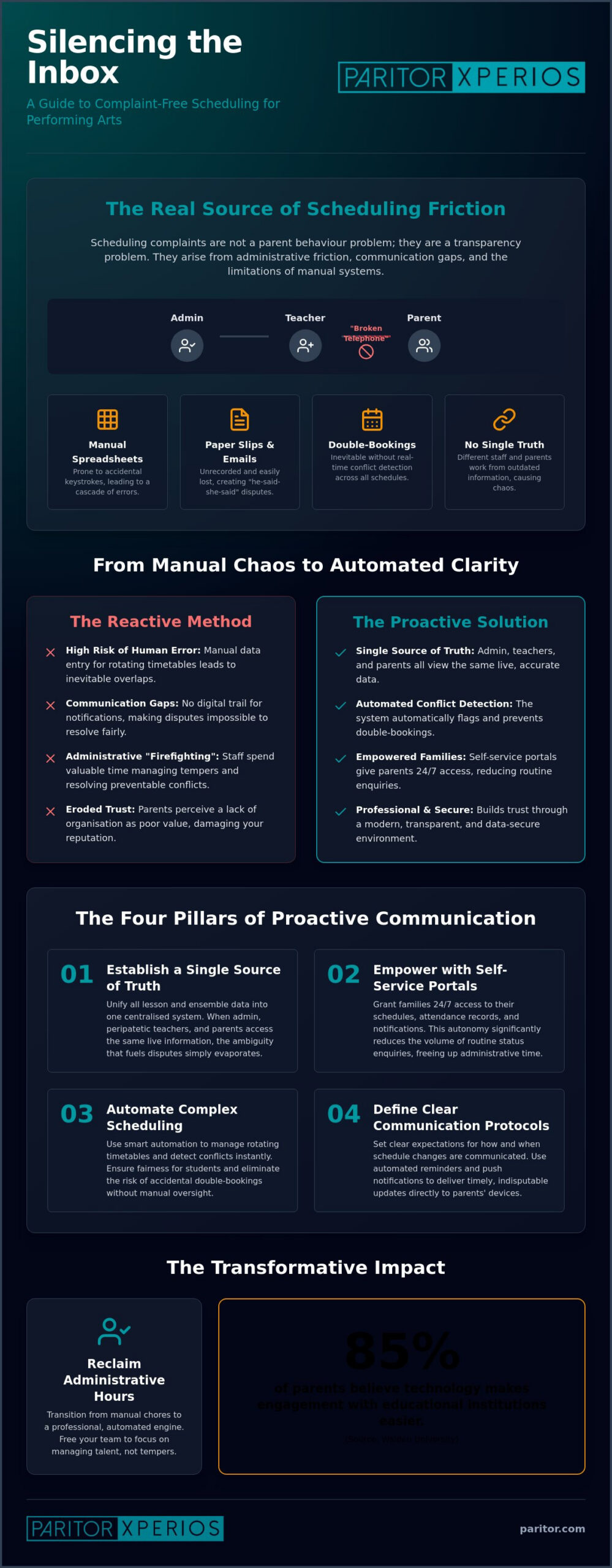
Scheduling complaints aren’t actually a parent behaviour problem; they’re a transparency problem. We understand the sinking feeling of discovering a double-booking on a manual spreadsheet or navigating yet another “he-said-she-said” dispute over a missed lesson notification. Avoiding parent complaints about scheduling starts with removing the administrative friction that weighs down your peripatetic teachers and office staff alike. It’s a taxing cycle that pulls your team away from their primary creative mission, leaving you to manage tempers rather than talent.
You deserve a system that works as hard as you do. This guide will show you how to eliminate manual errors and silence the inbox by transforming your scheduling from a chore into a transparent, automated engine. We’ll explore how to establish a single source of truth for all lesson and ensemble data, ensuring that every notification is clear, timely, and beyond dispute. By the end of this article, you’ll see exactly how to reclaim your time and build a professional, modern environment where communication flows seamlessly and the administrative burden finally lifts.
Key Takeaways
- Identify the “Broken Telephone” effect between teachers and admin that triggers most scheduling friction in performing arts environments.
- Discover how establishing a definitive source of truth is the key to avoiding parent complaints about scheduling and manual spreadsheet errors.
- Learn how self-service portals empower families with 24/7 access to lesson data, significantly reducing the volume of routine status enquiries.
- Explore how automated conflict detection and lesson rotation ensure fairness and eliminate the risk of accidental double-bookings.
- Reclaim your administrative hours and ensure data security by transitioning from manual chores to a professional, automated engine.
Understanding Why Scheduling Friction Occurs in Music Services
Scheduling for performing arts services is a delicate balancing act that requires precision, yet it is often managed with tools that are fit for purpose. It isn’t just about finding a time slot; it’s about synchronising a complex web of peripatetic teachers, room availability, and academic timetables. When these elements aren’t perfectly aligned, the “Broken Telephone” effect takes over. Admin staff might communicate a change to a teacher, but if the parent remains in the dark, the system has failed. This information asymmetry is a primary driver of frustration. Parents perceive a lack of organisation as a sign of poor value, which quickly erodes the trust you’ve worked hard to build.
Effective communication with families is essentially a specialised form of Customer Relationship Management (CRM). Without a centralised system, you’re essentially flying blind. Manual spreadsheets are particularly dangerous in high-volume environments where a single accidental keystroke can lead to a cascade of double-bookings. Last-minute changes are inevitable in the arts, but without a robust way to broadcast those updates, you’re left managing the emotional fallout rather than the music. Avoiding parent complaints about scheduling requires moving beyond these fragile, manual processes.
The Complexity of the Rotating Timetable
Standard school scheduling software often fails music services because it expects fixed, weekly periods. Instrumental lessons usually require a rotating timetable to ensure students don’t miss the same academic subject every week. Managing these rotations manually, whilst accounting for room constraints and specific instrument needs, is an immense administrative burden. It’s a logistical puzzle where the pieces change every term. Without automation, the risk of human error is high, leading to the very overlaps that trigger parent emails.
Communication Gaps in Manual Systems
Relying on paper slips in blazer pockets or unrecorded emails is a recipe for disaster. Avoiding parent complaints about scheduling is nearly impossible when your evidence is buried in a teacher’s personal inbox. When a parent claims they never received a notification, and you have no digital trail to prove otherwise, the dispute becomes a matter of opinion. The administrative cost of resolving these avoidable arguments is significant. It drains the energy of your team and distracts from your primary educational mission.
Proactive Communication: The First Line of Defence
Stopping friction before it starts is the most effective strategy for avoiding parent complaints about scheduling. It requires moving away from reactive “firefighting” and towards a system where everyone operates from a single source of truth. When your administrative team, peripatetic teachers, and parents all look at the same live data, the ambiguity that fuels disputes simply evaporates. This consistency ensures that a lesson change made in the morning is visible to the parent by lunchtime, preventing the confusion that typically leads to an angry inbox.
Setting clear expectations during the initial enrolment process is equally vital. If parents understand exactly how and when they’ll be notified of changes, they’re far less likely to feel aggrieved when a rotation occurs. Research indicates that 85% of parents believe technology makes engagement with educational institutions easier. By leveraging digital tools to Improve Parent-Teacher Communication, you create a professional boundary that protects your staff. Automated reminders are the final piece of this puzzle; they pre-empt the common “we forgot” excuse by placing the schedule directly into the parent’s hand via their smartphone.
Defining Your Communication Protocol
Establishing a standard window for schedule amendments helps manage parental expectations. You might decide that all weekly changes must be finalised by Friday afternoon, for instance. Rather than relying on passive emails that get buried amongst newsletters and spam, use push notifications to deliver high-priority updates. This ensures that peripatetic teachers are perfectly aligned with the central office, presenting a united front to families. Using a dedicated management platform allows you to synchronise these messages automatically across all portals.
The Role of Transparency in Building Trust
Parents value real-time access because it eliminates the “anxiety of the unknown” that often accompanies performing arts education. When they can check lesson times at 9 PM on a Sunday without waiting for the school office to open, the relationship shifts from combative to collaborative. This transparency proves that your service is organised and student-focused. It transforms scheduling from a weekly hurdle into a seamless, background process that supports the pupil’s musical journey rather than hindering it.
Implementing Self-Service Portals to Empower Parents
Traditional methods of managing parent enquiries often involve a high volume of “just checking” phone calls and emails. This manual workload is a significant drain on administrative resources and often leads to staff burnout. By implementing the Xperios Parent Portal, you provide families with 24/7 access to their child’s lesson times. This shift is a cornerstone of avoiding parent complaints about scheduling because it replaces uncertainty with immediate, verifiable data. When parents can see their schedule, attendance history, and teacher notes in one place, the need for constant back-and-forth communication drops dramatically.
Research suggests that 85% of parents believe technology makes engagement with educational institutions easier. By providing digital access, you can significantly reduce the volume of routine status enquiries that clog your inbox. Giving parents the ability to update their own personal circumstances or report planned absences directly through the system ensures your data remains accurate without constant manual entry. This transparency links scheduling directly to attendance tracking, providing full visibility that protects your service from disputes over missed lessons.
The Psychology of Self-Service
Parents today expect the same level of digital convenience in education that they experience with banking or shopping. They often prefer checking an app at their convenience rather than calling an office during restrictive working hours. This immediate access de-escalates potential conflicts before they ever reach your team. It moves the dynamic from one where parents must “ask permission” for information to one where they are empowered to “access information” autonomously. Providing this level of control fosters a sense of partnership and professional trust that manual systems simply cannot match.
Integrating Portals with Existing Workflows
A portal is only as good as the data it displays. The Xperios Parent Portal is designed to reflect real-time changes made by peripatetic teachers via their own dedicated portal. This ensures that if a lesson is moved to accommodate a school trip, the parent sees the update instantly on their own device. Beyond just timing, this system can link scheduling directly to instrument inventory management software. For services running instrument hire schemes, this integration means parents can manage their child’s equipment and lesson schedule in a single, unified environment. The result is a seamless experience across desktop and mobile devices that keeps everyone aligned and informed, making avoiding parent complaints about scheduling a natural outcome of your workflow.
Automation and Real-Time Updates: Eliminating Human Error
Manual scheduling is a ticking time bomb for administrative errors. When you rely on spreadsheets or paper diaries, a single oversight can lead to a cascade of double-bookings and room conflicts. Automation removes this risk by acting as an intelligent gatekeeper. Conflict detection ensures that no teacher is assigned to two students simultaneously and that no rehearsal room is overbooked. This level of precision is the most robust foundation for avoiding parent complaints about scheduling, as it eliminates the logistical failures that typically spark frustration.
Fairness is a major concern for parents, especially regarding lesson rotation. Manually ensuring that a student doesn’t miss the same academic subject every week is an exhausting task for peripatetic staff. Automated systems handle this rotation instantly, applying logic that ensures every pupil receives an equitable experience. Beyond the timetable, automated attendance alerts serve as a vital safeguarding tool. If a student fails to arrive for a lesson, the system can immediately notify the parent, proving that your service prioritises student safety and professional accountability.
The Power of Intelligent Scheduling
Managing a music service requires a bird’s-eye view of both individual tuition and group activities. Modern ensemble management software allows you to oversee complex groupings and rehearsals alongside 1-to-1 lessons. This unified view reduces the manual workload during the high-pressure “timetabling period” at the start of each term. It ensures that ensemble commitments don’t clash with individual tuition, creating a harmonious schedule that supports the student’s entire musical development. To see how these tools can work for your organisation, you can transform your administrative efficiency with a purpose-built system.
Automated Notifications as Evidence
One of the greatest benefits of an automated engine is the digital audit trail it creates. When a parent claims they weren’t informed of a schedule change, you no longer have to rely on memory or unrecorded phone calls. Modern platforms provide data-backed logs of every notification sent, including “seen” receipts that confirm when a message was opened. This transparency de-escalates “missed lesson” disputes by providing objective evidence of communication. It shifts the conversation from a conflict of opinions to a review of the facts, protecting your staff’s time and your service’s reputation for reliability.
Reclaiming Your Time with Xperios for Music and Performing Arts
Adopting a modern administrative engine is about more than just organisation; it’s about reclaiming the mental space needed to lead your service. Xperios acts as the industrious engine behind your daily operations, performing the labour-intensive tasks that previously drained your team’s energy. By automating the most friction-prone elements of your workflow, you can scale your service and increase student numbers without the need to hire additional administrative staff. This efficiency is the ultimate tool for avoiding parent complaints about scheduling, as it ensures your operations remain precise even as they grow more complex.
Data security is a critical concern that generic school advice often overlooks, particularly within the UK’s strict regulatory environment. Managing sensitive pupil data requires more than just a password-protected spreadsheet. Xperios ensures full GDPR compliance, providing a secure environment for all personal and financial information. Built on Microsoft Azure cloud hosting, the platform offers institutional-grade reliability and data redundancy. This provides you with the peace of mind that your data is safe, accessible, and backed by world-class infrastructure, allowing you to focus on educational outcomes rather than technical vulnerabilities.
A System Built on Sector Collaboration
Legacy systems often feel like a burden because they weren’t built with the unique needs of music hubs or performing arts schools in mind. Xperios is different; it is the cloud management standard because it was developed through direct collaboration with sector professionals. Moving away from outdated, fragmented tools to a modern, growth-oriented platform is a necessary step in your professional journey. In 2026, the importance of specialised music service management software cannot be overstated. It provides the modularity and simplicity required to manage everything from ensemble rehearsals to instrument hire in one unified space.
Your Next Steps to a Complaint-Free Office
The transition from manual chores to an automated system begins with a simple assessment of your current friction points. Identify where the most “he-said-she-said” disputes occur and where your admin team spends the most time on repetitive data entry. Moving from spreadsheets to an integrated cloud platform is a transformative process that restores focus to your primary creative mission. Avoiding parent complaints about scheduling becomes a natural byproduct of a system designed for transparency. By empowering parents with information and protecting your teachers with automated workflows, you create an environment where music and talent can finally take centre stage.
Modernising Your Administrative Mission
Transitioning from manual spreadsheets to an automated engine isn’t just about operational efficiency; it’s about building lasting institutional trust. By centralising your data and empowering families with self-service portals, you eliminate the information gaps that traditionally lead to “he-said-she-said” disputes. This strategic shift is the most effective path for avoiding parent complaints about scheduling whilst protecting your peripatetic teachers from administrative burnout. When everyone operates from a single source of truth, the focus naturally returns to the music.
Built on 30 years of industry expertise and trusted by leading UK music hubs, our platform provides a secure, stable foundation through Microsoft Azure hosting. You’ve dedicated your professional life to fostering talent and creativity; it’s time your software performed the heavy lifting for your office. Discover how Xperios can transform your organisation’s scheduling today and reclaim the time you need to grow your service. Your journey towards a quieter inbox and a more professional, modernised environment starts here.
Frequently Asked Questions
What is the most common cause of parent complaints regarding scheduling?
The primary cause is information asymmetry, where parents lack real-time visibility into schedule changes. This gap creates a “Broken Telephone” effect where instructions from admin staff or peripatetic teachers don’t reach the family in time. Avoiding parent complaints about scheduling is much easier when you eliminate this uncertainty by providing a definitive, digital source of truth that parents can access instantly.
How can a parent portal help reduce administrative enquiries?
Parent portals reduce enquiries by providing a 24/7 self-service hub for schedule and attendance data. Instead of phoning the office to confirm a lesson time or check a rotation, parents simply log in to see the most current information. This autonomy shifts the administrative burden away from your staff and empowers families to manage their child’s musical commitments on their own terms.
Can scheduling software handle rotating music lesson timetables?
Specialised systems are designed specifically to manage the complex logic of rotating instrumental timetables. Unlike standard school software, these platforms can automate rotations to ensure pupils don’t miss the same academic lesson every week. This automation ensures fairness and removes the risk of human error that typically occurs when trying to track these changes manually on a spreadsheet or paper diary.
Is it possible to automate lesson reminders for parents and students?
Automation allows you to schedule push notifications or emails that go out automatically before every lesson or rehearsal. These reminders act as a proactive safeguard against “forgotten” lessons, which are a frequent source of friction. By placing the schedule directly into the parent’s hand via their smartphone, you ensure they stay informed without any manual intervention from your office team.
How does real-time scheduling improve safeguarding in music services?
Real-time scheduling improves safeguarding by providing immediate attendance alerts if a pupil fails to arrive for their session. This transparency ensures that both the service and the parents are instantly aware of a student’s whereabouts. Having a live, centralised record of every lesson and ensemble activity also ensures that staff can account for every child in the event of an emergency.
What should I look for in a performing arts school administration system?
You should prioritise a system that offers modularity and deep sector-specific functionality, such as ensemble and instrument management. Look for a platform that is built on collaborative user input and hosted on a secure infrastructure like Microsoft Azure. A truly effective system will feel like an industrious engine that supports your growth without requiring you to increase your administrative headcount.
How can we handle complaints about lesson changes more effectively?
Handling disputes is more effective when you have a digital audit trail of all sent notifications. If a parent disputes a change, you can refer to time-stamped logs that prove when the update was broadcast and received. This objective data de-escalates conflicts by moving the conversation away from personal opinions and towards verifiable facts, protecting your staff’s professional reputation and saving hours of administrative time.
Is cloud-based scheduling software secure for storing pupil data?
Modern cloud-based platforms offer institutional-grade security that far exceeds traditional local storage or paper files. Platforms like Xperios are designed for full GDPR compliance and utilise advanced encryption to protect sensitive pupil data. This secure hosting provides a foundation of professional trust, ensuring that your organisation meets all regulatory requirements whilst protecting the privacy of the families you serve.