
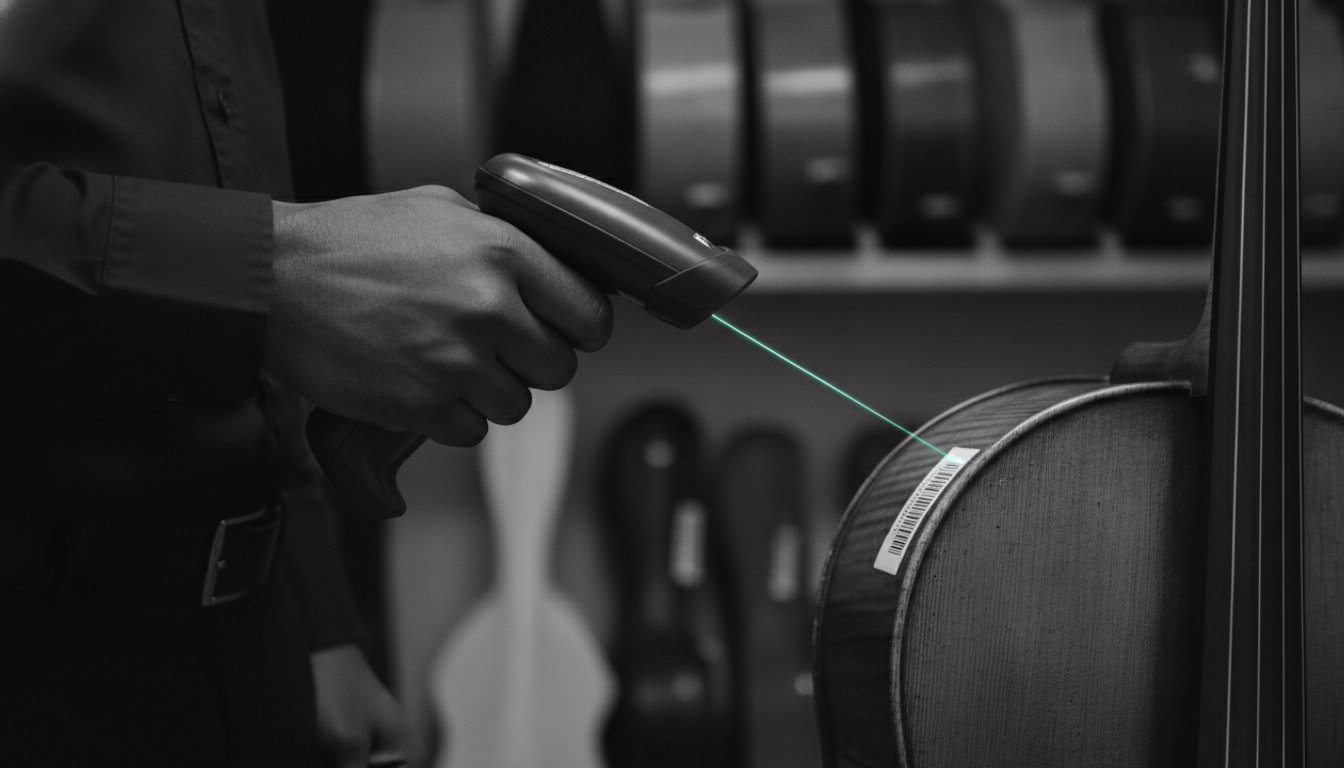
Imagine it’s the first week of the 2026 autumn term and a parent is adamant they returned a high-value flute before the summer holidays, yet your records are a confusing tangle of manual entries and missing signatures. You know that managing hundreds of assets is a relentless task that often leads to misplaced items and awkward disputes over damages. It’s frustrating when administrative paperwork eats into the time you should be spending on musical excellence.
We’re here to help you reclaim that lost time. In this guide, you’ll learn how a professional barcode system for instrument tracking eliminates manual errors and secures your inventory with absolute precision. By adopting the Xperios Instrument Management module, you can move from guesswork to a real-time view of every asset in your collection. We’ll show you how to automate loan agreements and accelerate your check-in processes, ensuring your music service remains organised, protected, and ready for the future.
Key Takeaways
- Identify the hidden financial drain of ghost assets and understand how manual spreadsheet management impacts staff morale and productivity.
- Discover how a professional barcode system for instrument tracking creates a seamless, cloud-based workflow that eliminates human error during busy term-time transitions.
- Compare various tracking technologies to see why barcodes remain the most reliable and cost-effective choice for large-scale musical inventory.
- Learn a structured five-step roadmap to successfully transition your existing records into a modern, digitised management environment with minimal disruption.
- See how integrating your inventory with the Xperios Instrument Management module provides a comprehensive, real-time view of loans, student portals, and teacher schedules.
The High Cost of Disorganised Instrument Inventory
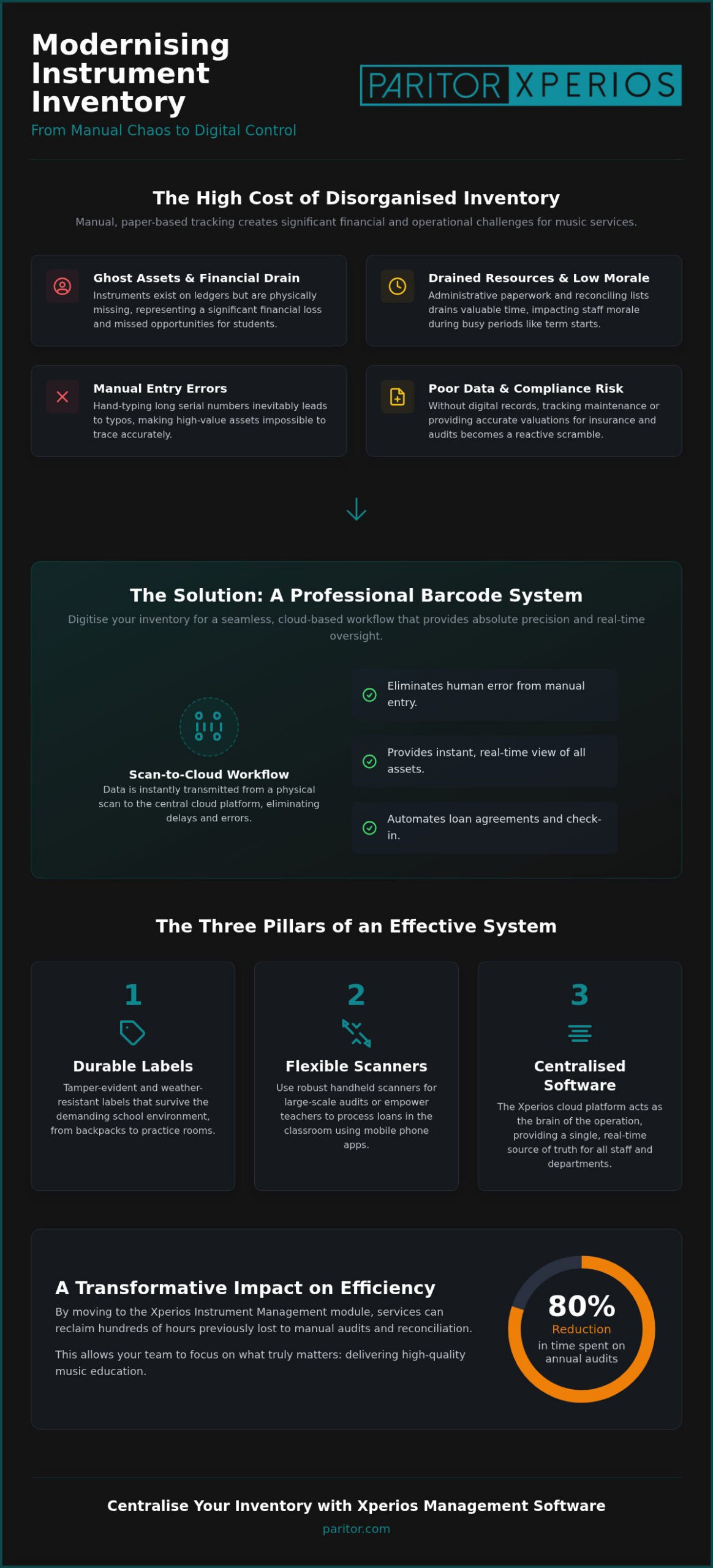
Managing a music service is a labour of love, but the administrative burden of tracking hundreds of violins, brass instruments, and woodwinds can quickly turn into a logistical nightmare. When you rely on fragmented spreadsheets, you aren’t just managing data; you’re managing stress. Staff morale often dips during the frantic start-of-term rush because manual entry is prone to errors. A professional barcode system for instrument tracking transforms this experience by replacing guesswork with certainty. It’s time to address the “ghost assets” that haunt your balance sheets, instruments that exist on a ledger but have long since vanished from the stockroom. These missing items represent a significant financial loss and a missed opportunity for a child waiting to learn.
As we move into 2026, the transition away from paper-based loan agreements is no longer a luxury; it’s an institutional necessity. Disorganised inventory directly impacts student equity. If a child is ready to start lessons but the instrument they need is “missing” due to poor tracking, the educational gap widens. Accountability is the foundation of a fair and accessible music service, and digital systems provide the stability required to scale your offerings safely.
Common Failures in Traditional Tracking Methods
Traditional methods often fail when they’re needed most. During the September intake, transcribing long serial numbers by hand leads to inevitable typos. A single digit out of place makes a high-value cello impossible to trace. Beyond simple location, manual systems rarely capture the full history of an item. Without a digital record, tracking maintenance schedules or repair costs becomes a reactive scramble rather than a proactive strategy. This lack of data makes it incredibly difficult to provide the accurate valuations required for insurance compliance or local authority audits. Reconciling physical stock with outdated lists is a drain on your most valuable resource: time.
The Benefits of Digital Accountability
Modern asset tracking systems offer a level of visibility that paper-based agreements simply cannot match. By 2026, the expectation for music services has shifted toward instant, cloud-based access. When you digitise your inventory, you gain immediate insight into where every asset is located, whether it’s in a school cupboard or a student’s home. This transparency ensures student equity, as you can quickly reallocate underused instruments to those on waiting lists.
By moving to the Xperios Instrument Management module, many services find they can reduce the time spent on annual audits by up to 80%. This efficiency allows your team to focus on what truly matters: delivering high-quality music education. Streamlining the transition between different teachers and departments becomes effortless when everyone is working from the same real-time data source. It’s about empowering your staff with tools that work as hard as they do.
How a Barcode System for Instrument Tracking Actually Works
At its heart, a barcode system for instrument tracking is a digital handshake between your physical inventory and your administrative records. It’s a simple yet powerful loop that ensures every asset is accounted for without the friction of manual typing. This system isn’t just about stickers; it’s a coordinated workflow involving durable labels, hardware scanners, and centralised management software that acts as the brain of your operation.
The “Scan-to-Cloud” workflow is the engine of this process. When a teacher or administrator scans a label, the data is instantly transmitted to the Xperios cloud platform. This eliminates the delay between the physical action of a loan and the digital update in the office. 1D and 2D barcodes remain the gold standard for educational inventory because they’re incredibly cost-effective and require no power source. Unlike complex RFID tags that can fail or require expensive maintenance, a barcode is always ready to be read, even after years in a student’s instrument case.
The Three Pillars: Labels, Scanners, and Software
Success depends on three key components working in harmony. First, you must choose the right label material. In a school environment, “tamper-evident” and “weather-resistant” labels are non-negotiable. They need to survive being shoved into backpacks and handled by excited children. Second, you need flexible hardware. Whilst dedicated handheld scanners are robust for large-scale audits, mobile phone applications allow teachers to process loans directly in the classroom.
Finally, your software must be the glue that holds everything together. The true benefits of asset tracking are realised when your inventory list talks directly to your student database. This integration ensures that when a scan occurs, the system knows exactly who has the instrument and when it’s due back. If you’re looking to simplify these complex tasks, the Xperios Instrument Management module is designed to perform this heavy lifting for you.
Data Security and UK Compliance
In 2026, data security is a primary concern for any educational body. Your instrument tracking data must be hosted securely in the UK to ensure compliance and peace of mind. By using Microsoft Azure hosting, you benefit from enterprise-grade reliability and high system uptime, ensuring your records are available whenever you need them. Meeting GDPR requirements is also straightforward when you use a platform designed for the UK music sector. Linking student names to instrument barcodes is handled with strict encryption, ensuring that personal data remains protected whilst your inventory remains visible.
Barcodes, QR Codes, or RFID: Which is Best for Music Hubs?
Choosing the right technology for your inventory is a decision that impacts your daily workflow for years. Whilst it’s tempting to look for the most advanced solution available in 2026, the best choice is often the one that teachers can use without a manual. A professional barcode system for instrument tracking offers a pragmatic balance between cost, speed, and reliability that more complex systems struggle to match. You need a solution that works in a damp storage room just as well as it does in a bright classroom.
Standard Barcodes (1D) vs QR Codes (2D)
Traditional 1D barcodes are the familiar vertical lines found on almost every consumer product. They remain a favourite for music services because they are exceptionally fast at bulk scanning. If you’re checking in fifty violins at the end of a term, the speed of a 1D scanner is unbeatable. This same efficiency is what makes them indispensable for commercial transactions; for example, you can learn more about BarraPOS to see how barcode scanning integrates into professional retail software. QR codes, or 2D barcodes, offer more information density. They can store URLs that lead students directly to a maintenance video or a digital sheet music library. However, QR codes can be more sensitive to damage. If a label is scuffed inside a brass case, a 1D barcode is more likely to remain readable. For most hubs, the simplicity of a standard barcode provides the most stable foundation for long-term asset management.
The Reality of RFID for Music Services
Radio Frequency Identification (RFID) is often marketed as the ultimate “hands-free” solution. The idea is that you can scan an entire cupboard of instruments just by walking past with a reader. In practice, music services face a significant hurdle: signal interference. The high metal content in brass instruments and the dense wood of cellos can block or reflect RFID signals, leading to inaccurate counts. This inaccuracy is a major risk when you’re trying to eliminate “ghost assets” that exist on paper but not in reality.
Cost is another critical factor. Implementing RFID can be five times more expensive than a barcode system for instrument tracking when you account for the tags and specialised readers. Most music hubs find that this investment doesn’t provide a proportional return. Barcodes are inherently more teacher-friendly because they provide an immediate, tactile confirmation of a scan. There is no ambiguity; the “beep” tells the teacher the job is done, allowing them to return to their students immediately. This reliability is why we continue to build our Xperios Instrument Management module around these core, dependable technologies.
Implementing Barcode Tracking: A 5-Step Transition Plan
Moving from a labyrinth of spreadsheets to a modern instrument tracking system is a transformative moment for any music service. It marks the shift from administrative guesswork to total inventory control. However, the transition requires a structured approach to ensure your staff and peripatetic teachers feel empowered by the new technology. Implementing a barcode system for instrument tracking is most successful when you treat it as a logical, phased journey rather than a weekend task.
Step 1 & 2: Data Audit and Label Selection
Before you touch a single instrument, you must address your data. Cleaning your current database ensures that you don’t migrate “ghost assets” or duplicate records into your new environment. You need a “one instrument, one record” policy to maintain absolute accuracy. A clean data audit is the foundation of any 2026 inventory system. Once your data is lean, you can order bespoke labels. These should be customised with your music service’s logo and contact details, serving as both a tracking tool and a clear mark of ownership for anyone who finds a misplaced item.
Step 3 & 4: The Labelling Blitz and Software Sync
The physical labelling process requires a gentle touch, especially with high-value assets. Unlike generic warehouse boxes, musical instruments have fragile surfaces and moving parts. Best practices suggest placing labels on the instrument case or on non-varnished areas where they won’t interfere with the player’s grip or the instrument’s resonance. Avoid valves, slides, and bridges at all costs. After labelling, bulk-upload your cleaned asset list into a central system like Xperios. This is the moment your physical stock finally syncs with your digital office. Take this time to test your scanners in various lighting conditions; instrument store rooms are notoriously dim, and you need to be sure your hardware can perform in every corner of your facility.
Step 5: Launching the New Loan Process
The final step is redefining the loan cycle itself. With your barcode system for instrument tracking now live, you can replace paper forms with digital signatures captured at the point of scan. This creates an immediate, legally binding record of the loan. You can also set up automated return reminders that trigger based on the barcode’s loan date, significantly reducing the number of instruments that go missing during the summer holidays. Finally, establish a clear protocol for “damaged on return” scans. By scanning an instrument back into the system and immediately flagging its condition, you eliminate disputes with parents and ensure that repairs are scheduled without delay. If you are ready to secure your inventory and reclaim your time, explore the Xperios Instrument Management module to begin your professional transition.
Centralising Your Inventory with Xperios Management Software
Generic asset tracking software often treats a high-value cello like a box of stationery. It lacks the nuance required for music education, where an asset’s value is tied to its playability and its role in a student’s development. By using a barcode system for instrument tracking that is built into a specialised platform, you bridge the gap between physical stock and educational delivery. Xperios doesn’t just record a location; it integrates loans directly with student portals and teacher timetables, ensuring the right instrument is always in the right hands at the right time.
Beyond Tracking: The Full Lifecycle Management
Managing a music service involves more than just knowing where a trumpet is currently located. You need to track its entire history, including repairs, annual valuations, and financial depreciation. Xperios allows you to maintain this data within a single, secure environment. If your service operates across multiple school “sub-hubs,” you can manage these disparate locations with ease, maintaining a bird’s-eye view of your entire inventory from a central office. This level of control is a natural extension of Ensemble Management Software, where every aspect of your service’s administrative life is synchronised and visible.
Empowering Parents and Students
Transparency builds trust amongst the families you serve. Through the Xperios Parent Portal, families gain instant visibility into the specific assets they are responsible for. When a student receives an instrument, the barcode scan can be linked to digital condition photos taken at the point of loan. This simple step drastically reduces disputes over damages upon return, as the evidence is clear, dated, and accessible to both parties. It creates a professional, modern image for your service, showing parents that you value your resources as much as their child’s musical journey. Families feel more accountable when they can see a clear digital record of the instrument in their care.
The ultimate benefit of this centralisation is the gift of time. Instead of spending days preparing for council audits or complex funding applications, you can generate comprehensive reports with a single click. This efficiency allows your team to move away from the taxing nature of manual administration and return to your primary mission: fostering musical talent. By 2026, the most successful music services won’t be those with the most instruments, but those with the most intelligent systems to manage them. Reclaiming your administrative hours starts with a professional barcode system for instrument tracking that works as an ally, not just a tool.
Securing Your Service’s Future in 2026
Transitioning to a professional barcode system for instrument tracking is more than just a technical upgrade; it’s a commitment to the long-term stability of your music service. By eliminating the friction of manual data entry and the financial drain of “ghost assets,” you reclaim the time needed to focus on your primary mission of musical excellence. We’ve explored how durable labelling and cloud-based workflows provide the real-time visibility necessary for modern accountability and student equity.
Choosing a partner that understands the specific needs of music education is essential. Xperios is already trusted by leading UK music services and hubs to manage their most valuable assets. Our platform is fully GDPR compliant and UK-hosted on Microsoft Azure, providing the institutional safety and reliability your organisation requires. You don’t have to manage these taxing administrative burdens alone.
Discover how Xperios transforms instrument tracking and see how our specialised modules can empower your team. Let’s work together to ensure every instrument in your collection is accounted for, protected, and ready for the next generation of performers.
Frequently Asked Questions
How much does a barcode system for instrument tracking cost?
The total cost depends on the size of your inventory and whether you choose dedicated hardware or mobile applications. Whilst we don’t provide fixed public pricing, a professional barcode system for instrument tracking typically involves a software subscription and a one-off investment in durable labels. This modular approach allows music services to scale their investment as their collection grows, ensuring you only pay for the capacity you actually need.
Do I need a special printer to create my own instrument barcodes?
You don’t necessarily need a special printer, but we recommend ordering professionally printed, tamper-evident labels for long-term durability. Whilst standard office printers can produce barcodes on adhesive paper, these often peel or fade when exposed to the moisture and friction common in instrument cases. Using high-quality, pre-printed labels with your service’s logo ensures that your tracking remains reliable and professional throughout the entire lifecycle of the asset.
Can I use a smartphone instead of a professional barcode scanner?
Yes, modern smartphones are highly capable of scanning barcodes through dedicated mobile apps. This is often the most convenient choice for peripatetic teachers who need to process loans in different school locations. However, for large-scale annual audits in a central warehouse, professional handheld scanners are often faster and more robust in low-light conditions. Xperios supports both options, giving your team the flexibility to choose the right tool for each specific task.
Is barcode tracking better than QR codes for musical instruments?
Barcodes are generally preferred for music hubs due to their superior scanning speed and reliability. Whilst QR codes can store more data, standard 1D barcodes are easier to read when labels are slightly scuffed or located in dimly lit storage rooms. Because music services often manage hundreds of similar items in bulk, the rapid point and scan nature of a barcode system for instrument tracking is usually more efficient than using QR codes.
How do I track instrument repairs using a barcode system?
You can track repairs by scanning the instrument’s barcode to open its digital history within the Xperios module. Once scanned, you can log the nature of the damage, the repair cost, and the date it was sent to the luthier. This creates a permanent audit trail for each asset. It’s an essential feature for maintaining accurate valuations and ensures that you never lose track of an instrument whilst it’s out for professional maintenance.
Is the data stored in a barcode system GDPR compliant?
Data security is built into the core of our platform. All information is hosted securely in the UK on Microsoft Azure, ensuring full compliance with GDPR regulations. When you link a student’s personal details to an instrument’s barcode, the system uses encryption to protect that sensitive information. This provides a secure environment for administrators, teachers, and parents, giving you peace of mind that your music service’s data is managed responsibly.
Can I track instruments across multiple school locations?
Yes, the cloud-based nature of the system allows for seamless tracking across any number of school sites or sub-hubs. When a teacher scans an instrument at a remote location, the central database updates instantly. This provides administrators with a real-time view of where every asset is located at any given moment. It eliminates the need for phone calls or manual spreadsheet updates between different departments, creating a truly unified inventory network.
What happens if a barcode label is peeled off or damaged?
If a label is lost, you can simply print or assign a new barcode to that specific asset within the software. The historical data, including previous loans and repair records, remains safely stored in the cloud and is immediately linked to the new label. To prevent this, we recommend using tamper-evident labels that are difficult to remove. These labels are designed to withstand the daily rigours of being handled by students and moved between venues.