

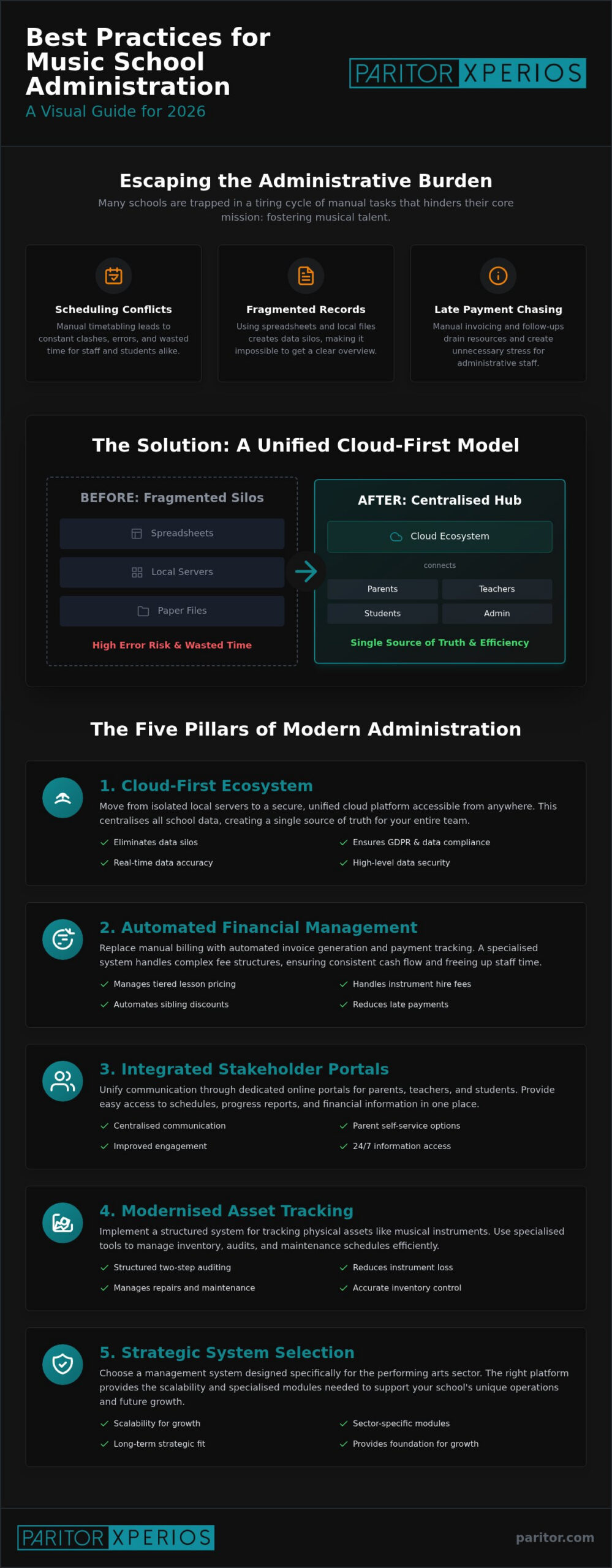
What if the most complex part of running your music school wasn’t the administrative paperwork, but the final rehearsals for your annual showcase? For many leaders, the daily reality is a tiring cycle of manual scheduling conflicts, losing track of instrument inventory, and the persistent stress of chasing late payments from parents. Adopting the best practices for music school administration 2026 allows you to move beyond these repetitive burdens. It’s an exhausting way to work; your true passion lies in fostering musical talent rather than managing spreadsheets.
We understand that the administrative weight can feel heavy, but this year marks a turning point for the sector. This guide shows you how to transform your operations into a silent, automated engine that supports your creative mission. You’ll discover how to modernise your music service or performing arts school with the latest strategies in digital automation, financial management, and student engagement. We’ll preview how a unified system for all data leads to automated invoicing and debt recovery, whilst simultaneously improving parent and teacher communication to ensure your school thrives in this new digital era.
Key Takeaways
- Move from fragmented local servers to secure, cloud-based ecosystems to centralise your data and eliminate administrative silos.
- Automate complex billing cycles and manage tiered pricing for lessons and ensembles to ensure consistent cash flow without manual chasing.
- Adopt the best practices for music school administration 2026 by implementing integrated portals that unify communication for parents, teachers, and students.
- Modernise your physical asset tracking with a structured two-step auditing process and specialised instrument management tools.
- Identify the essential criteria for selecting a management system that provides the scalability and sector-specific modules required for your school’s growth.
Transitioning to a Cloud-First Music Administration Model
A cloud-first model replaces isolated local servers with a unified, secure ecosystem that is accessible from any device. For many providers, 2026 represents the final tipping point for legacy system retirement. Keeping data in separate folders or physical filing cabinets creates administrative silos; these barriers prevent staff from seeing the full picture of a student’s journey. By centralising information, you ensure every department works from a single source of truth. Adopting these best practices for music school administration 2026 isn’t just about convenience. It’s about building a stable foundation for growth and reclaiming your time.
Data security is paramount for UK music hubs. Utilising Microsoft Azure provides a level of protection that local hardware simply cannot match. It ensures high-level encryption and data redundancy, meaning your records are safe even if your physical office faces a disruption. This technical infrastructure acts as an industrious engine behind the scenes. It allows your team to focus on tuition whilst the system handles the heavy lifting of data safety and professional reliability.
The End of the Spreadsheet Era
Manual data entry is often the primary cause of administrative burnout in performing arts schools. Whilst tools like Excel or Google Sheets appear free, they carry significant hidden costs in the form of human error and lost time. Transitioning to dedicated music service management software provides real-time accuracy that spreadsheets lack. When a parent updates their contact details in a portal, the change reflects across your entire system instantly. You no longer need to cross-reference multiple documents to find a simple phone number. It’s a shift that empowers your staff to work with confidence rather than frustration.
Ensuring GDPR and Data Compliance in the UK
As a data controller, your school has strict legal obligations regarding student information. Managing a complex curriculum, as outlined in this Music Education Overview, involves handling sensitive personal data daily. Cloud platforms simplify compliance by automating subject access requests and data deletion protocols. Using UK-based hosting ensures your data stays within the correct jurisdiction, meeting all regulatory standards. It provides a sense of relief to know that your school is not just organised, but also fully compliant with the latest UK data laws. This professional trust is essential for maintaining long-term partnerships with parents and local authorities.
Automating Financial Management and Invoicing Workflows
Manual billing cycles are often the most taxing part of the term. Chasing payments and calculating variable rates for different lesson types creates a constant administrative bottleneck. By implementing automated invoice generation, you eliminate the need for repetitive data entry. This transition is a core component of the best practices for music school administration 2026, as it ensures that financial records remain accurate and up to date without human intervention. It’s a relief for staff who no longer have to spend hours cross-referencing attendance sheets with bank statements.
Managing these complexities requires a focus on Strategic Arts Administration, where financial sustainability is balanced with educational goals. Music schools deal with unique variables that generic accounting software often fails to capture. A specialised system handles these tiers automatically, applying the correct rate based on the student’s enrolment status. This includes managing:
- Individual tuition rates and lesson durations
- Ensemble and group performance fees
- Instrument hire and maintenance levies
- Sibling or multi-lesson discounts
Streamlining Tiered Licensing and Fees
Effective management involves organising fees based on student demographics or specific lesson requirements. For UK music hubs, integrating this financial data with local authority accounting systems is vital for transparency. It reduces errors in financial reporting for school governors, providing them with a clear view of the school’s fiscal health. This level of precision builds institutional trust and supports long-term planning. You can explore how Xperios Financial Management simplifies these complex workflows for UK schools.
Reducing Late Payments with Digital Portals
The shift toward self-service parent accounts has revolutionised how fees are settled. When parents can access a digital portal to view their balance and pay instantly, the friction of manual bank transfers or cheques disappears. Linking attendance tracking directly to billing prevents disputes, as parents can see exactly which lessons they’re paying for in real-time. Implementing automated reminders increase cash flow by 30% by ensuring parents receive timely prompts before invoices become overdue. This proactive approach reduces debtor days and empowers your team to focus on teaching rather than debt recovery.
Enhancing Stakeholder Engagement via Integrated Portals
Effective communication is the heartbeat of a successful music service. Relying on lost emails and paper notes creates a fragmented experience that frustrates everyone involved. A three-pillar portal approach unifies Teachers, Parents, and Students into a single, cohesive ecosystem. This strategy is central to the best practices for music school administration 2026, as it ensures that every stakeholder has the information they need at their fingertips. It’s a shift that replaces administrative friction with a sense of clarity and professional trust.
Empowering your team with mobile-ready portals allows them to record attendance and student progress instantly from the classroom. This real-time data flow eliminates the need for end-of-term paperwork marathons. For families, creating a seamless parent portal for music schools experience provides a window into their child’s musical journey. When parents feel connected and informed, their commitment to the school strengthens, leading to better long-term outcomes for the students.
Managing Peripatetic Teacher Timetables
Peripatetic teachers often face the “clash” problem, where they must balance schedules across multiple school sites. Integrated portals solve this by giving teachers ownership of their timetables whilst maintaining central oversight. You can track teacher hours accurately for payroll and budget management, ensuring that everyone is paid correctly for the work they perform. This level of organisation acts as an industrious engine that supports your staff’s wellbeing and reduces the risk of scheduling errors that disrupt learning.
Student Portals and Progress Tracking
Student engagement thrives when learners have autonomy over their progress. Digitising music exams and assessments allows for instant feedback, which is far more motivating than waiting weeks for a paper certificate. Through a dedicated student portal, pupils can access practice logs and digital resources that support their development between lessons. This modern approach to tracking progress significantly improves retention rates amongst long-term music students. It transforms the learning experience from a passive weekly appointment into an active, self-driven pursuit that students feel proud to manage themselves.
Modernising Instrument Inventory and Asset Tracking
Losing track of a cello or a high-end flute isn’t just an administrative headache; it’s a direct financial loss. For many UK music services, managing physical stock remains a manual burden that relies on outdated paper logs or unreliable spreadsheets. Transitioning to modern standards involves a structured approach to asset tracking. This forms a vital pillar of the best practices for music school administration 2026. By digitising your inventory, you ensure that every instrument is accounted for, from the moment it enters your stores to its eventual disposal.
A modernised system acts as an expert facilitator, allowing you to follow five essential steps for better oversight:
- Step 1: Conduct a thorough audit of your current physical assets against your digital records.
- Step 2: Implement specialised instrument inventory management software to centralise all data.
- Step 3: Automate your hire and loan agreements to ensure parents sign terms and conditions digitally before the instrument leaves the building.
- Step 4: Schedule digital alerts for routine maintenance, safety checks, and PAT testing.
- Step 5: Generate instant asset valuation reports to satisfy insurance requirements and local authority audits.
Managing the Hire-Purchase Lifecycle
Effective tracking follows an instrument through its entire lifecycle. When you link hire fees directly to the parent’s monthly invoice, you eliminate the risk of forgotten payments or manual billing errors. Automated loan expiration alerts identify “lost” assets before they become unrecoverable. This level of oversight provides a sense of relief for staff who previously spent weeks chasing returns at the end of term. You can see how this works in practice with Xperios Instrument Management.
Repair and Maintenance Scheduling
Instruments must remain in a favourite condition to inspire students. Maintaining a digital history of every repair per instrument allows you to spot trends in damage or wear across your entire fleet. This data is invaluable when budgeting for annual maintenance of high-value assets, such as grand pianos or orchestral percussion. By proactively scheduling repairs through digital prompts, you ensure that no student is ever left without a functioning tool for their musical education. It’s a supportive approach that keeps your school’s creative engine running smoothly without the stress of unexpected equipment failure.
Strategic Implementation: Choosing the Right Administration System
Selecting the right platform is more than a technical tick-box exercise; it’s a commitment to your school’s future. Generic “off-the-shelf” CRMs often fail because they lack the specific modules needed for ensemble management or instrument tracking. These systems lead to frustrating workarounds that consume the very time you’re trying to save. In contrast, specialised platforms like Paritor excel by providing the scalability and niche functionality required for growing music services. Finalising your roadmap involves selecting a partner that understands your unique workflows and provides a secure, Microsoft Azure-hosted environment.
Structured onboarding and staff training programmes are non-negotiable. Without a clear plan, even the best software remains underutilised. A dedicated ally in technology will provide the training necessary to empower your team, turning administrative relief into a permanent reality. Adopting these best practices for music school administration 2026 ensures your school is supported by an industrious engine that works behind the scenes, allowing you to focus on your primary creative mission.
Data Migration and System Configuration
Moving legacy data into a modern cloud environment can feel daunting for many administrators. A structured migration process ensures that student records, financial histories, and inventory logs are transferred safely without any loss of integrity. Customising workflows to match your specific school or hub structure is essential for long-term success. Professional implementation services provide the expertise needed to configure the system correctly from day one. This expert facilitation allows your staff to work with confidence, knowing that the data they rely on is accurate and accessible from any location.
Building a Future-Proof Performing Arts School
A truly modern system must handle growth across multiple locations and diverse student demographics. Integration with third-party accounting software and local authority systems is a key requirement for UK hubs. This connectivity ensures that financial reporting remains seamless and compliant with regulatory standards. As your student numbers grow, your administration system should scale effortlessly to match that demand. Adopting the best practices for music school administration 2026 positions your organisation as a leader in the sector, ready to adapt to new challenges with a stable and reassuring presence. To see these benefits first-hand, you can Organise a demonstration of Paritor to see these best practices in action.
Empower Your School for a New Era of Musical Excellence
The shift toward a cloud-first model isn’t just a technical upgrade; it’s a fundamental change in how your organisation operates. By centralising your data and automating financial workflows, you remove the manual burdens that stifle growth. Implementing integrated portals ensures that every teacher, parent, and student remains connected in a secure, professional environment. Adopting these best practices for music school administration 2026 allows you to reclaim your time and refocus on the creative mission that defines your school.
Xperios has been trusted by UK music hubs since 1993 to provide the industrious engine needed behind the scenes. Securely hosted on Microsoft Azure, our platform offers dedicated modules for every aspect of arts administration, ensuring your data remains safe and compliant. You don’t have to manage these complexities alone; we’ve built our tools on decades of collaborative user insights to ensure they meet your exact needs.
Discover how Xperios can transform your music school administration and start your journey toward a more efficient, future-proof school today. We’re here to support your progress every step of the way, helping you build a legacy of musical talent without the administrative stress.
Frequently Asked Questions
What are the essential administrative tasks for a music school in 2026?
Modern schools prioritise digital-first workflows including automated lesson scheduling, real-time attendance tracking, and centralised financial management. These tasks form the foundation of the best practices for music school administration 2026. You should also focus on maintaining digital instrument inventories and managing secure parent communication. Moving these processes into a unified ecosystem reduces the risk of human error and frees your staff to focus on educational excellence.
How does cloud software improve GDPR compliance for music services?
Cloud platforms hosted on Microsoft Azure provide high-level encryption and data redundancy that physical servers cannot match. They simplify your role as a data controller by automating subject access requests and ensuring data is deleted according to your retention policies. Using UK-based hosting ensures your records stay within the correct jurisdiction. This professional reliability builds trust with families whilst meeting all current UK regulatory standards for student information.
Can I manage peripatetic teacher schedules across multiple school locations?
You can manage complex peripatetic timetables by using mobile-ready portals that allow teachers to view and update their schedules from any site. This system prevents scheduling clashes across multi-school hubs and gives teachers ownership of their daily routines. Centralised oversight allows you to monitor hours for payroll purposes without needing manual time sheets. It’s an industrious way to support your staff whilst maintaining total control over service delivery.
What is the best way to track instrument loans and hire agreements?
The most effective method is using specialised instrument management modules that link hire fees directly to parent accounts. You should utilise digital hire agreements that require a parent’s signature before an instrument is released. Automated alerts then notify you when a loan is due for return or maintenance. This proactive approach ensures your physical assets are protected and that your inventory remains in a favourite condition for students.
How can I reduce the time spent on manual invoicing and fee collection?
Automating your financial workflows allows you to generate termly or monthly invoices based on real-time attendance data. When parents use a digital portal to settle fees, you eliminate the need for manual bank reconciliation and cheque processing. Automated reminders also help recover debt without the stress of personal phone calls. Adopting these best practices for music school administration 2026 can significantly reduce the hours your team spends on repetitive financial labour.
Is it possible to integrate music school software with my existing accounting system?
Modern administration platforms are designed to integrate seamlessly with third-party accounting systems and local authority software. This connectivity ensures that your financial data flows directly into your central ledger without the need for manual exporting. It provides school governors with transparent, accurate reports on your fiscal health. This level of integration supports institutional safety and allows for more precise long-term budget planning for your music service.
What features should I look for in a parent portal for performing arts?
Look for self-service features that allow parents to update contact details, view lesson schedules, and settle invoices instantly. A high-quality portal should also provide a window into the student’s musical journey through progress reports and exam notifications. Secure, integrated messaging is vital to replace lost emails and paper notes. This supportive tool empowers parents to take an active role in their child’s education whilst reducing your administrative burden.
How long does it typically take to implement a new administration system?
Implementation timelines vary based on the size of your school and the complexity of your data, but a phased approach ensures a smooth transition. The process usually involves initial system configuration, followed by secure data migration and staff training. Working with a partner that provides structured onboarding helps minimise disruption to your daily operations. This expert facilitation ensures your new system is fully operational and supporting your school’s growth as quickly as possible.