

Could your music school’s reliance on paper registers and legacy spreadsheets be costing you up to 20% of your annual revenue in late payments? It is a staggering figure, but for many UK music leaders, the administrative burden of manual billing is a daily reality that drains time from their creative mission. You likely understand that effective change management for music schools is now a necessity for growth, yet you understandably worry about resistance from long-serving staff or the risk of data loss during a cloud migration.
We believe that digital transformation shouldn’t feel like a high-stakes gamble. This 2026 strategic guide promises to show you how to navigate these organisational shifts whilst maintaining the high standards of tuition your parents and students expect. We’ll explore how to secure staff buy-in for a modern platform, manage the complex logistics of peripatetic teachers during a transition, and ultimately achieve the long-term efficiency gains that allow your school to thrive in a digital-first environment. By the end of this guide, you’ll have a clear roadmap for moving from outdated paperwork to a streamlined, secure, and supportive administrative future.
Key Takeaways
- Understand why moving away from fragmented spreadsheets is essential to protect your school’s revenue and future-proof your operations in 2026.
- Discover how to use empathy and dedicated digital tools to overcome staff resistance and simplify complex administrative workflows for your teachers.
- Compare the security and efficiency advantages of migrating to a Microsoft Azure-hosted cloud platform versus the risks of maintaining legacy local servers.
- Master a proven five-step framework for change management for music schools that ensures stakeholder alignment and a smooth transition to modern systems.
- Learn how a consultative approach to onboarding, backed by 30 years of industry expertise, can eliminate the fear of data loss during migration.
The Landscape of Change in Music Education for 2026
Change management for music schools is often misunderstood as a simple technical upgrade. It is actually a structured approach to organisational change that ensures your staff, teachers, and students thrive whilst you modernise your operations. For a music service or conservatoire, this involves moving away from the “status quo” of fragmented spreadsheets and toward a unified digital ecosystem. Relying on local files and manual entries is no longer just an inconvenience; it’s a risk to your school’s growth and financial stability.
Why Traditional Administrative Methods are Failing
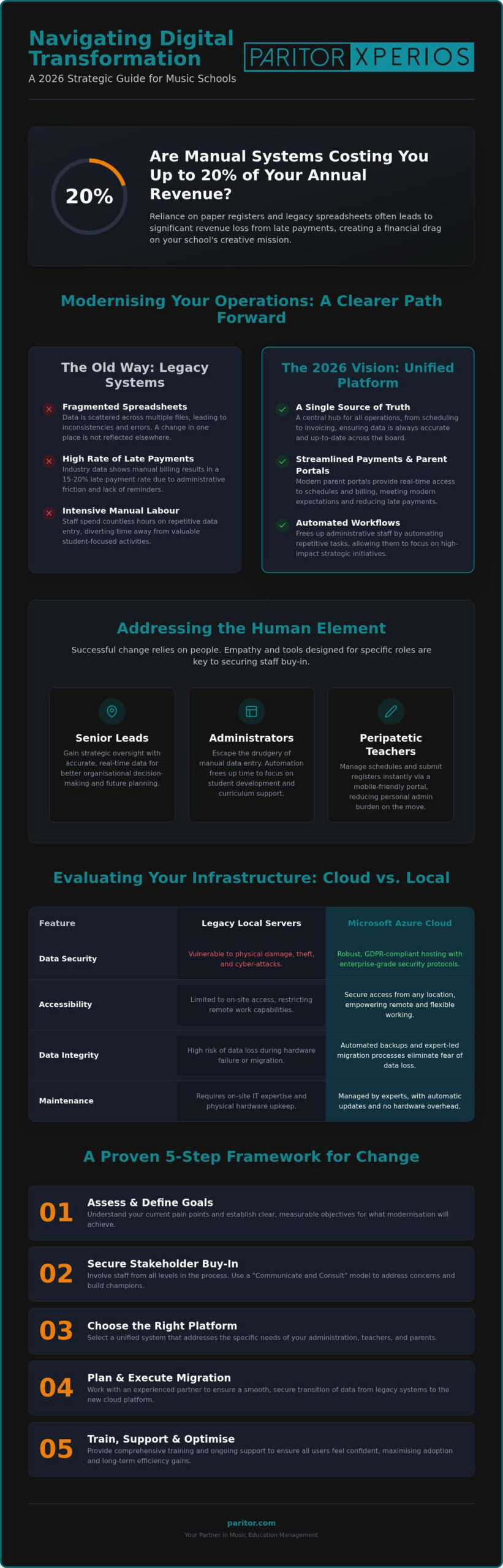
The limitations of manual systems become painfully clear when managing complex ensemble schedules or instrument inventories. Spreadsheets don’t talk to each other. This fragmentation creates data silos where a change in a student’s lesson time doesn’t reflect on their invoice. Industry data indicates that manual administrative systems in music schools often lead to a 15% to 20% late payment rate. This is a direct result of the administrative friction inherent in legacy setups. Beyond the financial impact, the hidden costs of administrative labour are significant. Your team spends hours on repetitive data entry that could be spent on student development or curriculum planning.
The 2026 Vision for Music School Modernisation
Modernisation in 2026 is driven by three primary factors: operational efficiency, robust data security, and evolving parent expectations. Parents now expect real-time access to schedules and billing through digital portals. They want the same convenience they experience with other modern services. Simultaneously, the Data Use and Access Act 2025 has heightened the need for secure, GDPR-compliant hosting on accredited cloud platforms. This is where professional standards become vital for institutional trust.
A unified cloud standard allows your staff to work remotely and access vital information from any location. Adopting music service management software provides a central hub for all your operations. It replaces the chaos of unlinked systems with a single source of truth. This shift empowers your leadership team with accurate data, allowing for better decision-making and a more resilient organisation. Embracing change management for music schools ensures this transition is not just a change in tools, but an upgrade in your school’s culture and capability.
Addressing the Human Element: Staff Buy-in and Culture
Successful change management for music schools relies more on people than programming. You have three distinct personas to manage: senior leads seeking strategic oversight, administrators drowned in manual tasks, and peripatetic teachers focused on their students. Empathy is your most potent tool here. Many staff members fear that new systems are designed for monitoring or that automation might eventually replace their roles. Five key aspects of change management suggest that co-design and leadership are essential to bridge this gap. You must reframe the software as a supportive ally that removes the repetitive drudge work rather than a digital overseer.
To convert “change sceptics” into “platform champions”, you should involve them in the selection process early. When staff see their specific pain points addressed, their resistance often turns to relief. It’s about showing, not just telling, how a unified system protects their time and allows them to focus on the music.
Supporting Peripatetic and Self-Employed Teachers
Peripatetic staff present a unique challenge because they are rarely on-site. They often feel disconnected from administrative shifts and may view new software as just another hurdle. To win them over, you must prove that the system respects their time. A dedicated Xperios Teacher Portal reduces their personal admin burden by allowing them to submit registers and view schedules instantly. Since these teachers are often on the move between schools, mobile-friendly tools are non-negotiable. When a teacher can manage their entire day from a smartphone in a practice room, the platform transforms from a chore into a convenience.
Effective Communication and Consultation Strategies
In UK educational settings, a “Communicate and Consult” model works best. Don’t simply announce a launch date. Instead, run a feedback session or a digital “town hall” where staff can voice their concerns without judgment. Transparent timelines are vital; people need to know exactly when the old spreadsheets will be retired and what support is available during the transition. By involving vocal critics early in the testing phase, you can often turn them into your strongest advocates. This inclusive approach ensures that the school’s culture evolves alongside its technology, creating a stable foundation for long-term growth. Effective change management for music schools is ultimately about building a community that feels empowered by progress.
Evaluating Infrastructure: Legacy Systems vs. Modern Cloud Platforms
Infrastructure serves as the physical and digital foundation of change management for music schools. When transitioning from local servers to a performing arts school administration system, you’re not just swapping software; you’re fundamentally changing your school’s financial and operational resilience. Local servers carry a high Total Cost of Ownership (TCO) that is often hidden. Between hardware maintenance, energy costs, and the need for specialist on-site IT support, the price of “owning” your data is high. Cloud-based SaaS models consolidate these expenses into a predictable, manageable subscription, allowing you to reallocate funds toward tuition and instruments.
Security is perhaps the most compelling reason to modernise. Hosting your school’s data on Microsoft Azure provides institutional-grade protection that no local office setup can match. It ensures that sensitive student information is encrypted and compliant with the Data Use and Access Act 2025. Beyond security, modularity allows your system to grow with you. You can implement financial management first, then add instrument or ensemble modules as your staff becomes more confident. This flexibility prevents the system from feeling overwhelming, which is a key part of successful change management for music schools.
Automation within these modern platforms directly addresses the cash flow issues common in the sector. By automating the invoicing process, you eliminate the manual errors that lead to disputes and delays. Integrated payment links and automated reminders can significantly reduce late payments, ensuring that your school’s financial health remains stable whilst you focus on educational excellence.
The Risk Assessment of Outdated Databases
Legacy systems often suffer from “single points of failure”, where a single corrupted file or an absent staff member can bring administration to a standstill. If your scheduling relies on one person’s master spreadsheet, you’re at risk. System downtime doesn’t just cause a headache; it erodes parent trust and disrupts lesson delivery. Generating accurate reports from manual data is also notoriously difficult. It’s nearly impossible to get a clear view of teacher utilisation or student retention when your data is fragmented across unlinked files. This lack of clarity makes strategic planning a guessing game rather than a data-driven process.
Cloud Modernisation and Data Integrity
Real-time data synchronisation is the lifeblood of modern ensemble management. When a student joins a choir or changes their violin grade, every relevant department sees that update instantly. This creates “one version of truth” for your entire organisation. You don’t have to worry about the finance team billing for a lesson that the teacher has already cancelled. Automated backups also play a vital role in disaster recovery. Unlike local backups that might be forgotten or damaged, cloud systems ensure your data is redundant and recoverable in minutes. This reliability provides the peace of mind your leadership team needs to focus on growth.
A Five-Step Framework for Implementing Organisational Change
Successful change management for music schools requires a structured, logical progression. It is not about a single “launch day” but a series of deliberate phases that build institutional confidence and technical proficiency. By following a proven framework, you can mitigate the risks of staff resistance and data fragmentation whilst ensuring a smooth transition to modern systems.
- Step 1: Audit and Preparation. Begin by mapping your current administrative workflows. You must identify where bottlenecks occur and which assets, such as paper registers or offline spreadsheets, need digitising.
- Step 2: Stakeholder Alignment. Secure buy-in from your board by highlighting the potential revenue recovery and efficiency gains. Gain staff trust by positioning the software as a solution to their specific administrative frustrations.
- Step 3: Data Migration and Clean-up. Moving records to Xperios is the perfect time to “spring clean” your data. You should remove duplicates and ensure every student record is complete before the migration begins to maintain a high standard of data integrity.
- Step 4: Phased Onboarding and Training. Roll out the system in manageable stages. You might start with ensemble management before moving to complex financial billing. This allows staff to master one module at a time, reducing the feeling of being overwhelmed.
- Step 5: Review and Optimisation. Once live, measure your success against clear KPIs. Track the reduction in manual admin hours and the improvement in payment turnaround times to prove the value of the shift.
Auditing Your Instrument Inventory and Assets
Many schools overlook their physical assets during a digital shift, yet this is often where the greatest efficiency gains lie. To prepare, create a comprehensive checklist of all instruments, including serial numbers, conditions, and current locations. Historical loan agreements often exist on paper or in unlinked files; these must be digitised and linked to student profiles within your instrument inventory management software. Tagging and categorising equipment correctly ensures that your new system can automate repair schedules and loan reminders effectively. This level of organisation prevents the loss of valuable assets and provides a professional experience for parents and students alike.
Ensuring GDPR Compliance and Data Security
Organisational change is a legal necessity under the Data Use and Access Act 2025. Xperios simplifies the complex task of maintaining GDPR compliance for music schools UK by centralising data within a secure Microsoft Azure environment. By using dedicated teacher and parent portals, you eliminate the need to send sensitive student data via email, which is a primary cause of data breaches. This professional standard of data handling builds lasting trust with your school community and ensures your institution remains compliant with evolving UK regulations. If you are ready to secure your school’s data, explore how Xperios Instrument Management can stabilise your inventory records today.
Partnering with Paritor: Ensuring a Seamless Transition
Choosing a software provider is a significant decision, but selecting a partner for your digital journey is what ensures long-term success. Paritor doesn’t just deliver a platform; we provide a stabilising force during the complex process of change management for music schools. Built on over 30 years of industry-specific experience since 1993, Xperios is the result of direct collaboration with music leaders who understand the unique pressures of ensemble management and peripatetic scheduling. We act as your industrious engine behind the scenes, allowing you to reclaim your focus on educational excellence.
The Implementation Journey with Xperios
Our structured onboarding process begins on day one, ensuring you never feel abandoned during the transition. You’ll work with dedicated account managers based right here in the UK who understand the specific regulatory and operational context of British music services. This isn’t a one-size-fits-all solution. We take a consultative approach to implementation, ensuring that Xperios is customised to fit your existing workflows rather than forcing you to change your successful teaching models. This partnership includes comprehensive data migration services, which eliminates the fear of losing historical records during the move to the cloud. We provide ongoing support and training to ensure every member of your team feels empowered by the new system.
Measuring the ROI of Your Digital Transformation
The true value of modernisation is found in the time you reclaim. By automating labour-intensive tasks, schools can significantly reduce the 15% to 20% late payment rates often associated with manual systems. You can measure your success through concrete metrics like total administrative hours saved and improved staff retention, as your team is freed from the burden of repetitive paperwork. Xperios allows your music school to scale its student numbers and ensemble programmes without the need to increase your administrative headcount. This efficiency creates a narrative of progress that benefits staff, students, and parents alike. If you’re ready to move away from the frustration of legacy systems, we invite you to book a discovery call with our team to start your journey toward a more efficient, secure future. We are committed to being your long-term partner in organisational growth, ensuring that your school remains at the forefront of music education for years to come.
Future-Proofing Your Music School for 2026 and Beyond
Modernising your school is about more than just software; it’s about evolving your culture to support educational excellence. We’ve explored how a structured framework and empathetic leadership can transform administrative burdens into streamlined workflows. By prioritising data integrity and staff buy-in, you ensure that your transition is a permanent step forward rather than a temporary disruption.
Effective change management for music schools requires a partner who understands the unique rhythm of the performing arts. With over 30 years of experience and institutional-grade security through Microsoft Azure cloud hosting, Paritor offers the stability you need. Our dedicated UK-based implementation and support teams are here to ensure your data migration is seamless and your staff feel empowered. It’s time to let technology handle the heavy lifting so you can focus on the music.
Begin your modernisation journey with a personalised Xperios demonstration. We look forward to helping your school thrive in this new digital era.
Frequently Asked Questions
How long does it typically take to implement a new management system in a music school?
Implementation typically takes between four and twelve weeks depending on the complexity of your school’s data. Smaller private schools often launch faster; large hubs require a more structured, phased approach to ensure every department is aligned. Our UK-based team works closely with you to establish a realistic timeline that avoids disruption to your term-time teaching. This ensures a stable transition whilst maintaining your focus on student progress and educational excellence.
Will our existing data be safe during the migration to Xperios?
Your data is protected by institutional-grade security throughout the entire migration process. We host Xperios on Microsoft Azure, providing a level of encryption and redundancy that local servers simply cannot match. Our structured onboarding includes dedicated data migration services to ensure historical records are transferred accurately. We act as your industrious engine; performing the heavy lifting of data clean-up so you don’t have to worry about information loss or security breaches.
How can I encourage my peripatetic teachers to use the new teacher portal?
Focus on the immediate relief the Xperios Teacher Portal provides by eliminating their manual administrative burdens. Teachers are more likely to adopt the platform when they see it simplifies register submission and provides real-time schedule access on their mobile devices. Demonstrating how the tool reclaims their time for actual tuition is the most effective strategy. This approach is a core part of successful change management for music schools; turning sceptics into champions through visible benefits.
Is Xperios suitable for small private music schools as well as large hubs?
The platform is built on a modular philosophy that makes it perfectly scalable for any organisation size. Small private schools benefit from the same high-level security and automation as large hubs but can choose to use only the specific modules they need. Whether you are managing fifty pupils or five thousand, the system adapts to your operating model. This flexibility allows you to grow your school without being held back by administrative constraints or software limitations.
What kind of training is provided for our administrative staff?
We provide comprehensive, structured training tailored to the specific roles within your administrative team. This includes initial onboarding sessions and ongoing support to ensure everyone feels confident using the new system. Our UK-based implementation team offers expert guidance; helping your staff master everything from financial management to instrument inventory. We believe in a partnership model where our success is defined by your team’s ability to excel in their roles without the burden of paperwork.
How does the software handle complex scheduling for ensembles and choirs?
Xperios Ensemble Management uses a central hub to synchronise schedules across multiple departments instantly. When you update a choir rehearsal time, the change reflects on teacher registers and parent portals immediately. This “one version of truth” prevents the scheduling conflicts common in manual systems. It is specifically designed to handle the intricate logistics of music education; ensuring that complex group sessions are managed with the same ease as one-to-one lessons or classroom tuition.
Can Xperios integrate with our existing accounting software?
Xperios Financial Management is designed to streamline your billing processes and can export data for use with major accounting platforms. By automating the creation of invoices and tracking payments, it reduces the manual entry that often leads to errors. This integration ensures your financial records remain accurate whilst significantly improving your cash flow. It’s an essential tool for any school leader looking to modernise their financial oversight and reduce the daily friction of administrative labour.
Is the platform compliant with UK GDPR and safeguarding standards?
The system is fully compliant with UK GDPR and the Data Use and Access Act 2025. By centralising student data on secure cloud infrastructure, we eliminate the risks associated with sending sensitive information via email or paper registers. This high standard of institutional safety is a key marker of our person-centric approach. Effective change management for music schools ensures that safeguarding remains a top priority whilst you transition to more efficient, modern digital processes.