

What if the hours your team spends wrestling with fragmented spreadsheets and manual data entry could be traded for more time spent in the rehearsal room? It’s a common frustration amongst music hub leaders; the weight of administrative labour often feels like it’s stifling the very creativity you’re meant to foster. Between tracking instrument loans across dozens of schools and chasing late payments, the musical mission of your service can sometimes feel like an afterthought.
Implementing modern music hub administration software is no longer just a digital convenience; it’s a strategic necessity in 2026. With the Data (Use and Access) Act 2025 now in full effect, having a secure, centralised system is the only way to ensure compliance whilst reducing the stress of financial reporting. This guide discovers how modern platforms transform operations, automate invoicing, and empower educators to focus on what they do best. We will explore the latest trends in cloud-based management and show you how to turn administrative burden into a streamlined engine for growth.
Key Takeaways
- Transition from manual spreadsheets to a centralised digital ecosystem to eliminate data silos and protect against regulatory risks.
- Discover how high-performance music hub administration software automates peripatetic scheduling and tracks instrument inventory across multiple school sites.
- Master the use of strategic data analytics to streamline Arts Council England (ACE) reporting and target provision using demographic heat mapping.
- Ensure institutional safety by integrating your management platform with Local Authority finance systems whilst maintaining rigorous GDPR standards.
- Learn why a modular approach to software allows you to customise your toolkit, ensuring you only pay for the specific functionality your service requires.
The Evolution of Music Hub Administration: Beyond the Spreadsheet
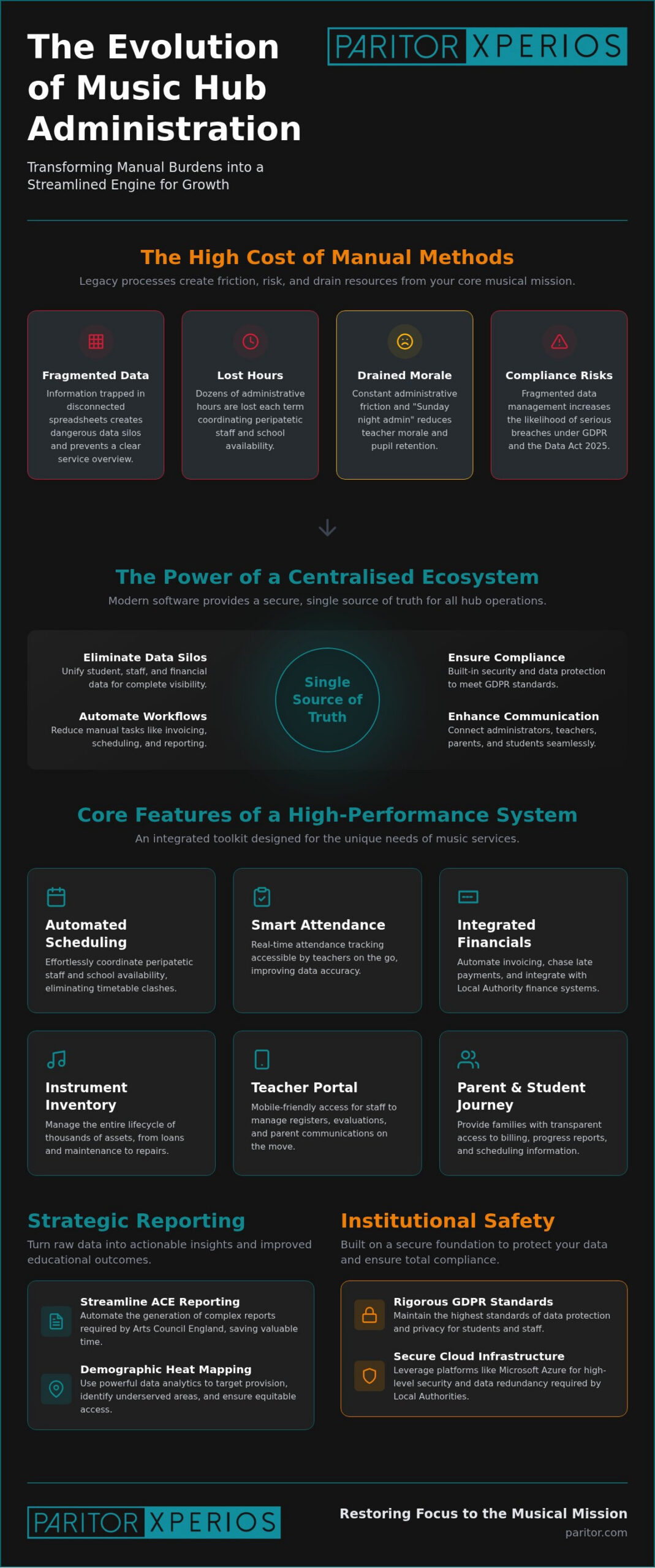
For decades, many music hubs relied on a patchwork of paper diaries and local spreadsheets. It worked for small teams, but the scale of modern hubs demands more. Today, modern music hub administration software is defined as a centralised ecosystem that harmonises tuition, asset management, and financial oversight into a single source of truth. This digital shift mirrors the evolution of music education software; moving from simple instructional tools to robust, institutional-grade management platforms.
Legacy methods like Excel create dangerous data silos. Information gets trapped in disconnected files, making it impossible to gain a clear overview of your service. This isn’t just an efficiency problem. It’s a legal risk. With the Data (Use and Access) Act 2025 and stringent UK GDPR requirements, fragmented data management increases the likelihood of serious breaches. Adopting specialised music hub administration software replaces these risks with secure, encrypted environments where data flows seamlessly between departments.
The High Cost of Manual Administration
Manual scheduling isn’t just tedious. It’s expensive. Administrators often lose dozens of hours every term simply coordinating peripatetic staff and school availability. This friction drains teacher morale. It can lead to lower pupil retention when communication fails or mistakes occur. The administrative burden is an opportunity cost that directly reduces the time available for high-quality music tuition and ensemble development.
Transitioning to a Cloud-Based Standard
Cloud-based management is now a necessity for services operating across multiple locations. Peripatetic teachers need real-time data access whilst travelling between schools to track attendance and student progress accurately. Using a foundation like Microsoft Azure ensures that this data remains safe and accessible. It provides the high-level security and data redundancy required by Local Authorities. This infrastructure guarantees consistency in service delivery across an entire geographic region. Every student receives the same standard of care regardless of their school’s location.
Modern platforms prioritise the user experience for everyone involved. Parents get easy access to billing. Teachers manage their schedules with ease. Administrators finally have the headspace to lead. It’s about restoring focus to the musical mission.
Core Features of a High-Performance Music Hub System
A high-performance system does more than store student names. It acts as an active assistant that anticipates the needs of your service. Modern music hub administration software integrates several critical functions into one fluid workflow. This includes automated scheduling for peripatetic staff, smart attendance tracking, and integrated financial modules for automated invoicing. By consolidating these tools, hubs can eliminate the data duplication that often leads to billing errors or missed lessons. These modern music lesson platforms represent a shift toward holistic management where every module communicates with the next.
Effective asset management is equally vital. Tracking thousands of violins, brass instruments, and keyboards across a county requires specialised instrument inventory management software. A robust system manages the entire lifecycle of an asset, from the initial loan application to routine maintenance and emergency repairs. This ensures that every child has a functional instrument whilst protecting the hub’s significant capital investment.
Empowering Teachers through the Teacher Portal
Administrative friction often follows peripatetic teachers from school to school. Mobile-friendly portals solve this by allowing staff to manage registers and evaluations on the go. This eliminates the dreaded “Sunday night admin” where teachers spend their weekends backfilling paper registers into a computer. Real-time updates mean that if a student is absent, the teacher knows instantly. Evaluations and progress notes are recorded at the point of delivery, ensuring they’re accurate and meaningful. These portals also facilitate secure communication with parents, allowing for updates on pupil progress without teachers having to share their personal contact details.
Streamlining the Parent and Student Journey
Transparency builds trust with families. A dedicated parent portal for music schools simplifies the entire journey, from the first lesson application to ensemble memberships. Parents can view their child’s schedule, download invoices, and read progress reports in one secure location. This self-service approach significantly reduces the volume of phone calls and emails to the central office. When parents feel informed and in control of their payments and schedules, pupil retention rates naturally improve. You might find that Xperios for Music Services offers exactly the kind of modular flexibility needed to support these diverse stakeholder needs.
Finally, integrated exam and assessment modules allow hubs to track attainment over time. This data is invaluable for demonstrating the impact of your service to stakeholders and ensuring that every pupil is progressing at an appropriate pace. It turns anecdotal success into measurable educational outcomes.
Strategic Reporting: Turning Data into Educational Outcomes
Data shouldn’t just sit in a digital filing cabinet. It should work for you. For hub leaders, the true value of music hub administration software lies in its ability to convert thousands of individual data points into a coherent strategic narrative. By utilising built-in analytics, you can move beyond simply reacting to administrative tasks and start proactively shaping the musical landscape of your region. This shift from record-keeping to strategic oversight allows for a more nuanced understanding of how your service impacts students across different demographics.
Identifying gaps in service provision becomes a visual process through deprivation-driven heat mapping. By overlaying student participation data with demographic and socio-economic markers, hubs can pinpoint exactly which schools or neighbourhoods are under-served. This evidence-based approach is essential for monitoring the effectiveness of Whole Class Ensemble Tuition (WCET) programmes. It ensures that your resources are being deployed where they can make the most significant difference, rather than just where they’ve always been sent.
Preparing for ACE and DfE Returns
The annual reporting cycle often brings a wave of anxiety to hub offices. Modern systems eliminate this by automating the collection of data points required for national returns, such as those for Arts Council England (ACE) or the Department for Education (DfE). Because the software tracks attainment and reach in real time, there’s no need for a mad scramble to gather registers or survey teachers at the end of the year. Automated reporting transforms the high-pressure return season from a period of frantic data gathering into a simple verification exercise. This transparency ensures your statistics are accurate, defensible, and ready for scrutiny.
Data-Led Decision Making for Hub Leaders
A “helicopter view” of your entire operation is vital for long-term planning. Leaders can use centralised dashboards to assess the health of ensembles, identifying which groups are thriving and which may need additional support or recruitment drives. Integrating specialised ensemble management software provides deep insights into scheduling efficiency and rehearsal attendance across the service. This level of detail extends to asset management too. By analysing instrument hire trends, you can make informed decisions about future purchasing strategies, ensuring your inventory matches the evolving musical interests of your pupils. Financial reporting also plays a key role here, providing the hard evidence needed to justify budget allocations or identify untapped revenue streams through new service offerings.
Implementation and Compliance: Ensuring Institutional Safety
Adopting new music hub administration software is more than a technical upgrade. It’s a commitment to institutional safety. For many hub leaders, the transition from legacy systems or fragmented spreadsheets feels daunting. However, the move to a modern, accredited platform provides a level of security that manual methods simply cannot match. By prioritising compliance and structured integration, you protect your organisation from regulatory risks whilst creating a stable foundation for growth. It’s about moving from a position of administrative vulnerability to one of professional confidence.
Institutional safety also means ensuring your team is fully supported throughout the transition. A structured onboarding programme for both administrative staff and peripatetic teachers is essential. This process goes beyond basic training; it’s about building a partnership where the software provider understands your specific workflows. When the technology is built on collaborative user insights, the “fear of the new” is replaced by the relief of streamlined operations.
The Path to Successful System Integration
Successful integration requires a clear strategy for migrating data from legacy databases. This isn’t just about moving names and addresses. It’s about ensuring that historical records, instrument loan histories, and financial data remain intact and accurate. One of the most significant hurdles for hubs is the integration with central Local Authority finance systems. High-performance software should bridge this gap, creating seamless workflows that allow for automated data exchange between the music service and the council’s accounting tools. This reduces manual reconciliation and ensures that every invoice is accounted for correctly within the broader institutional framework.
Prioritising GDPR and Data Security
Data protection is a non-negotiable priority in 2026. With the Data (Use and Access) Act 2025 now in full effect, music hubs must navigate complex responsibilities as data controllers. Modern music hub administration software acts as a robust data processor, providing the technical safeguards needed to manage sensitive student information securely. This is particularly vital when managing data across multiple portals and device types used by teachers in the field.
Utilising cloud hosting on accredited platforms like Microsoft Azure ensures high-level data redundancy and protection. Under the current UK GDPR, the stakes are high; serious infringements can lead to fines of up to £17.5 million or 4% of annual turnover. By choosing a system that prioritises regulatory compliance and data security, you ensure that student and parent information is protected by industry-leading encryption. If you’re ready to secure your service’s future, you can explore how Xperios for Music Services handles compliance with institutional-grade security.
Choosing Your Partner: Why Xperios is the Standard for 2026
Selecting the right music hub administration software is a decision that defines the operational trajectory of your service. It shouldn’t be a simple transaction; it’s an investment in a partnership. Xperios for Music Services stands as the industry standard for 2026 because it wasn’t built in a vacuum. It’s the result of decades of collaborative development alongside the very people who use it every day. By listening to the specific frustrations of hub leads and administrators, we’ve refined a platform that mirrors the actual workflows of a modern music service. It’s technology built by the sector, for the sector.
A significant advantage of this system is its modularity. We understand that every hub is unique, with different priorities and budget constraints. Our modular approach ensures you only pay for the specific functionality your service requires. Whether you need robust instrument tracking or a comprehensive financial module, you can customise your toolkit without the burden of paying for redundant features. This flexibility is backed by a commitment to ongoing innovation. Regular software updates are driven directly by sector feedback, ensuring the platform evolves alongside the changing requirements of the UK music education landscape. You aren’t just buying a snapshot of today’s technology; you’re joining a platform that grows with you.
A Partner in Your Creative Mission
We view our role as more than just a software provider. Paritor acts as a dedicated facilitator, supporting the growth of performing arts services across the UK through a long-term strategic partnership. We understand the music education landscape because we’re part of it. Our UK-based support team provides more than technical help; they offer deep domain knowledge to help you maximise your system’s potential. They speak your language and understand the nuances of term-time pressures. For a full overview of how these components work together to support your goals, you can explore the complete guide to music service management software.
Reclaiming Time for What Matters Most
The ultimate goal of any music hub administration software is to restore focus to your creative mission. By performing the labour-intensive tasks that drain your team’s energy, Xperios acts as the industrious engine behind the scenes. It allows your staff to step away from the spreadsheets and back into the classrooms and rehearsal halls. When the administration is seamless, the music can flourish. Adopting this platform isn’t just a step forward for your office; it’s a step forward for every student and teacher in your service. It’s time to evolve beyond the administrative burden and prioritise the progress of your pupils. Discover how Xperios can transform your Music Hub administration today.
Evolving Your Music Service for a Digital Future
The transition from fragmented spreadsheets to a unified digital ecosystem is the most significant step your service can take this year. By adopting specialised music hub administration software, you replace the friction of manual data entry with the relief of automated workflows. We’ve explored how cloud-hosted security on Microsoft Azure protects your institutional data whilst modular portals empower your teachers and parents alike. This shift doesn’t just improve efficiency; it ensures your hub remains compliant with the latest data regulations and reporting standards.
Trusted by UK Music Services since 1993, Xperios offers a modular system tailored specifically to your organisation’s size and needs. This industrious engine works behind the scenes, ensuring your ACE reporting is seamless and your financial management is secure. It’s time to reclaim your schedule and restore focus to the creative mission that drives your hub. Book a consultation to see how Xperios empowers your Music Hub. Your team deserves the headspace to lead, teach, and inspire the next generation of musicians with confidence and clarity.
Frequently Asked Questions
What is music hub administration software?
Modern music hub administration software is a centralised digital ecosystem that replaces fragmented spreadsheets with a single source of truth for tuition, assets, and finance. It organises every aspect of your service, from peripatetic scheduling to automated billing, into one fluid workflow. By consolidating these tasks, it restores focus to your creative mission and provides the clarity needed for strategic decision-making across your entire region.
How does the software help with ACE and DfE reporting?
The software automates the collection of specific data points required for national returns, such as pupil reach and attainment statistics. Because the system tracks these metrics in real time throughout the academic year, hub leads can generate accurate reports for Arts Council England (ACE) and the Department for Education (DfE) at the touch of a button. This eliminates the high-pressure data scramble typically associated with return season.
Is the data stored securely and is it GDPR compliant?
Data security is a top priority, with music hub administration software like Xperios built on Microsoft Azure to provide institutional-grade encryption and redundancy. The system is fully compliant with UK GDPR and the Data (Use and Access) Act 2025, ensuring that sensitive student and parent records are managed safely. This secure infrastructure protects your organisation from regulatory risks whilst providing a foundation of professional trust.
Can the system integrate with our Local Authority finance software?
Yes, modern management systems are designed to integrate seamlessly with Local Authority finance software and third-party accounting tools. This connectivity ensures that financial data flows accurately between your music service and the central council office, reducing the need for manual reconciliation. By automating these workflows, you eliminate common billing errors and ensure that every invoice is tracked correctly within your broader institutional framework.
How long does it take to implement a new management system?
Implementation timelines depend on your hub’s size and the volume of data being migrated from legacy systems. A structured onboarding programme typically guides your team through the transition over several months, ensuring that administrative staff and teachers are fully trained. This partnership-led approach focuses on tailoring the software to your specific workflows, resulting in a stable and reliable system that is ready for full operation.
Does the software support instrument inventory and hire schemes?
Yes, specialised modules provide comprehensive oversight of your entire instrument inventory and hire schemes. The software tracks the full lifecycle of each asset, from initial loan applications and hire fees to routine maintenance and emergency repairs. This allows hub leaders to protect their significant capital investments whilst ensuring that every student has access to a functional instrument, regardless of their school’s location.
Can teachers use the system on their mobile phones?
Mobile-friendly teacher portals allow peripatetic staff to access schedules, registers, and student evaluations from any device. This means teachers can update attendance in real time whilst travelling between schools, ensuring that data is always current. By moving away from paper registers, you eliminate the repetitive burden of weekend administration and allow your teaching staff to focus entirely on their musical instruction.
Is there a portal for parents to pay invoices and check schedules?
A dedicated parent portal allows families to pay invoices, download progress reports, and check lesson schedules in one secure location. This self-service functionality significantly reduces the volume of phone calls and emails to the central hub office, freeing up your administrative team for more strategic tasks. When parents have clear, real-time access to their child’s musical journey, it builds trust and improves long-term pupil retention.