

Did you know that whilst your classrooms are full, your music school could still be operating on razor-thin margins because teacher payroll is quietly consuming up to 60% of your gross revenue? You’ve likely spent years perfecting your curriculum and hiring the best talent, yet you’re still searching for how to improve music school profitability whilst bogged down by manual invoicing. It’s exhausting to feel like an administrator rather than an educator. We understand the weight of these repetitive tasks and how they pull you away from your primary creative mission.
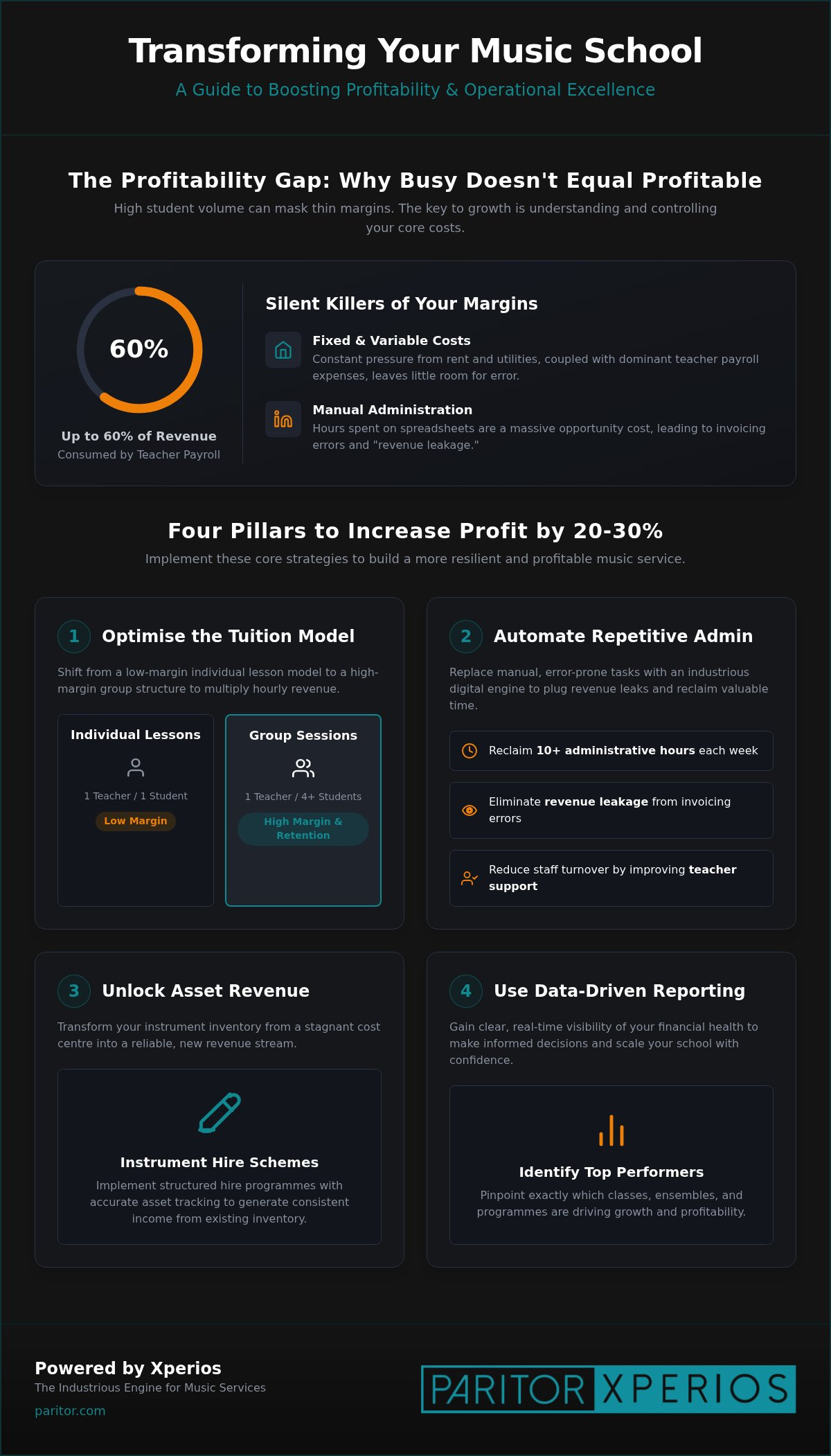
This guide reveals how to transform your music service from a high-volume, low-margin operation into a streamlined, highly profitable business through operational excellence and automation. By embracing the right tools, you can finally reclaim your time and gain clear visibility of your financial health. We will explore how to automate repetitive admin tasks and implement reporting structures that can help you increase your profit margins by at least 20% to 30%.
Key Takeaways
- Learn how to optimise your tuition model by balancing high-value individual lessons with high-margin group sessions to maximise hourly revenue.
- Discover how to improve music school profitability by automating invoicing and payment collection to eliminate revenue leakage and late payments.
- Transform your instrument inventory from a stagnant cost centre into a reliable revenue stream through structured hire schemes and accurate asset tracking.
- Gain clear visibility of your financial health using real-time reporting to identify exactly which classes and ensembles are driving your growth.
- Reclaim hours of administrative time each week by replacing manual, repetitive tasks with an industrious digital engine built on industry insights.
The Profitability Gap: Why Volume Doesn’t Always Equal Success
Many music school directors find themselves caught in the “Busy-ness Trap.” Your corridors are buzzing, your teachers are fully booked, and your student numbers have never been higher. Yet, your net profit remains stubbornly stagnant. This disconnect occurs because high volume does not automatically translate to a healthy bottom line. When considering how to improve music school profitability, you must look beyond the number of enrolments and scrutinise the margins hiding behind the music.
In 2026, the financial landscape for various Types of music schools has shifted. Fixed costs, such as commercial rents and utility bills, exert constant pressure. Variable costs, dominated by teacher payroll that often consumes 50% to 60% of revenue, leave little room for error. Real profitability is built on three specific pillars: a scalable tuition model, operational efficiency, and high student retention. Without these, manual processes become a silent killer of your margins, slowly draining resources through invisible leaks.
Understanding Your True Cost Per Student
To protect your margins, you need to calculate the true cost of every lesson. This isn’t just the teacher’s hourly rate; it includes the administrative overhead and the “dead time” between sessions. If a teacher is paid for an hour but only 45 minutes are billable due to transitions or setup, your profitability drops instantly. Identifying the break-even point for different formats, such as individual versus group tuition, allows you to organise your schedule for maximum financial impact whilst maintaining educational standards.
The Hidden Costs of Manual Administration
Manual administration is perhaps the most taxing burden on a growing school. Spending ten hours a week on spreadsheets represents a massive opportunity cost; those are hours you could spend on community outreach or developing new ensembles. Manual data entry inevitably leads to errors in invoicing and scheduling, which results in “revenue leakage” that is difficult to track. Additionally, administrative friction is a primary driver of teacher turnover. When staff feel supported by an industrious engine that handles the paperwork, they remain focused on teaching, which stabilises your workforce and reduces recruitment costs. Understanding how to improve music school profitability starts with acknowledging that your time is your most valuable asset.
Optimising the Tuition Model for Higher Margins
Rethinking your delivery model is the most direct path when considering how to improve music school profitability. Whilst individual lessons are the cornerstone of musical excellence, they are often the least profitable due to high teacher payroll costs. By moving to a group-based model for beginner and intermediate levels, you can effectively quadruple your hourly revenue whilst maintaining a competitive price point for parents. This shift transforms your school from a collection of private studios into a scalable educational community.
A “Hybrid Model” offers the best of both worlds. You can preserve high-value individual sessions for advanced students whilst funneling new enrolments into high-margin group classes. Transitioning existing students to this format requires a focus on the social benefits of music. Peer learning and ensemble playing are powerful motivators that individual lessons often lack. Organisations like the Music Performance Trust Fund highlight the importance of accessible music education, and group lessons are a key driver for this accessibility and long-term engagement.
The Group Class Profit Multiplier
Structuring group lessons correctly ensures that educational quality remains high whilst your margins grow. Instead of a single student paying for an hour of a teacher’s time, four students paying a reduced fee can generate significantly more revenue per hour. This model also improves student retention; the social bond formed amongst peers makes students less likely to quit. To manage this effectively, you must establish clear teacher pay scales that reflect the increased responsibility of group instruction whilst still protecting your net profit.
Scheduling for Maximum Capacity
The efficiency of your timetable is the engine room of your profitability. Gaps between lessons are “dead time” that you still pay for in terms of building overheads. Using ensemble management software allows you to eliminate these gaps and coordinate peripatetic teachers across multiple sites with precision. By centralising your bookings, you can identify “off-peak” hours in your music centre and fill them with new ensembles or choirs, which act as high-capacity revenue drivers. When you move away from manual spreadsheets to a dedicated management system, these strategic shifts become far less daunting. Discover how a dedicated partner like Paritor can help you reclaim your time and focus on growth.
Plugging the Leaks: Administrative Automation and Revenue Recovery
Revenue leakage is the quietest threat to your bottom line. Whilst you focus on delivering high-quality tuition, small financial drains often go unnoticed; late payments, unbilled extra hours, and untracked instrument hire can accumulate into a significant deficit. Understanding how to improve music school profitability requires a shift from chasing money to preventing its loss through systematic automation. When your administration is handled by an industrious engine, you stop being a debt collector and return to being an educator.
Centralising your data ensures that every lesson taught is accurately recorded and billed. Without a unified system, a teacher might forget to report a one-off ensemble session or a change in lesson duration. These unbilled hours represent direct profit lost. Automation removes the reliance on human memory, creating a seamless link between the classroom and the accounts office. By reclaiming this “lost” revenue, many schools see an immediate boost in their net margins without needing to recruit a single new student.
Automating the Invoicing Lifecycle
Moving away from manual, termly billing is essential for modern cash flow. The 2026 music education landscape favours predictable, subscription-style payments that parents can easily manage. Implementing music service management software allows you to automate the entire invoicing lifecycle, from initial generation to final reconciliation. This system can handle complex billing cycles and integrate directly with your accounting software, which eliminates the need for double-entry bookkeeping and reduces the risk of manual data entry errors. It is a transition that replaces administrative taxing labour with a stable, reliable process.
Reducing Late Payments without Damaging Relationships
Chasing parents for money is awkward and time-consuming; it can often strain the vital relationship between the school and the family. Automated billing removes this social friction. Parents actually prefer the professionalism of a secure online portal where they can make immediate card payments or set up a Direct Debit. To reduce your “Days Sales Outstanding” (DSO), you can organise polite, automated email and SMS reminders for overdue accounts. These messages feel less like a personal confrontation and more like a standard service notification. This approach stabilises your monthly cash flow whilst empowering your staff to focus on student progress rather than spreadsheet discrepancies.
Unlocking Hidden Revenue Streams through Asset Management
Strategising how to improve music school profitability involves looking at your storage rooms just as closely as your teaching studios. Many organisations view their instrument inventory as a stagnant cost centre or a logistical headache. However, with the right oversight, your instrument cupboard becomes a reliable source of recurring revenue. By formalising your hire schemes, you provide an essential service to beginner students whilst creating a steady cash flow that supports the school’s wider mission.
Digital oversight is the key to protecting these investments. Tracking the depreciation, maintenance, and repair history of every violin or cello ensures you aren’t blindsided by sudden replacement costs. When these assets are managed through a centralised system, you gain a clear picture of which instruments are your most profitable earners and which are costing too much in repairs. This level of detail allows you to make informed procurement decisions based on actual usage data rather than guesswork.
Instrument Hire: The Recurring Revenue Opportunity
Implementing a structured hire programme is one of the most effective ways to build a secondary income stream. Using instrument inventory management software allows you to track loans and returns with total precision. You can set hire rates that comfortably cover annual maintenance whilst remaining accessible to families. Most importantly, you can prevent asset loss through automated “overdue return” notifications. This industrious engine works behind the scenes to ensure your property is returned or renewed without an administrator needing to send a single manual email.
Event and Assessment Monetisation
Beyond instrument hire, your school can unlock revenue through value-added services such as assessments and events. Charging for internal exams or specialised assessments through the Xperios Exams and Assessments Module creates a professional pathway for student progress whilst contributing to your bottom line. Similarly, concert ticketing can be simplified and monetised through an integrated student portal. This allows you to manage the logistics of ticket sales and seating without increasing your administrative headcount. These small, high-margin transactions accumulate quickly, providing the financial cushion needed to reinvest in your teaching staff. Discover how to turn your hidden assets into growth at Paritor.
Data-Driven Growth: Scaling Your School with Xperios
Scaling a music school often feels like a balancing act between growth and administrative bloat. If you double your student count but also double your office staff, your net profit remains unchanged. Real growth is achieved when you can scale your operations without multiplying your overheads. This is how to improve music school profitability at scale; you must rely on real-time data rather than gut feeling. With the Xperios platform, music service leads can access comprehensive financial reporting that identifies exactly which classes, ensembles, and teachers are driving your margins. Data brings clarity.
By pinpointing your most profitable sessions, you can replicate those successes whilst addressing or restructuring underperforming areas. This data-driven approach allows you to expand into multiple locations with confidence. You don’t need to hire a new administrator for every new centre when your industrious engine handles the scheduling and billing automatically. It’s about working smarter, not harder, to ensure your school’s professional journey remains on an upward trajectory.
Key Metrics Every Music School Owner Should Track
To truly understand your business health, you must look beyond the bank balance. Tracking Student Lifetime Value (LTV) against Acquisition Cost (CAC) reveals the long-term sustainability of your marketing efforts. You should also monitor capacity utilisation rates across your different instruments and centres. If your piano studios are at 95% capacity whilst your brass rooms sit at 40%, you have a clear indicator of where to focus your recruitment. Measuring revenue per square foot of teaching space ensures that every inch of your facility is working as hard as possible to support your mission.
The Role of the Xperios Parent Portal
High-volume communication is a major “enquiry overhead” that drains administrative time. Discover how parent portals for music schools empower families whilst saving you hours of manual labour. By enabling self-service bookings and progress tracking, you improve student retention and reduce the volume of phone calls and emails. Families appreciate the transparency of having real-time scheduling information at their fingertips. This level of professional service empowers your users and reinforces their commitment to your school. When families can manage their own accounts, your team is free to focus on strategic growth and educational excellence, which is how to improve music school profitability in the long term.
Future-Proofing Your Music School’s Success
Transitioning from a high-volume, low-margin model to a streamlined business requires a shift in mindset. Efficiency creates growth. By optimising your tuition formats and plugging revenue leaks through automation, you can fundamentally change your bottom line. Treating your instrument inventory as a profit centre and using real-time data to guide your expansion ensures you stop fighting the “busy-ness trap.” Understanding how to improve music school profitability is the first step toward a sustainable future.
Xperios is built on 30 years of industry experience. It’s trusted by leading UK music hubs and services to handle their most taxing administrative burdens. Our secure Microsoft Azure-hosted platform acts as the industrious engine behind your success, freeing you to focus on the music. Book a demo of Xperios to see how we can transform your school’s profitability. Your mission deserves a partner that understands the specific frustrations of music education management. Let’s modernise your operations and empower your creative community.
Frequently Asked Questions
What is the average profit margin for a music school?
Average profit margins for UK music schools typically range between 10% and 20%, though these are often squeezed by high teacher payroll costs. Because staff pay can consume up to 60% of gross revenue, many directors find it difficult to maintain a healthy bottom line. Implementing automated systems and high-margin tuition models can help push these margins toward the 30% mark by reducing administrative overheads.
How can I increase my music school revenue without raising prices?
You can increase revenue by diversifying your services through instrument hire schemes, event ticketing, and internal assessment fees. Transitioning beginner students into group classes is another effective way to generate more income per teaching hour without increasing the cost for individual families. These strategies are essential when researching how to improve music school profitability whilst remaining accessible to your local community.
Is group tuition really as effective as private lessons for profitability?
Group tuition is a powerful profit multiplier because it allows you to collect multiple fees for a single hour of teacher payroll. Whilst a private lesson has a fixed revenue ceiling, a group of four students can significantly increase the hourly yield for the same studio space. This model also fosters a social learning environment amongst peers, which often leads to higher student engagement and better long-term retention.
How does management software actually save me money?
Management software saves money by plugging “revenue leaks” like unbilled lessons, untracked instrument loans, and late payments. It acts as an industrious engine that automates the invoicing lifecycle, which eliminates the need for manual data entry and reduces human error. This efficiency allows you to scale your student numbers and add new locations without the need to hire additional administrative staff.
What are the best ways to reduce student churn and improve retention?
Reducing churn relies on building a social community and providing families with clear visibility of musical progress. Group lessons create peer bonds that make students less likely to quit during difficult practice periods. Additionally, offering a Parent Portal allows families to stay engaged with their child’s journey through real-time scheduling and progress tracking, which reinforces the value of your service.
How do I handle late payments from parents without being awkward?
The most effective way to handle late payments is to remove the personal element by using automated reminders. Xperios Financial Management allows you to send polite, system-generated notifications and offer secure online payment portals or Direct Debit options. Parents usually prefer this professional, digital approach, and it prevents teachers or directors from having to have uncomfortable conversations about money.
Should I hire more admin staff or invest in software first?
Investing in software is almost always the more profitable choice for a growing school. Software provides a scalable foundation that performs labour-intensive tasks without the added costs of national insurance, office space, or holiday pay. It empowers your existing team to focus on student recruitment and curriculum development whilst the system handles the repetitive paperwork in the background.
How can I track my instrument inventory more effectively?
Effective tracking requires a centralised digital system that records the location, condition, and repair history of every asset. Xperios Instrument Management allows you to monitor loans and returns in real time, ensuring that your property is never forgotten or lost. This level of oversight transforms your instrument cupboard into a reliable recurring revenue stream through structured hire programmes.