
Picture this: it’s Monday morning, and your registrar has just discovered a timetable clash that affects three practice rooms, two visiting tutors, and a dozen students waiting for their lesson confirmations. Meanwhile, a stack of outstanding tuition fee reminders sits unanswered, and nobody can quite agree on where the school’s borrowed cellos actually are. Sound familiar? This is the daily reality that the right conservatoire management software exists to eliminate.
You already know the problem runs deeper than a few spreadsheets in need of updating. Arts education administration is a genuinely complex challenge, a three-body problem of people, instruments, and spaces that generic school management tools simply weren’t built to handle. The frustration is real, the administrative overhead is significant, and the time lost to manual processes is time stolen from your core educational mission.
This guide cuts through the noise and shows you exactly how modern management platforms transform conservatoire operations. From intelligent scheduling and automated invoicing to secure instrument loan tracking and GDPR-compliant student records, you’ll discover what to look for, what questions to ask, and how purpose-built platforms are helping arts organisations reclaim their time and redirect their energy where it belongs: the music.
Key Takeaways
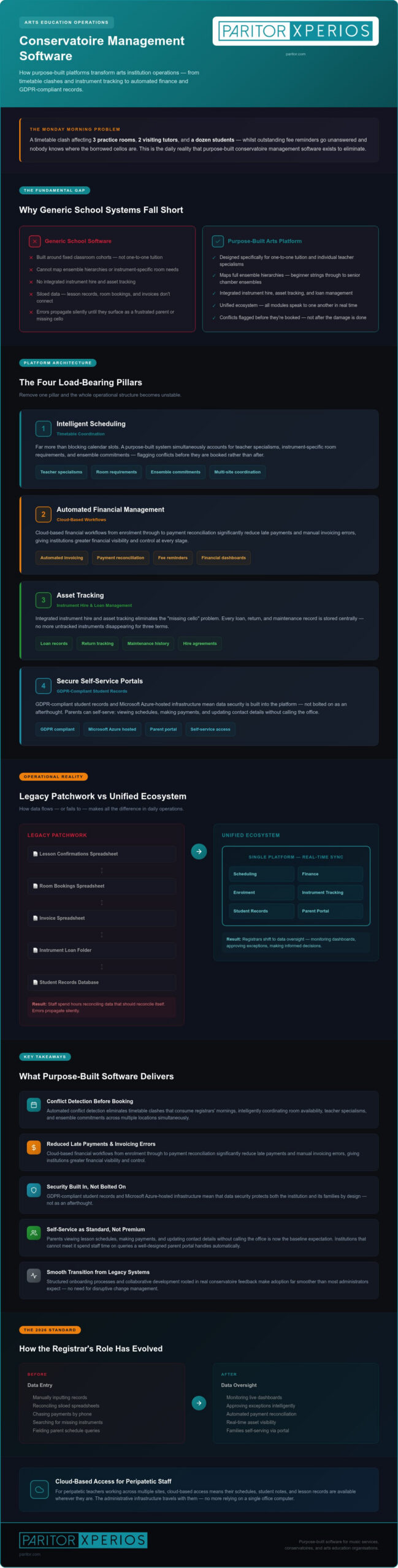
- Purpose-built conservatoire management software does far more than digitise spreadsheets — it unifies scheduling, finances, and instrument tracking into a single, intelligent ecosystem built specifically for the complexities of arts education.
- Automated conflict detection eliminates the timetable clashes that consume registrars’ mornings, intelligently coordinating room availability, teacher specialisms, and ensemble commitments across multiple locations simultaneously.
- Cloud-based financial workflows — from enrolment through to payment reconciliation — significantly reduce late payments and manual invoicing errors, giving institutions greater financial visibility and control.
- GDPR-compliant student records and Microsoft Azure-hosted infrastructure mean that data security is built into the platform rather than bolted on as an afterthought, protecting both the institution and its families.
- Transitioning away from legacy systems needn’t be disruptive — structured onboarding processes and collaborative development rooted in real conservatoire feedback make adoption far smoother than most administrators expect.
The Evolving Landscape of Conservatoire Administration
Conservatoire management software isn’t simply a digital filing cabinet. At its best, it’s a unified ecosystem that connects every operational layer of an arts institution: enrolment, scheduling, finance, instrument tracking, and family communication, all speaking to one another in real time. That interconnectedness is what separates a purpose-built platform from the patchwork of spreadsheets, shared drives, and generic school databases that many institutions are still relying upon in 2026.
The limitations of legacy approaches aren’t just inconvenient; they’re genuinely costly. When lesson confirmations live in one spreadsheet, room bookings in another, and invoices in a third, the administrative burden compounds daily. Staff spend hours reconciling data that should reconcile itself. Errors propagate silently until they surface as a frustrated parent, a double-booked studio, or an untracked cello that’s been missing for three terms. Generic tools weren’t designed to prevent these problems because they were never designed with arts education in mind.
There’s also a growing expectation shift from the families and students institutions serve. Self-service administration, the ability for parents to view lesson schedules, make payments, and update contact details without picking up the phone, is no longer a premium feature. It’s the baseline expectation. Institutions that can’t meet it are spending staff time on queries that a well-designed parent portal would handle automatically.
Why Generic School Systems Fall Short
Standard school management systems are built around classroom cohorts: fixed groups, fixed rooms, fixed timetables. Conservatoire life operates on an entirely different model. One-to-one tuition demands granular scheduling that accounts for individual teacher specialisms, student grade levels, and instrument-specific room requirements simultaneously. Ensemble hierarchies, from beginner string groups through to senior chamber ensembles, add another layer of complexity that most off-the-shelf platforms simply cannot map. Add integrated instrument hire and asset tracking into the equation, and the gap between what generic systems offer and what arts institutions actually need becomes very clear, very quickly.
The 2026 Standard: Efficiency and Artistry
The most forward-thinking institutions have moved beyond data entry as a job description. Cloud technology now enables registrars to shift into a role of data oversight, monitoring dashboards, approving exceptions, and making informed decisions rather than manually inputting records. For peripatetic staff working across multiple sites, cloud-based access means their schedules, student notes, and lesson records are available wherever they are. The administrative infrastructure travels with them.
Ultimately, the software an institution chooses reflects something about its values. A platform that’s clunky, slow, or poorly suited to arts education sends a signal to staff, students, and families alike. The right conservatoire management software signals something different: that the institution takes its operational professionalism as seriously as it takes its musical standards.
Core Pillars of a Modern Conservatoire Management System
Effective conservatoire management software isn’t built around one standout feature. It’s the integration of multiple capabilities, each handling a distinct operational layer, that creates genuine institutional transformation. Think of it as load-bearing architecture: remove one pillar, and the whole structure becomes unstable. The four pillars that define a genuinely capable platform are intelligent scheduling, automated financial management, asset tracking, and secure self-service portals.
Intelligent scheduling in an arts education context means far more than blocking out calendar slots. A purpose-built system accounts for teacher specialisms, instrument-specific room requirements, and ensemble commitments simultaneously, flagging conflicts before they’re booked rather than after. The result is a timetable that holds together across an entire institution, not just within individual departments.
Financial automation addresses a different kind of pressure. Manual invoicing introduces human error at every stage: the wrong fee applied, the missed payment chaser, the deposit that was never returned. Automated billing workflows eliminate these failure points by generating invoices based on actual lesson data, triggering payment reminders on schedule, and reconciling receipts without staff intervention. For institutions managing hundreds of tuition accounts simultaneously, that level of automation isn’t a luxury; it’s a necessity.
Centralised Student and Teacher Portals
Xperios delivers dedicated portals for every stakeholder group, and the operational impact is immediate. Parents access live lesson schedules and make payments without calling the office. Teachers log attendance, add progress notes, and review their upcoming timetable from any device, which is particularly valuable for peripatetic staff moving between sites. Students can handle exam registrations and resource bookings independently, reducing the administrative traffic that typically bottlenecks front-of-house staff. Each portal does its own work, so your team doesn’t have to.
Instrument and Asset Management
Instrument tracking is where many generic platforms fall completely silent. A dedicated instrument management module handles the full lifecycle of every asset: acquisition, condition logging, hire contract management, repair history, and deposit returns. Critically, hire records link directly to student profiles, creating a single, auditable chain of accountability. When a cello goes out on loan, the system knows who has it, when it’s due back, and what deposit is held against it. For institutions running large-scale hire schemes, this integration is invaluable. The Ultimate Guide to Instrument Inventory Management Software for Music Services (2026) explores this capability in depth for organisations managing significant instrument portfolios.
Taken together, these pillars form the operational backbone of a well-run arts institution. If you’d like to see how they work in practice, exploring Xperios for Performing Arts is a practical next step.
Masterful Scheduling: Coordinating Tuition, Ensembles, and Space
Timetabling in a conservatoire isn’t a single problem. It’s dozens of overlapping constraints arriving simultaneously: a violin tutor available only on Tuesdays, a studio with a grand piano that three teachers want at 4pm, a chamber group that can only rehearse when all five students are free. Generic scheduling tools treat these as separate variables. Purpose-built conservatoire management software treats them as a single, interconnected system, resolving conflicts before they’re ever confirmed.
Automated conflict detection is the operational centrepiece of this capability. Rather than flagging errors after a booking is made, an intelligent scheduling engine evaluates room availability, teacher specialisms, instrument requirements, and existing commitments in real time. The result isn’t just fewer clashes; it’s a timetable that holds together under pressure, week after week, without a registrar manually cross-referencing three separate spreadsheets to make it work.
Managing Peripatetic Timetables Across Multiple Sites
This is the workflow that most scheduling tools quietly ignore. Peripatetic teachers don’t live in one building. They move between primary schools, community centres, and main conservatoire sites, often on the same day. A cloud-based scheduling module means their timetable, student notes, and room assignments travel with them, accessible from any device. When a cancellation occurs at one site, the system updates instantly across all locations, preventing the wasted journey that no software thought to prevent.
Flexible scheduling for one-off events adds another layer of complexity that a well-designed platform handles without friction. Masterclasses, intensive holiday courses, and visiting artist workshops all require bespoke booking logic: different room configurations, temporary access rights, and attendance tracking that sits outside the regular lesson cycle. Rather than building workarounds in a calendar app, administrators can configure these events directly within the same system that manages weekly tuition.
Ensemble and Orchestra Management
Rehearsal scheduling for large ensembles introduces a coordination challenge that individual lesson timetabling simply doesn’t prepare you for. Organising separate sectionals for strings, brass, and woodwind, then bringing them together for full orchestra calls, requires visibility across every student’s existing commitments simultaneously. Ensemble Management Software: Streamlining Administration for Modern Music Services explores how a dedicated module handles this complexity, including digital registers that log attendance across large groups in a single action rather than a manual headcount.
Optimising Physical Resources
Room occupancy is a resource that many institutions underestimate. Intelligent booking visualisations surface underused slots and highlight bottlenecks, giving administrators the data to make smarter decisions about space allocation. Integration with access rights management means practice rooms can be made available for out-of-hours bookings without requiring staff to be on site. Every stakeholder sees a clear, live calendar view, which removes the ambiguity that generates unnecessary queries and keeps everyone working from a single source of truth.
Financial Integrity and Data Security in the Cloud
Financial administration is where administrative debt accumulates fastest. A missed payment reminder here, a manually entered invoice there, and suddenly the finance team is chasing overdue accounts whilst simultaneously trying to close the month. Purpose-built conservatoire management software addresses this not by adding more steps to the process, but by removing the manual ones entirely.
Automated billing workflows generate invoices directly from lesson data, so what a student actually received is what they’re charged for. Payment reminders trigger on schedule without anyone needing to remember to send them. Reconciliation happens in the background. The net result is a finance function that runs with genuine precision rather than depending on individuals to catch every exception before it becomes a problem.
For board-level reporting, that precision translates into something equally valuable: reliable financial data. When income, outstanding balances, and payment trends are drawn from a single, integrated source rather than assembled from multiple spreadsheets, the reports produced are ones that leadership can actually trust and act upon.
Invoicing and Payment Automation
Xperios Financial Management handles tiered pricing structures natively, accommodating the varied fee schedules that arts institutions routinely operate: different rates for individual tuition, group lessons, ensemble participation, and instrument hire, all within the same billing cycle. Integration with popular accounting software and local authority payment systems means financial data flows outward without manual re-entry. Parents, in turn, access a clear view of their billing history through the Xperios Parent Portal, reducing the volume of payment queries that reach the office and giving families the transparency they expect from a modern institution.
Security Standards and Microsoft Azure
Data security in arts education isn’t a technical footnote. It’s a governance responsibility. Xperios is hosted on Microsoft Azure, which provides enterprise-grade infrastructure with robust data redundancy and availability standards. For UK institutions, this matters specifically in the context of GDPR compliance: knowing that sensitive pupil data is held within a hosting environment built to meet those obligations is a meaningful assurance, not a marketing claim.
Access controls are implemented at a granular level. Staff see only the data their role requires. Encryption protects sensitive records in transit and at rest. Whether a peripatetic teacher is logging attendance from a primary school or a registrar is processing enrolments from home, the system is built to provide a secure working environment from any location, without compromising the integrity of institutional data.
This is the standard that UK arts organisations should be measuring every platform against. If a prospective system can’t speak clearly to its hosting environment and GDPR approach, that silence is itself an answer. Explore how Xperios handles financial management and data security to see what that standard looks like in practice.
Transitioning to Xperios: The Future of Arts Education Management
The most common reason arts institutions delay adopting new conservatoire management software isn’t scepticism about the benefits. It’s anxiety about the transition itself. What happens to years of accumulated student records? How long before staff are genuinely productive on a new system? These are legitimate questions, and the honest answer is that the quality of your onboarding experience depends almost entirely on the platform you choose and the team behind it.
Paritor has been working with UK music services and arts organisations since 1993. That longevity matters because it means the development of Xperios hasn’t happened in isolation from the sector it serves. Feature roadmaps are shaped by direct feedback from registrars, finance teams, and peripatetic staff who use the platform daily. The result is software that reflects how conservatoires actually operate, not how a development team imagined they might.
Scalability is built into the platform’s architecture from the outset. Whether you’re a private teaching studio managing a handful of students or a national hub coordinating hundreds of peripatetic teachers across multiple sites, Xperios grows with you. There’s no point at which you’ll outgrow the system and need to start the migration process again.
A Partnership, Not Just a Purchase
Structured onboarding means your historical data moves across cleanly, your staff are trained before go-live, and your workflows are configured to match your organisation rather than forcing your organisation to match the software. Bespoke development options are available for institutions with genuinely unique requirements, and ongoing support means you’re never left to troubleshoot alone. Joining Xperios also means joining a community of UK music services and conservatoires, organisations navigating the same operational challenges, and contributing to a shared development direction that benefits everyone in the network.
Next Steps for Your Organisation
Start by identifying where your administrative time is actually going. Common bottlenecks include:
- Manual timetable reconciliation across multiple departments or sites
- Chasing outstanding tuition fee payments without automated reminders
- Instrument hire records held separately from student profiles
- Parent queries that a self-service portal would resolve without staff involvement
Once you’ve mapped your pain points, a tailored demonstration will show you exactly how Xperios addresses each one in practice, not in theory. For a broader view of how purpose-built platforms are transforming UK arts administration, The Complete Guide to Music Service Management Software in 2026 is the natural next read. The administrative burden your team carries today isn’t inevitable. It’s a problem with a solution.
Your Administration Deserves Better Than Workarounds
The case for purpose-built conservatoire management software isn’t complicated. Every hour your team spends reconciling spreadsheets, chasing unpaid invoices, or tracking down a borrowed instrument is an hour that isn’t going towards the students and music that matter. That’s the real cost of staying with systems that were never designed for arts education.
Xperios brings together intelligent scheduling, automated financial workflows, and secure cloud infrastructure into a single platform built specifically for how UK arts institutions operate. Trusted by UK music hubs for over 30 years, hosted on Microsoft Azure, and developed in genuine collaboration with the registrars and finance teams who use it daily, it’s a platform that earns its place in your operations rather than simply occupying it.
The administrative burden your team carries today isn’t permanent. The right platform changes what’s possible, and the transition is far smoother than most administrators expect.
Book a tailored Xperios demonstration and see exactly what your institution could reclaim.
Frequently Asked Questions About Conservatoire Management Software
What is the best management software for a music conservatoire?
The best conservatoire management software is one built specifically for arts education rather than adapted from a generic school system. Xperios by Paritor is purpose-built for UK music services and performing arts institutions, covering scheduling, financial management, instrument tracking, and family communication within a single integrated platform. It’s been developed in direct collaboration with registrars and finance teams since 1993, which means the features reflect real operational needs rather than assumptions about them.
How does conservatoire software handle instrument hire and tracking?
Xperios Instrument Management tracks every asset through its full lifecycle: acquisition, condition logging, hire contracts, repair history, and deposit returns. Crucially, each hire record links directly to the relevant student profile, creating a clear, auditable chain of accountability. When an instrument goes out on loan, the system records who has it, when it’s due back, and what deposit is held, so nothing disappears quietly between terms without a paper trail.
Is Xperios GDPR compliant for UK music schools?
Yes. Xperios is hosted on Microsoft Azure, which provides enterprise-grade infrastructure with robust data redundancy and security standards appropriate for UK institutions operating under GDPR. Access controls are applied at a granular level so staff only see the data their role requires, and sensitive records are encrypted both in transit and at rest. For UK arts organisations, this means data protection is built into the platform’s architecture rather than treated as an optional add-on.
Can teachers manage their own timetables and attendance online?
Yes, and this is one of the most immediate practical benefits for peripatetic staff. The Xperios Teacher Portal gives teachers access to their full timetable, student notes, and lesson records from any device. They can log attendance and add progress notes directly after a lesson without returning to a central office. When a cancellation occurs, their schedule updates in real time across all sites, which eliminates the wasted journeys that paper-based or email-led systems routinely cause.
Does the software integrate with existing accounting systems?
Xperios Financial Management integrates with popular accounting software and local authority payment systems, so financial data flows outward without manual re-entry. Invoices are generated directly from lesson data, and reconciliation happens automatically rather than requiring a staff member to cross-reference multiple exports. If your organisation uses a specific accounting platform, it’s worth raising this during a demonstration to confirm compatibility with your current setup.
How long does it take to implement a new conservatoire management system?
Implementation timelines vary depending on the size of your institution and the complexity of your existing data, but Paritor’s structured onboarding process is designed to make the transition as smooth as possible. Historical data is migrated cleanly, staff are trained before go-live, and workflows are configured to match your organisation’s existing processes rather than forcing you to adapt to the software. Most institutions find the transition considerably less disruptive than they anticipated.
What are the benefits of using a cloud-based system for performing arts schools?
Cloud-based conservatoire management software means your entire operational infrastructure is accessible from any location, which matters enormously for institutions with peripatetic staff, multiple sites, or administrators who occasionally work remotely. There’s no reliance on a single on-site server, updates are applied automatically, and data is backed up with the redundancy standards that Microsoft Azure provides. For performing arts schools managing complex, multi-site operations, that flexibility isn’t a convenience; it’s a genuine operational advantage.
Can we manage multiple locations and peripatetic staff with one system?
Yes. Xperios is built to scale across multiple sites within a single platform, so timetables, room bookings, and staff schedules across different locations are all visible and manageable from one central view. Peripatetic teachers see their full schedule regardless of which site they’re working at on a given day, and administrators can monitor occupancy, attendance, and financial data across all locations simultaneously. There’s no need to maintain separate systems for separate sites and then attempt to reconcile them manually.