

Did you know that only 20% of school decision-makers consider teacher adoption when selecting new EdTech? This oversight explains why getting teacher buy-in for new technology often feels like an uphill battle against a staff already burdened by “another new system.” You’ve likely felt the tension between wanting to modernise and the reality of a weary team who already feel stretched to their limits.
It’s frustrating to invest in tools designed to help, only to find them causing more friction than they solve. This guide reveals that successful adoption doesn’t require a hard sell. It requires a shift in focus. Discover how to transform technology adoption from a source of friction into a catalyst for administrative relief and creative freedom.
We’ll explore strategic ways to empower your team, ensuring a smooth transition to a cloud-based platform that your staff will actually want to use. By the end, you’ll understand how to achieve total system adoption and improved organisational efficiency by prioritising the human element of your organisation.
Key Takeaways
- Learn why shifting the conversation from “modernisation” to “administrative relief” is the most effective way of getting teacher buy-in for new technology.
- Identify the specific repetitive tasks, such as invoicing and attendance tracking, that cause the most friction for your teaching staff.
- Discover how to segment your team into adopters and sceptics to leverage “Champions” for more effective peer-to-peer training.
- Implement a five-step framework that prioritises collaboration and small-scale pilot phases to ensure a smooth transition.
- Explore how Xperios provides an industrious back-end engine that handles labour-intensive tasks, allowing teachers to focus on their creative missions.
Overcoming Resistance: Why Teacher Buy-In Matters in 2026
Teacher buy-in is far more than a simple agreement to use a new application. It represents the psychological and practical commitment to a tool, where the user sees the platform as an ally rather than an obstacle. In the specialised world of music and arts education, this commitment is often the difference between a successful digital transition and a wasted investment. When administrators attempt a “top-down” implementation without consulting their team, they often meet resistance from professionals who value their creative autonomy and classroom time above all else. Success in getting teacher buy-in for new technology depends on demonstrating that the software serves the teacher, not just the head office.
The cost of low adoption is high. When staff refuse to engage with a centralised system, they create fragmented data silos. One teacher might use a paper register, whilst another uses a personal spreadsheet. This inconsistency leads to administrative bottlenecks and significant security risks. If sensitive student data is stored on personal devices or shared via unencrypted channels, the organisation becomes vulnerable to data breaches. Total system adoption ensures that every piece of information, from attendance to billing, remains secure and accessible within a single, reliable environment.
The Unique Stressors of Music and Arts Educators
Music and arts teachers face a specific set of logistical hurdles that differ from general classroom instruction. They often manage manual registers for dozens of individual lessons, track the location of expensive instruments, and juggle complex scheduling conflicts. Many staff report feeling “tech fatigue,” but this is frequently a misunderstanding. In reality, they are suffering from admin fatigue. They aren’t tired of educational technology itself; they are tired of systems that add more clicks to their day without removing any paperwork. True teacher buy-in is a partnership between administrative goals and classroom reality, where the software performs the heavy lifting so the teacher can focus on the music.
Why 2026 is the Year for Digital Transformation
The landscape of education changed rapidly by mid-2026. Data security has moved from a “nice to have” to a strict operational requirement. Modern platforms now utilise cloud-based standards like Microsoft Azure to ensure that student information is protected by enterprise-level encryption. This shift is essential for maintaining GDPR compliance in school settings, where the handling of minor’s data is under constant scrutiny. Adopting a secure, integrated system isn’t just about efficiency. It’s about professional trust and institutional safety. To understand the broader context of these changes, you can explore The Complete Guide to Music Service Management Software in 2026.
Shifting the Narrative: From “New Software” to “Administrative Relief”
The most common mistake in getting teacher buy-in for new technology is leading with the technology itself. When you announce “new software,” teachers often hear “new work.” To bridge this gap, leaders must stop selling innovation and start selling the gift of time. By mid-2026, research shows that 74% of education technology leaders believe the greatest potential for digital tools lies in productivity. Teachers who utilise modern automation save an average of 5.9 hours per week. That is nearly a full day of teaching reclaimed from the clutches of spreadsheets and paper files.
Focus your narrative on the specific, repetitive tasks that your staff dislike most. Invoicing, attendance tracking, and instrument auditing are not why people enter the teaching profession, yet these tasks often consume their evenings. Frame the adoption as a strategic move to install an industrious engine behind the scenes. This engine performs the labour-intensive work, allowing the teaching staff to return to their core creative missions. For those looking to align procurement with staff needs, the ISTE offers a practical guide to edtech buying that emphasizes this partnership approach.
Focusing on the “Why” Before the “How”
Before demonstrating how to click through a menu, share the vision of a stress-free administrative environment. Acknowledge the taxing nature of manual scheduling and the anxiety of potential errors in a paper-based system. When teachers understand that Xperios for Music Services was built to ensure they are paid accurately and on time, their perspective shifts. They no longer see a burden; they see a safeguard for their professional livelihood. This empathetic approach transforms the rollout from a mandate into a supportive gesture from management.
The Psychology of Relief and Empowerment
There is a profound emotional shift when a teacher moves from feeling monitored by a system to feeling supported by one. Cloud technology facilitates this by providing real-time information access through secure portals. Rather than waiting for an office update, staff can check their schedules or student notes instantly from any device. This transparency builds trust. It replaces the “Big Brother” fear of technology with a sense of agency. When a teacher can manage their day through a dedicated Teacher Portal, they aren’t just using software; they are exercising professional control over their working life. This flexibility is essential for peripatetic staff who need reliable data whilst moving between multiple locations.
Strategic Rollout: Identifying Champions and Addressing Scepticism
Staff members aren’t a monolithic group. They react to change in diverse ways based on their previous experiences with digital tools and their current workload. Successful leaders recognise this by segmenting their team into three distinct categories: Early Adopters, Wait-and-Seers, and Vocal Sceptics. By tailoring your approach to each group, getting teacher buy-in for new technology becomes a manageable, phased process rather than a chaotic overhaul. This segmentation allows you to address specific anxieties whilst building momentum through visible successes.
Early Adopters are your natural allies. They thrive on innovation and are often the first to explore new features. Wait-and-Seers are more cautious; they need to see evidence that a tool works before they commit their limited time. Vocal Sceptics, whilst often perceived as a hurdle, provide the most valuable feedback. They highlight the practical friction points that others might overlook. Addressing their concerns through a structured feedback loop ensures the system is robust enough for everyone. When sceptics feel their concerns are heard and resolved, they often become the most loyal users of the platform.
The most common objection you’ll face is the perceived lack of time. “I don’t have time to learn a new system” is a valid concern for teachers already working at capacity. Address this through structured, bite-sized onboarding. Instead of a single, overwhelming training day, offer modular sessions that focus on immediate utility. This approach respects their schedule and builds confidence through steady, incremental progress. It’s about showing that the temporary investment in learning will result in a permanent reduction in administrative labor.
Empowering Your Internal Tech Champions
Selecting the right advocates is a strategic necessity. Look for staff who are both technologically savvy and respected by their peers. These “Champions” should receive early access to the Xperios platform, allowing them to master the interface before the wider rollout. This early involvement fosters a culture of collaborative user input. When teachers see their colleagues successfully using a tool, the psychological barrier to adoption drops significantly. Peer-to-peer support feels like a partnership, whereas administrative mandates often feel like a burden.
Turning Sceptics into Advocates
Resistant staff members often have the most to gain from automation. Focus on their specific pain points to demonstrate immediate value. If a sceptic spends hours every week manually updating group lists, show them how Ensemble Management Software: Streamlining Administration for Modern Music Services can generate instant registers with a single click. These “quick wins” provide the tangible evidence needed to win over even the most hesitant staff. When a sceptic experiences the relief of a reclaimed hour, their perspective on the system changes from one of suspicion to one of appreciation.
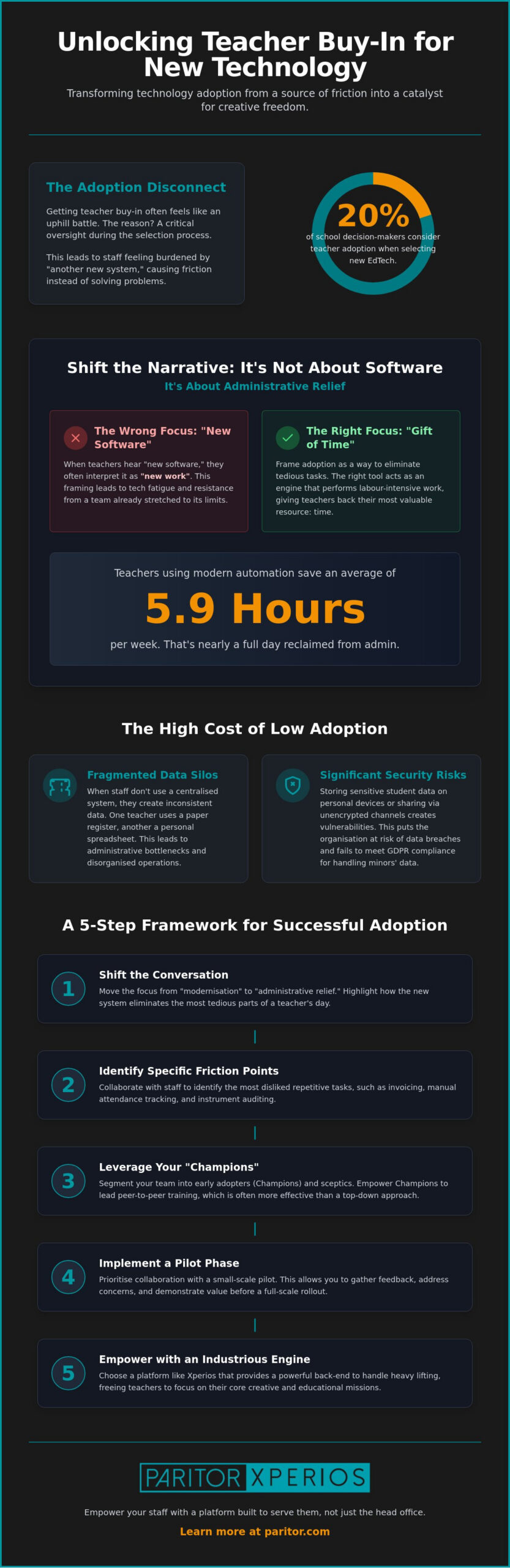
A 5-Step Framework for Successful Technology Adoption
Implementing a new system requires more than just a software license. It requires a structured strategy that respects the professional expertise of your staff. Historically, only 20% of school decision-makers have prioritised teacher adoption when selecting tools. Reversing this trend is the first step in getting teacher buy-in for new technology. By following a consultative framework, you can move from initial scepticism to total organisational efficiency.
- Step 1: Consult and Collaborate. Involve teachers in the selection criteria early. Ask what features would actually make their lives easier, such as instant attendance tracking or mobile access.
- Step 2: The Pilot Phase. Run a small-scale trial with a specific department or a single youth ensemble. This allows you to identify potential friction points in a controlled environment.
- Step 3: Bespoke Training. Avoid generic tutorials. Use sector-specific workflows, such as scheduling a term of peripatetic lessons, so staff see immediate relevance to their daily roles.
- Step 4: Iterative Feedback. Create a formal process for staff to suggest system configurations. When teachers see their input reflected in the platform’s setup, they feel a sense of ownership.
- Step 5: Celebrate Success. Once the system is live, highlight the tangible benefits. Share data on the hours saved or the reduction in billing errors to reinforce the value of the transition.
Planning Your Implementation Timeline
Big bang launches often lead to panic and resistance. A phased rollout is far superior because it allows for professional data migration and system testing. Set realistic milestones for staff proficiency, moving from basic register taking to more advanced features like instrument tracking over several months. This steady pace ensures that the industrious engine of your organisation remains stable whilst everyone learns the new rhythms of the system. It’s a journey that prioritises stability over speed.
Bespoke Onboarding and Continuous Support
Effective onboarding must reflect real-world teaching scenarios. Utilise the secure Teacher Portal to provide self-service learning materials that staff can access on their own terms. Whilst some may view professional service fees as an extra cost, they are a vital investment in long-term success. These fees ensure that you have expert guidance during the critical setup phase, preventing the initial errors that often damage staff confidence. To see how this framework applies to your organisation, you can explore our specialised management modules and start your journey toward a more efficient future.
Empowering Your Staff with Xperios: Built for Teachers, by Experts
Xperios serves as the industrious engine behind the scenes of your organisation. It doesn’t seek the spotlight; instead, it prides itself on being the invisible support that allows your educators to excel in their primary roles. The platform’s foundation rests on decades of collaborative user input, ensuring that every feature addresses a real-world frustration experienced by music and arts professionals. This user-centric philosophy is a critical factor in getting teacher buy-in for new technology. It demonstrates that the software was built specifically for teachers, rather than just as a tool for administrative oversight.
The modular design provides a centralised hub where scheduling, ensemble bookings, and instrument inventory coexist. By housing these disparate tasks in one place, you eliminate the need for staff to toggle between multiple, disconnected systems. This philosophy of simplicity reduces the cognitive load on your team and builds professional trust. Reliability is further reinforced through enterprise-level security. Built on Microsoft Azure, Xperios ensures your data is protected by the highest standards of cloud infrastructure and full GDPR compliance. It’s a reassuring, stable presence in an increasingly complex digital landscape.
The Xperios Teacher Portal: Simplicity by Design
Busy educators on the go need an interface that is intuitive and responsive. The Xperios Teacher Portal delivers exactly that, removing the friction from daily tasks like attendance tracking and invoicing. It’s a tool that respects the user’s time and restores focus to the classroom. For organisations managing large stocks of equipment, the portal offers seamless integration with Instrument Inventory Management Software. This ensures that teachers can check the status of a violin or a cello as easily as they check their morning schedule, all within the same ecosystem.
A Partnership for Long-Term Growth
Adopting a new system is the beginning of a professional journey. We position ourselves as a dedicated ally rather than a detached service provider. Our tiered licensing model ensures that the system grows alongside your organisation, providing a scalable solution that remains cost-effective as your student numbers increase. We understand that your mission is creative excellence. Our role is to provide the technological foundation that makes that excellence sustainable. Discover how Xperios can transform your organisation’s efficiency and staff morale.
Reclaim Your Focus and Empower Your Team
Successful digital transformation isn’t about the software itself; it’s about the time and creative freedom it restores to your staff. By shifting the narrative from administrative oversight to genuine relief, you transform the process of getting teacher buy-in for new technology from a hurdle into a shared victory. Implementing a phased rollout and empowering internal champions ensures your team feels supported rather than burdened during the transition.
Xperios is the industrious engine designed specifically for this purpose. Built on over 30 years of collaborative user input, our platform is trusted by leading UK music services and conservatoires to handle the heavy lifting of scheduling and billing. Because we are securely hosted on Microsoft Azure with full GDPR compliance, you can rest assured that student data remains protected at the highest institutional standards. It’s time to move forward with a partner that understands the specific pressures of your sector.
Book a consultative demo of Xperios today to see how our modular system can eliminate repetitive burdens. Let’s work together to restore your organisation’s focus to what matters most: the music and the students.
Frequently Asked Questions
What is the biggest barrier to getting teacher buy-in for new technology?
The primary barrier is job-related stress and the perception that new software equals additional labour. In 2026, many educators report significant stress, making them wary of any tool that doesn’t offer immediate relief. Successful leaders overcome this by proving the tool is an ally that reclaims time rather than a burden that consumes it. It’s about shifting the focus from technical innovation to administrative relief.
How can I support teachers who are not tech-savvy during a software rollout?
Providing modular, bite-sized training sessions is the most effective way to support staff who feel less confident with digital tools. Pairing these teachers with “Champions” allows for low-pressure, peer-to-peer learning. Using an intuitive platform like the Xperios Teacher Portal also removes technical friction. This allows staff to focus on the positive outcomes for their students rather than the complexities of the interface itself.
Why is a pilot program important for technology adoption in schools?
A pilot program is essential because it provides a low-risk environment to identify specific friction points before a full rollout. By running a trial with a single department, you can gather iterative feedback and refine system configurations. This small-scale success creates tangible evidence of efficiency, making the process of getting teacher buy-in for new technology significantly smoother across the wider organisation.
How does Xperios help reduce the administrative burden on music teachers?
Xperios acts as an industrious engine that automates the repetitive tasks music teachers dislike most, such as manual invoicing and attendance tracking. By centralising scheduling and ensemble management into one secure platform, it eliminates the need for fragmented spreadsheets. This automation saves teachers an average of nearly six hours per week. It allows them to restore their focus to creative instruction and student progress.
Can new technology actually improve teacher retention in the arts?
What role does data security play in gaining staff trust for new systems?
Data security is fundamental to gaining staff trust because teachers need to know that sensitive student information is handled professionally. Using platforms hosted on Microsoft Azure ensures that data is protected by enterprise-level encryption and full GDPR compliance. This reliability builds a foundation of professional trust. It reassures staff that the system is a safe and stable addition to their professional toolkit.
How long does it typically take to achieve full teacher buy-in?
Full buy-in typically follows a steady, logical progression over one to two academic terms. It begins with the initial consultation and moves through a pilot phase before total system adoption is achieved. Whilst the technical setup may be quick, the psychological shift requires time for staff to experience the “quick wins” and administrative relief that the software provides in their daily lives.
What should I do if a small group of staff remains resistant to the new system?
If a small group remains resistant, the best strategy is to create a feedback loop where their specific concerns are heard and addressed. Identifying their unique “pain points” allows you to demonstrate how the system can solve their most frustrating tasks. Often, resistance stems from a fear of losing time. Proving that the tool is an industrious engine for their benefit eventually turns sceptics into advocates.