

Imagine it’s the peak of the assessment season and you’re trapped between a crashing spreadsheet and a pile of unpaid invoices, whilst faculty members wait for their jury schedules. You didn’t dedicate your career to music education to spend your evenings as a logistics coordinator or a debt collector. We know that the pressure of manual administration often feels like a barrier to the very artistry you’re trying to foster. It’s a common frustration, but it doesn’t have to be your reality in 2026.
Modern music exam administration software is designed to act as your invisible partner, taking the weight of repetitive tasks off your shoulders. By adopting a centralised system, you can eliminate manual errors and automate parent communications; this ensures every fee is tracked and every room is booked without a single frantic email. In this guide, we’ll show you how updated technology allows you to reclaim your time and focus entirely on student performance and growth. We’ll explore the shift toward cloud-based automation and how these tools are helping organisations meet the latest national standards with ease, reliability, and professional security.
Key Takeaways
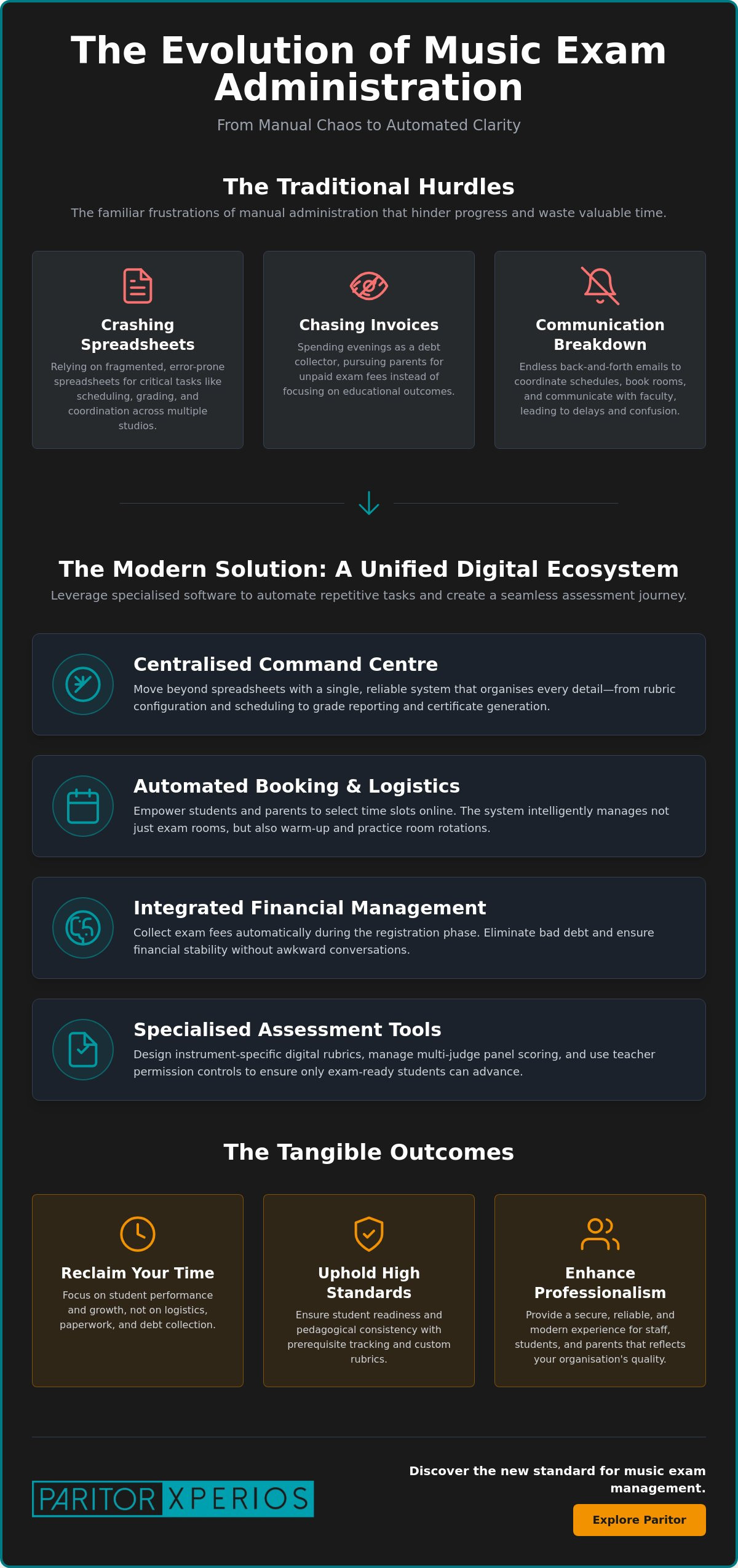
- Learn how a specialised digital ecosystem moves beyond simple scheduling to automate complex tasks like rubric configuration and grade reporting.
- Discover how customisable exam fields and teacher permission controls ensure only exam-ready pupils advance to maintain institutional standards.
- Understand the methodology for replacing fragmented manual spreadsheets with a centralised system that simplifies coordination across multiple studios.
- Explore the strategic implementation of music exam administration software to create a seamless journey from defining instrument-specific rubrics to final assessment.
- See how integrating your assessments with financial and instrument management modules creates a unified, efficient administrative engine for your organisation.
What is Music Exam Administration Software?
At its heart, music exam administration software is a specialised digital ecosystem designed to handle the intricate lifecycle of musical assessments. Rather than a basic booking tool, this technology serves as a dedicated command centre that organises and manages every variable of the examination process. It’s built to understand that a violin grade exam requires entirely different parameters than a drum kit jury. By integrating with the academic principles of Computational musicology, these systems provide a structured way to quantify progress, turning subjective performances into actionable data and secure achievement portfolios.
This software goes far beyond simple scheduling. It provides the framework for complex rubric configuration, allowing departments to define specific criteria for technique, expression, and sight-reading. When the assessment is complete, the system automatically handles grade reporting and certificate generation. Crucially, it integrates financial management directly into the workflow. This ensures that exam fees are collected upfront during the registration phase, removing the awkward and time-consuming task of chasing parents for payments whilst you’re trying to finalise a performance schedule. With the global ERP market projected to reach USD 123.41 billion by 2030, the shift towards these integrated, cloud-based solutions is a clear industry standard for 2026.
The Core Components of a Modern System
- Automated booking engines: These allow students and parents to select specific time slots that fit their schedule, reducing the back-and-forth communication that typically plagues admin teams during peak seasons.
- Digital rubrics: Tailored marking sheets for different instrument families, ensuring that a percussionist isn’t being judged on the same technical nuances as a cellist or a vocalist.
- Secure teacher portals: Dedicated spaces for faculty to enter real-time marking and feedback, which are then instantly synced to the student’s central record for immediate review.
Why General School Software Often Fails Music Services
Generic school management tools often struggle with the unique demands of the performing arts. They usually lack support for multi-judge panel scoring, where composite grading from three or more experts must be calculated instantly. These rigid systems also fail to account for the physical logistics of a music service; they can’t manage warm-up room rotations alongside performance spaces. A standard classroom booking system doesn’t understand that a student needs 20 minutes in a practice room before their 15-minute assessment. Without the flexibility to handle specific Grade variations within a single session, general software often creates more work than it saves. Using dedicated music exam administration software ensures that these nuances are built into the workflow from day one.
Essential Features for High-Stakes Assessments and Juries
High-stakes assessments require a level of precision that general scheduling tools simply cannot provide. When a student steps into a performance jury, the administrative framework behind them must be flawless. Modern music exam administration software provides this stability through customisable exam fields that adapt to your specific syllabus or board requirements. Whether you’re assessing ABRSM, Trinity, or internal faculty standards, the software organises the data to match your pedagogical goals. It’s about creating a system that reflects the unique nuances of music education rather than forcing your curriculum into a generic template.
One of the most significant challenges in music program administration is ensuring teacher accountability and student readiness. To address this, advanced systems include teacher permission controls. This feature ensures that only pupils marked as “exam-ready” by their instructors can apply for a slot. Prerequisite tracking further verifies that students have passed necessary theory or practical levels before they can proceed. This gatekeeping reduces the risk of students attempting assessments they aren’t prepared for, which protects both the student’s confidence and the examiner’s time. It’s a supportive way to maintain high standards across the entire department.
Instrument-Specific Rubrics and Marking Schemes
Effective assessment isn’t one-size-fits-all. You can configure technique, musicality, and interpretation criteria for every instrument in your programme. For vocalists, you might prioritise diction and breath control; for percussionists, the focus may shift to rudimental accuracy. The system enables multi-faculty panels to submit independent scores for a single performance simultaneously. Composite Scoring is the automated aggregation of multiple judge marks, providing a fair and instant final result. This allows for automated reporting on specific components like aural tests, sight-reading, and technical proficiency, giving students clear, actionable feedback without the wait.
Logistics and Resource Management
Coordination is often the most taxing part of the assessment season. A centralised view allows you to manage performance halls, pianos, and accompanist availability in one place. You can also manage “Extras” such as warm-up room time slots and specific equipment hire requirements. For a truly seamless experience, ensure your instrument inventory management software is synced with your exam requirements. This ensures that the right piano is tuned or the correct percussion kit is available in the right room at the right time. If you’re looking to simplify these complex workflows, exploring the Xperios Exams and Assessments Module is a logical next step for any growing music organisation.
Overcoming the Traditional Hurdles of Manual Exam Admin
The peak of exam season often transforms music departments into high-pressure logistics centres. When you’re coordinating 300 students across 20 different studios, the traditional “spreadsheet nightmare” becomes an active risk to your organisation’s efficiency. Manual data entry is prone to human error, leading to double-booked accompanists or misplaced grade entries. Transitioning to dedicated music exam administration software eliminates these friction points by providing a single, reliable source of truth. It replaces fragmented email chains and handwritten notes with a streamlined digital workflow that stays accurate even during the busiest assessment periods.
Fragmented communication between teachers, parents, and administrators is another significant hurdle. Chasing parents for exam fee payments or waiting for teachers to confirm a student’s readiness takes hours of administrative time. By integrating online payments directly into the assessment module, you significantly reduce the financial risk of unpaid fees. Parents receive automated notifications and can pay securely through a portal, whilst administrators track every transaction in real-time. This creates a professional, transparent experience for families and ensures your budget remains stable.
The Security of Cloud-Based Assessments
Data security is a critical concern for UK-based educational organisations handling sensitive student results. Relying on local server storage is a vulnerability; a single hardware failure can wipe out years of assessment history and current schedules. Our systems utilise UK-based cloud hosting on Microsoft Azure to provide robust data redundancy. This ensures full GDPR compliance whilst protecting your music service data management from external threats. Cloud-based systems mean your records are always accessible to authorised staff, yet perfectly shielded from loss or breach. It’s about providing peace of mind for both your staff and the families you serve.
Empowering Teachers through the Teacher Portal
Administrative teams often find themselves “chasing” marks and approvals from busy faculty members. The Teacher Portal changes this dynamic by giving instructors a direct entry point for their student data. Faculty can view their complete jury schedule across all instruments, ensuring they’re always in the right place at the right time. They can also approve student exam entries with a single click, streamlining the prerequisite check process. This autonomy doesn’t just reduce the admin burden; it empowers teachers to take ownership of their students’ assessment journeys without the paperwork. It’s a supportive tool that allows your educators to focus on pedagogy rather than forms.
The Strategic Implementation Journey
Adopting new technology is a strategic evolution for any music organisation. It requires a clear roadmap to move from fragmented spreadsheets to a unified digital environment. The implementation of music exam administration software follows a logical, five-phase journey designed to minimise disruption whilst maximising organisational impact. This structured approach ensures that every stakeholder, from the senior administrator to the visiting examiner, understands their role in the new assessment ecosystem.
- Phase 1: Configuration. Begin by defining your specific exam types, grades, and instrument-specific rubrics. This is where you tailor the system to reflect your unique pedagogical standards.
- Phase 2: Governance. Establish teacher permissions and prerequisite gatekeeping. This ensures only qualified candidates advance, maintaining the integrity of your assessment sessions.
- Phase 3: Engagement. Launch the portal for parent bookings and upfront payments. This phase shifts the administrative burden away from your office and onto an automated, self-service system.
- Phase 4: Execution. On the day of the exam, utilise digital marking and real-time room management. This allows examiners to focus on the performance rather than the paperwork.
- Phase 5: Completion. Deliver results automatically and generate comprehensive achievement reports. This final step closes the loop, providing students with immediate feedback and a secure record of their progress.
Maximising the Parent Experience
The exam journey is often a source of anxiety for families. You can significantly improve this experience by using a parent portal for music schools to provide real-time updates and clear instructions. Automated reminders for exam dates and times ensure that students arrive prepared and on schedule, whilst a “click-and-pay” functionality at the point of booking removes the friction of manual invoicing. This level of professional transparency builds trust and positions your organisation as a modern, student-centric institution.
Evaluating Success: Data and Reporting
Once your assessment cycle is complete, the software provides a wealth of data to help you plan for the future. You can generate instant lists of applicants and grades, alongside any required extras like accompanists or specific equipment. Analysing pass rates and progress trends across different departments allows you to identify areas of excellence or those needing additional support. This high-level data is essential when planning resource allocation for ensemble management software, ensuring your groups are populated by students with the appropriate technical proficiency. To see how this strategic journey can transform your organisation, we invite you to explore the Xperios Exams and Assessments Module today.
Why Xperios is the Standard for Music Exam Management
Xperios stands as the definitive choice because it treats assessments as a core pedagogical pillar rather than a mere scheduling event. Our music exam administration software is the result of 30 years of dedicated experience in the music service management software sector. This deep domain knowledge allows us to build tools that anticipate the specific pressures of the assessment season. We don’t just provide a platform; we offer a relief-oriented design that absorbs the heavy lifting of coordination. This allows your team to step away from the stress of logistics and return to their primary mission of fostering musical excellence.
Our commitment to continuous innovation is driven by a person-centric approach. We actively refine our features based on direct feedback from UK music hubs, conservatoires, and private providers. This collaborative evolution ensures that the software solves real-world problems, such as managing complex jury panels or securing sensitive student data. By choosing a partner that understands the nuances of the performing arts, you’re investing in a stable, forward-thinking future for your organisation.
Seamless Integration Across the Xperios Suite
The true power of the system lies in its modularity. When you utilise the Xperios Exams and Assessments Module, you aren’t working in a data silo. The system communicates directly with the Xperios Financial Management module, triggering automated invoicing the moment a parent confirms a booking. This synergy extends to the Xperios Student Portal, where results and progress tracking are updated instantly. Parents enjoy a consistent, professional experience across every touchpoint, whether they’re paying for a grade exam or checking a rehearsal schedule. This unified approach ensures that data flows effortlessly between departments, eliminating the need for manual cross-referencing or repetitive data entry.
Ready to Modernise Your Assessments?
Adopting Xperios is more than a software upgrade; it’s a partnership-led journey. We understand that migrating legacy data from old systems or physical records can feel daunting. Our onboarding process is led by industry veterans who ensure your transition is smooth and your data remains secure. As your organisation grows from a local teaching practice to a regional music service, the Xperios cloud platform scales with you. It provides the technical infrastructure needed to handle increasing student volumes whilst maintaining the highest service standards. It’s time to move beyond the limitations of outdated admin and embrace a system built specifically for your needs. Discover how Xperios transforms music exam administration and reclaim your time for the music.
Transform Your Assessment Strategy for 2026
The transition from manual spreadsheets to a centralised digital ecosystem is a necessary step forward for any ambitious music organisation. By adopting modern music exam administration software, you replace the traditional logistical burden with a streamlined, reliable engine that handles everything from rubric configuration to automated results. This shift doesn’t just improve efficiency; it protects your organisation with Microsoft Azure cloud hosting for maximum UK data security and builds trust through a professional parent experience.
Trusted by leading UK Music Hubs and Conservatoires, our systems are designed to reduce your administrative workload by automating portal-based bookings and upfront payments. This allows your faculty to step away from the paperwork and return to their primary creative mission. It’s about empowering your team and providing students with a clear, secure path to achievement. If you’re ready to eliminate the stress of the assessment season and prioritise student progress, we’re here to help you take that next step. Book a discovery call to see the Xperios Exams module in action and start your journey toward a more organised, empowered future.
Frequently Asked Questions
Can music exam administration software handle different grading systems?
Yes, the software is designed to accommodate various grading systems, including ABRSM, Trinity College London, and your own internal assessment frameworks. You can configure the system to match the specific grades, marks, and criteria required by different examination boards. This flexibility ensures that your administrative workflow remains consistent regardless of the syllabus being used, allowing for a unified approach to student progress tracking across your entire organisation.
How does the software manage multi-judge panels for performance juries?
Multi-judge panels are managed through a digital “Composite Scoring” feature that allows several faculty members to enter independent marks for the same performance. The system then automatically aggregates these scores based on your predefined weighting. This eliminates the need for manual calculations or paper-based moderation. It provides an instant, fair result that is immediately recorded in the student’s achievement portfolio, ensuring transparency and professional accuracy during high-stakes juries.
Is student assessment data secure in a cloud-based system?
Yes, your student assessment data is highly secure because it’s hosted on UK-based Microsoft Azure cloud servers. This infrastructure provides robust data redundancy and full GDPR compliance, protecting sensitive information from hardware failure or unauthorised access. Using music exam administration software with this level of security ensures that your records are always accessible to authorised staff whilst remaining shielded behind enterprise-grade encryption and professional safety protocols.
Can parents pay for exams directly through the software?
Parents can pay for exam fees directly through the integrated Parent Portal at the point of booking. This “click-and-pay” functionality ensures that fees are collected upfront, which significantly reduces the financial risk of unpaid invoices and the administrative burden of chasing payments. The system automatically syncs these transactions with the Xperios Financial Management module, providing real-time visibility into your assessment revenue and simplifying your end-of-term reconciliation.
Does the system allow for instrument-specific marking rubrics?
Yes, the platform allows you to create bespoke, instrument-specific marking rubrics that reflect the unique technical requirements of different instrument families. You can define specific criteria for woodwind, strings, or percussion, ensuring that examiners have the correct marking sheet for the student in front of them. This level of detail ensures that feedback is pedagogically relevant and that every student is assessed against the most appropriate standards for their chosen discipline.
How do teacher permissions work for exam entries?
Teacher permissions act as a vital gatekeeping tool, ensuring that students can only be entered for assessments once their instructor has confirmed they are ready. Administrators can set prerequisite checks, such as requiring a passed theory grade before a practical exam booking is permitted. This supportive structure ensures that your assessment sessions run smoothly and that students only face high-pressure exams when they have the necessary technical foundation to succeed.
Can we schedule warm-up rooms and accompanists alongside the main exam?
You can coordinate warm-up rooms, performance halls, and accompanist availability within a single, centralised view. The software’s resource management tools allow you to schedule practice slots immediately preceding the exam, ensuring a logical flow for students and staff alike. By managing these “Extras” alongside the main assessment, you avoid the common pitfalls of double-booking and room conflicts, creating a professional and calm environment for your performers.
Will the software integrate with our existing student database?
The system is built as a modular suite, meaning the Exams and Assessments Module integrates seamlessly with your existing Xperios database. This ensures that student records, teacher schedules, and financial data are all connected without the need for manual data migration between different platforms. A centralised system provides a single source of truth, allowing your music exam administration software to pull relevant student history and prerequisites automatically for every new assessment cycle.