

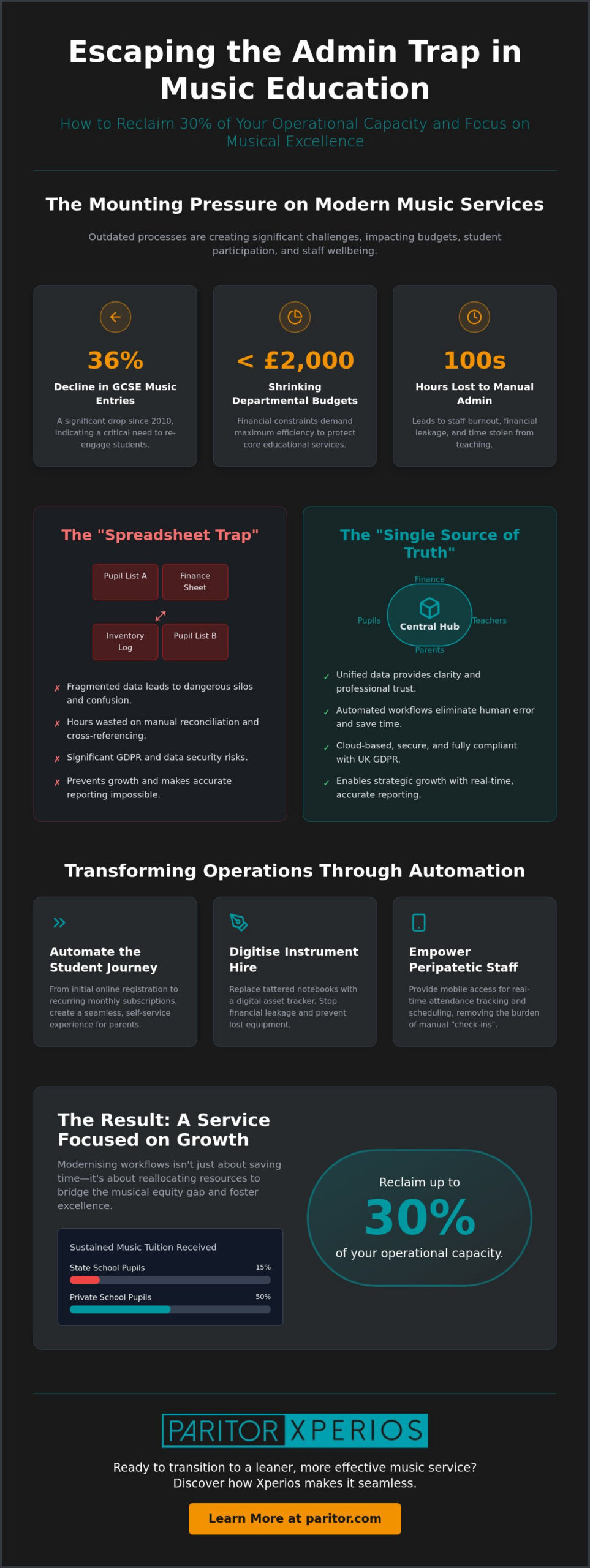
With GCSE music entries down by 36% since 2010 and departmental budgets often falling short of £2,000, the pressure on your leadership has never been higher. You likely feel the weight of this squeeze every time you reconcile a fractured spreadsheet or hunt for a missing instrument. It’s exhausting to watch talented staff burn out under the weight of manual data entry while your core mission of musical excellence is pushed aside by paperwork.
Reducing admin burden for music service managers is no longer just a “nice to have” goal; it’s a vital strategy for institutional survival in 2026. This guide reveals how you can reclaim 30% of your operational capacity by modernising workflows and finally escaping the manual spreadsheet trap. We’ll explore how to establish a centralised single source of truth for your data and automate billing to eliminate financial leakage. You’ll discover a clear roadmap to transition your team from reactive admin tasks to proactive strategic growth and musical excellence.
Key Takeaways
- Discover how reducing admin burden for music service managers can reclaim 30% of your operational capacity by modernising workflows and eliminating the manual “spreadsheet trap”.
- Learn why moving to a secure, cloud-based “single source of truth” provides the essential foundation for a lean, professional music hub.
- Identify the specific touchpoints where you can automate the student journey, from initial online registration through to recurring monthly subscriptions.
- Understand how to transform instrument hire from a manual ledger into a digital asset tracker to stop financial leakage and lost equipment.
- Explore how structured onboarding and data migration services make transitioning to Xperios a seamless process, even for time-poor management teams.
The True Cost of Administrative Burden in Music Service Management
Administrative burden isn’t just a list of tasks. It’s the friction between your intent to provide world-class music education and your team’s actual execution. In many music hubs, this burden feels like a constant battle against “red tape” that stifles creativity and stalls progress. The True Cost of Administrative Burden is measured in more than just hours. It’s measured in the psychological toll on peripatetic teachers who spend their evenings reconciling registers rather than preparing lessons. This systemic exhaustion leads to institutional burnout and high staff turnover. It’s a heavy price to pay for outdated processes.
Financially, the “invisible” admin costs are staggering. When billing is manual, tuition fees fall through the cracks and stay uncollected. Instruments go out on loan and never return because the tracking ledger is a tattered notebook or a lost file. In 2026, these inefficiencies are no longer sustainable. With only 15% of state school students receiving sustained tuition compared to 50% in private schools, manual data entry has become a barrier to musical equity. By reducing admin burden for music service managers, we can reallocate resources to bridge this gap and ensure every child has access to quality instruction.
The “Spreadsheet Trap”: Why Fragmented Data is Your Biggest Enemy
Fragmented data is a significant liability. When you have multiple versions of a pupil list, you create dangerous data silos. This isn’t just confusing; it’s a GDPR risk under the Data Use and Access Act 2025. Your team spends hours cross-referencing finance spreadsheets with scheduling software and inventory logs. The spreadsheet trap is a systemic failure of scalability that prevents your service from growing. It keeps your data trapped in a cycle of human error and manual reconciliation, making it impossible to gain a clear view of your service’s health.
Calculating the ROI of Administrative Efficiency
Efficiency isn’t just about saving time. It’s about revenue protection. Automated billing ensures every lesson is accounted for and every fee is collected without human intervention. This shift allows you to expand ensemble programmes without the need to hire more administrative staff. You can find a full breakdown of these capabilities in this music service management software guide. Investing in better systems means your budget goes toward instruments and instructors, not paperwork. It’s about moving from a reactive state to a position of strategic development where musical excellence is the primary focus.
Centralisation: The Foundation of a Lean Music Service
Centralisation is the antidote to the data silos that often plague growing organisations. The transition from legacy local servers to secure, cloud-based environments like Microsoft Azure represents a fundamental shift in how modern hubs operate. In 2026, relying on physical hardware in a back office is a significant risk to both data security and operational continuity. By adopting a cloud-first approach, you establish a “Single Source of Truth”. This ensures that every pupil record, parent contact, and teacher schedule is synchronised across the entire organisation. It eliminates the need for manual reconciliation and provides a foundation of professional trust that is impossible to achieve with fragmented systems.
This unified data structure is particularly powerful when meeting the complex reporting requirements of local authorities. Managers often dread the end-of-term data pull, yet centralisation turns this into a simple, automated process. You can generate accurate, real-time reports on student engagement and financial performance without hunting through separate departments. This level of clarity is vital for reducing admin burden for music service managers who need to prove the value of their programmes to external stakeholders whilst maintaining strict compliance with the Data Use and Access Act 2025.
Cloud-Based Accessibility for the Modern Hub
Real-time data access is essential for peripatetic teachers who navigate multiple school sites daily. Automated attendance tracking via mobile devices removes the burden of manual “check-ins” at the end of the week. It ensures that attendance data is captured at the point of delivery, improving accuracy and safeguarding. In 2026, data redundancy and high-level encryption are standard requirements for protecting sensitive student information. Modern cloud infrastructure provides these safeguards automatically, ensuring your service remains compliant with the latest UK GDPR updates whilst maintaining seamless accessibility for remote staff.
Organising Teacher and Student Portals
Allowing teachers to manage their own timetables within a centralised framework is a game-changer for office efficiency. When staff can update their availability or record lesson notes directly into the system, the volume of routine enquiries to the central office plummets. This self-service philosophy is equally effective for families. Integrating a parent portal for music schools gives parents instant visibility of lesson schedules and billing history. This transparency reduces friction and empowers users to find their own answers. Adopting a modular solution like Xperios for Music Services allows you to scale these portals as your service grows, ensuring your administrative engine remains lean and effective.
Automating the Student Journey: From Booking to Billing
The student journey often begins with a flurry of fragmented emails and phone calls. This manual back and forth is the primary bottleneck for many hubs. By implementing intelligent online booking forms, you can capture all necessary data at the initial point of entry. This doesn’t just save time; it ensures that data is accurate and compliant from day one. When a prospective student sees real-time availability, the enquiry to enrolment timeframe shrinks from days to minutes. This speed is a critical factor in reducing admin burden for music service managers, allowing your team to focus on service quality rather than data entry.
The transition from a trial lesson to a recurring monthly subscription should be invisible. In a modern system, once a parent approves the trial outcome, the software automatically converts the record into a permanent enrolment. This triggers the necessary billing cycles and adds the student to the correct register without a single manual click from your office staff. It’s a seamless progression that ensures no student is lost in the gap between interest and instruction.
Frictionless Financial Management
Managing the finances of a large music service is notoriously complex. Xperios Financial Management integrates directly with your existing accounting software to eliminate the need for tedious double entry. The system handles complex discount structures automatically. Whether it’s a sibling discount, a multi-instrument reduction, or a pupil premium adjustment, the software calculates the correct total every time. This automation has a profound impact on cash flow. Automated invoicing and direct debit collections ensure that payments arrive on time, whilst automated arrears chasing handles the awkward conversations for you. This level of financial stability allows you to plan your ensemble programmes with confidence.
The Parent Portal as an Admin Assistant
A superior parent experience is one of the most effective tools for reducing internal workload. By providing an Xperios Parent Portal, you turn every parent into a part-time admin assistant. Families can update their own contact details, medical information, and marketing preferences at any time without staff intervention. This self-service model drastically reduces the volume of routine enquiries hitting your inbox.
Communication also becomes more efficient through digital progress reports. Instead of printing and posting paper assessments, teachers can log achievements directly into the Xperios Teacher Portal, which then notifies parents immediately. Providing 24/7 access to lesson schedules and exam dates means parents no longer need to call the office to check a time. It is a win for the family and a massive relief for your administrative team, ensuring everyone stays informed without the need for constant manual updates.
Resource Management: Streamlining Instruments and Ensembles
Managing ensembles and large-scale concerts presents a similar logistical challenge. Coordinating hundreds of students, dozens of teachers, and multiple venues often leads to a flurry of frantic emails. Moving these processes into a single platform ensures that concert logistics are handled with professional precision. You can manage membership lists, track attendance, and organise rehearsals without ever leaving the system. This level of integration turns a chaotic event day into a calm, well-orchestrated performance.
Digital Instrument Tracking and Maintenance
Automated repair schedules are vital for ensuring all assets are safe and playable. When an instrument is flagged for repair, the system can automatically notify the technician and update the hire status. Linking instrument loans directly to pupil records provides instant accountability for both parents and staff. This transparency ensures that you always know who has which asset and when it’s due for return. For a deeper dive into best practices, explore this guide on instrument inventory management software. Effective tracking stops your budget from leaking away through lost or damaged equipment.
Ensemble and Event Scheduling Without the Stress
Large-scale concerts and multi-teacher rehearsals don’t have to be an administrative nightmare. Using dedicated ensemble management software allows you to automate concert ticketing and seating plans, which drastically reduces event-day admin. You can even create a digital event register in under two minutes by following these simple steps:
- Step 1: Access the Event Management module and select your target ensemble.
- Step 2: Input the venue details and rehearsal or performance times.
- Step 3: Select the required staff and assign them to the event.
- Step 4: Click “Publish” to instantly push the register and schedule to the Teacher and Parent Portals.
This automated workflow ensures that everyone is informed and registers are ready before the first note is played. If you’re ready to stop the paper trail, you can explore Xperios Instrument Management to see how digital tracking transforms your service.
Transitioning to Xperios: Reclaiming Your Focus
The most common objection we hear from leadership teams is a simple one: “I don’t have time to implement new software.” It is a classic paradox. You’re too busy fighting fires to install a sprinkler system. However, staying trapped in a cycle of manual data entry and fragmented spreadsheets only ensures that the fires keep starting. Reducing admin burden for music service managers isn’t just about software; it’s about a fundamental shift in your professional role. By automating the repetitive, labour-intensive tasks we have discussed, you move from being a “fire-fighter” to a “service-builder”. You reclaim the mental space needed to focus on strategic development, musical excellence, and long-term sustainability.
This transition doesn’t have to be a solo effort. We view our relationship with music hubs as a partnership, not just a purchase. Our team understands the unique pressures of the sector because our platform was built on collaborative user input from managers who have faced the exact same hurdles you’re navigating today. We’ve designed a consultative process that maps your specific service workflows before a single piece of data is moved, ensuring the system fits your organisation rather than forcing you to change your mission to fit the software.
The Onboarding Process: Setting Up for Success
We handle the heavy lifting of legacy data migration. Our specialists move your records from disparate spreadsheets and local servers into the secure Xperios cloud infrastructure. This eliminates the implementation friction that often stalls modernisation projects. Once your data is live, we focus on training your administrative team to become “power users”. During the first 90 days, you’ll see the “spreadsheet trap” dissolve as automated billing and real-time registers take over. It’s a period of rapid empowerment where the relief of a streamlined workflow becomes a daily reality for your staff.
Scalability and Future-Proofing Your Service
Your management tools should grow alongside your ambitions. Whether you are managing 500 pupils or a massive regional hub with over 5,000 students, Xperios provides the scalability you need. Our platform evolves with the industry, incorporating updates like the 2024 UK Music Metadata Agreement and the latest GDPR requirements automatically. This ensures your service remains compliant and professional without requiring constant manual oversight. It is time to stop managing paperwork and start leading your musical community. Book your Xperios discovery session today and take the first step toward reclaiming your operational capacity.
Modernising Your Vision for 2026
The shift toward a lean, automated music service is no longer a distant goal. It’s a necessary evolution for hubs facing budget shortfalls and increasing administrative complexity. By centralising your data and automating the student journey, you eliminate the friction that leads to institutional burnout. You move from a reactive state of daily “fire-fighting” to a proactive role focused on musical excellence. Reducing admin burden for music service managers is the essential first step to unlocking 30% more operational capacity within your team.
Paritor has been trusted by UK music hubs for over 30 years. Our platform is built on secure Microsoft Azure cloud infrastructure, ensuring your data is safe and accessible whilst you work. With a dedicated UK-based support and implementation team, we ensure your transition is smooth and successful. Discover how Xperios can transform your music service administration. Your focus belongs on the music and your students. We’re here to help you build a more efficient, future-proof service.
Frequently Asked Questions
How much time can a music service manager realistically save with Xperios?
Most users reclaim approximately 30% of their operational capacity by automating repetitive manual workflows. This significant saving is achieved by eliminating the “spreadsheet trap” and digitising lesson registrations and billing. By reducing admin burden for music service managers, the platform allows leadership teams to move away from reactive paperwork and focus on long-term strategic growth.
Is Xperios compliant with UK GDPR and local authority data standards?
Xperios is fully compliant with UK GDPR and the Data Use and Access Act 2025. The system is built on secure Microsoft Azure cloud infrastructure, which meets the high-level encryption and data redundancy standards required by UK local authorities. Background updates ensure that your service remains aligned with the latest regulatory changes without requiring manual intervention.
Can we migrate our existing student data from Excel or other legacy systems?
Yes, our dedicated UK-based implementation team manages the entire data migration process from your existing Excel files or legacy software. We understand that data integrity is vital, so we work closely with you to ensure pupil records, schedules, and financial histories are accurately transferred. This structured approach reduces implementation friction and ensures you’re ready to go from day one.
Does the software handle complex billing like sibling discounts or bursaries?
Xperios Financial Management is designed to handle complex billing structures including sibling discounts, pupil premium bursaries, and multi-buy reductions automatically. Once your specific rules are configured, the system applies the correct discounts to every invoice without any manual input. This automation prevents financial leakage and ensures that families always receive accurate, professional billing statements.
What support is available for peripatetic teachers using the system on the go?
Teachers can access the Xperios Teacher Portal via any mobile device to manage their timetables and registers whilst moving between school sites. The portal allows for real-time attendance tracking and lesson note entry, which syncs immediately with the central office. This mobile accessibility removes the need for teachers to perform manual data entry at the end of a long day.
Can Xperios manage instrument repairs as well as hire schemes?
Xperios Instrument Management tracks the entire lifecycle of your assets, including hire history, maintenance logs, and repair schedules. You can flag instruments for repair and notify technicians directly through the platform, ensuring all equipment remains safe and playable. This centralised tracking provides instant accountability and prevents the loss of valuable inventory through unmonitored loans.
Is the system suitable for small private music schools as well as large hubs?
The platform is highly modular and scales effectively for organisations of all sizes, from small private practices to regional music hubs. With various plans available, including options for services with over 50 pupils, the software provides the necessary tools to grow your organisation. Reducing admin burden for music service managers remains our core mission regardless of your student numbers.
How does the Parent Portal help reduce the number of administrative enquiries?
The Xperios Parent Portal empowers families to manage their own contact details, medical information, and lesson schedules 24/7. By providing this self-service transparency, you significantly reduce the volume of routine phone calls and emails to your administrative team. Parents feel more informed and involved, whilst your office staff are freed from answering basic scheduling and billing queries.