
Could a single spreadsheet error be the reason your next budget request fails? It’s a frustrating reality for many music leads who find themselves drowning in manual data entry whilst trying to justify their department’s value. When you’re facing a board of governors, the conversation often stalls on costs rather than impact. Providing accurate music service reporting for school governors shouldn’t feel like an uphill battle against fragmented data and safeguarding anxieties. You know that your current systems are stretched thin; the fear of a flat “no” based on budget constraints is enough to keep any administrator awake at night.
We’re here to help you flip the script. This guide will show you how to master the art of building a compelling business case that aligns software investment with your governors’ strategic priorities and organisational health. You’ll learn how to present a digital transition not as a luxury expense, but as a vital tool for financial transparency, improved safeguarding, and better service delivery for every student. We’ll explore how to move from reactive paperwork to a streamlined department that wins the board’s confidence and secures the investment your music service deserves.
Key Takeaways
- Reframe your request by shifting the focus from administrative cost to strategic risk mitigation and institutional health.
- Simplify music service reporting for school governors by replacing manual, error-prone spreadsheets with automated and accurate data insights.
- Quantify the “hidden” ROI of digital transformation by calculating the hours reclaimed for core tuition and the reduction in financial leakage.
- Structure your board pitch to lead with the “Strategic Why” to ensure governors view software as a necessity rather than a luxury.
- Leverage the heritage of sector-specific partners like Xperios to provide the professional security and stability that boards demand.
Understanding the Governor Mindset: Why Software is a Strategic Priority
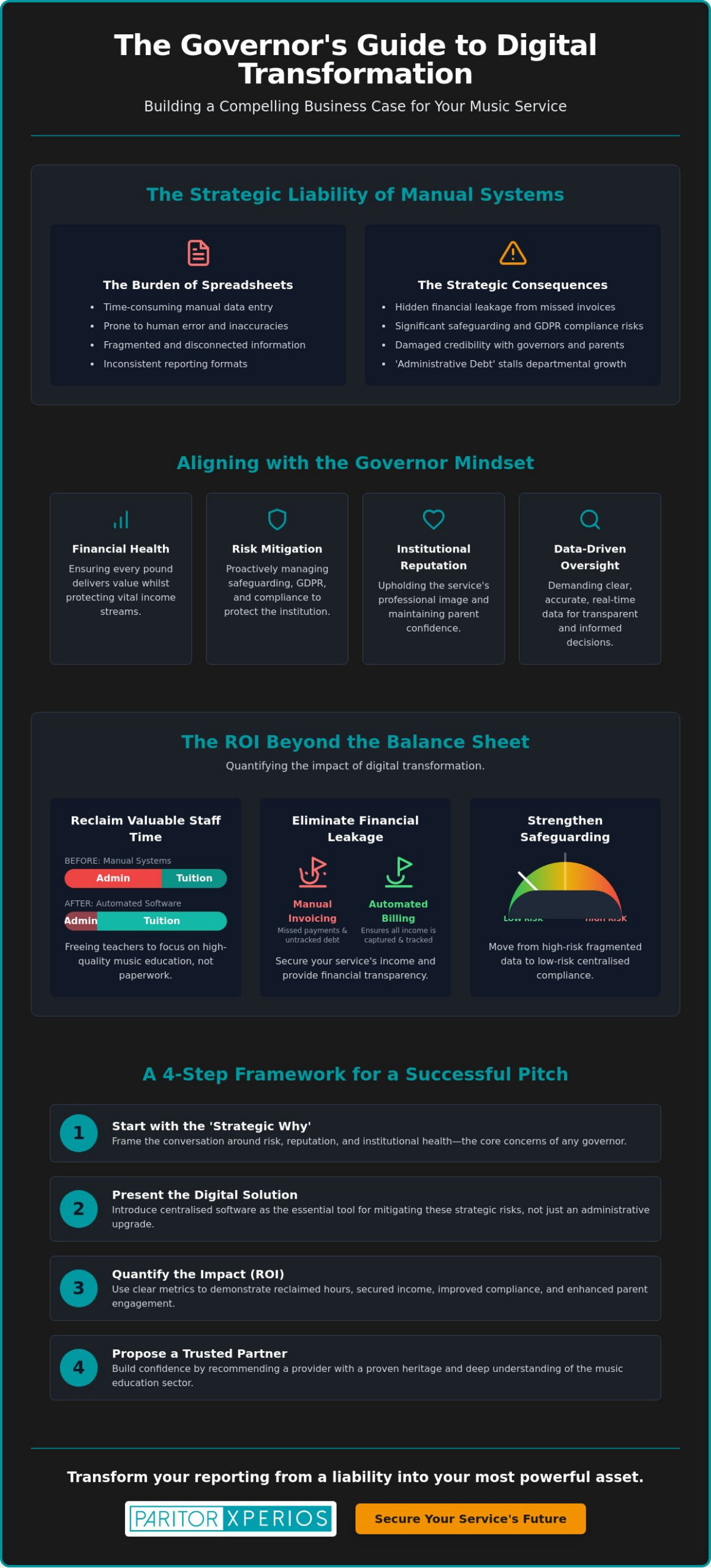
Governors operate at the highest level of institutional oversight. They aren’t just looking at the quality of the orchestra or the talent of the choir; they’re managing the complex intersection of finance, reputation, and risk. To effectively communicate with them, you must first align with Understanding the Governor Mindset. In their eyes, every administrative process is either an asset that supports the mission or a liability that threatens it. In 2026, relying on manual spreadsheets isn’t just a nuisance. It’s a strategic liability that threatens the stability of the entire service.
The landscape of British arts education has changed. With the introduction of the new Ofsted report card system and the establishment of the National Centre for Arts and Music Education in September 2026, the pressure for transparency has never been higher. Boards are moving away from simple cost-cutting and towards active value-creation. They want to see how every pound invested enhances the student experience. However, many departments are held back by Administrative Debt. This is the hidden cost of inefficient legacy systems. Like financial debt, it accumulates interest in the form of wasted staff hours, lost invoices, and inaccurate data. If you don’t address it now, the cost of doing nothing will eventually exceed the cost of the software itself.
The Shift Toward Digital Governance
Governors need clarity to make informed decisions. Digital transparency allows them to fulfil their oversight duties without digging through piles of fragmented paperwork. Real-time data provides a live pulse of the organisation, which is far more valuable than outdated, manual termly reports that are often weeks old by the time they’re read. Using modern software helps you move away from the “we’ve always done it this way” culture whilst maintaining the high standards expected of a professional music service. When you provide accurate music service reporting for school governors, you’re giving them the tools to be advocates rather than just auditors.
Safeguarding and Compliance as Non-Negotiables
Safety isn’t optional. Fragmented data is a primary risk factor in student safeguarding and GDPR compliance. When student information is scattered across multiple documents, the risk of a data breach or a missed safeguarding flag increases significantly. Centralised software ensures compliance by design, protecting the board from legal repercussions and serving as an insurance policy for the organisation’s reputation. Robust music service reporting for school governors turns these risks into manageable, transparent metrics that prove your service is safe, secure, and professional. It replaces the fear of board rejection with the confidence of institutional safety.
Building the Business Case: ROI Beyond the Balance Sheet
Governors view every pound spent through the lens of Return on Investment. In a music department, ROI isn’t just about a profit margin; it’s about the efficiency of your delivery. By automating the repetitive tasks that currently drain your staff’s energy, you’re not just buying software; you’re buying back time for creativity. When senior leaders and teachers are freed from the burden of manual data entry, they can refocus on their primary mission: high-quality tuition. This shift is a core component of the official government strategy for education technology, which advocates for digital tools to reduce administrative workload.
Financial leakage is another critical area where software proves its worth. Manual invoicing often leads to missed payments and untracked debt. Automated systems ensure that every lesson is accounted for and every bill is sent on time. Furthermore, your physical assets require the same level of scrutiny. Implementing instrument inventory management software allows you to track thousands of pounds worth of equipment with precision. This level of detail is exactly what’s needed for robust music service reporting for school governors, providing the board with the assurance that resources are being managed responsibly. It also improves parent engagement; when families have access to clear portals and instant updates, student retention naturally increases.
Financial Efficiency and Income Protection
Automated billing does more than save time; it stabilises your cash flow. By reducing the gap between service delivery and payment, you protect the organisation from significant late-payment risks. This financial clarity is vital when you’re securing Arts Council or Local Authority funding, as it demonstrates a well-governed, professional operation. Accurate music service reporting for school governors provides the evidence needed to justify continued or increased support. In an arts context, we define ROI as the balance between operational cost and educational impact. Protecting your income through technology ensures that the educational impact remains the priority.
Operational Resilience and Scalability
Operational resilience is also strengthened by embracing modern manufacturing techniques; for instance, music services can utilise protomolecule.co.uk for specialist 3D printing and rapid prototyping to create bespoke instrument parts or unique educational resources.
Cloud-based systems offer a level of disaster recovery that local servers and spreadsheets simply cannot match. If a local machine fails, your data remains safe and accessible. This resilience allows you to scale your ensembles and classes without the need to hire more administrative staff. A modern performing arts school administration system supports multi-site management, making it easy to oversee multiple venues or partner schools from a single dashboard. This scalability is essential for any service looking to grow its reach whilst maintaining tight control over its operations. To see how these tools work in practice, you might explore the specific modules within Xperios for Music Services.
Addressing the Three Main Objections: Cost, Complexity, and Security
Governors are tasked with being cautious stewards of the school’s resources. When you propose a new system, their initial instinct is often to focus on the price tag as a standalone expense. To move past this, you must reframe the initial implementation fee as a capital investment. By amortising this cost over a three to five-year period, the annual impact on the budget becomes significantly more manageable. It’s helpful to contrast this with the “Cost of Inaction”. Staying on legacy systems carries its own heavy price: the financial leakage from manual billing errors and the operational risk of data silos that we discussed earlier. Investing in a professional platform is a proactive step to stop these invisible costs from draining your budget year after year.
Complexity is the second major hurdle. Boards worry that a new system will overwhelm already busy staff or lead to a dip in productivity. You can counter this by highlighting the importance of a structured onboarding process. Modern software isn’t just a tool; it’s a supported transition. When you choose a partner with 30 years of sector-specific experience, you aren’t asking your team to learn a generic database. You’re giving them a system built specifically for their daily workflows. This familiarity, combined with user-friendly portals, ensures staff proficiency and long-term buy-in from the very first term.
Security and Data Integrity for Boards
Data security is a non-negotiable priority for any governing body. Boards need to know that student records and financial data are protected by more than just a local password. By utilising Tier-1 cloud providers like Microsoft Azure, professional systems offer a level of security and data redundancy that most local school servers simply cannot match. Automatic updates mean the system is always protected against the latest threats without requiring manual intervention from your IT team. Additionally, tools like a parent portal for music schools actually improve data integrity. When parents manage their own contact details and preferences, it drastically reduces the administrative errors that plague manual music service reporting for school governors.
The Implementation Roadmap
A clear roadmap is the best way to reassure a risk-averse board. Briefly outline the transition period, showing how the system will be phased in to ensure minimal disruption to tuition. Governors value stability; they want to know that the service won’t grind to a halt during the switch. Highlighting a partnership with an established UK veteran ensures that you have access to expert support throughout the migration. This strategic approach turns a daunting technical change into a controlled professional upgrade. Ultimately, robust music service reporting for school governors becomes the natural byproduct of a secure, well-implemented system that the board can trust implicitly.
How to Organise Your Pitch for the Board Meeting
Walking into a board meeting with a list of software features is a common mistake. Governors aren’t interested in the technical specifications of a database; they care about how that database protects the school’s reputation and financial health. Your pitch must lead with the Strategic Why. Explain that the transition is about shifting from reactive, manual processes to a proactive, data-driven culture. This high-level approach ensures that music service reporting for school governors is seen as a strategic asset rather than a clerical task.
Visual evidence is your most powerful ally in the boardroom. Instead of describing administrative delays, show them. Use simple charts to illustrate current bottlenecks, such as the volume of manual errors in billing or the hours lost to fragmented data entry. When you present your proposal, offer a tiered comparison of options. Always include the “Do Nothing” scenario, but frame it as a high-risk choice. By highlighting the potential for safeguarding lapses or financial leakage, you make it clear that staying on legacy systems is the most expensive path you could take.
Preparation happens long before the meeting starts. Identify a “Champion Governor”-ideally someone with a background in finance, technology, or risk management-and invite them to review the benefits of the software beforehand. Having an ally on the board who can speak to the professional stability of the platform is invaluable. End your presentation with a clear, time-bound recommendation. A specific request, such as “We recommend approval by the end of this month to ensure a seamless September rollout,” gives the board a logical next step to follow.
Preparing Supporting Documentation
Your supporting pack should be concise and outcome-focused. Create a one-page executive summary that highlights the benefits of reclaimed time and improved compliance. Rather than listing every module, focus on the positive impact for students and staff. Including case studies from other music service management software users provides the social proof that governors value. Pre-empt technical concerns by attaching a brief FAQ sheet that addresses security, data migration, and staff training.
Leading the Boardroom Discussion
During the discussion, keep the focus on future-proofing the organisation. You’ll likely face questions about budget re-allocation or long-term SaaS costs. Address these by pointing back to the operational resilience and income protection discussed in previous sections. Sometimes, a quick demonstration of a high-impact feature, like the automated scheduling in ensemble management software, can instantly clarify the value of the investment. It makes the abstract concept of “efficiency” tangible for everyone in the room. To prepare your own professional pitch deck, you can explore our resource centre for board-ready templates.
Why Xperios is the Standard Governors Trust
Governors value stability above all else. When you’re asking for investment, you’re asking the board to enter a long-term relationship with a technology partner. Paritor has spent 30 years as a dedicated, sector-specific ally in the UK. We aren’t a generic software house trying to adapt to music education; we’re industry veterans who transitioned into technology to solve the exact administrative burdens you face. This “Built by the Sector, for the Sector” philosophy ensures that our tools remain relevant as the educational landscape evolves. It gives governors the peace of mind that they’re investing in a platform with deep roots and a proven track record.
Technical rigour is the foundation of professional trust. Xperios is hosted on secure Microsoft Azure servers, providing the data redundancy and business continuity that boards demand. We ensure full GDPR compliance by design, protecting student and parent data with the highest standards of encryption. This infrastructure transforms music service reporting for school governors from a risky manual process into a secure, automated system. Because the platform is modular, you don’t need to overreach. You can start with Xperios for Music Services and Xperios Financial Management, then scale into ensemble or instrument management as your needs grow.
A Partnership, Not Just a Provider
Next Steps for Your Organisation
Securing a “yes” from the board requires more than just a good argument; it requires data. We recommend booking a consultative demo to see how the system handles your specific workflows. This session allows you to gather the concrete evidence needed for your board report. We also provide implementation templates that show the governors a clear, controlled path forward, eliminating the fear of disruption. Taking this step is about more than just efficiency. It’s a commitment to modernise your organisation and secure its legacy for the next generation. Accurate music service reporting for school governors is within reach. It’s time to move forward with confidence. Book your consultative demo today to begin the transition.
Secure the Future of Your Music Service
Winning board approval isn’t about pitching a software product; it’s about presenting a vision for a more resilient and professional organisation. By reframing digital transformation as a strategic investment in financial stability and safeguarding, you move the conversation beyond simple budget constraints. You’ve seen how accurate music service reporting for school governors can replace the anxiety of manual spreadsheets with the confidence of real-time, transparent data. This clarity allows your board to act as true advocates for your mission rather than just auditors of your costs.
Choosing a partner with over 30 years of sector expertise ensures your transition is backed by institutional knowledge and technical rigour. Our systems are GDPR compliant and hosted on secure Microsoft Azure servers; this is the reliability that leading UK Music Hubs and Conservatoires trust every day. Now is the time to eliminate the hidden costs of administrative debt and reclaim your focus for tuition and creativity. Book a consultative Xperios demo to build your business case and take the first step toward a modernised, secure legacy for your students. Your department’s growth starts with the right foundation.
Frequently Asked Questions
How do I explain the difference between a one-off cost and a SaaS subscription to governors?
You can explain a SaaS subscription as an ongoing service agreement that covers hosting, security updates, and technical support; whereas a one-off cost often leads to hidden maintenance fees. SaaS ensures the software remains compliant with evolving UK regulations without requiring additional capital for version upgrades. It shifts the financial model from a large upfront burden to a predictable annual operating expense that scales with your department’s growth.
Can software really help with safeguarding and Ofsted or Arts Council compliance?
Centralised software significantly strengthens safeguarding by ensuring student data is stored in a secure environment with restricted access and clear audit trails. This level of data integrity is essential for accurate music service reporting for school governors during Ofsted inspections or Arts Council reviews. It replaces fragmented spreadsheets with reliable reports on student participation and inclusion, providing the evidence needed to meet the latest regulatory frameworks.
What is the typical ROI period for music service management software?
Most music services begin to see a return on investment within the first 12 to 18 months of implementation. This ROI is achieved through the reduction of financial leakage in billing and the hundreds of administrative hours reclaimed by staff. By automating debt recovery and invoicing, the system pays for itself by capturing revenue that was previously lost to manual errors or untracked instrument loans.
How do we handle staff who are resistant to moving away from paper-based systems?
Address staff resistance by focusing on the empowerment and relief that comes from eliminating repetitive, labour-intensive tasks. When teachers see how portals handle their scheduling and registers automatically, their focus returns to tuition rather than paperwork. Providing a structured transition period with hands-on training ensures everyone feels supported, turning the software into a helpful ally rather than a technical hurdle they’ve to overcome.
Is it better to present software as an IT expense or an operational investment?
It’s far more effective to present software as an operational investment in the service’s long-term health rather than a simple IT expense. Governors are more likely to approve funding for a tool that directly improves student outcomes, financial transparency, and safeguarding. Frame the purchase as a necessary infrastructure upgrade that allows the department to scale its ensembles and lessons without increasing administrative headcount or overhead costs.
What happens if the board says “no” due to this year’s budget constraints?
If the board declines due to immediate budget constraints, ask for a formal review of the high-risk “do nothing” scenario. Highlight the potential costs of data breaches or lost revenue that manual systems create. You might also propose a phased approach, starting with a single module, to prove the value of music service reporting for school governors before rolling out the full platform in the next financial year.