

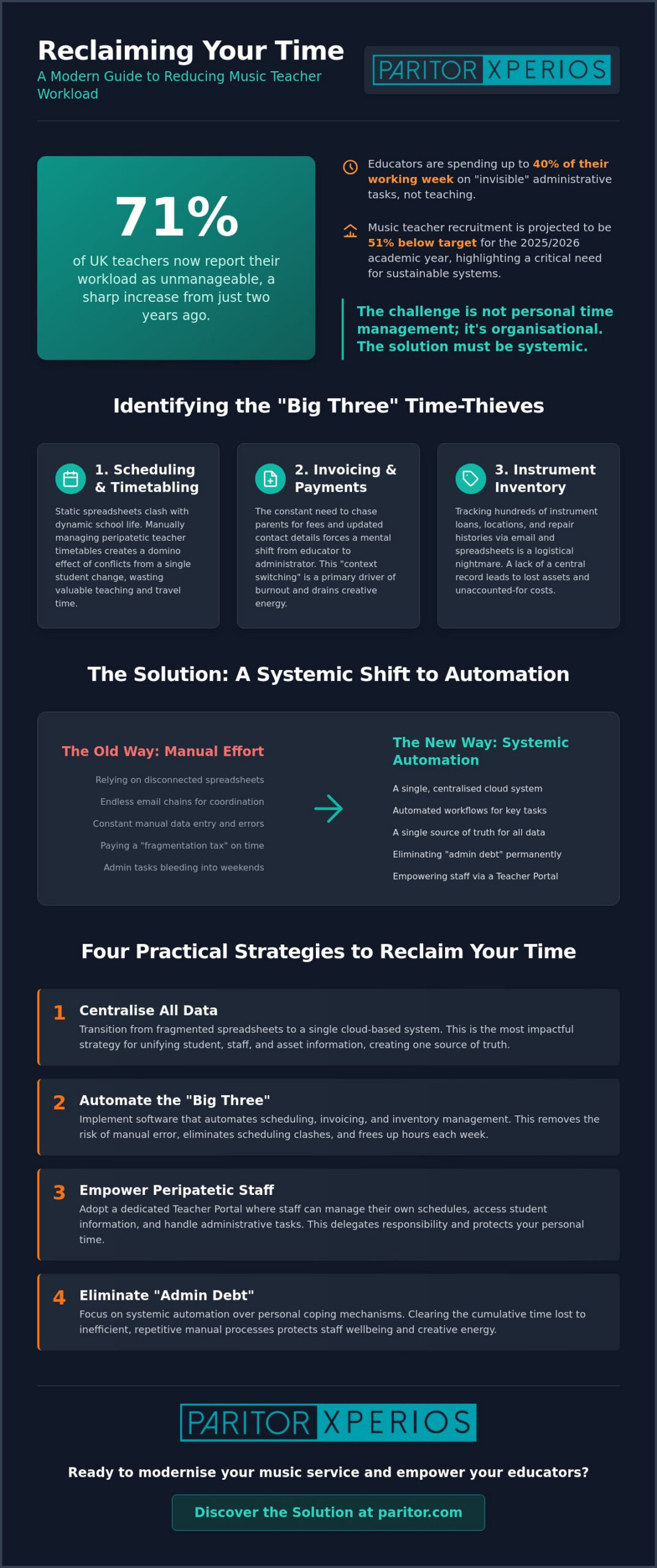
Did you know that 71% of UK teachers now report their workload as unmanageable, a sharp increase from just two years ago? If you’re spending your Sunday nights manually organising student timetables or chasing late payments from parents, you’re already familiar with this exhaustion. Reducing music teacher workload isn’t a matter of personal time management; it’s an organisational challenge that requires a systemic solution. You didn’t enter this profession to become a full-time administrator, yet the burden of tracking hundreds of instrument loans on a spreadsheet can make it feel that way.
Modern compliance and reporting requirements have nearly doubled the paperwork for music services in recent years. You’re often forced to be an administrator first and a musician second, which carries a heavy emotional cost. Admin debt is the cumulative time lost to inefficient, repetitive manual processes. Reducing music teacher workload means clearing this debt to protect staff wellbeing and ensure student outcomes don’t suffer. With music teacher recruitment projected to be 51% below target for the 2025/2026 academic year, we must prioritise systems that allow educators to focus on their core mission rather than spreadsheets. We believe that when teachers are empowered by better organisational strategies, they can finally return to the creative work they love, such as utilising innovative audio platforms like Supervisormusic to enrich the learning environment.
We understand the weight of these administrative demands because we’ve built our tools alongside educators who face them every day. This guide promises to show you how to eliminate burnout and reclaim your teaching hours through systemic automation and smarter organisational strategies. We’ll explore how to implement a streamlined weekly schedule that manages itself and how automated financial reporting can transform your work-life balance. By the end of this article, you’ll have a clear roadmap to modernise your department and return your focus to what truly matters: your students’ musical progress.
Key Takeaways
- Transition from personal coping mechanisms to systemic automation to eliminate “admin debt” and protect your creative energy.
- Centralising student and asset data into a single cloud-based system is the most impactful strategy for reducing music teacher workload in 2026.
- Automating the “Big Three” time-thieves of scheduling, invoicing, and inventory removes the risk of manual errors and frustrating scheduling clashes.
- Adopting a dedicated Teacher Portal empowers peripatetic staff to manage their own schedules, ensuring administrative tasks no longer bleed into your weekends.
The Growing Burden: Why Music Teacher Workload is at a Breaking Point
For many educators, the joy of teaching is being stifled by a mounting pile of digital paperwork. In 2026, the reality is that teacher workload is at a breaking point, with 71% of UK staff describing their daily tasks as unmanageable. This isn’t just a general education issue; it’s particularly acute in music services where the administrative burden is uniquely complex. Reducing music teacher workload requires more than just better “to-do” lists; it demands a fundamental shift in how we handle the business of education.
Music education is uniquely fragmented compared to other subjects. You aren’t just managing a classroom. You’re coordinating one-to-one lessons across multiple sites, overseeing large ensembles, and tracking hundreds of physical assets. Traditional time-management tips fail here because they don’t account for the specific logistical hurdles of the performing arts. When you’re managing 100+ instrument loans on a spreadsheet, a simple “prioritisation” tip doesn’t help. You need a system that removes the task entirely.
The “Invisible Work” of Music Education
Much of the burden is invisible. It’s the tasks that don’t appear in a job description but consume up to 40% of the working week. Think about the time spent re-drafting timetables because a student changed their lesson time, or the constant stream of parent emails regarding missed payments. Managing peripatetic schedules across different school locations creates a significant mental load that stays with you long after the school day ends. When you’re manually entering data across different systems, you’re paying a “fragmentation tax” that drains your energy before you even pick up an instrument.
The Shift from Teaching to Administration
Modern compliance and reporting requirements have nearly doubled the paperwork for music services in recent years. You’re often forced to be an administrator first and a musician second, which carries a heavy emotional cost. Admin debt is the cumulative time lost to inefficient, repetitive manual processes. Reducing music teacher workload means clearing this debt to protect staff wellbeing and ensure student outcomes don’t suffer. With music teacher recruitment projected to be 51% below target for the 2025/2026 academic year, we must prioritise systems that allow educators to focus on their core mission rather than spreadsheets. We believe that when teachers are empowered by better organisational strategies, they can finally return to the creative work they love.
Identifying the Time-Thieves: The Top Administrative Burdens
Identifying the specific tasks that eat away at teaching time is the first step toward reclaiming your week. We often see music services trapped by the “Big Three” time-thieves: scheduling, invoicing, and inventory management. These aren’t just minor annoyances. They’re systemic leaks that drain hours of professional energy every single week. When you’re manually coordinating 100+ instrument loans or repairs, the logistical nightmare alone can overwhelm a department’s capacity for growth. Research into effective strategies for reducing teacher workloads suggests that identifying these specific friction points is essential for long-term retention.
The friction often begins with the hidden hours spent chasing parents for updated contact details or outstanding fees. It’s not just the five minutes spent sending an email; it’s the mental context switching required to move from pedagogical planning to debt collection. This administrative drift is a primary factor in the burnout discussed previously. Manual systems for tracking physical assets are equally draining. Without a centralised record, tracking the repair history of a cello or the current location of a borrowed flute becomes a game of forensic email-searching that nobody has time for.
The Scheduling Struggle: Beyond the Spreadsheet
Excel is often the first tool teachers reach for, but it’s the enemy of a scalable music service. Spreadsheets are static, whilst your department is dynamic. A single change in a student’s availability can trigger a domino effect of clashes and wasted travel time across your entire peripatetic team. Manually managing peripatetic teacher timetables without stress is impossible when you’re relying on data that is disconnected from your student records. This fragmentation is exactly why reducing music teacher workload must start with moving away from manual data entry and toward live, shared systems.
Financial Friction: The Burden of Manual Invoicing
The hours lost to manual billing and reconciling bank statements represent some of the most expensive time in your organisation. Manual systems don’t just take longer; they increase the likelihood of late payments and bad debt because the follow-up process is so labour-intensive. Managing tiered pricing for different ensembles and lesson types adds another layer of complexity that manual invoicing simply can’t handle with accuracy. If you find yourself dreading the end of the term because of the billing mountain ahead, it’s a clear sign that your current processes are no longer fit for purpose. Adopting automated financial management tools can turn this week-long ordeal into a background process that runs itself.
Systemic Solutions vs. Personal Resilience: Why Technology is the Key
Personal resilience is often touted as the solution to workplace stress. For music educators, however, it’s often just a sticking plaster on a structural wound. If you’re struggling to keep up, it’s not because you aren’t organised enough. It’s because your current processes are designed for a smaller, less complex era. 2026 marks the rise of the autonomous music office, where technology shifts from being a tool you use to a system that works on your behalf. True progress in reducing music teacher workload comes from process elimination, not just finding better ways to cope with a broken system.
Recent research on music student workload highlights that systemic stress ripples through the entire department, affecting both staff and pupils. By centralising data in the cloud, you move away from manual duplication and toward a model of efficiency. This isn’t just about saving time; it’s about restoring your focus to your primary creative mission. When the system performs the labour-intensive tasks, you’re free to excel in your role as an educator.
The Power of a Single Source of Truth
Updating student details in five different places is a waste of professional talent. A centralised system ensures that a change made in the office is immediately visible to peripatetic staff on the go. This single source of truth maintains strict GDPR compliance whilst ensuring that every teacher has the information they need at their fingertips. When data is live and accessible, service leaders can make better decisions amongst their teams without waiting for end-of-term reports. It eliminates the fragmentation tax that we discussed earlier in this guide.
Self-Service Portals: Letting the System Do the Work
Every “where is my lesson?” email is a symptom of a broken communication channel. Automated portals empower parents and students to self-serve, checking schedules and progress reports without needing to contact the office. Giving students ownership of their own musical journey via dedicated logins reduces the administrative friction that typically bogs down a music service. For a deeper look at how this works, see our guide on The Ultimate Parent Portal for Music Schools. By letting the system handle the routine queries, you free up your team to focus on high-impact teaching rather than answering the same questions repeatedly.
Five Practical Strategies to Reclaim Your Teaching Time
Reclaiming your teaching hours isn’t about working faster or staying later. It’s about identifying the structural leaks in your week and sealing them with systemic automation. Reducing music teacher workload requires a tactical approach to process elimination that targets the most repetitive tasks first. By following these five strategies, you can shift your focus from being an administrator back to being an educator.
- Step 1: Audit your week. Document every repetitive manual task you perform, from re-drafting timetables to chasing late payments. If a task is performed more than once a week, it’s a candidate for automation.
- Step 2: Centralise your data. Move away from fragmented files and onto a single cloud platform. This ensures that student, teacher, and instrument records are always synchronised and accessible from any location.
- Step 3: Automate the billing cycle. Configure your system to trigger invoices and payment reminders on a set date every month. This removes the “billing mountain” at the end of each term and improves cash flow.
- Step 4: Implement a parent portal. Give parents the ability to check schedules, book lessons, and update contact details themselves. This drastically reduces the volume of routine enquiries hitting your inbox.
- Step 5: Use intelligent scheduling. Optimise travel routes for peripatetic staff and ensure room usage is maximised. Modern tools can handle the complex logic of instrument-specific requirements and teacher availability automatically.
Automating the Instrument Hire Lifecycle
Managing a large collection of assets is one of the most significant “time-thieves” in music education. Transitioning to digital tracking allows you to monitor the entire lifecycle of an instrument, from the initial checkout to its eventual return and repair. For a comprehensive look at how to manage these physical assets, read The Ultimate Guide to Instrument Inventory Management Software. Implementing barcode or RFID integration can reduce inventory audit times by 80%, allowing your staff to focus on instrument maintenance rather than manual data entry.
Streamlining Communication for Ensembles
Fragmented WhatsApp groups and endless email chains often lead to missed rehearsals and confusion. You can eliminate this friction by centralising rehearsal schedules and repertoire lists in one accessible location. This ensures every ensemble member has the latest information without needing to search through their inbox. Using mass-messaging features allows for instantaneous updates regarding venue changes or weather cancellations. It’s about creating a reliable communication hub that respects everyone’s time. You can modernise your department’s efficiency today by adopting Xperios for Music Services to handle these complex logistical demands.
Empowering Educators: How Xperios Transforms Music Service Administration
Implementing the strategies discussed in this guide requires a robust technical foundation that understands the unique pulse of music education. Xperios has emerged as the professional standard for UK music service management, providing a centralised engine that handles the heavy lifting of daily operations. By shifting the administrative burden to a system designed specifically for this sector, reducing music teacher workload becomes a sustainable reality rather than a temporary fix. Our platform doesn’t just store data; it actively performs the tasks that previously drained your team’s energy.
The Xperios Teacher Portal is a primary example of this efficiency in action. It specifically targets the daily friction faced by peripatetic staff, allowing them to manage registers, view schedules, and record student progress from any device. This accessibility removes the need for end-of-day data entry and ensures that information is captured at the point of delivery. When teachers are equipped with tools that respect their time, they can focus entirely on the quality of their instruction whilst the system handles the background logistics.
Trust and reliability are at the core of our partnership with educators. Xperios is hosted on Microsoft Azure, providing world-class cloud infrastructure that ensures high availability and data redundancy. We maintain full GDPR compliance, giving service leaders peace of mind that student and financial records are protected by the highest security standards. This professional-grade environment is built on decades of user-led development; we’ve transitioned from industry veterans into technology providers to ensure our tools are the most empathetic in the sector.
Xperios for Music Services: Built by the Industry
Modernising your department shouldn’t come with an “onboarding headache”. Xperios is designed with a modular philosophy, allowing you to adopt features like Xperios Financial Management or the Xperios Exams and Assessments Module at a pace that suits your organisation. This flexibility ensures that you can scale your operations without outgrowing your software. For a deeper look at how integrated systems can revolutionise your department, consult The Complete Guide to Music Service Management Software. We help you transition from fragmented legacy processes to a streamlined, modern workflow that supports growth.
Your Partner in Professional Growth
Our core promise remains unchanged: we perform the labour-intensive tasks so you can focus on the music. Adopting Xperios is a necessary step forward in the professional journey of any music service or hub looking to protect its staff from burnout. We provide structured onboarding and bespoke development options to ensure the system aligns perfectly with your specific organisational goals. If you’re ready to reclaim your teaching hours and eliminate administrative debt, organise a consultation to see how Xperios can reduce your workload and transform your service for the future.
A New Standard for Music Service Management
The transition to 2026 requires a fundamental shift from manual coping mechanisms to systemic automation. By auditing your week and centralising your data, you can finally move away from the administrative debt that has historically stifled growth. Reducing music teacher workload isn’t just about saving minutes; it’s about preserving the creative energy of your staff and ensuring the long-term health of your department. When the system performs the labour-intensive tasks, you’re free to focus on the pedagogy that defines your mission.
Xperios provides the modular, secure foundation needed to make this transition a reality. Trusted by UK Music Hubs for over 30 years and securely hosted on Microsoft Azure, our platform is designed specifically for services, conservatoires, and private teachers. We act as your industrious engine behind the scenes, ensuring your operations remain efficient and compliant. Explore how Xperios can reclaim your teaching time. You have the power to modernise your workflow and restore your focus. Let’s build a more sustainable future for music education together.
Frequently Asked Questions
How can software actually reduce my workload instead of adding to it?
Modern software reduces your burden by eliminating repetitive manual processes rather than simply digitising them. Instead of you acting as the bridge between different spreadsheets, a system like Xperios performs these labour-intensive tasks in the background. This shift from manual entry to systemic automation is the most effective way of reducing music teacher workload, as it removes the need for constant context-switching between teaching and administration.
Is cloud-based management secure enough for sensitive student data?
Cloud-based systems are significantly more secure than traditional spreadsheets stored on local hard drives or shared via email. Our platform is securely hosted on Microsoft Azure, providing professional-grade data redundancy and robust protection against unauthorised access. We maintain full GDPR compliance and adhere to strict regulatory standards, ensuring that sensitive student records and financial data are protected by the highest levels of institutional safety.
What are the most time-consuming admin tasks for music teachers?
The most taxing burdens usually involve coordinating complex logistics that change frequently. Managing peripatetic timetables, tracking instrument hire history, and reconciling monthly payments often consume up to 40% of a teacher’s working week. These tasks create a “fragmentation tax” where time is lost to small, repetitive actions. Centralising these functions into a single source of truth allows educators to reclaim those lost hours for student progress.
Can Xperios help with managing instrument repairs and hire schemes?
Yes, Xperios Instrument Management is designed to handle the entire lifecycle of your physical assets. The system tracks every loan from the initial checkout to its eventual return, maintaining a detailed digital history of repairs and maintenance for each instrument. By using barcode integration, you can perform inventory audits in a fraction of the time it takes to manually check paper records or static spreadsheets.
How much time can a music service realistically save by automating invoicing?
Automating your financial processes can transform a week-long manual ordeal into a background task that requires minimal oversight. By using Xperios Financial Management, you eliminate the need to manually draft hundreds of individual bills or cross-reference bank statements. This automation ensures that invoices and payment reminders are triggered on a set date every month, clearing the “billing mountain” and significantly improving your service’s cash flow.
What should I look for in a performing arts administration system?
You should prioritise a modular system that is built specifically for the unique logic of the music sector. Look for features that support one-to-one scheduling, ensemble coordination, and physical asset tracking within a single platform. It is also essential to choose a partner that offers structured onboarding and has a proven track record of working with UK Music Hubs, conservatoires, and private teachers to ensure the tool meets your specific needs.
How does a parent portal help reduce teacher workload?
A parent portal reduces workload by empowering families to self-serve for routine information. When parents can check rehearsal schedules, view lesson times, and pay fees through a dedicated login, it drastically reduces the volume of routine enquiries hitting your inbox. This self-service model ensures that communication remains clear and consistent whilst freeing up your administrative staff to focus on higher-impact organisational tasks.
Is it difficult to migrate my existing spreadsheets into a new system?
Transitioning from legacy spreadsheets is a structured process designed to avoid the typical “onboarding headache”. We act as a dedicated ally during this phase, helping you to organise and import your data into the Xperios environment securely. Our goal is to ensure a smooth migration that establishes a reliable foundation for your future growth, allowing you to move away from fragmented files and into a modern, centralised workflow.