

Your student records aren’t just a list of names; they’re the foundation of your professional reputation and your biggest hidden liability. You likely feel that managing data security for private tutors UK is a legal minefield that drains your energy and pulls you away from your students. Whether you’re struggling with messy spreadsheets or worrying about safeguarding leaks, the administrative burden is real. It’s especially daunting now that the Data (Use and Access) Act 2026 has introduced stricter enforcement rules and a new mandatory complaints process as of 19 June 2026.
This article promises to simplify these complexities by showing you how to protect your students’ information whilst ensuring full UK GDPR compliance. You’ll learn how to build a professional practice using secure digital systems that act as a “set and forget” solution for your business. We’ll preview the updated ICO fee tiers, the significant increase in PECR fines, and the specific steps you can take to reclaim your time and secure your reputation with parents.
Key Takeaways
- Understand why holding sensitive data on minors makes you a high-value target and how to safeguard your professional reputation against modern breaches.
- Identify the correct lawful basis for your data processing, including the vital distinction between student consent and contractual necessity for lesson bookings.
- Evaluate the hidden security risks of manual record-keeping and why moving away from unencrypted spreadsheets is essential for maintaining UK GDPR compliance.
- Implement a robust framework for data security for private tutors UK by conducting a simple data audit and securing your hardware with multi-factor authentication.
- Discover how Xperios for Private Teachers provides a secure, professional system hosted on world-class infrastructure to give you and your parents complete peace of mind.
Navigating Data Security for Private Tutors in the UK (2026)
In 2026, data security for private tutors UK has evolved from a technical checkbox into a fundamental pillar of educational trust. It’s no longer just about choosing a strong password; it involves the systemic protection of the entire student journey. For an independent educator, data security means ensuring that every piece of information you collect; from initial enquiries to sensitive progress reports; remains confidential, accurate, and accessible only to those with a legitimate right to see it.
Private tutors have become high-value targets for cybercriminals because they often hold “clean” data on minors. This information, including home addresses, dates of birth, and learning difficulties, is highly prized for long-term identity fraud. Simultaneously, parent expectations have shifted. Modern clients view your digital infrastructure as a direct reflection of your teaching quality. They’re looking for tutors who demonstrate digital professionalism through secure portals and encrypted communication rather than messy email chains or paper records.
Adopting a “Security by Design” approach is the most effective way to manage these risks. This philosophy involves building your tutoring practice with protection at its core. Instead of bolting on security measures as an afterthought, you integrate privacy into every lesson booking, invoice, and feedback session you conduct.
Why “Good Enough” Security is No Longer Sufficient
Small UK tutoring businesses are no longer “too small to notice” for hackers. Cyber threats are increasingly automated, with bots scanning for any unencrypted database or weak login credentials. If a breach occurs, the resulting reputational damage amongst local parent networks is often permanent and far more costly than any technical fix. Under the guidance of the ICO, a tutor who determines the purposes and means of processing personal data is legally defined as a data controller.
The Role of the Information Commissioner’s Office (ICO)
The ICO is the UK’s independent body set up to uphold information rights. Most tutors must register with the ICO and pay an annual data protection fee if they use electronic systems to process student information. This legal requirement is a cornerstone of the UK General Data Protection Regulation (UK GDPR) and the Data Protection Act 2018. These laws require you to process data fairly, lawfully, and transparently.
It’s vital to distinguish between different types of information:
- Personal Data: Standard identifiers like names, email addresses, and phone numbers.
- Special Category Data: More sensitive information, such as health records, disability details, or specific safeguarding notes, which requires a much higher level of security and a specific lawful basis for processing.
Understanding Your Legal Obligations: UK GDPR and Beyond
Compliance shouldn’t feel like a barrier to your teaching. It’s actually a framework designed to protect your professional integrity. To master data security for private tutors UK, you first need to identify your “lawful basis” for holding information. The UK GDPR outlines six bases, but as a tutor, you’ll mostly rely on ‘Contract’ and ‘Consent’.
Many tutors mistakenly believe they need explicit consent for every single interaction. In reality, if a parent books a block of lessons, you process their contact details because it’s a ‘Contractual Necessity’ to deliver the service. You don’t need a separate tick-box for that specific purpose. However, if you want to send a monthly newsletter or marketing emails, that’s where ‘Consent’ becomes mandatory. It must be freely given, specific, and easy to withdraw. Mixing these up can lead to administrative headaches or a report to the ICO.
Transparency is your best tool for building trust with families. You’re legally required to provide a Privacy Notice that explains exactly what you do with student data. Avoid dense legalese; instead, use clear, empathetic language that tells parents how you’re keeping their children’s details safe. This document should also mention the “Right to be Forgotten,” which allows individuals to request the deletion of their data once it’s no longer necessary for your records.
Safeguarding and Sensitive Information
Handling medical notes or SEND (Special Educational Needs and Disabilities) information requires extra vigilance. This is classified as special category data. Storing these sensitive details in a physical notebook is a high-risk behaviour; it can be lost, stolen, or accidentally seen by others. Professional data security for private tutors UK involves moving these notes into encrypted digital environments where access is strictly controlled. Securely managing this data is a key part of your wider physical safeguarding duties.
Retention Periods: How Long Should You Keep Data?
You shouldn’t keep student records indefinitely. The principle of “data minimisation” means you must delete information once the purpose for holding it has ended. Whilst you need to retain financial records for six years for HMRC, you don’t need to keep a student’s home address or learning progress notes for that long. It’s best practice to manage student data securely through automated systems that can flag or archive old records automatically. If you find the manual tracking of these dates exhausting, adopting a dedicated management system can handle the heavy lifting for you.
The Risks of Manual Record-Keeping: Why Spreadsheets are a Liability
It’s tempting to rely on the familiar grid of a spreadsheet. For many, it represents the simplest way to track lesson times and contact details without the perceived hurdle of learning a new system. However, this ease of use masks significant vulnerabilities in data security for private tutors UK. An unencrypted Excel file or a shared Google Sheet is often a wide-open door for unauthorised access. Unlike professional databases, spreadsheets lack the granular permission controls needed to keep sensitive student information truly private.
Consider the “lost device” scenario. If your laptop is stolen from your car or left on a train, and your student records are stored in a local spreadsheet without hardware-level encryption, that sensitive information is immediately compromised. You might think, “I only have 10 students, I don’t need a system.” Yet, those 10 students represent 10 families who have entrusted you with their children’s safety. A breach of 10 records carries the same legal reporting requirements to the ICO as a breach of 100. The reputational fallout in a small community can be devastating, regardless of your student numbers.
Shared cloud sheets carry their own specific risks. One accidental “anyone with the link can view” setting can expose your entire student database to the public internet. This isn’t just a technical oversight; it’s a direct violation of your duty of care under the Data Protection Act 2018. Relying on these manual methods keeps you in a state of constant, low-level anxiety about what might happen if a single file goes missing or a link is shared incorrectly.
The Problem with “Free” Communication Tools
WhatsApp is a common pitfall for tutors seeking convenience. Whilst it’s great for socialising, using it for professional parent communication often breaches UK GDPR boundaries. It mingles personal and professional data on a platform you don’t fully control, making it nearly impossible to honour a “Right to be Forgotten” request. Similarly, standard email lacks a robust audit trail for financial transactions. Manual invoicing through email creates fragmented data silos that are difficult to protect and even harder to organise during tax season.
Version Control and Data Corruption
Manual record-keeping inevitably leads to “data sprawl” where different versions of a student’s history exist across your phone, tablet, and PC. This duplication increases the risk of data corruption and inaccurate safeguarding notes. Using professional music service management software centralises data to eliminate sprawl, ensuring you always work from a single, secure source of truth. This transition restores your focus to teaching whilst the system handles the complex task of keeping your records accurate and compliant.
Implementing a Robust Security Strategy for Your Tutoring Practice
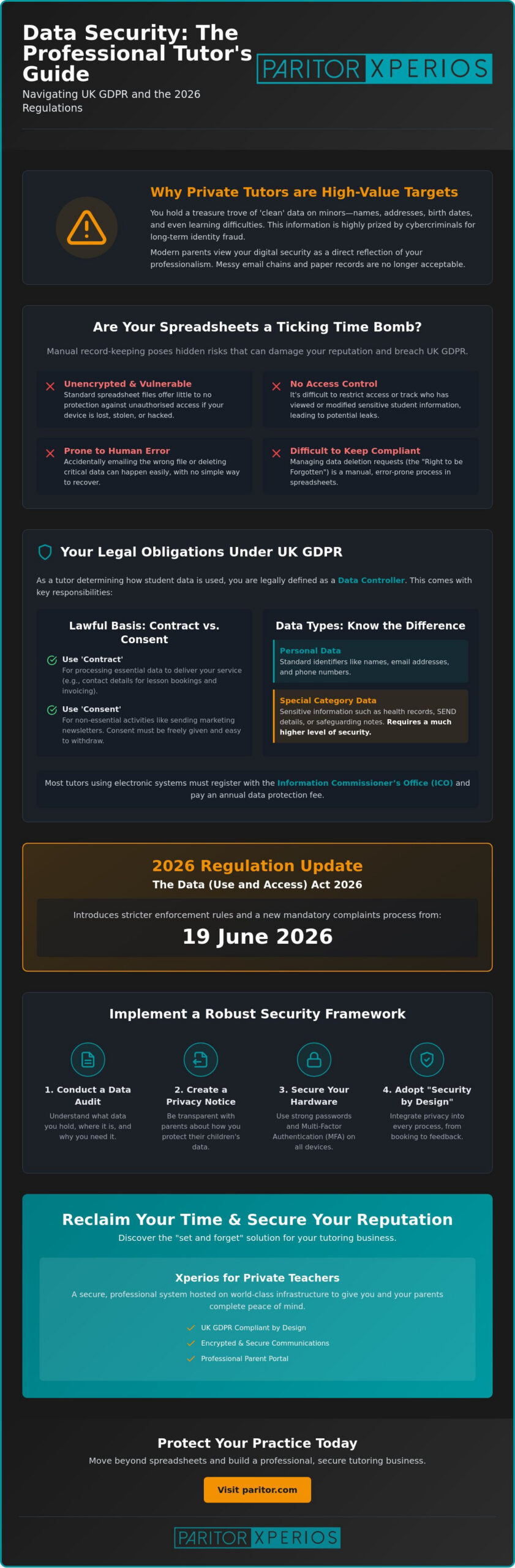
Transitioning from manual records to a proactive security framework doesn’t have to be overwhelming. By following a structured approach, you can transform data security for private tutors UK from a source of anxiety into a professional asset. A robust strategy allows you to focus on your educational mission whilst the system safeguards your business interests.
The first step is conducting a thorough data audit. You need to identify exactly what information you hold, where it’s stored, and who has access to it. Check your email archives, physical notebooks, and any cloud storage folders. Once you have a clear map of your data, you can move to step two: securing your hardware. Ensure that every device you use for teaching, whether it’s a tablet or a laptop, utilises full-disk encryption and multi-factor authentication (MFA).
Step three involves moving away from local files and adopting a cloud-based management system. Professional platforms hosted on secure infrastructure, such as Microsoft Azure, provide industrial-grade protection that no individual tutor could maintain alone. Following this, step four is to formalise your parent communication. Instead of fragmented messages across various apps, use a dedicated portal for all bookings and feedback. Finally, step five is to establish a regular “purge” schedule. Review your records every term and delete any data that’s no longer required for active teaching or tax compliance. To see how a professional system can automate these steps for you, explore the Xperios platform today.
The Power of Multi-Factor Authentication (MFA)
MFA is the single most effective barrier against account takeover. It requires a second form of verification, such as a code sent to your phone, before granting access to your records. You should enable MFA for your email, your cloud storage, and any performing arts school administration system you use. When choosing passwords, avoid using personal details or reusing the same phrase across multiple sites. A unique, complex password for your teaching account is a simple but vital layer of data security for private tutors UK.
Educating Parents and Students
Your security measures are a powerful way to build trust. When you explain to parents that their child’s data is stored in an encrypted, professional environment, it demonstrates a level of care that sets you apart from less organised competitors. Use your secure portal as a central “centre” for all educational interactions. Setting clear boundaries for where students should submit work prevents sensitive files from being scattered across insecure email threads or messaging apps. This organised approach protects everyone involved and reinforces your reputation as a modern, professional educator.
Reclaiming Your Time with Xperios for Private Teachers
Managing a successful tutoring practice shouldn’t mean spending your evenings trapped in administrative loops. Xperios for Private Teachers has emerged as the professional standard in 2026 because it addresses the core frustrations of independent educators. This software wasn’t built in a vacuum; it was forged through collaborative user insights to ensure every portal and feature serves a practical purpose. It feels like a dedicated ally because it understands the specific, repetitive burdens of lesson management and financial tracking. By acting as an industrious engine behind the scenes, it allows you to return your focus to your primary mission: teaching.
Security is the foundation of this partnership. By utilising Microsoft Azure hosting, Xperios provides a level of technical assurance usually reserved for large institutions. This world-class infrastructure ensures that data security for private tutors UK is no longer a manual burden you carry alone. Automated scheduling and invoicing modules significantly reduce the risk of data entry errors common in spreadsheets. These automated systems prevent accidental information leaks and ensure financial records remain accurate and compliant. It is a stable, reassuring presence that grows alongside your professional journey.
Modular Simplicity: Only What You Need
The Xperios Teacher Portal provides real-time, secure access to your student information from any authorised device. This modular approach means you only interact with the features that serve your specific workflow, keeping the system clean and easy to navigate. If your practice expands to include group sessions or workshops, the ensemble management software capabilities can scale with you seamlessly. Having a single, secure “source of truth” for your business eliminates the data sprawl discussed in previous sections. It ensures that every safeguarding note and lesson record is exactly where it should be, protected by industrial-grade encryption.
Professionalism That Empowers Growth
Adopting a dedicated system provides a profound sense of psychological relief. When your compliance is handled automatically, the persistent anxiety regarding ICO fines or sensitive data leaks simply fades away. This newfound clarity allows you to project a modern, sophisticated image to parents, which naturally fosters trust and long-term loyalty. You’re no longer just a tutor with a spreadsheet; you’re a professional educator backed by world-class technology that prioritises student safety. Discover how Xperios protects your tutoring business and your students today.
Future-Proof Your Professional Tutoring Practice
Mastering data security for private tutors UK is no longer a choice between convenience and compliance; it’s a commitment to your students’ safety and your own peace of mind. By moving away from vulnerable spreadsheets and adopting a structured security strategy, you protect your business from the reputational damage of a breach. You’ve seen how the right digital infrastructure transforms administrative burdens into a streamlined, professional experience that parents truly value. Transitioning to a secure “source of truth” ensures you’re always ready for the requirements of the Data (Use and Access) Act 2026.
Xperios for Private Teachers offers a stable, secure foundation built on Microsoft Azure for institutional-grade protection. It’s a system specifically designed for UK educational compliance and is trusted by music services and independent teachers nationwide. Instead of worrying about data audits and retention periods, you can focus on the creative mission of teaching. Secure your tutoring practice with Xperios for Private Teachers and step into a more organised, empowered future. Your professional journey deserves a partner that works as hard as you do. You’ve built your reputation on excellence; let technology help you maintain it.
Frequently Asked Questions
Do I need to register with the ICO as a private tutor in the UK?
Yes, if you process student personal information electronically for business purposes, you almost certainly need to register with the Information Commissioner’s Office (ICO). This is a legal requirement under the Data Protection Act 2018. Most independent tutors fall into Tier 1, which requires an annual fee. Failing to pay this fee can result in a £400 fine, so it’s a vital step in establishing your professional practice.
Is using Google Drive or Dropbox enough for UK GDPR compliance?
Whilst these platforms offer basic encryption, they aren’t specifically designed to manage the complex requirements of tutoring compliance. They lack the automated data retention controls and tutoring-specific audit trails needed to respond to modern regulatory requests. Relying solely on general cloud storage often leads to “data sprawl,” where sensitive files are scattered across folders without the granular access controls provided by a dedicated management system.
What should I do if I lose a device containing student data?
If you lose a laptop or tablet containing student records, you must immediately assess the risk to the individuals involved. If the data was unencrypted, you are legally required to report the breach to the ICO within 72 hours. This scenario highlights why hardware encryption and remote-wipe capabilities are essential for data security for private tutors UK. Having your data stored in a secure cloud portal rather than locally mitigates this risk entirely.
How long am I legally required to keep student records after they leave?
You should only keep student records for as long as you have a legitimate reason to do so. Whilst HMRC requires you to keep financial and tax records for at least six years, personal progress notes and home addresses should usually be deleted once the tutoring relationship ends. Holding onto sensitive data longer than necessary increases your liability. Using a system that flags old records for deletion helps you maintain a “clean” and compliant database.
Can I use WhatsApp to send progress reports to parents?
Using WhatsApp for professional reports is discouraged because it mingles personal and business data on a platform you don’t fully control. It makes fulfilling a “Right to be Forgotten” request nearly impossible and often breaches the privacy boundaries expected in a professional educational setting. A secure parent portal is a much safer alternative. It ensures that sensitive progress reports remain within a protected environment that is fully compliant with UK GDPR standards.
What are the penalties for non-compliance with UK GDPR for small businesses?
The financial penalties for non-compliance can be severe, even for sole traders. For serious breaches, the ICO can issue fines under the Standard Tier, which reaches up to £8.7 million or 2% of annual turnover. Additionally, as of June 2026, fines for marketing breaches under PECR have been aligned with these higher levels. Beyond the fines, the loss of trust amongst your local parent network can cause permanent damage to your tutoring reputation.
How does cloud-based software improve my data security compared to a laptop?
Cloud-based software removes the “single point of failure” inherent in storing data on a physical laptop. When you use a professional system, your information is encrypted and stored on industrial-grade servers like Microsoft Azure. This means that if your hardware is damaged or stolen, your student records remain safe and accessible from any other authorised device. It provides a level of data redundancy and professional security that local storage simply cannot match.
What is a Subject Access Request (SAR) and how do I handle one?
A Subject Access Request is a formal request from an individual to see all the personal data you hold about them. You must respond to these requests within one month. Under the Data (Use and Access) Act 2026, you can now “stop the clock” if you need to ask the requester for clarification. Professional data security for private tutors UK involves having your records organised so you can quickly export this information without spending hours searching through emails.