

Late payments aren’t a sign of forgetful parents; they are a symptom of a friction-filled billing system that only automation can fix. You didn’t open your studio to spend your evenings acting as a debt collector. Chasing overdue fees is exhausting, and it creates a subtle tension that can erode the trust you’ve built with your students’ families. It’s time to reclaim those lost hours and restore the focus to your primary educational mission.
This guide will show you exactly how to reduce late payments music school administrators often struggle with. By implementing professional automation and clear financial frameworks, you can secure your cash flow whilst maintaining a warm, professional relationship with every parent. We’ll explore the 2026 efficiency checklist, including the benefits of a centralised system like Xperios Financial Management to ensure your income is as predictable as a metronome. From automated reminders to the seamless integration of a Parent Portal, you’re about to transform your administration into a silent, industrious engine that works behind the scenes.
Key Takeaways
- Learn how to transition to a ‘payment in advance’ model to eliminate the cycle of chasing fees and secure your school’s income.
- Identify the specific friction points in manual billing that create the ‘matching nightmare’ of bank statement reconciliation.
- Discover how to reduce late payments music school administrators face by implementing a digital-first registration process.
- Reclaim hours of administrative time by automating the journey from scheduling to payment with Xperios Financial Management.
- Foster professional trust with families by providing a transparent and easy-to-use Parent Portal for all financial interactions.
The True Cost of Late Payments in Music Education
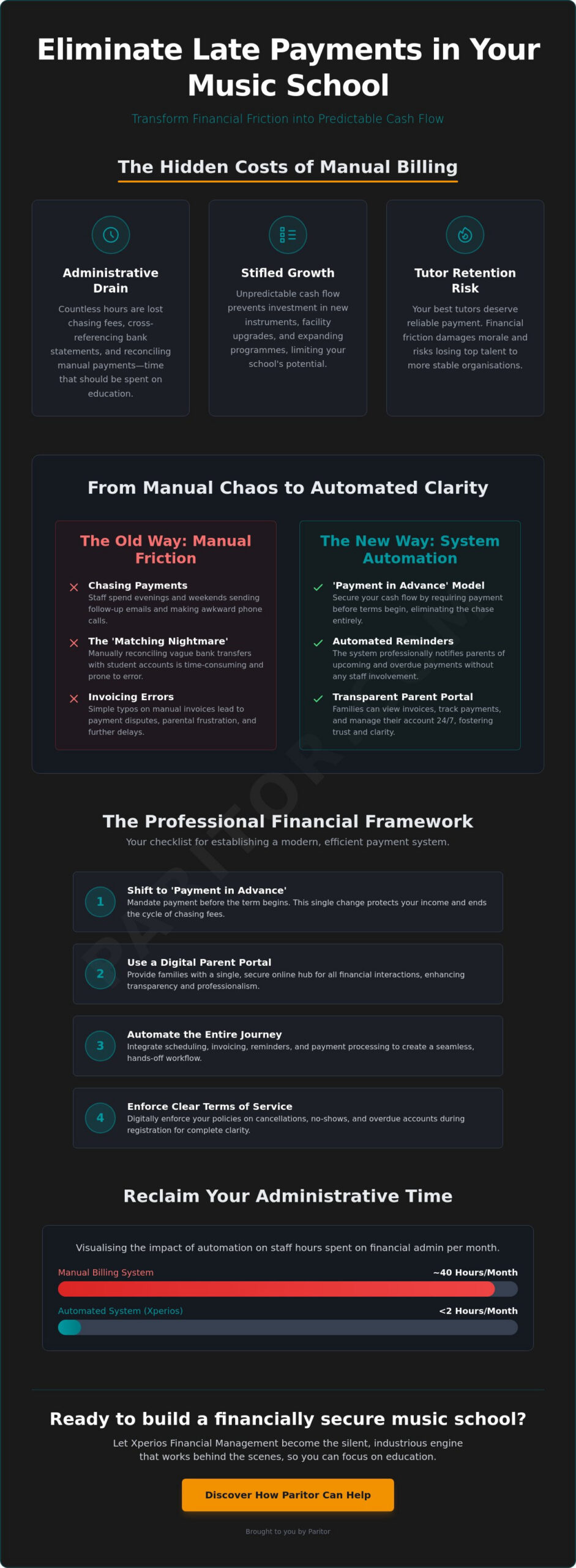
Late payments are often viewed as a simple administrative nuisance, but for a growing music service, they represent a systemic barrier to educational excellence. When funds don’t arrive on time, the ripple effect touches every corner of the organisation. It isn’t just about the balance sheet; it’s about the ‘Administrative Drain’ that pulls your team away from their core mission. Every hour spent cross-referencing bank statements or matching manual transfers to student names is an hour taken away from curriculum development or student mentorship. This manual reconciliation is a significant waste of skilled labour that stalls the momentum of your school.
When payments miss their deadlines, schools often have to consider how to implement penalties to encourage better behaviour. Understanding what is a late fee? is a useful starting point for your terms and conditions, but relying on penalties is rarely as effective as preventing the delay in the first place. Beyond the immediate cash flow issue, there is the hidden cost of manual invoicing errors. A simple typo in a fee amount or a student name can lead to prolonged payment disputes. These errors create unnecessary friction with parents and further delay the arrival of essential funds.
Perhaps the most critical impact is on tutor retention. High-quality peripatetic teachers expect and deserve financial reliability. If your ability to pay your staff depends on the unpredictable timing of parent transfers, you risk losing your best educators to more stable organisations. To reduce late payments music school leaders must look beyond the bank balance and recognise how financial friction undermines the entire educational ecosystem.
Financial Stability and Growth
Inconsistent cash flow is a direct threat to your school’s future. Without a predictable monthly income, it’s difficult to justify investment in new instruments, facility upgrades, or expanding your ensemble programmes. This instability also limits your capacity to support the community; the ability to offer bursaries or sibling discounts relies on having a secure financial foundation. Payment friction is the primary obstacle to sustainable music school growth.
The Emotional Toll on Staff
Music teachers should never have to act as debt collectors. Asking a parent for overdue fees at the end of a violin lesson creates an awkward atmosphere that can damage the teacher-pupil bond. Maintaining a professional centre of excellence requires a clear separation between education and finance. By using a professional system to reduce late payments music school administrators protect their staff from these uncomfortable interactions. This allows teachers to focus entirely on pedagogy whilst the automated system handles the billing quietly in the background, preserving the trust and transparency essential for a positive learning environment.
Establishing a Professional Financial Framework
A robust financial framework is the backbone of a successful music service. It transforms the way you interact with families from a series of awkward transactions into a professional partnership. One of the most effective ways to reduce late payments music school administrators deal with is transitioning to a ‘Payment in Advance’ model. By requiring payment before the term or month begins, you eliminate the need to chase funds whilst lessons are already underway. This shift protects your cash flow and ensures that your teachers are never working on credit. It sets a standard of mutual respect from the very first lesson.
Clarity is your best tool for preventing disputes amongst your student base. Tiered pricing structures and transparent billing cycles help parents understand exactly what they are paying for and when. When parents know that invoices arrive on the 1st and are due by the 8th, they can budget accordingly. If you need to apply late fees, do so as a professional standard rather than a personal penalty. Keeping these fees consistent and clearly documented ensures they are legally sound and professionally enforced. This maintains the institutional ‘centre’ of excellence that defines your school.
Crafting Your 2026 Terms of Service
Your Terms and Conditions shouldn’t be hidden in a paper welcome pack; they should be a digital agreement that parents must acknowledge during registration. Essential clauses should cover notice periods for cancellations, typically half a term, to ensure tutors are always compensated for their time. Clear definitions for ‘no-show’ policies and explicit details on overdue account procedures are vital. Managing this sensitive data also requires strict GDPR compliance, which is why a secure music school management platform is essential for modern, multi-location services.
Standardising the Billing Cycle
Deciding between monthly and termly billing depends on your demographic, but consistency is key. Monthly billing often fits family budgets better, whilst termly billing reduces the frequency of administrative tasks. Set a ‘hard’ deadline for payments; if a balance remains unpaid after a specific grace period, lessons should be automatically suspended. Communicating these changes requires empathy. Explain to existing parents that these frameworks exist to ensure the school can continue providing high-quality tuition and resources for every student. This transparency builds long-term trust and helps reduce late payments music school staff previously had to manage manually.
Manual vs Automated Billing: Identifying the Friction Points
Whilst many teachers believe bank transfers are the simplest method for parents, they often create a ‘matching nightmare’ for the office. Identifying which ‘J. Smith’ paid for which flute lesson amongst dozens of similar transactions is an inefficient use of skilled labour. This manual reconciliation is exactly where friction begins. To reduce late payments music school administrators must remove these hurdles. Automated invoicing does not just save time; it eliminates the human error that parents frequently cite as a reason for delay. There is also a profound psychological shift when a parent receives a formal, digital invoice compared to a casual text message. The former signals a professional institution with clear standards, whereas the latter can feel like a negotiable request.
Friction is the silent killer of cash flow. If a parent has to log into their banking app, copy across an IBAN, and manually type in a reference number, the likelihood of delay increases. Automation replaces this cumbersome process with a seamless, one-click experience. By removing the physical and mental effort required to pay, you make ‘on-time’ the path of least resistance. This transition allows your staff to stop acting as debt collectors and return to their roles as expert facilitators of musical education.
The Pitfalls of Traditional Invoicing
Traditional invoicing is riddled with invisible costs. Emails get lost in spam filters, amounts are entered incorrectly, and the lack of a clear ‘Pay Now’ button creates a significant barrier to completion. For a school with 100 students, manually generating and sending invoices can easily consume 10 hours of administrative time every month. In contrast, an automated system performs the same task in roughly 10 minutes. This reclaimed time can be reinvested into student recruitment or event planning, moving your school forward instead of keeping it stuck in paperwork.
The Power of Cloud-Based Portals
Modern parents expect 24/7 access to their account information. By implementing music service management software, you provide a centralised hub where families can view their balance and payment history at any time. The Xperios Parent Portal links attendance directly to billing, ensuring every invoice is accurate and transparent. This real-time data is invaluable for administrators; it allows you to spot ‘at-risk’ accounts that haven’t logged in or viewed their invoice. Identifying these patterns early enables you to reduce late payments music school accounts might otherwise accrue, allowing for gentle, proactive intervention before a small delay becomes a significant debt.
The Music School Payment Recovery Checklist
To reduce late payments music school administrators must move beyond reactive chasing and adopt a structured recovery framework. The first step is establishing a baseline by auditing your current payment success rate. Knowing exactly how many accounts fall into arrears each term allows you to measure the impact of new interventions. Once you have this data, you can implement a ‘Digital First’ registration process. By capturing payment details during the initial booking or audition phase, you set a professional tone and ensure that the mechanism for payment is already in place before the first note is played.
The 2026 standard for excellence involves making it impossible for parents to ‘forget’ their obligations. Enabling Direct Debit or recurring card payments through a centralised system removes the burden of memory from the family. This is supported by a dedicated Xperios Parent Portal, where parents can manage their own account details and view their history 24/7. This self-service approach empowers families whilst significantly lowering the administrative load on your office team. To see how these tools can transform your school, you can explore the Xperios suite of management tools today.
Stage 1: Pre-Emptive Action
Prevention begins the moment a student joins your service. Collecting payment information upfront ensures that the financial relationship is established immediately. Send a ‘Welcome to the Term’ email that includes a transparent breakdown of costs, including any ensemble fees or instrument hire. Some schools find success by offering a small ‘early bird’ discount to incentivise prompt behaviour, turning a potential administrative headache into a positive incentive for your most organised families.
Stage 2: The Automated Chase
Consistency is key to maintaining professional boundaries. An automated three-stage reminder sequence ensures that no account slips through the cracks. Start with a polite nudge 48 hours before the deadline. On the due date, send a notification containing a direct link to the payment portal for immediate action. If the deadline passes, the system should issue a firm ‘Overdue’ alert. This automated message should clearly state the consequences, such as the suspension of lessons, ensuring that the teacher is never the one delivering bad news.
Stage 3: Review and Refine
A professional financial framework requires constant refinement based on real-world data. Monthly reporting on ‘debtor days’ helps you identify trends amongst specific ensembles or locations. You might find that certain payment methods have higher failure rates or that specific templates receive better responses. By reviewing parent feedback and response rates, you can update your favourite templates to ensure your communication remains effective. This iterative process is the most reliable way to reduce late payments music school staff have to manage, allowing you to focus on the growth of your organisation.
Reclaiming Your Time with Xperios Financial Management
Xperios wasn’t designed in a vacuum by developers who have never stepped foot in a rehearsal room. It was built through direct, ongoing collaboration with music service leaders who understand the specific frustrations of managing multiple tutors and locations. This partnership ensures that every feature addresses a real-world administrative burden. By automating the entire journey from the moment a lesson is scheduled to the second funds are received, we provide a solution that restores focus to your primary mission. To reduce late payments music school administrators must move away from disjointed spreadsheets and embrace a unified system that handles the heavy lifting behind the scenes.
The Xperios Parent Portal is a cornerstone of this modern approach. It empowers families to manage their accounts on their own terms, providing the convenience and transparency they expect in 2026. When parents can view invoices, check lesson attendance, and pay balances from their smartphone, the friction that leads to delays simply vanishes. This shift allows you to scale your organisation and increase student numbers without the need to increase your administrative headcount. You can grow your reach whilst your office team remains lean and focused on high-value tasks.
Seamless Integration of Finance and Education
One of the most powerful ways to reduce late payments music school services experience is by ensuring billing accuracy through integration. Xperios Financial Management links attendance records directly to invoices, meaning parents are only ever billed for the tuition delivered. This precision eliminates the disputes that often stall the payment process. Beyond standard lessons, the system also manages instrument hire fees and ensemble subs in one centralised hub. Xperios frees up hours of administrative labour every week by performing these repetitive reconciliation tasks automatically.
Security and Peace of Mind
Trust is the foundation of any music service, and that trust extends to how you handle sensitive family data. Xperios is hosted on Microsoft Azure, utilising world-class cloud infrastructure to ensure the highest standards of data redundancy and reliability. We maintain full GDPR compliance, giving you the confidence that student and parent information is protected by industry-leading security protocols. Adopting this platform is a necessary step forward in your professional journey. Ready to modernise? Discover how Xperios can transform your music school’s efficiency today.
Modernising Your Financial Foundation
Securing your school’s financial future requires a shift from reactive chasing to proactive automation. We’ve explored how a professional framework, built on ‘payment in advance’ models and transparent digital terms, eliminates the friction that causes delays. Moving away from the ‘matching nightmare’ of manual bank transfers restores your office team’s focus to what truly matters; supporting musical excellence. By adopting these strategies, you can significantly reduce late payments music school leaders have historically struggled to manage whilst improving the trust and transparency you share with families.
With 30 years of industry expertise, we understand that your time is best spent in the classroom or rehearsal hall, not on debt collection. Xperios is already used by leading UK Music Hubs and provides the institutional safety of Microsoft Azure secure hosting. It’s time to let technology perform the labour-intensive tasks so you can excel in your own role. You deserve an administrative system that acts as a dedicated ally, not a source of stress.
Book a demo of Xperios to see how we automate your billing and start reclaiming your administrative hours today. Your journey toward a more efficient, professional, and stable music service is just a single step away.
Frequently Asked Questions
How do I ask parents for late payments without sounding rude?
The most effective way to ask for payment without causing offence is to use automated, system-generated reminders. By removing the personal element, the request becomes a standard administrative process rather than a direct confrontation between the teacher and the parent. This approach preserves the educator-parent relationship whilst maintaining the professional centre of excellence your school represents. Framing the nudge as a routine notification helps ensure the focus remains on the student’s musical progress.
Should I charge a late payment fee for music lessons?
Charging a late fee is a standard professional practice that encourages timely behaviour and covers the administrative cost of chasing funds. It is essential to outline these fees clearly within your terms and conditions so parents are aware of the consequences upfront. Many institutions implement a flat fee or a small percentage after a five-day grace period. This creates a clear financial framework that respects the tutor’s time and the school’s operational stability.
What is the best way to collect fees for a music school?
Direct Debit and recurring card payments are the most reliable methods for modern music services in 2026. These ‘pull’ payment methods ensure that funds arrive on a set date without requiring any manual action from the parent. This shift eliminates the ‘matching nightmare’ associated with bank transfers and provides your school with a predictable monthly income. It also provides families with a seamless, hands-off experience that fits into their busy schedules.
How can I automate my music school’s invoicing?
You can automate your invoicing by adopting a centralised system that links your lesson schedules directly to your billing module. Software like Xperios Financial Management performs the labour-intensive task of generating invoices based on real-time attendance data. This ensures 100% billing accuracy and allows you to send hundreds of invoices in minutes. Automation removes the risk of human error and frees up hours of administrative time every week for your team.
What should be included in a music school’s payment policy?
A comprehensive payment policy must include clear billing cycles, accepted payment methods, and explicit notice periods for cancellations or lesson suspensions. You should also detail the consequences for overdue accounts and provide information on how sensitive financial data is protected under GDPR. Ensuring parents acknowledge these terms through a digital registration process creates a professional foundation and helps reduce late payments music school administrators might otherwise face.
Is it professional to stop lessons if a parent hasn’t paid?
Suspending lessons for non-payment is a professional and necessary boundary that protects your school’s financial health. Allowing tuition to continue without payment can devalue the expertise of your tutors and set an unsustainable precedent for other families. A ‘hard’ deadline, supported by automated alerts, ensures that parents understand the professional nature of the service. This clear stance protects the teacher-pupil bond from the strain of ongoing financial disputes.
How do I deal with parents who consistently pay late?
For families who consistently miss deadlines, the best approach is to require a stored payment method on file or transition them to a ‘payment in advance’ model. Providing access to a Parent Portal allows these parents to view their balance and payment history 24/7, removing any excuses regarding lost invoices. A firm but empathetic conversation about institutional standards can also help reduce late payments music school staff have to spend time reconciling manually.
Can management software really reduce my late payments?
Specialist management software is designed specifically to eliminate the friction points that lead to payment delays. By offering one-click payment links and automated three-stage reminder sequences, the software makes paying on time the path of least resistance for parents. It acts as an industrious engine behind the scenes, identifying at-risk accounts early and ensuring your cash flow remains stable whilst you focus on your primary educational mission.