

With the online music education market projected to reach $4.61 billion in 2026, the sheer scale of modern tuition has finally outpaced the humble spreadsheet. You likely started your journey to inspire students and foster a love for performance, not to spend your weekends reconciling billing errors or hunting for lost violins. It’s a common frustration; you want to focus on the pedagogy, yet the administrative weight of coordinating teachers and parents feels like a full-time job in itself. Understanding how to manage a music service in this high-growth environment requires more than just grit; it demands a shift towards a robust, digital ecosystem.
We believe that technology should act as your most industrious ally, performing the heavy lifting so you can lead with confidence. This guide provides a comprehensive framework to help you master these logistical complexities and achieve true administrative excellence. We will explore how to automate your financial workflows, maintain total visibility over your instrument inventory, and implement secure portals that enhance the experience for every teacher, parent, and student in your organisation.
Key Takeaways
- Transition from manual workflows to a digital-first model to transform your organisation into a modern, community-wide music hub.
- Discover how to manage a music service with greater ease by automating the entire billing cycle and peripatetic teacher scheduling.
- Implement a comprehensive framework for tracking instrument lifecycles and maintaining rigorous data security for student records.
- Navigate a smooth digital transformation by following a strategic migration plan that prioritises staff training and user adoption.
- Future-proof your operations with modular cloud solutions that allow you to scale your administrative capacity as your student base grows.
Understanding the Scope of Modern Music Service Management
Modern music services have transformed into sophisticated community hubs that extend far beyond the classroom. In 2026, leading a service means acting as a central pillar for local culture, coordinating everything from large-scale ensembles to individual peripatetic tuition. The scale of this operation is immense; the online music education market alone is valued at $4.61 billion this year. If you’re still relying on manual spreadsheets to track this growth, you’re likely feeling the strain of administrative bloat. Understanding how to manage a music service in this environment requires a departure from legacy methods in favour of a digital-first ecosystem.
A common pitfall for new administrators is seeking guidance from the wrong sources. Most online management advice focuses on the role of a talent manager or artist representative. Whilst those roles are vital for individual careers, they don’t address the logistical reality of a Head of Service. You aren’t managing one star; you’re managing thousands of pupils, hundreds of teachers, and complex relationships with local authorities. When considering how to manage a music service effectively, you must prioritise the needs of four core stakeholders: your teaching staff, the pupils, their parents, and your funding partners. Each group requires clear communication and transparent data to remain engaged.
The Evolution of Music Hubs and Services
The role of the Lead Partner has expanded significantly within the national landscape. You’re now expected to balance high-level educational outcomes with commercial sustainability, all whilst ensuring music remains accessible to every child. This balancing act is impossible without a “single source of truth” for your data. When your instrument inventory, teacher schedules, and student assessments live in disparate systems, errors become inevitable. Centralising this information allows you to move from reactive firefighting to proactive leadership.
Core Management Objectives for 2026
Your primary objective remains pupil progress, but this can’t be achieved if your team is drowning in paperwork. Administrative efficiency is the engine that allows pedagogy to thrive. By 2026, several key goals define a successful service:
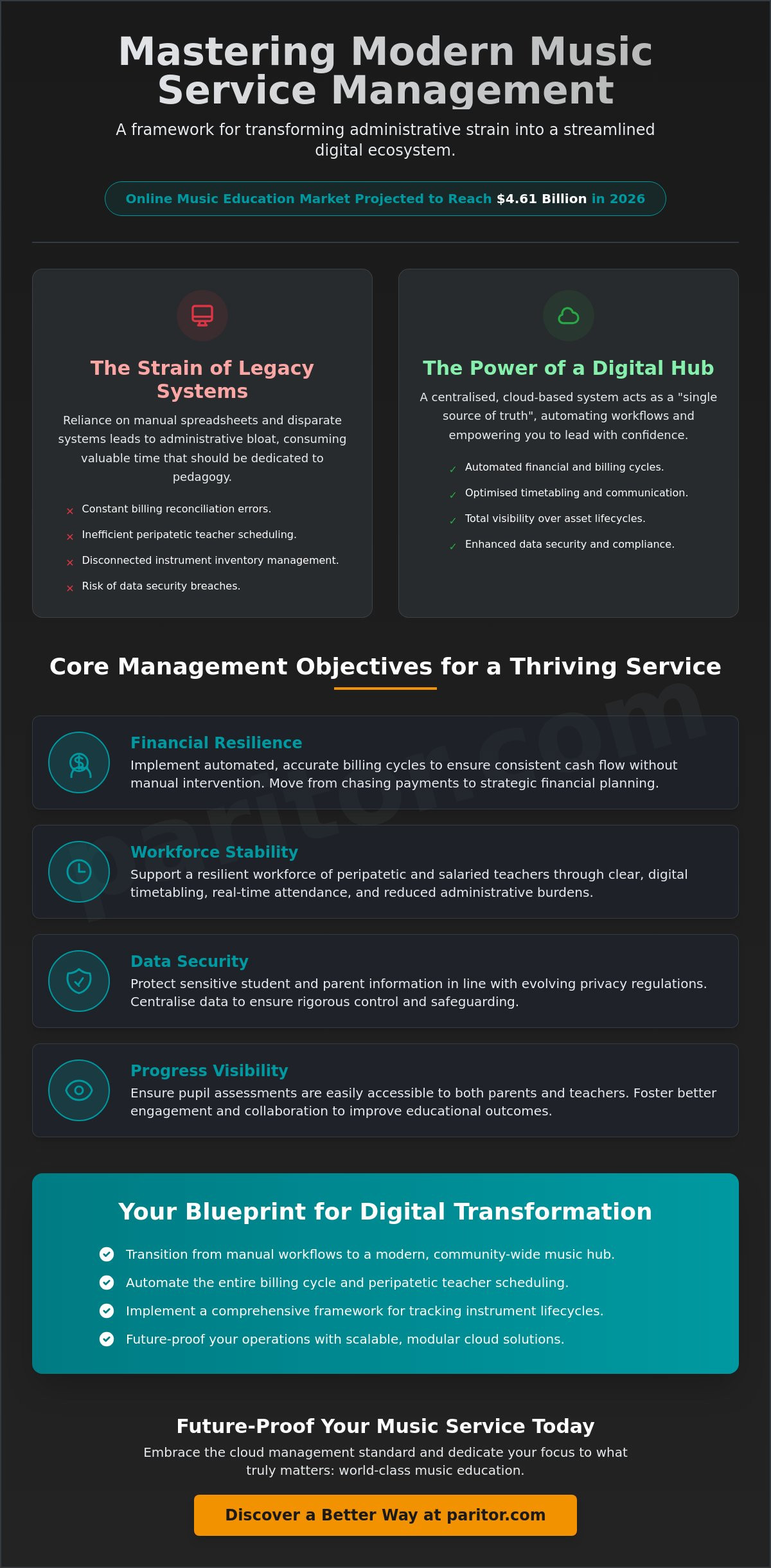
- Financial Resilience: Implementing automated, accurate billing cycles to ensure consistent cash flow without manual intervention.
- Workforce Stability: Supporting a resilient workforce of peripatetic and salaried teachers through clear, digital timetabling and reduced admin burdens.
- Data Security: Protecting sensitive student and parent information in line with evolving privacy regulations.
- Progress Visibility: Ensuring that pupil assessments are easily accessible to both parents and teachers to foster better engagement.
Focusing on these objectives allows you to reclaim your time. Instead of chasing late payments or correcting scheduling conflicts, you can return to your core mission: delivering world-class music education to your community.
Streamlining the Administrative Core: Scheduling and Financials
The heart of any music service is its administrative core. If this fails, the entire educational mission suffers. Coordinating dozens of peripatetic teachers across hundreds of venues isn’t just a challenge; it’s a logistical puzzle that can’t be solved with paper diaries. When you’re looking at how to manage a music service, you must address the “admin friction” that prevents teachers from doing what they do best: teaching. By automating the journey from lesson booking to payment receipt, you eliminate the repetitive labour that leads to burnout and errors.
Mastering the Peripatetic Timetable
Teaching music in schools requires constant movement. A teacher’s day is often split between multiple sites, making travel time a significant drain on resources. Smart scheduling focuses on minimising these gaps and maximising actual tuition hours. Real-time attendance tracking is equally vital; it provides immediate safeguarding data and ensures that reporting for local authorities is accurate. If a lesson is cancelled, automated notifications should alert parents and teachers instantly. This removes the need for manual phone calls and allows for make-up sessions to be organised without extra paperwork. It’s about creating a rhythm that works for everyone.
Managing ensembles and large-scale events shouldn’t require manual spreadsheet entry every time a new student joins. A centralised system allows these complex groups to be managed with the same ease as a one-to-one lesson.
Financial Automation and Revenue Protection
Managing the finances of a large-scale service is a far cry from overseeing a single artist’s budget. You’re dealing with thousands of small transactions, subsidies, and remissions. Discovering how to manage a music service through automation doesn’t just save time; it protects your revenue. Moving to secure online payment portals is no longer optional; it’s a necessity for institutional safety. Organisations like the National Endowment for the Arts highlight the importance of robust management to ensure the long-term sustainability of cultural programmes.
Accurate financial reporting helps you identify revenue leaks and manage diverse demographics with precision. Automated reminders reduce the stress of chasing late payments, whilst clear invoicing builds trust with parents. By integrating these systems, you create a seamless experience that feels professional and reliable. If you want to see how these modules work in practice, exploring Xperios Financial Management can provide a clear roadmap for your own digital journey. This shift allows you to move away from paper invoices and towards a more resilient, future-proof financial model.
Managing Assets and Safeguarding: Instruments and Student Data
Whilst digital innovation is transforming the music industry at a rapid pace, the physical reality of a music service remains grounded in tangible assets. Managing a fleet of instruments worth hundreds of thousands of pounds requires more than just a locked cupboard and a sign-out sheet. If you’re struggling with inventory loss or damaged equipment that hasn’t been tracked, you’re experiencing a significant leak in your service’s sustainability. Understanding how to manage a music service in 2026 means treating your instruments as a lifecycle, not just a one-off purchase.
This organisational control extends to the most sensitive asset of all: student data. With the global audio management software market projected to reach $728 million in 2026, the tools available to protect this data are more sophisticated than ever. You have a legal and moral duty to ensure that every piece of information, from a child’s medical needs to a parent’s home address, is handled with absolute security. Implementing a system that combines asset tracking with rigorous safeguarding protocols isn’t just about compliance; it’s about building a foundation of trust with the families you serve.
Instrument Inventory and Hire Schemes
Digital tracking allows you to maintain a complete history for every instrument in your collection. You can record serial numbers, current conditions, and loan histories with a single click. By using a tool like Xperios Instrument Management, you can automate hire agreements and send collection reminders to parents before an instrument goes missing. This proactive approach ensures your high-value assets are protected and that regular maintenance is scheduled. It turns a chaotic hire scheme into a streamlined revenue stream with a clear return on investment.
Safeguarding and GDPR in Music Education
Safeguarding is the non-negotiable core of education management. You must ensure that all teacher data and DBS checks are centralised and accessible to those who need them. Controlling data access through secure, role-based portals ensures that sensitive information never falls into the wrong hands. When you’re considering how to manage a music service, your digital infrastructure must meet UK GDPR standards whilst providing easy access to real-time information for your authorised staff. This balance of security and utility allows your team to focus on tuition, knowing the background checks and data protections are handled by an industrious, reliable system.
By centralising these diverse elements, you eliminate the need for multiple, disconnected databases. You create a secure environment where instruments are tracked, children are protected, and data is managed with professional precision. This level of oversight provides the relief and confidence you need to lead your service into the future.
Implementing a Strategic Digital Transformation
Modernising your operations through a cloud platform is a vital step forward. It marks the transition from administrative survival to strategic growth. Some industry advice suggests doing as much as possible on your own before seeking professional systems, but for a large-scale organisation, this is risky. Manual workarounds often lead to data breaches and lost revenue. Learning how to manage a music service at scale requires a structured migration that respects your staff’s time and your data’s integrity. This process isn’t just about changing software; it’s about evolving your service’s culture.
Audit and Data Migration
Before you migrate, you must clean your existing records. Moving “dirty data” into a new system only migrates your existing problems. Start by identifying data silos; these are the isolated spreadsheets or paper files that don’t talk to each other. By integrating these into a single cloud environment, you create a unified history for every student and teacher. Set clear KPIs for this transition. You might aim for a specific reduction in admin hours or an increase in instrument hire revenue. These metrics prove the value of the shift to your board or local authority.
Stakeholder Engagement and Portals
A successful transformation relies on user adoption. Overcoming the “we have always done it this way” hurdle requires showing immediate value to your team. Providing a personalised experience is central to how to manage a music service effectively in a competitive educational market. Empowering teachers with mobile-friendly tools allows them to record registers and progress reports in seconds. This isn’t just about efficiency; it’s about empowerment.
Engaging parents through a dedicated Xperios Parent Portal shifts the burden of booking and payments away from your office. Parents appreciate the convenience of self-service, whilst your staff gain hours of reclaimed time. This digital shift creates a seamless student experience that encourages long-term engagement. When a student can see their progress and parents can manage tuition easily, retention rates naturally improve. You can measure this success through real-time data analytics, allowing you to refine your strategy based on facts rather than assumptions. If you’re ready to start your migration, discover how Xperios can facilitate your digital transformation today.
Future-Proofing with Xperios: The Cloud Management Standard
Choosing the right infrastructure is the final piece of the puzzle when learning how to manage a music service for the long term. Xperios by Paritor isn’t just a software package; it’s the industrious engine behind the UK’s most successful music hubs. Built on 30 years of direct collaboration with music service leaders, it reflects the nuances of the sector that generalist tools simply can’t grasp. This partnership ensures that the platform evolves alongside your needs, providing a stable and reassuring presence in an ever-changing educational landscape.
Security and reliability form the bedrock of our professional trust. By hosting Xperios on Microsoft Azure, we provide a foundation of institutional safety that includes full UK GDPR compliance and robust data redundancy. You don’t have to worry about server maintenance or security patches; these labor-intensive tasks are handled automatically in the background. This allows you to focus entirely on your creative and educational mission, confident that your student data and financial records are protected by world-class cloud infrastructure.
Why a Bespoke Solution Trumps General Software
Generic CRM or accounting software often fails the specific needs of music education. These systems don’t understand the complexity of peripatetic timetabling or the lifecycle of a cello loan. Attempting to force your workflows into a generalist tool creates “workaround fatigue” and increases the risk of manual error. Xperios offers a modular advantage, allowing you to select the specific tools you need today, such as the Xperios Exams and Assessments Module or Xperios Ensemble Management, and scale your system as your service grows.
The impact on your daily operations is immediate. Xperios users consistently report significant reductions in administrative labour, often reclaiming hundreds of hours previously lost to manual data entry. Whether it’s coordinating a large-scale event through Xperios Event Management or tracking a violin through its entire repair history, specialized modules solve niche problems with elegant simplicity. This efficiency doesn’t just save money; it restores focus to the classroom.
Next Steps for Your Music Service
Reforming your administration is a journey of progress and modernisation. We invite you to join a community of forward-thinking leaders who have already made the shift to a digital-first model. The most effective way to understand how to manage a music service with Xperios is to see it in action. By booking a consultative demo, you can explore how our modular features map directly onto your existing workflows and identify the specific areas where you can reclaim the most time.
Your organisation deserves a dedicated ally that understands your frustrations and shares your goals. It’s time to move beyond the limitations of spreadsheets and embrace a system built specifically for the music education sector. Discover how Xperios can modernise your music service management and start your journey toward administrative excellence today.
Leading Your Music Service into a New Era
The transition from manual administration to a digital-first ecosystem is the most significant step you can take for your organisation’s growth. By centralising your peripatetic schedules, automating complex financial cycles, and securing your instrument inventory, you reclaim the time needed to focus on world-class pedagogy. This framework has shown that mastering how to manage a music service in 2026 requires a shift away from fragmented spreadsheets and towards a unified, cloud-based “single source of truth.”
As an industrious partner to the sector, Xperios offers a modular system that scales alongside your ambitions. Trusted by leading UK Music Hubs since 1993, our platform is fully GDPR compliant and hosted on the secure Microsoft Azure cloud. Whether you need to streamline ensemble bookings or protect sensitive student data, we provide the tools to eliminate repetitive burdens and empower your teaching staff.
Explore Xperios: The Gold Standard for Music Service Management
Take the next step in your professional journey and restore focus to your primary creative mission. Your community’s musical future is bright; with the right systems in place, your service is ready to lead the way.
Frequently Asked Questions
What is the best way to manage a large instrument inventory?
Digital tracking through a centralised system is the most effective method for overseeing high-value assets. This allows you to monitor serial numbers, current conditions, and loan histories in real time. Using a dedicated module like Xperios Instrument Management ensures that hire agreements are automated and maintenance is scheduled before issues arise. This level of oversight reduces loss and improves the return on your initial investment.
How can I reduce the time spent on music service invoicing?
Automating the entire billing cycle from lesson booking to payment receipt is the key to administrative efficiency. By removing manual data entry, you eliminate the repetitive labour that leads to errors and late payments. A secure system like Xperios Financial Management handles subsidies and remissions automatically, ensuring that your revenue is protected whilst providing a seamless experience for both parents and administrators.
Is cloud software secure enough for student safeguarding data?
Yes, provided the platform is hosted on a high-tier infrastructure like Microsoft Azure and maintains full UK GDPR compliance. Secure, role-based portals ensure that sensitive information is only accessible to authorised staff. This modern approach to data redundancy provides a foundation of institutional safety that legacy paper-based systems cannot match. It gives you the relief of knowing your safeguarding data is protected by professional standards.
Can I manage multiple school locations from one central system?
A unified cloud platform allows you to oversee every school and venue within your network from a single, organised dashboard. This centralisation provides a “single source of truth” for your service data, making it easier to coordinate peripatetic staff and track pupil progress across the region. It’s the most effective strategy for anyone learning how to manage a music service with multiple delivery sites.
How do I handle peripatetic teacher scheduling more efficiently?
Implementing real-time digital timetabling reduces travel time and maximises actual tuition hours for your staff. Automated notifications handle lesson cancellations and make-up sessions, removing the need for manual phone calls. This approach reduces the administrative friction that often leads to teacher burnout. It allows your team to focus on their primary mission of delivering high-quality music education without being bogged down by paperwork.
What are the benefits of a parent portal for a music service?
A parent portal empowers families to manage their own bookings, payments, and student progress reports through a secure self-service interface. This reduces the daily volume of enquiries to your central office and improves engagement. When parents have instant access to schedules and financial records, it builds trust and encourages long-term commitment to your service. It’s an essential tool for modernising the parent experience.
How does Xperios help with UK music hub reporting?
Xperios centralises all the data required for national reporting, from pupil demographics to ensemble participation numbers. Instead of manually collating spreadsheets from various departments, you can generate accurate reports with a few clicks. This ensures that your service remains compliant with funding requirements whilst providing clear evidence of the educational impact you’re making. It turns a month-long task into a simple, industrious process.
What is the first step in digitalising my music service administration?
The first step is to conduct a thorough audit of your current data silos and legacy systems. Identifying where your information is fragmented allows you to plan a clean migration into a unified cloud environment. Understanding how to manage a music service in the digital age starts with a commitment to modernisation that prioritises data integrity and staff empowerment from the very beginning of the journey.