
What if the greatest barrier to delivering world-class music education isn’t a lack of talent, but the weight of your own spreadsheets? You likely started this journey to inspire young musicians, yet you often find yourself trapped in a cycle of manual invoicing, paper-based instrument hire forms, and the constant stress of chasing late payments. It is an exhausting administrative burden that pulls you away from the rehearsal room and keeps you tethered to a desk.
We understand that modern music service administration should feel like a seamless performance rather than a logistical battle. This guide provides a comprehensive checklist for 2026, designed to help you reclaim your time and modernise your workflows. You’ll learn how to eliminate timetabling errors, automate your financial processes, and create a central communication hub that connects teachers, parents, and students effortlessly. It is time to let the software handle the heavy lifting so you can get back to the music.
Key Takeaways
- Understand the transition from traditional clerical tasks to strategic data management to meet the efficiency standards expected of modern music hubs.
- Identify and clear administrative bottlenecks using a 10-point audit that prioritises centralised data and automated financial workflows.
- Discover how modernising your music service administration can lift the psychological weight of manual data entry and empower your team.
- Strengthen the “Triangle of Communication” by connecting parents, teachers, and the central office through real-time, secure portals.
- Learn how to future-proof your organisation with modular tools that adapt to your specific needs, from ensemble management to assessments.
Defining Modern Music Service Administration in 2026
The days of dusty filing cabinets and handwritten registers are over. Modern music service administration has evolved into a high-stakes discipline. It’s no longer about simple clerical tasks; it’s about strategic data management that supports musical excellence. In 2026, music hubs are expected to function with the precision of a corporate entity whilst maintaining their core educational mission. This “engine room” of the service ensures that every peripatetic teacher is in the right place, every instrument is accounted for, and every invoice is accurate. When the administration is seamless, the music takes centre stage.
Professional standards in this field continue to rise. Organisations like the National Association for Music Education (NAfME) have long championed the importance of structured support for music educators. Today, that support includes managing complex GDPR compliance requirements and the logistical puzzles of hybrid teaching models. Budget constraints mean every penny must be tracked. There’s no room for the financial leakage caused by manual errors or lost instrument hire forms. Modern administrators must be technologically savvy, using data to prove the value of their programmes to stakeholders and local authorities.
The Core Pillars of a Music Hub System
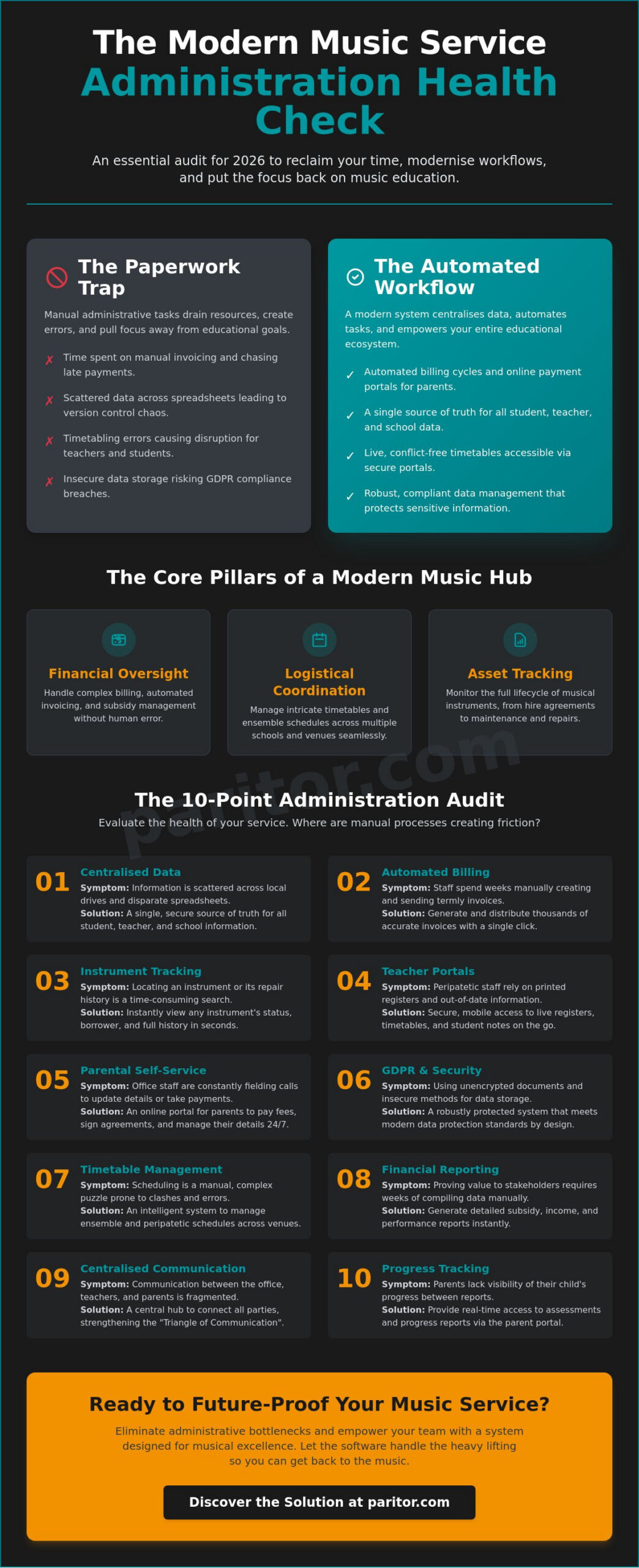
Effective music service administration rests on three specific areas that must work in harmony to ensure stability and growth:
- Financial oversight: Handling complex billing cycles, automated invoicing, and subsidy management without human error.
- Logistical coordination: Managing intricate timetables and ensemble schedules across multiple schools and venues.
- Asset tracking: Monitoring the full lifecycle of musical instruments, from initial hire agreements to routine maintenance and repairs.
Why “Good Enough” is No Longer Enough
Relying on “good enough” legacy systems often leads to hidden costs that drain your resources. A single data entry error in a teacher’s timetable can disrupt an entire day of lessons, leading to frustration and peripatetic burnout. In 2026, teacher retention depends on a system that respects their time and simplifies their reporting. Parents also expect a modern experience; they want real-time access to progress reports and payment history through secure portals. If the back-office fails to meet these digital expectations, the reputation of the entire service is at risk. Efficiency isn’t just a goal; it’s a requirement for survival.
The Music Service Administration Audit: A 10-Point Checklist
To move your organisation forward, you must first understand where the friction lies. Many leads feel they are managing their services well until a specific request, such as a last minute instrument audit or a complex subsidy report, reveals the cracks in the foundation. This 10-point audit is designed to help you evaluate the health of your music service administration and identify where manual processes are draining your team’s energy. It’s about moving from reactive fire-fighting to proactive management.
- Centralised Data: Do you have a single source of truth for all student, teacher, and school information, or is it scattered across local drives?
- Automated Billing: Can your system generate and send termly invoices without human intervention, or is your team trapped in a cycle of manual data entry?
- Instrument Tracking: Can you locate any specific instrument in your inventory within 30 seconds, including its current borrower and repair history?
- Teacher Portals: Do your peripatetic staff have secure, mobile access to live registers and student notes whilst they are on the move?
- Parental Self-Service: Can parents pay fees, sign hire agreements, and update contact details online at any time of day?
Conducting a thorough audit often reveals exactly where specialised music service software can bridge the gap between administrative chaos and operational clarity.
Evaluating Your Financial and Logistical Health
Spreadsheets are the enemy of scale. If your organisation suffers from “spreadsheet sprawl”, where data is duplicated across multiple files, you’re inviting errors and version control issues. Assess how much time your office staff spend on manual scheduling compared to strategic development. Security is also paramount; your student data storage must be robustly protected to meet modern GDPR standards. If you’re still relying on unencrypted documents, your service is at significant risk.
Communication and Reporting Metrics
Effective music service administration relies on clear, digital audit trails. You should be able to generate a hub-wide attendance report with a single click, providing immediate insights into engagement levels. Tracking student progress shouldn’t be limited to paper notebooks; digital assessments allow for better continuity when teachers change. When your communication triangle, connecting the office, teachers, and parents, is digitised, information flows freely and misunderstandings disappear. This level of transparency builds trust with every stakeholder in your educational community.
Overcoming the Paperwork Trap: Manual vs Automated Workflows
Administrative staff in music hubs don’t just feel tired; they feel buried. The psychological weight of “busy work”, the endless re-typing of student names or the manual cross-referencing of bank statements, stifles creativity and morale. When your team spends their energy on repetitive data entry, they have less capacity for strategic growth. Identifying bottlenecks is the first step toward freedom. These usually appear during term-time transitions when the demands of music service administration are at their peak. Automation removes the “Friday afternoon panic” associated with last-minute timetable changes or missing registers. It replaces chaos with a calm, predictable rhythm.
Excel feels safe. It isn’t. Many leads cling to spreadsheets because they’re familiar, yet these files are often the primary source of error and stress. Modern cloud systems are actually more intuitive because they’re designed for the specific nuances of music education. Transitioning to a dedicated platform isn’t just about new software; it’s about evolving your music service administration from a reactive chore into a proactive asset. It’s time to stop fighting with cells and formulas and start using a system that understands your workflow.
Manual Labour vs. Digital Orchestration
The difference between manual and automated systems is most visible in the finance office. Processing hundreds of termly invoices manually can take days of concentrated effort. Xperios Financial Management reduces this to a few clicks, ensuring invoices are sent accurately and on time. Human data entry is a significant liability; a single typo in a bank detail or a student ID can cause weeks of payment delays. Scalability is the final hurdle. Manual systems inevitably break as your service grows, whilst digital orchestration allows you to double your student intake without doubling your staff’s workload.
Reclaiming the “Music” in Music Service
Every hour saved on paperwork is an hour that can be reinvested into the rehearsal room. By using the Xperios Teacher Portal, peripatetic staff can submit registers instantly, saving hours of office-based reconciliation every week. These administrative savings have a tangible impact. You can redirect the time and resources saved into student bursaries, new instrument purchases, or expanded ensemble programmes. For a deeper look at this transition, read our Modernising Music Service Management: A 2026 Guide. When the back-office runs itself, you can finally focus on the musical outcomes that truly matter.
Organising the Educational Ecosystem: Portals and Compliance
The success of a modern music hub depends on the strength of the “Triangle of Communication”. This is the vital link between the central office, the peripatetic teaching staff, and the parents. When this triangle is fractured by missed emails or outdated paper registers, the entire service suffers. Effective music service administration in 2026 repairs these connections by providing a single, secure digital environment where information flows instantly. It’s about creating a transparent ecosystem where everyone has the information they need exactly when they need it.
Security is the foundation of this ecosystem. Managing sensitive student data requires more than just a password protected spreadsheet. Professional hubs now rely on cloud infrastructure like Microsoft Azure to host their data. This ensures the highest levels of GDPR compliance, data redundancy, and institutional safety. You shouldn’t have to worry about data breaches or lost files; your system should provide a stable, encrypted environment that protects your community’s privacy automatically. This level of technical assurance allows you to lead with confidence.
Empowering Your Teaching Staff
Peripatetic tutors are often the face of your service, yet they frequently feel the most disconnected from the central hub. The Xperios Teacher Portal empowers these staff members by putting real-time timetables and mobile registers directly onto their devices. They can track attendance and student progress in the classroom, with the data syncing instantly to the office. This eliminates the need for tutors to carry physical folders or spend their evenings on manual reporting. By reducing the burden of exam and assessment paperwork, you allow your tutors to focus on what they do best: teaching.
Enhancing the Parent Experience
Parents in 2026 expect a digital-first experience that matches their daily interactions with other services. Parent portals meet this expectation by allowing families to book lessons, join ensembles, and manage instrument hire through a simple self-service interface. This significantly reduces the volume of inbound phone calls and repetitive queries reaching your office team. Secure payment gateways ensure that fees are collected safely, whilst automated receipting provides instant peace of mind. Real-time notifications about concert dates and progress reports keep families engaged and informed without any extra manual effort from your staff.
Discover how the Xperios Parent Portal can transform your community engagement and streamline your daily operations.
Future-Proofing Your Service with Xperios by Paritor
Adopting a new system feels like a daunting leap. We know this because we’ve spent three decades listening to music service leads describe their specific frustrations. Xperios has become the cloud management standard for UK music services because it isn’t a generic solution adapted for education; it’s a platform built from the ground up through direct collaboration with the sector. This history of partnership ensures that the software understands the unique rhythm of your academic year. It simplifies the complexities of music service administration by replacing fragmented tools with a single, industrious engine.
Modularity is at the heart of our philosophy. You shouldn’t have to pay for features your organisation doesn’t yet require. You can start with Xperios Financial Management to solve your immediate billing crises, then add Xperios Instrument Management or Xperios Ensemble Management as your service expands. This flexibility allows you to build a bespoke digital environment that fits your current needs whilst providing a clear path for future growth. Every module is designed for simplicity, ensuring that your transition to the cloud is a step forward, not a technical hurdle.
A Partner, Not Just a Provider
We pride ourselves on being more than just a software vendor. Our commitment to UK-based support means you’re always connected to experts who understand the local educational landscape. Whether you’re a private tutor or a large national music hub, the platform scales effortlessly to match your volume. For a comprehensive look at how technology is reshaping our sector, explore The Complete Guide to Music Service Management Software in 2026. We handle the technical heavy lifting, including secure data migration and staff onboarding, so you can focus on your students.
Next Steps: Moving Beyond the Checklist
The roadmap to a paperless music service begins with a single conversation. Moving beyond a checklist requires a consultative approach where we look at your specific bottlenecks and design a workflow that eliminates them. We invite you to book a demonstration of the Xperios platform to see how these modules function in a real-world setting. You’ll discover how automated registers, real-time timetables, and secure portals can transform your daily operations. It’s time to reclaim your time and restore your focus to world-class music education. Modernise your music service with Xperios today and lead your organisation into a more efficient, empowered future.
Harmonising Your Organisation for the Future
Modernising your music service administration isn’t just about efficiency; it’s about reclaiming the creative heart of your hub. By moving away from fragmented spreadsheets and adopting automated workflows, you eliminate the friction that leads to staff burnout and parental frustration. A digital ecosystem built on centralised data ensures that your teachers, parents, and administrators are always in sync, allowing information to flow without the need for manual intervention.
Xperios provides the stability and innovation needed to navigate these logistical challenges. Our platform is built on 30 years of direct user collaboration and is securely hosted on Microsoft Azure to ensure institutional safety and GDPR compliance. With specialised modules for instrument and ensemble management, it’s the industrious engine that lets you scale your service without increasing your paperwork. You don’t have to manage this transition alone; we’re here to facilitate your progress every step of the way.
Discover how Xperios can organise your music service and free up your time for what matters most. It’s time to lead your organisation into a more efficient, empowered, and musical future.
Frequently Asked Questions
What is the most important part of music service administration?
The most important element is establishing a single source of truth for all organisational data. Having student records, teacher schedules, and financial history in one central location prevents the errors caused by fragmented spreadsheets. This foundation ensures that every other part of the music service administration process, from billing to instrument hire, runs with total accuracy and transparency.
How can I reduce the time spent on music school invoicing?
You can drastically reduce invoicing time by automating the billing cycle through specialised software. Instead of manually entering data for hundreds of students, a system like Xperios Financial Management generates and sends invoices termly with just a few clicks. This shift eliminates repetitive manual labour and ensures payments are requested on time without administrative delays or human error.
Is cloud software secure for storing student and teacher data?
Yes, modern cloud software is highly secure when hosted on enterprise-grade infrastructure like Microsoft Azure. This provides robust protection against data breaches whilst ensuring full GDPR compliance through encrypted storage and regular data redundancy. It offers a much higher level of institutional safety than local drives, protecting sensitive student and staff information automatically.
Can music service software help with instrument inventory tracking?
Specialised music service administration software includes dedicated modules for tracking the full lifecycle of your instrument inventory. You can instantly locate any specific instrument, see its current borrower, and review its entire repair history digitally. This creates a clear audit trail that prevents assets from going missing and simplifies the management of hire agreements and maintenance schedules.
How do I manage peripatetic teacher timetables more efficiently?
Managing peripatetic timetables is most efficient when using real-time teacher portals that sync directly with the central office. Tutors can view their live schedules on any mobile device and submit digital registers immediately after a lesson. This removes the need for paper-based systems and prevents the scheduling conflicts that often occur when relying on manual communication or outdated registers.
What are the benefits of a parent portal for music schools?
A parent portal reduces inbound administrative queries by allowing families to manage their own bookings and payments online. Parents can update contact details, sign hire forms, and view progress reports at their convenience 24/7. This self-service model empowers parents whilst freeing your office team from handling routine tasks and the burden of repetitive phone calls.
How long does it take to implement a new music service management system?
The implementation timeline varies based on the size of your organisation, but a structured onboarding process typically takes a few weeks. This includes secure data migration from your current systems and comprehensive training for your administrative staff. A consultative approach ensures that the platform is configured to your specific workflows before you go live, ensuring a smooth transition.
Do I need a separate system for ensemble and event management?
You don’t need a separate system if you choose a modular platform that includes ensemble and event management as integrated components. Using a single system like Xperios ensures that student data flows seamlessly between individual lessons, group rehearsals, and public performances. This unified approach eliminates the need to cross-reference multiple databases or manually export lists for a single event.