

Determining your total investment in performing arts billing software requires evaluating your maintenance history, booking software (financial management module), peripatetic teacher timetables, and reporting tools. Paritor tailors setups to specific organisational needs rather than publishing fixed price lists. Get in touch with our staff for a bespoke pricing estimate based on your present management requirements.
Key Takeaways: Performing arts billing software automates complex tuition fees and multi-venue scheduling by integrating student records directly with accounting ledgers and parent portals.
- Market entry rates for administrative platforms typically average £50 per month across a top-ten software sample.
- Generic accounting tools fail unless your organisation has static schedules without variable lesson lengths.
- Choose modular systems for multi-site operations to centralise data while avoiding costs for unused features.
- The article’s cost table shows that base subscriptions often exclude essential data migration and training.
A modular software model that fits your team size
Choosing the right software model depends on your team size, administrative complexity, and billing frequency. Clients who pick a modular system avoid paying for features they never touch. Three situations come up often: a small academy that needs quick setup and automated invoicing; a multi-site operation that needs centralised data control; a local authority that must run instrument lifecycle management under strict data protection on Microsoft Azure cloud hosting.
If you manage dynamic schedules, booking software with an integrated parent portal simplifies fee collection. To review tailored options, read our billing software guide for complete details.
For local authorities, pairing teaching rotas with arts school management (instrument lifecycle management) on Microsoft Azure keeps data protection requirements in view. Paritor provides the single source of truth across these distinct operations.
What performing arts management software actually centralises
Performing arts billing software centralises your tuition administrative workflows, automated payment processing, and core operational reporting into a single platform. Treat it as your administrative control room: it connects student accounts directly with external accounting packages, grant tracking tools, and live box office databases.
You can review the ROI strategic guide to see how automated workflows protect revenue.
The system syncs incoming tuition fees and ledger entries alongside your arts school management records. This setup keeps your general ledger current while protecting data security through cloud hosting on Microsoft Azure, and it reconciles every transaction instantly. Proper recordkeeping supports accurate financial reporting across accounts, and the integration tracks teaching rotas alongside donor contributions and public funding. It replaces manual spreadsheets with one single source of truth.
How performing arts billing software automates class payments
Automated direct debits reduce payment chasing while securing income for music lessons and instrument hire. When parents forget termly fees, your office wastes hours sending manual reminders. Modern billing software removes this friction by issuing invoices directly through a parent portal.
Setting up scheduled direct debit collections alongside instrument hire agreements ensures recurring fees arrive automatically without administrative delays. Parents log into their account to pay balance charges, review schedules, or view hired equipment. The system processes secure online payments instantly, matching every transaction against student records, so staff no longer manually reconcile bank statements or rekey ledger entries into arts school management platforms. A dedicated scheduling software overview shows how linking your finance system to teaching rotas keeps financial records synchronised with actual attendance.
Manual invoicing leaks tuition revenue over time. Automated billing supports predictable cash flow while protecting staff time, and automated administration protects your revenue while freeing hours for teaching.
How drama school software frees capacity for growth
Drama school software expands your business capacity by automating multi-location timetables, complex age-group rosters, and seasonal workshop registration within a single cloud system.
In work supporting creative academies, overlapping class slots across multiple venues frequently strained staff capacity until centralised automation took over the logistics through a single source of truth hosted on secure Microsoft Azure. That shift (problem: clashing multi-venue slots; action: one cloud system balancing rotas and class caps; outcome: clashes and bottlenecks removed) is the growth pattern you can repeat.
By switching to dedicated arts school management technology, you eliminate scheduling clashes and administrative bottlenecks. The platform balances teaching rotas automatically across different venues while handling class caps. Parents can select appropriate age groups, register for holiday workshops, and complete secure online payments through a dedicated parent portal, which removes daily admin burdens so you can focus on teaching. Explore integrated timetable guidance to see how integrated scheduling supports multi-site growth. Modular booking software features help your business scale while maintaining GDPR compliance.
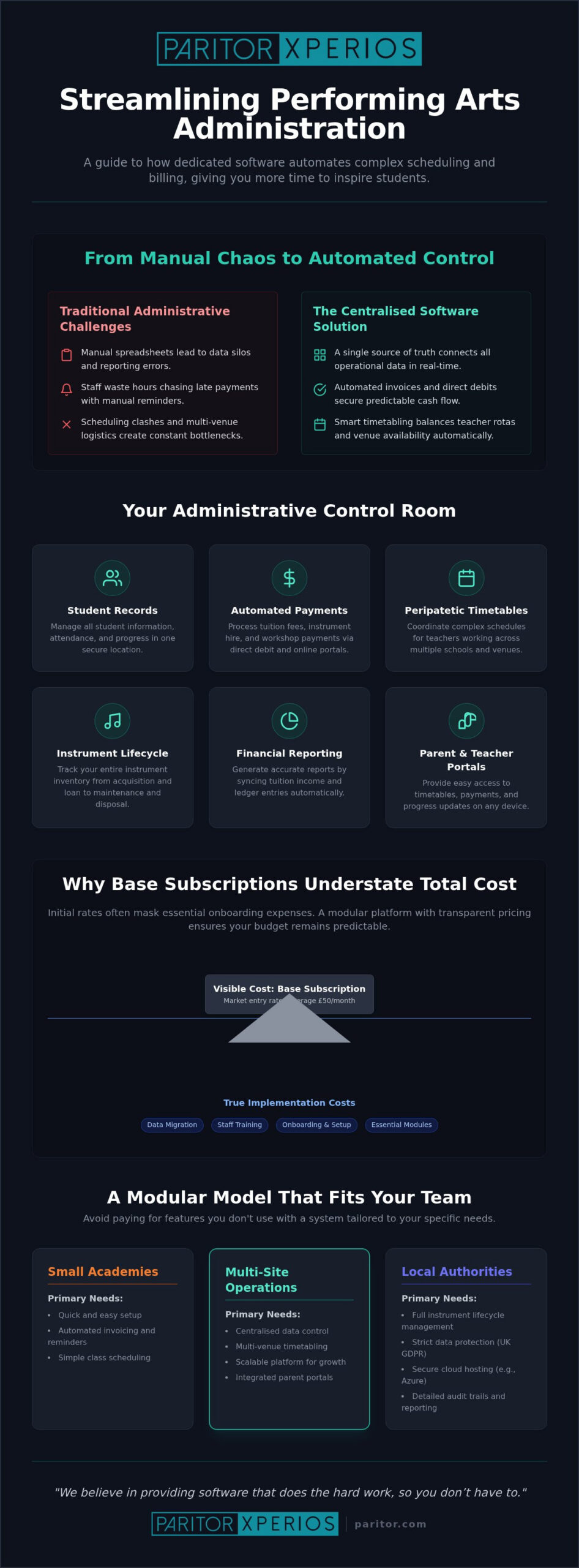
Why base subscription rates understate total implementation cost
Selecting music administrative software means evaluating true long-term value rather than relying on basic subscription tiers alone. Initial low rates frequently mask heavy onboarding expenses that inflate your true expenditure, so modular platforms that disclose setup costs upfront keep your budget predictable.
Comparing base costs against actual total ownership reveals the true outlay for your organisation. Based on a top-ten sample of software packages, typical entry subscription rates sit within a market price band of £45–55/month, $45–55, with a median of £50/month, $55.
| Cost Component | Base Subscription | Implementation & Add-ons |
|---|---|---|
| Entry Rates | Standard monthly platform fee | Custom data migration |
| Operational Modules | Booking software | Staff training packages |
| Asset Tracking | Arts school management | Teacher schedule (peripatetic teacher timetables) |
Budgeting solely for monthly access ignores fuel-and-maintenance style costs: data migration, system setup, and tailored training accumulate quickly. Managing cloud platforms built on Microsoft Azure provides long-term stability and automated GDPR protection. Using Xperios as your single source of truth streamlines secure online payments and removes administrative burden. Reach out to our specialists for a tailored estimate designed around your operational demands.
Tip: Always request a written breakdown of data migration and onboarding fees before committing to a monthly subscription plan.
Centralised financial reporting for arts charity budgets
Booking software centralises your box office revenue, grant income, and charity accounts into a single source of truth.
Linking box office admissions directly to grant impact metrics eliminates tedious manual reporting. You can allocate funds to specific performance outreach projects without spreadsheet cross-referencing, so every revenue contribution is clearly accounted for against the projects it supports.
Charity accounting demands transparency, and tracking every pound automatically helps you meet that bar. Cloud software hosted on Microsoft Azure keeps sensitive financial records secure and GDPR compliant. Streamlining administrative tasks gives your team more room for creative work and community engagement, and modern platforms remove the administrative burden so your arts charity can thrive.
5 Steps that protect your data during migration and setup
Switching your booking software needs a structured roadmap to protect your data and prevent administrative downtime. Moving your records to cloud hosting on Microsoft Azure protects privacy while streamlining daily tasks when you organise records before the transfer.
- Audit existing data: Clean your current records to eliminate duplicate entries and outdated contact information before transfer.
- Configure your system: Customise Paritor modules to match your administrative setup and arts school management needs.
- Migrate securely: Transfer your student, financial, and teaching-rota files into the centralised single source of truth.
- Train your team: Walk your staff through the parent portal, automated billing tools, and daily workflows.
Our team guides you through every technical hurdle so data security under GDPR rules stays intact. You gain an industrious engine that handles complex tasks without delay.
Where generic tools break on performing arts workflows
Generic administrative tools fail to manage complex performing arts billing workflows. Standard accounting platforms cannot handle variable lesson lengths, shared group costs, or multi-location timetables.
From client work, generic options quickly create administrative bottlenecks: they lack essential tools for arts school management and leave teams on manual workarounds. Off-the-shelf systems treat your scheduling like a basic retail calendar. While basic software fits static desk jobs, a dedicated platform handles dynamic education environments.
A custom booking software handles intricate billing rules automatically and keeps teaching rotas synchronised with student accounts. Small community groups with basic schedules might manage on general tools; growing music services need dedicated systems. Choosing dedicated software saves hours of staff time every week while keeping your financial records secure.
Frequently asked questions
What is performing arts management software?
Performing arts management software is a centralised cloud platform that automates administrative tasks for music services and creative centres. Systems like Xperios bring your booking software, student records, and teaching rotas into a single source of truth. Hosted securely on Microsoft Azure, it protects your data while giving parents easy online access, so you can focus on teaching rather than rekeying records.
How can drama school software help me grow my business?
Drama school software accelerates your growth by automating invoicing and managing arts school management without extra administrative staff. By giving families access to a parent portal for secure online payments, you reduce late fees and build cash flow. Automated enrolment forms capture new sign-ups instantly without manual data entry, so you can expand your creative classes with the admin load already handled.
What is the best CRM for small arts charities in the UK?
A strong CRM fit for a small UK charity combines modular flexibility, full GDPR compliance, and accessible online portals for families. Based on generic market rates for mid-tier administrative platforms, typical entry costs vary across the sector; request a personalised quote for exact platform figures. A modular system lets you pay only for the features you actively use today.
Do arts charities need specialist software or can they use a general charity CRM?
Arts charities need specialist platforms because standard charity CRMs cannot coordinate complex ensemble management, venue bookings, or tuition schedules natively. General systems often force staff to record teaching schedules on external spreadsheets, which increases security risks and doubles workload. Dedicated software keeps your tuition, billing, and child safety data within one compliant platform and reduces avoidable mistakes.
How do arts charities measure and report impact?
Arts charities track impact by extracting clear performance metrics on student retention, workshop attendance, and lesson engagement directly from their central database. Custom reports allow teams to demonstrate compliance, submit funding requests, and present verified progress data to trustees quickly. Instant reports help funding bodies see the real value of your educational projects.
Managing your performing arts organisation in 2026
Modern performing arts billing software removes the weekly administrative burden from your admin team.
Xperios simplifies arts school management by running your invoicing, scheduling, and pupil records inside a single cloud system. Built as a modular platform, it helps UK music services and academies organise teaching-rota data while maintaining strong GDPR compliance on Microsoft Azure, giving administrators control without manual workarounds.
To discuss your venue or school’s specific requirements, contact our team today.