
What if the hours spent generating progress reports for music students actually drained your energy for teaching rather than supporting your pupils? If you manage an instrumental service or teach across multiple schools, you already know the frustration of end-of-term paperwork. Spending late evenings typing repetitive feedback, untangling version errors across shared spreadsheets, and wondering if parents even read the finished pages is exhausting. You want to celebrate your pupils’ musical growth, but manual administrative routines constantly get in the way.
We believe your software should do the hard work so you don’t have to. In this practical guide, you will discover how to produce structured, insightful music progress reports quickly without administrative overwhelm. We will explore how to standardise assessment criteria across visiting peripatetic teachers, give parents transparent visibility into practice habits and exam milestones, and transform pupil tracking into an effortless routine that protects your teaching time and complies with UK data protection regulations.
Key Takeaways
- Discover why balanced developmental feedback keeps pupils motivated and helps prevent drop-out during challenging technical plateaus.
- Identify the core assessment metrics needed to track posture, tone production, and expressive interpretation across visiting instructors.
- Learn how moving away from manual spreadsheets removes version errors and saves vital teaching hours each week.
- Follow a practical five-step workflow for generating progress reports for music students directly during lessons to avoid end-of-term backlogs.
- See how modern cloud portals replace vulnerable paper slips while ensuring full alignment with UK data protection regulations.
Why Meaningful Progress Reports Matter in Music Education
Music education thrives on gradual mastery. Unlike conventional classroom subjects where test scores offer clear metrics, instrumental learning relies on physical coordination, expressive nuance, and continuous habit formation. Meaningful student progress reports serve as structured developmental records for this journey. They capture small technical milestones that standard marks miss, helping pupils recognise their personal growth when tackling challenging pieces.
Without clear feedback, students often hit technical plateaus where progress feels invisible. These difficult stages represent the highest risk point for student drop-out. Structured feedback reframes these hurdles, showing learners that finger independence on the piano or embouchure stability on brass instruments takes dedicated time to consolidate.
The Purpose of Musical Assessment
Academic grading generally reflects summative performance at a single moment. Musical assessment, by contrast, focuses on developmental trajectories. Grounded in the broader tradition of student progress reporting, formative evaluation in music tracks technical control alongside interpretive maturity over time.
Regular milestone reviews build confidence ahead of graded exams with boards such as ABRSM, Trinity College London, or Rockschool. Breaking syllabus goals into visible, bite-sized targets removes exam anxiety and noticeably boosts student retention across term boundaries.
The Communication Bridge Between Teachers and Parents
Most parents cannot easily tell whether home practice sounds correct, particularly during early string or woodwind tuition. Consistent summaries bridge this gap by translating studio practice instructions into clear guidance that families can support at home:
- Clear practice goals: Explaining exactly which bars require slow metronome work instead of vague instructions to “practise more”.
- Technique checks: Alerting parents to posture, hand position, or bow hold adjustments to watch out for between lessons.
- Repertoire milestones: Celebrating completed studies to demonstrate tangible returns on ongoing lesson investments.
The challenge lies in delivery. For visiting peripatetic instructors teaching dozens of pupils across scattered schools, generating progress reports for music students using paper slips or disjointed files creates heavy administrative strain. Streamlining this task into a swift, structured routine ensures parents stay informed whilst protecting teacher wellbeing and instructional time.
Essential Components of a Music Student Progress Report
Generic school rubrics rarely capture how an instrumentalist develops. A single letter grade cannot explain why a violinist struggles with string crossings or celebrate a pianist mastering thumb-under technique. When generating progress reports for music students, using balanced categories provides clarity for families while keeping notes objective and swift to record.
Technical Skill and Repertoire Tracking
Technical evaluation should isolate physical mechanics from musical interpretation. Track measurable metrics across lessons:
- Physical setup: Posture, hand shape, and instrument hold.
- Tone production: Embouchure control, bow distribution, or finger attack.
- Technical exercises: Scale fluency, tempo stability, and articulation habits.
- Repertoire log: Pieces completed, current performance material, and technical targets for next term.
Aural Awareness and Sight-Reading Milestones
Aural perception and quick-study skills underpin confident musicianship, yet they are frequently omitted from written feedback. Evaluate pitch accuracy, pulse retention, and rhythmic imitation using simple rating bands such as emerging, developing, or secure. Documenting unfamiliar score reading helps benchmark progress against regulated exam requirements, giving families a realistic timeline for future entry milestones.
Engagement and Independent Practice Habits
A pupil’s weekly routine at home directly shapes their progress in the studio. Rather than logging raw minutes, evaluate consistency and self-reflection. Frame practice resistance constructively. Phrasing such as “needs support establishing three short ten-minute routines each week” guides parents without discouraging the student.
Widely cited research on family engagement shows that active parent involvement directly improves learning consistency and pupil confidence. Streamlining these observations through specialised music tuition platforms ensures instructors capture these developmental details effortlessly between lessons without administrative backlog.
Manual Spreadsheets versus Automated Music Management Systems
Many music leaders still coordinate termly evaluations through a patchwork of local spreadsheets and shared document folders. At first glance, spreadsheets seem familiar and flexible. However, just as schools and educators increasingly rely on platforms like Rise to track student performance and activity through unified dashboards, music departments also benefit from modern digital oversight. In practice, generating progress reports for music students through static files introduces hours of administrative friction, version confusion, and significant data security risks.
The Hidden Administrative Drain of Paper and Spreadsheets
When peripatetic tutors note observations across paper notebooks or disparate spreadsheets, someone has to re-type that information into finished parent letters. This repetitive transcription drains hours that could be spent preparing ensemble arrangements or mentoring staff. Manual data entry also invites costly version-control errors, such as overwriting a pupil’s exam entry record or emailing draft comments intended for someone else.
Security is an even larger liability. Saving unencrypted student records on personal laptops or transmitting spreadsheets via standard email breaches UK data protection regulations. A dedicated cloud-based platform replaces scattered files with unified data sovereignty, maintaining a strict audit trail and keeping confidential pupil records secure.
Consistency Across Visiting Peripatetic Staff
Visiting music instructors possess diverse performance backgrounds and teaching styles, which can lead to wild inconsistencies in reporting standards. One teacher may write three paragraphs detailing phrasing, whilst another leaves two hurried lines. As highlighted in NAfME’s position statement on assessment in music education, transparent and systematic criteria are essential for documenting instrumental growth fairly and accurately.
Centralised digital templates standardise reporting across every studio, school, and instrument family:
- Standardised evaluation criteria: Every instructor evaluates posture, technique, and musicality using the same agreed rubrics.
- Instant distribution: Automated notifications alert parents the moment an evaluation is ready, eliminating the delay of printed letters lost in instrument cases.
- Direct data synchronisation: Assessment marks link straight into pupil files without manual copying.
Adopting dedicated music service management software removes the administrative weight of manual transcription, helping your staff deliver uniform, professional communications while safeguarding precious teaching time.
How to Generate Music Student Progress Reports Step by Step
Generating progress reports for music students does not have to mean losing entire weekends to admin. When instructors write comments from memory at the end of term, the process feels endless and details get blurred. Setting up an ongoing routine turns report writing into a natural extension of regular teaching, saving time and delivering sharper observations.
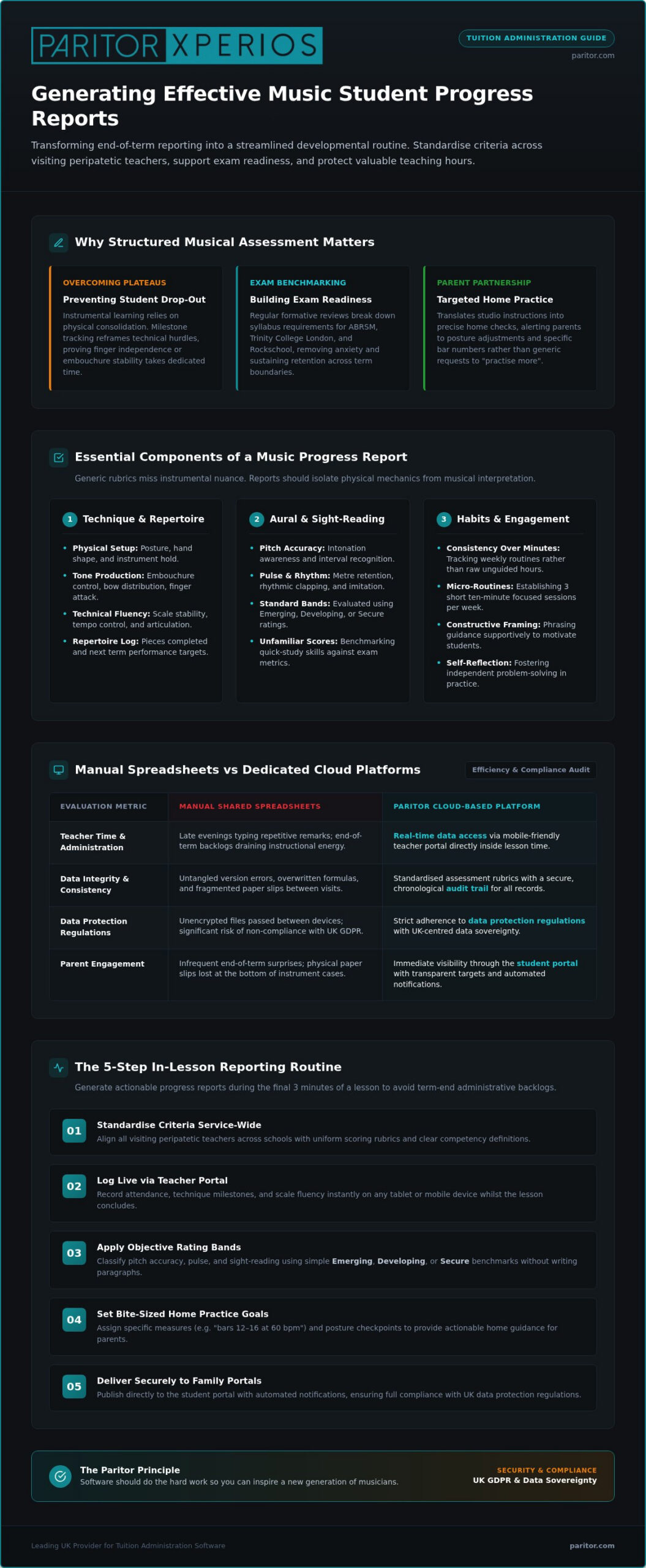
You can streamline the entire cycle across your teaching team with a simple five-step workflow:
- Log live notes: Record bullet points during the final two minutes of each instrumental lesson.
- Apply criterion banks: Use agreed assessment descriptors for core areas like intonation and posture.
- Add custom targets: Pair technical feedback with a clear practice goal for the following term.
- Run moderation: Allow department heads to review grammar, tone, and grading balance before publishing.
- Distribute digitally: Publish final reports directly to online pupil and parent accounts.
Capturing Ongoing Notes During Weekly Lessons
Encourage tutors to log quick observations on a mobile interface straight after hearing an exercise. Entering a quick sentence while the performance is fresh takes seconds. Over twelve weeks, these micro-notes compile into a thorough record of technical development. Tutors can also tag specific achievements against examination syllabus criteria, ensuring accurate recall when assessment deadlines arrive.
Drafting Balanced and Constructive Feedback
Effective feedback pairs positive recognition with actionable corrections. Avoid vague praise like “good effort on scales”. Instead, try constructive phrasing: “Sophie shows excellent finger independence in her C major scale; focusing on steady thumb-under movement at 60 bpm will improve her tempo stability.” Using standardised comment banks speeds up writing without sacrificing personal detail.
Reviewing and Finalising Termly Documents
Senior leaders need clear moderation workflows before documents reach families. Dedicated administrative controls allow department heads to review tone, check consistency across teaching studios, and verify factual details quickly. Integrating this review process alongside your systems for managing peripatetic teacher timetables ensures reports are completed on time without disrupting visiting schedules.
Ready to modernise your music administration? Book an Xperios consultation today to simplify your reporting and reclaim valuable teaching hours.
Delivering Reports Securely and Engaging Families with Xperios
Handing paper slips to pupils at the end of an instrumental lesson often means evaluations end up crumpled at the bottom of a music bag. When generating progress reports for music students, delivery needs to be instant, secure, and engaging. Modern digital workflows replace lost paper and frantic email chains with direct communication channels that keep families connected to their child’s musical development.
Instant Digital Delivery via the Parent Portal
The Xperios Teacher Portal provides instructors with an intuitive interface on any smartphone, tablet, or laptop. Tutors can record lesson notes, update assessment rubrics, and log technical milestones between lessons without carrying stacks of physical files across schools. Once department leaders approve the feedback, automated notifications inform guardians instantly.
Through the Xperios Parent Portal, families gain secure, real-time data access to current targets, practice suggestions, and past evaluations. Having an ongoing record of past terms lets parents track developmental growth over years, from early finger exercises to advanced graded exams. This regular visibility strengthens home practice support and keeps families committed to long-term tuition. Learn more about improving family engagement in our guide to choosing a parent portal for music schools.
Safeguarding Pupil Data and UK GDPR Compliance
Distributing evaluations via unencrypted PDF attachments or storing student notes on personal flash drives introduces severe liabilities. Pupil assessment data is governed by UK data protection regulations and the Data Protection Act 2018. Education providers must safeguard personal information and ensure educational records can be produced securely within statutory timeframes.
The Xperios cloud-based platform resolves these vulnerabilities by hosting records on secure Microsoft Azure infrastructure, ensuring strict data sovereignty within the UK. Fine-grained permission controls allow instructors to view only their assigned cohorts, whilst a chronological audit trail logs every record creation, edit, and portal viewing event. These safeguards eliminate compliance worries, making the process of generating progress reports for music students safe, seamless, and professional.
Transform Your Music Reporting and Reclaim Your Teaching Time
End-of-term pupil evaluations shouldn’t come at the cost of your evenings or teacher wellbeing. By replacing static spreadsheets with live lesson notes and standardised criteria, generating progress reports for music students becomes a smooth, painless routine. When families gain clear visibility into technique, practice consistency, and upcoming exam goals, they stay actively engaged and committed to long-term musical study.
With over 30 years supporting music services across the UK, Paritor understands the unique demands of instrumental instruction. The mobile-friendly teacher portal lets tutors record observations effortlessly during lessons, while Microsoft Azure hosting guarantees UK data sovereignty and strict compliance with UK data protection regulations. Free your staff from administrative burdens so they can focus on what matters most: inspiring young musicians. Discover how Xperios simplifies student reporting for your music service today.
Frequently Asked Questions
How often should a music service issue progress reports to students?
Most UK music services issue progress reports either termly or twice annually, alongside continuous informal lesson notes. Maintained schools have a statutory duty to provide an annual written report under the Education Regulations 2005, but instrumental tuition benefits from more frequent termly updates. Termly reporting gives families timely visibility into technique, repertoire milestones, and practice habits ahead of upcoming exam entry windows or concert performances.
What key skills should be included in an instrumental music report?
A balanced music report should evaluate five core areas: physical technique (posture, embouchure, or hand position), tone production, rhythmic accuracy, expressive interpretation, and independent practice habits. Incorporating aural awareness and sight-reading milestones also helps families understand overall musical literacy. When generating progress reports for music students, pairing each skill with a simple descriptor and an actionable practice target ensures feedback stays balanced and practical.
How can teachers write meaningful music reports without spending hours at home?
The most effective approach is logging micro-notes during lessons rather than attempting to write dozens of reports from memory at term-end. Dedicating the final two minutes of each session to input quick bullet points on a digital interface builds a rich record over the term. Using structured comment banks with agreed rubrics also speeds up drafting, allowing tutors to provide personalised guidance without sacrificing their personal evenings to administrative tasks.
Is it secure to email music student progress reports directly to parents?
Standard email is not secure for transmitting pupil records containing personal identification, attendance, and developmental evaluations. Under UK data protection regulations, unencrypted attachments sent over open networks risk compliance breaches and data leaks. Modern music services protect pupil privacy by using dedicated cloud portals hosted on secure UK infrastructure like Microsoft Azure. This setup maintains an immutable audit trail and ensures password-protected, encrypted access for authorised families.
How do digital reports support preparation for graded music exams?
Digital reports create clear roadmaps by breaking down exam board syllabus criteria from bodies like ABRSM, Trinity, or Rockschool into manageable termly targets. Tracking technical exercises, set pieces, sight-reading, and aural tests across consecutive terms lets instructors highlight specific areas needing refinement. Parents can track when their child is genuinely ready for entry, which reduces last-minute exam anxiety and boosts student pass rates and performance confidence.
Can visiting peripatetic teachers complete progress reports on mobile devices?
Yes, modern management platforms provide mobile-responsive interfaces built specifically for visiting peripatetic staff. Instructors can access pupil registers, update assessment descriptors, and log notes on smartphones or tablets between lessons without carrying paper files. When generating progress reports for music students across multiple school venues, the Xperios Teacher Portal updates records in real time, saving hours of double-handling and synchronising directly with central music service records.
What is the best way to handle negative feedback in a music report?
Reframe negative observations as constructive, actionable practice goals rather than personal criticism. Instead of noting that a pupil fails to practise scales, specify that establishing three five-minute scale routines each week will build fluency and tempo consistency. Identifying the exact mechanical hurdle and offering a step-by-step solution keeps students motivated, avoids discouraging struggling learners, and gives parents a clear, supportive role to play at home.