
The cheapest monthly subscription might actually be your most expensive administrative mistake. You’ve likely felt the frustration of opaque pricing structures that look affordable on paper but balloon as soon as you add a new teacher or student. Managing a growing organisation shouldn’t feel like you’re being penalised for your success with per-head fees that eat into your margins. This guide will help you master the complexities of music school software pricing models UK, moving beyond simple monthly rates to understand the true Total Cost of Ownership.
We’ll explore the differences between flat fees, modular subscriptions, and usage-based tiers to ensure you find a system that reduces administrative labour whilst staying firmly within your 2026 budget. You’ll also learn how to maintain compliance with the Data (Use and Access) Act 2025 without falling victim to hidden implementation costs. It’s time to reclaim your focus from paperwork and return it to your primary educational mission. By understanding the underlying value of automated financial workflows and modular scalability, you can build a stable foundation for your school’s future growth.
Key Takeaways
- Distinguish between outdated on-premise systems and modern cloud-based solutions to ensure your data remains secure and accessible in 2026.
- Discover how a modular subscription allows you to scale costs by selecting only the specific functions, such as instrument or ensemble management, that your organisation actually requires.
- Learn how to identify and plan for hidden implementation fees and data migration complexities to avoid unexpected budget overruns during onboarding.
- Master the art of calculating true ROI by comparing various music school software pricing models UK against the administrative hours saved through automated billing and parent portals.
- Understand why a consultative onboarding process is superior to self-service setups for complex UK music organisations seeking long-term stability.
Understanding Music School Software Pricing Models in the UK
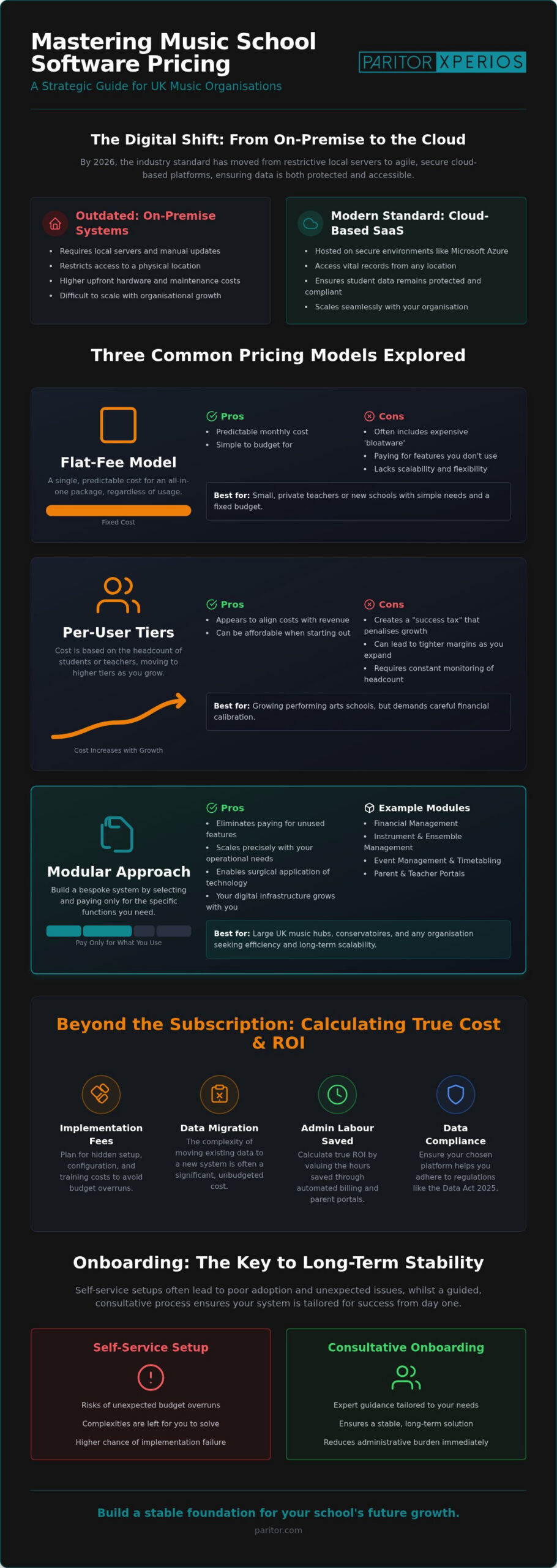
The digital landscape for UK music education has shifted dramatically over the last decade. Legacy on-premise systems, which required local servers and manual updates, have largely been replaced by agile Software as a Service (SaaS) platforms. By 2026, the industry standard has moved towards cloud-based management hosted on secure environments like Microsoft Azure. This shift ensures that student data remains protected whilst allowing administrators to access vital records from any location. Understanding the various software business models is now a core competency for school leaders who want to modernise their operations without overextending their budgets.
UK music services have unique requirements that general studio management tools often overlook. A standard dance or sports school might only need a simple register, but a music hub must manage instrument inventories, ensemble schedules, and complex tutor billing. Because of this complexity, music school software pricing models UK generally fall into three categories: flat-fee, per-user, and modular. Each has distinct implications for your long-term financial health and administrative workload.
The Flat-Fee Model: Simplicity vs Scalability
Flat-fee pricing offers a single, predictable cost for all features regardless of how much you use the system. For small private teachers or nascent schools, this predictability provides a sense of security. You know exactly what’s leaving the bank account each month. However, these “all-in-one” packages frequently include bloatware. You’ll often find yourself paying for advanced exam management or instrument tracking modules that your organisation doesn’t actually require. It’s a simple approach, but it lacks the precision needed for efficient resource allocation as your service evolves.
Per-User and Per-Student Tiers
Many providers utilise tiered pricing based on your total headcount of students or teachers. As your pupil base expands, you move into higher cost brackets. This model is popular amongst growing performing arts schools because it appears to align costs with current revenue. Yet, it can inadvertently create a “success tax.” When your school thrives and student numbers spike, your software costs climb automatically. If your tuition fees aren’t perfectly calibrated to absorb these jumps, growth can actually lead to tighter margins. It’s a model that demands constant monitoring to ensure that your expanding student body doesn’t result in an unsustainable administrative bill.
The Modular Approach: Paying Only for What You Use
The flat-fee and per-user models often force a compromise between simplicity and cost. A modular approach, however, allows your organisation to build a bespoke system that fits your specific operational footprint. Instead of paying for a rigid bundle of features you might never touch, you select only the components you need, such as Financial Management or Event Management. This strategy reflects the evolving EdTech business models that prioritise user flexibility and institutional efficiency. This modular structure is a core component of modern music school software pricing models UK, designed to eliminate the all-or-nothing approach that often leads to budget fatigue.
For large UK music hubs and conservatoires, modularity is the professional standard. It provides the ability to scale up during busy periods or disable specific functions for smaller departments. Whilst competitors often push “all-in-one” bundles that result in expensive bloatware, Xperios allows for a more surgical application of technology. You can start with a core foundation and add specialised modules as your service matures. This level of granularity ensures your digital infrastructure grows alongside your organisation without unnecessary financial strain.
Tuition and Scheduling Modules
Managing a team of peripatetic teachers requires precise coordination. With a dedicated tuition module, you can automate complex timetabling without the overhead of a full event management suite. This reduces the administrative labour cost per pupil, as the software handles the repetitive task of matching teachers with available slots. Integrating this with a Teacher Portal or Student Portal ensures that communication is seamless. It’s about restoring focus to the lesson itself rather than the logistics surrounding it. When evaluating music school software pricing models UK, the ability to automate these specific workflows often provides the fastest return on investment.
Specialist Modules: Instruments and Ensembles
Many organisations struggle with tracking assets across multiple schools or venues. Utilising a dedicated instrument inventory management software module allows you to oversee hire schemes, schedule repairs, and monitor asset health in real-time. Similarly, managing an orchestra or choir requires specific ensemble management tools that a standard private teacher wouldn’t need.
- Track instrument condition and location across the county.
- Automate hire billing and late return notifications.
- Coordinate ensemble rehearsals and attendance registers.
By separating these specialist tasks into distinct modules, you ensure that your budget is always working for you. You don’t pay for ensemble tools if you only offer one-to-one tuition. This level of clarity is why many organisations choose to partner with Xperios to build a more efficient administrative engine.
Uncovering Hidden Costs: Implementation and Integration
Many providers lure you in with a low monthly rate, but the real complexity starts on day one. Implementation fees represent the professional labour required to translate your existing workflows into a digital environment. For organisations with decades of paper-based or legacy records, this process is vital. It involves more than just a data dump; it’s a strategic reconfiguration of how your school operates. When analysing music school software pricing models UK, you must look beyond the subscription to the one-time costs that ensure a stable launch.
Training and support are the final pieces of the puzzle. A system is only as good as the people using it. Investing in professional training ensures that your team feels empowered rather than overwhelmed. It’s the difference between a tool that sits idle and a platform that drives institutional efficiency. This consultative approach prevents staff from reverting to manual spreadsheets, which is where true ROI is often lost.
Data Migration and GDPR Compliance
Moving records for thousands of pupils requires precision. Manual entry is a recipe for error and a massive drain on staff time. Professional migration ensures every student profile, financial history, and assessment record is mapped correctly from your legacy system. Security is paramount. By hosting on Microsoft Azure, we ensure data residency and redundancy that meets the highest UK standards. This protects you against the reputational and financial risks of data breaches whilst ensuring you remain compliant with the latest data protection regulations without extra hidden costs.
Third-Party Software Integrations
A music school doesn’t exist in a vacuum. Your management platform must talk to your accounting tools. Whether you use Xero, Sage, or a bespoke local authority financial system, seamless integration reduces manual double-entry. This is where API access becomes a critical part of music school software pricing models UK. Whilst some might view API fees as an extra, they pay for themselves by eliminating hours of reconcilement work every week. Eligible smaller organisations may also find financial assistance through the UK Government’s Help to Grow Scheme, which can significantly lower the barrier to adopting advanced digital tools that automate your reporting.
Evaluating ROI: Beyond the Monthly Subscription
True value isn’t found in the lowest price tag. It’s found in the hours reclaimed by your team and the financial stability gained through automated workflows. When you analyse music school software pricing models UK, the subscription fee is only one part of the equation. The real return on investment (ROI) comes from eliminating the manual labour that currently drains your budget. By centralising your data, you prevent expensive errors like double-booked rehearsal spaces or forgotten instrument hire fees which represent direct financial losses to your service.
Financial Automation and Invoicing
Manual invoicing is slow. It’s prone to human error and relies on administrative staff spending their valuable time chasing late payments. By using automated billing cycles linked to Bacs or Direct Debit, you ensure that fee collection happens whilst you sleep. Real-time financial reporting allows music service leads to see exactly where their revenue stands without waiting for end-of-month reconciliations. The most significant saving often comes from reducing “the chase.” Automated reminders for overdue fees significantly improve cash flow, often paying for the software subscription through recovered late payments alone. This financial precision allows you to plan your 2026 budget with total confidence.
Reclaiming Teacher and Administrator Time
The true goal of music service management software is to shift the focus from paperwork to pedagogy. Every hour an administrator spends manually updating a spreadsheet or tracking down a missing violin is an hour lost to educational development. By implementing a parent portal for music schools, you empower families to handle their own data. Self-service portals for registrations, payments, and timetable checks reduce the volume of enquiries hitting the central office.
Typical UK music hubs report that centralising these functions can reclaim over 15 hours of administrative time every week. This isn’t just about efficiency; it’s about creating a calmer, more professional environment for your staff and students alike. When you compare different music school software pricing models UK, you must weigh the upfront cost against these long-term efficiency gains. To see how these reclaimed hours can transform your organisation, you can explore our specialised Xperios modules and find a configuration that fits your specific needs.
Choosing the Right Model for Your UK Music Organisation
Deciding between various music school software pricing models UK requires a clear understanding of your long-term goals. Whilst a small private studio might prioritise the simplicity of a flat-fee system, larger music hubs and services benefit most from the precision of modularity. This structure allows you to allocate your budget where it has the most impact, whether that’s in financial automation or instrument tracking. A modular system ensures you never pay for features that remain untouched in your dashboard, avoiding the common trap of expensive bloatware.
Success in the digital transition depends heavily on the onboarding process. A self-service setup often leaves complex organisations with gaps in their data or inefficient workflows that cost more in the long run. A consultative approach is essential. It ensures the software is tailored to your specific reporting needs and local authority requirements. This partnership allows you to modernise your music service with the confidence that your system is built on over 30 years of industry expertise.
Decision Checklist for Music Hubs and Services
Before committing to a vendor, use this checklist to evaluate their suitability for the UK sector:
- UK Standards: Does the provider demonstrate full compliance with the Data (Use and Access) Act 2025 and UK GDPR?
- Specialist Functions: Can the platform handle complex ensemble management alongside your core 1-to-1 tuition?
- Scalability: Will the pricing model penalise your growth, or does it offer the flexibility to scale costs alongside student numbers?
- Local Integration: Can the system connect seamlessly with your existing local authority financial tools like Xero or Sage?
Next Steps: Arranging a Personalised Demo
A generic walkthrough rarely reveals how a system will handle your specific administrative burdens. Arranging a personalised demo is the only way to see modular pricing in action and understand your true Total Cost of Ownership. Before your session, gather your current student numbers, teacher headcounts, and a list of your most time-consuming manual tasks. This preparation allows the vendor to build a bespoke quote that reflects your actual usage rather than a best-guess estimate.
Reclaiming your focus from paperwork starts with a consultation. By choosing a system designed specifically for the UK music education sector, you ensure your organisation remains stable and professional for years to come. We invite you to contact the Paritor team today to arrange your demonstration and discover how Xperios can transform your administrative engine into a source of institutional growth.
Reclaiming Focus for Your Educational Mission
Choosing between various music school software pricing models UK is a strategic decision that shapes your organisation’s financial health and administrative efficiency. Throughout this guide, we’ve highlighted how a modular approach eliminates expensive bloatware and how automated financial workflows turn reclaimed time into a tangible return on investment. By prioritising transparency during implementation and security in hosting, you can move away from the taxing nature of manual spreadsheets and return your focus to creative excellence.
As a seasoned industry veteran with over 30 years of music education expertise, Paritor remains the trusted choice for UK Conservatoires and Music Hubs. Our ISO 27001 certified data security and Microsoft Azure hosting provide the institutional safety your organisation demands in 2026. It’s time to empower your staff with a platform built specifically to eliminate repetitive burdens and support long-term growth. Explore Xperios Pricing and Arrange Your Bespoke Demo today to start your journey toward a more modern, streamlined service. We look forward to partnering with you to ensure your digital transition is both seamless and empowering.
Frequently Asked Questions
What is the average cost of music school software in the UK?
Average costs vary significantly depending on the chosen music school software pricing models UK. Small private teachers might find flat rates around £10 to £40 per month, whilst large organisations with hundreds of students often require bespoke SaaS subscriptions. These costs typically scale with your headcount or the complexity of the modules you select. It’s essential to look beyond the initial monthly fee to understand the total cost of ownership over several years.
Do most pricing models include data migration fees?
Professional data migration is usually a one-time implementation fee rather than being included in the monthly subscription. For large-scale organisations, this fee covers the technical labour required to map legacy records into a secure, GDPR-compliant cloud environment. Whilst manual entry might seem cheaper for very small schools, the risk of error and the administrative labour involved often make professional migration the more cost-effective choice for established music services.
Can I change my pricing tier as my music school grows?
Yes, tiered SaaS models are built specifically to grow alongside your organisation. As your student base or teacher headcount expands, you can move into higher tiers or add new modules, such as Ensemble Management. This flexibility ensures that your digital infrastructure remains stable without requiring a complete system overhaul. Choosing a modular platform allows you to scale specific functional areas independently, ensuring you only pay for the additional capacity when you actually need it.
Is there a difference in pricing for non-profit music hubs vs private schools?
Pricing is typically dictated by the volume of students and the specific functional modules required rather than the organisation’s non-profit or private status. However, large music hubs often have more complex needs, such as Instrument Management for hire schemes, which requires different modules than a standard private school. Most providers offer tiered structures that accommodate both the lean operations of private teachers and the high-volume requirements of county-wide music services.
Are there hidden costs associated with parent portals or teacher apps?
Some providers implement “success taxes,” where costs spike as you add more students to your parent or teacher portals. It’s vital to check whether these portals are included as a flat-rate module or if they incur per-user charges. Transparent music school software pricing models UK will clearly outline these costs upfront. Avoiding systems with hidden per-head fees ensures that your budget remains predictable even as your school becomes more popular and successful.
How does modular pricing compare to all-in-one flat fee models?
Modular pricing offers surgical precision, allowing you to pay only for the features your organisation operates. In contrast, all-in-one flat fee models often include “bloatware” or tools you may never utilise. Whilst flat fees offer simplicity for small private teachers, larger hubs find that modular systems provide better long-term value. This approach prevents you from subsidising advanced features that aren’t relevant to your current educational or administrative mission.
What financial integrations should I expect in a UK-specific system?
A UK-specific system should offer seamless integration with common accounting tools like Xero or Sage, alongside automated Bacs and Direct Debit links. These integrations are essential for reducing the administrative burden of manual fee collection and reconciliation. You should also expect the software to handle local authority reporting standards if you operate as part of a wider government service. These automated links are critical for maintaining a healthy cash flow and reducing late payments.
Is staff training usually included in the implementation price?
Structured staff training is almost always part of the professional onboarding and implementation package. This ensures your team is proficient in using modules like Financial Management or Scheduling from day one. Investing in this initial training is vital for maximising your return on investment, as it prevents staff from reverting to inefficient manual spreadsheets. Professional onboarding provides the stable foundation needed to modernise your service and reclaim valuable time for your core educational mission.