

The true cost of a manual music exam entry isn’t the fee itself; it’s the hours of administrative labour lost to spreadsheets and the anxiety of a single data error. Most music leads recognise the sinking feeling when a student is missed or a parent overlooks a notification. Transitioning to dedicated music exam management software isn’t just about digitisation. It’s about reclaiming your department’s creative mission. By moving away from fragmented systems, you eliminate the risk of manual errors whilst ensuring every assessment runs like clockwork.
We know how exhausting it is when paperwork overshadows pedagogy. Managing hundreds of entries across various boards is a logistical nightmare, especially when manual invoicing and communication breakdowns occur. This guide explains how modern cloud-based software automates the complex journey from scheduling to result tracking, all whilst maintaining total data security. We’ll explore how a centralised dashboard and automatic notifications can transform your workflow, alongside the essential role of secure, UK-hosted student records in complying with the latest 2026 data regulations.
Key Takeaways
- Understand how transitioning from fragmented spreadsheets to a unified cloud ecosystem eliminates manual errors and reduces administrative fatigue.
- Discover how integrated portals for teachers, parents, and students create a collaborative environment that automates scheduling and communication.
- Learn why modern music exam management software hosted on Microsoft Azure provides superior data security and UK GDPR compliance compared to legacy systems.
- Compare the total cost of ownership between on-premise servers and scalable cloud subscriptions to ensure long-term financial efficiency.
- Explore the modular journey of the Xperios Exams and Assessments Module, allowing your organisation to scale from assessment management to full hub operations.
The Evolution of Music Exam Management Software
Modern music exam management software is far more than a digital filing cabinet. It is a unified cloud ecosystem that synchronises every moving part of the assessment process. For decades, music services relied on a patchwork of paper entries and local spreadsheets. Whilst these tools were once sufficient, the complexity of modern music education demands a more robust approach. Just as the development of music notation software revolutionised the way educators create and share scores, cloud-based management platforms are now doing the same for the administrative backbone of music schools. Centralisation is no longer a luxury; it is a critical requirement to meet the national music hub standards of 2026, especially regarding Arts Council England reporting requirements.
Why Manual Systems Are Failing Modern Hubs
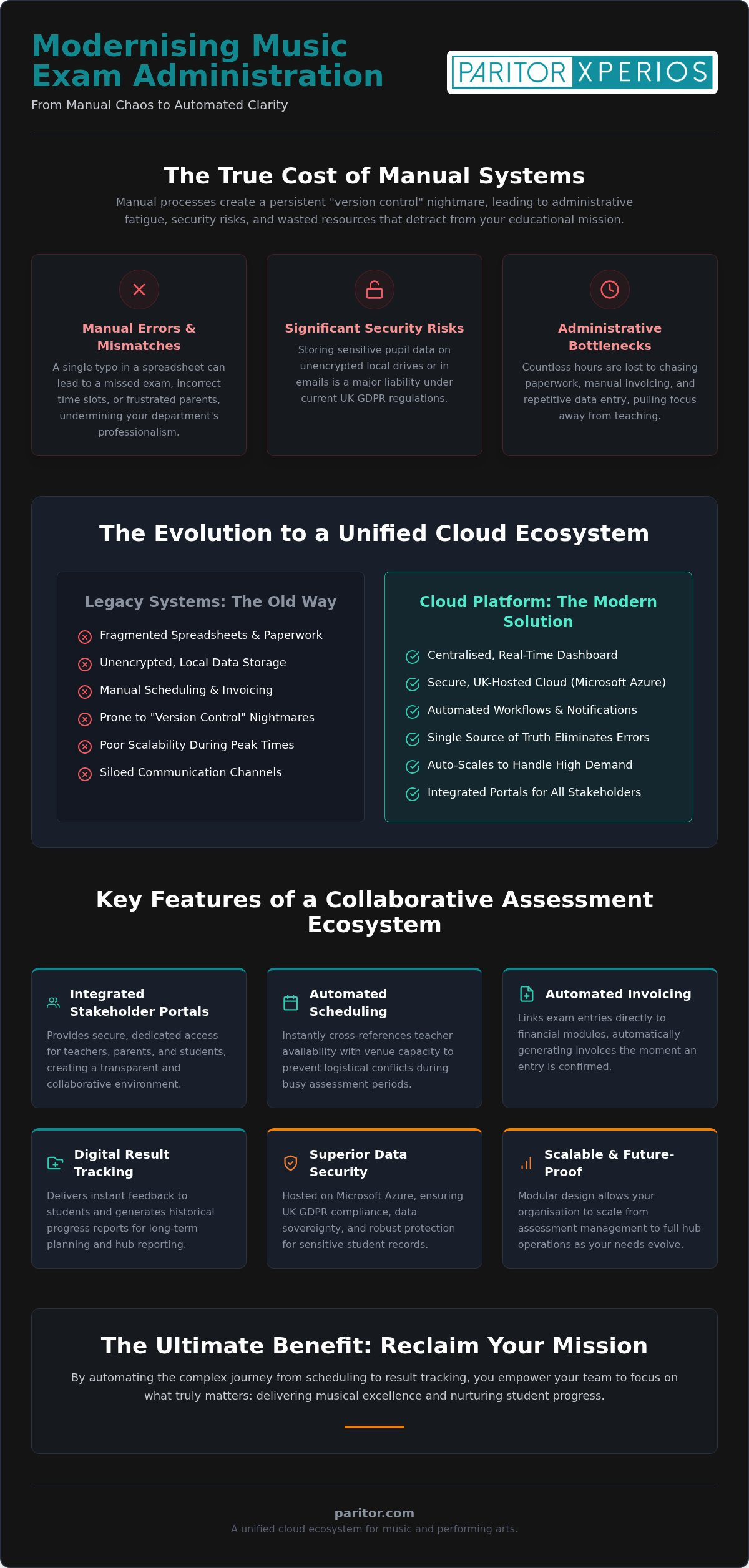
Manual systems create a persistent “version control” nightmare. When multiple administrators update a shared spreadsheet, errors are inevitable. A single typo can lead to a missed exam entry or a student being allocated the wrong time slot. Beyond simple mistakes, there are grave security risks. Storing sensitive pupil data on unencrypted local drives or emailing spreadsheets between staff is a significant liability under current UK GDPR regulations. These administrative bottlenecks don’t just create extra work. They delay pupil progress and frustrate parents who expect professional, timely communication. It’s a taxing way to work that pulls focus away from your primary educational mission. Moving to a centralised platform provides immediate relief from these repetitive burdens.
The Core Benefits of a Cloud-First Approach
Adopting a cloud-first strategy provides a sense of empowerment for the entire team. Peripatetic teachers often work across multiple sites, making traditional office-based systems impractical. With a cloud-based solution, they can access real-time assessment data from their tablet or smartphone whilst moving between schools. This ensures they always have the most current schedule at their fingertips. Scalability is another vital advantage. Music services experience seasonal spikes in exam entries that can cause legacy hardware to lag or crash. Cloud systems scale automatically to handle the load without any reduction in performance. Additionally, automated backups ensure that student records and assessment histories are never lost. It’s a stable, reassuring presence that allows your team to focus on musical excellence rather than data recovery or paperwork.
Key Features of a Collaborative Assessment Ecosystem
A high-functioning music department relies on synergy between administrators, educators, and families. High-quality music exam management software provides the digital glue that holds these relationships together. By integrating portals for every stakeholder, the software transforms a traditionally siloed process into a transparent, shared journey. Automated scheduling tools take the headache out of logistics by instantly cross-referencing teacher availability with venue capacity. This ensures that no two exams are booked in the same room at the same time, providing a sense of calm during busy assessment periods. It’s about creating a stable environment where everyone knows exactly where they need to be.
The financial side of assessments is often the most taxing for administrators. Modern platforms solve this by linking exam entries directly to financial modules. This allows for automated invoicing the moment an entry is confirmed. Digital result tracking then closes the loop, providing instant feedback to students and generating historical progress reports for the hub. This data-driven approach ensures that no student’s achievement is lost in a paper trail, allowing for better long-term planning and resource allocation.
Streamlining the Exam Entry Workflow
Teachers are often the ones burdened with the initial data entry for exams. Modern systems empower them to submit entries directly through a secure portal, which significantly reduces the workload for central office staff. These platforms include automated validation checks to ensure accuracy. For instance, the software can verify if a student has passed the necessary prerequisites before allowing a higher-grade entry. This logic-driven approach is particularly effective when used alongside ensemble management software, as it allows hubs to track a student’s progress across both individual lessons and group performances. As institutions increasingly offer Remote Exams, having a system that can manage both physical and digital assessment paths becomes essential for modern education standards.
Enhancing Stakeholder Communication
Communication breakdowns are a primary source of stress for parents and teachers alike. Automated notifications via email and SMS ensure that exam times, venue details, and preparation requirements are delivered directly to the right people. Parents can use a dedicated parent portal for music schools to view their child’s schedule and make secure fee payments. This eliminates the need for manual invoicing and the awkward task of chasing late payments. For students, the system provides a digital record of achievement that celebrates their progress and clearly outlines their upcoming goals. It’s a professional way to manage expectations and celebrate success. If you’re looking to modernise your department, you might explore our modular assessment tools to see how they fit your specific needs.
Cloud vs. Legacy Exam Admin: A Comparison
Choosing between maintaining local servers and adopting a cloud subscription is a pivotal decision for any modern music hub. On-premise systems carry hidden costs, including hardware maintenance, electricity, and the constant need for manual backups. In contrast, cloud-based music exam management software offers a predictable monthly cost that includes security, storage, and support. This shift removes the financial burden of unexpected hardware failures and allows for more accurate long-term budgeting. By moving to the cloud, organisations transition from being hardware owners to service users, which significantly lowers the total cost of ownership.
Security standards also differ vastly between the two models. Local IT departments often lack the resources to match the multi-layered protection of enterprise-grade platforms like Microsoft Azure. Cloud solutions provide robust encryption and automated regulatory patches that deploy the moment a new threat is identified. This speed is impossible with legacy systems, where updates often require manual installation across every local machine. Beyond technical safety, there is a human element. Removing the repetitive, soul-crushing labour of manual data entry improves staff morale. When administrators are freed from spreadsheets, they can focus on student engagement, which directly impacts staff retention and institutional growth.
Calculating ROI and Time Savings
Measuring the return on investment starts with the reduction in admin hours per exam cycle. When you implement comprehensive music service management software, you effectively eliminate the need for dedicated internal IT support for your assessment tools. The financial benefits extend to your cash flow. Integrated billing modules reduce the incidence of late payments by providing parents with immediate, secure payment links. This automation ensures that fees are collected before the exam takes place, protecting the hub’s financial stability whilst reducing the time spent chasing arrears.
Reliability and Institutional Peace of Mind
During peak assessment periods, system downtime isn’t just an inconvenience; it’s a crisis. Legacy systems are prone to single point of failure risks, where a local server crash can halt operations for days. Cloud-based platforms offer 99.9% uptime, backed by 24/7 monitoring and data redundancy. This means that even if one server node fails, another takes over instantly without the user noticing. This level of reliability provides institutional peace of mind, ensuring that your team can deliver a professional service to students and parents without the constant fear of a technical breakdown.
Security, GDPR, and Data Sovereignty in 2026
Transitioning away from legacy Local Authority systems can feel like a daunting leap. Many music hubs still rely on outdated databases that lack modern security protocols, making them vulnerable to contemporary cyber threats. Professional music exam management software provides a secure path forward by ensuring all sensitive pupil records are stored in UK-based data centres. This commitment to national data sovereignty is essential for institutional safety. It guarantees that your data remains within the UK legal jurisdiction, providing a stable foundation for your administrative operations.
Compliance is a moving target. With the Children’s Wellbeing and Schools Act (CWSA) 2026 and the Data Use and Access Act (DUAA) 2025 now in full effect, the standards for handling children’s personal information have never been higher. Xperios ensures total compliance with these latest UK GDPR standards, incorporating the ICO’s updated 2026 guidance into its core architecture. Protecting these records requires more than just a password. Implementing multi-factor authentication (MFA) adds a vital layer of security, ensuring that only authorised personnel can access sensitive assessment data. It’s about building a trustworthy atmosphere where parents feel their children’s information is safe.
The Microsoft Azure Hosting Standard
Choosing world-class infrastructure is the only way to ensure long-term reliability. Xperios is hosted on Microsoft Azure, providing music hubs with the same level of security used by global financial institutions. This cloud-first approach offers built-in data redundancy, meaning your information is mirrored across multiple secure locations. If a hardware failure occurs, disaster recovery protocols trigger instantly to prevent data loss. You also benefit from continuous, automated security patching. Instead of waiting for a manual update, the system evolves in real-time to counter emerging vulnerabilities, allowing you to focus on education rather than IT maintenance.
Safe and Smooth Data Migration
Moving data from a legacy database to the cloud requires a structured framework to ensure nothing is lost in translation. We provide a clear onboarding process that prioritises data integrity during the implementation phase. This involves cleansing old records and mapping them accurately to the new system. Once the migration is complete, you can set granular user permissions. This allows you to control exactly who sees what, from peripatetic teachers viewing their own schedules to senior leads accessing financial reports. If you are ready to secure your department’s future, book a security consultation to discuss your migration needs.
Evolving Your Organisation with Xperios
The Xperios Exams and Assessments Module stands as the industry standard for organisations ready to leave administrative chaos behind. It isn’t just a tool; it’s a reflection of over 30 years of partnership with the UK music education sector. Since our founding in 1993, we’ve refined our platform based on direct feedback from music service leads and administrators. This collaborative history ensures that our music exam management software addresses the specific, lived frustrations of your department. Adopting Xperios marks the start of an “Evolve” journey. You move from reactive firefighting to a state of professional excellence where your systems support your goals rather than hindering them.
Our modular philosophy means you don’t have to change everything overnight. You can begin by streamlining your assessment logistics and then scale at a pace that suits your team. This flexibility allows you to build a bespoke management environment that grows alongside your hub’s ambitions. It provides a sense of relief to know that as your service expands, your software is already prepared to handle the increased complexity.
Specialised Modules for Comprehensive Management
The power of a modular system lies in its ability to connect every facet of your service. Beyond exams, you can integrate instrument inventory management software to track assets with precision. This connectivity is vital for meeting the rigorous reporting requirements of funding bodies like Arts Council England in 2026. Instead of spending weeks collating data from various sources, you can generate real-time reports with a few clicks. Whether you’re managing large-scale events or ensemble scheduling, the system ensures that every resource is optimised and every student’s journey is documented. It allows you to organise your data with institutional confidence.
Your Partner in Modernisation
Choosing a platform is as much about the support as it is about the technology. We act as a dedicated ally, providing UK-based training programmes and ongoing support to ensure your team feels confident and empowered. When you adopt Xperios, you join a community of forward-thinking music services committed to modernisation and efficiency. We don’t just provide software; we facilitate progress. The next step in your professional journey is simple. You can request a consultative demonstration of Xperios to see exactly how our music exam management software can be tailored to your organisation’s unique needs.
Secure Your Department’s Future Excellence
Modernising your assessment logistics is a vital step toward reclaiming your time and focusing on musical standards. You’ve seen how a unified cloud ecosystem eliminates manual errors whilst ensuring your data remains secure within the UK. By moving away from fragmented spreadsheets, you empower your staff and provide parents with the professional service they expect. It’s a transition that replaces administrative anxiety with institutional confidence.
Adopting the right music exam management software transforms the way you interact with every stakeholder. It’s about more than just digital entries; it’s about building a reliable, collaborative environment. Xperios is designed specifically for music education and hosted on Microsoft Azure, providing a stable and UK GDPR compliant foundation for your hub. This infrastructure ensures that your data is protected by world-class security protocols, allowing you to focus on your primary educational mission.
Evolve your music service with Xperios cloud management and join a community of organisations prioritising professional administration. Your journey from administrative burden to creative focus starts today. We’re here to help you every step of the way.
Frequently Asked Questions
What is the best way to manage music exam entries for a large hub?
The most efficient method for a large hub is to adopt a centralised music exam management software ecosystem. Using the Xperios Exams and Assessments Module replaces fragmented spreadsheets with a single source of truth. This allows your administrative team to manage hundreds of entries simultaneously without the risk of version control errors. It also provides a clear audit trail for every entry, ensuring that no student is missed during the busy assessment season.
How does cloud software improve music exam scheduling?
Cloud-based solutions improve scheduling by automating the logistical cross-referencing of teachers, venues, and student availability. Instead of manual calendar checks, the system identifies potential clashes instantly. It accounts for complex requirements, such as specific piano needs or travel time between sites for peripatetic staff. This creates a stable and predictable timetable, reducing the stress on your administrative team whilst ensuring that venues are utilised at their maximum efficiency.
Is student data secure in a cloud-based exam management system?
Security is a primary priority in modern systems. Student data is protected by enterprise-grade encryption and multi-factor authentication when hosted on platforms like Microsoft Azure. By utilising UK-based data centres, Xperios ensures national data sovereignty. This is a significant upgrade from legacy local drives, as it includes continuous monitoring and automated disaster recovery protocols. You can rest assured that sensitive pupil records are guarded by the same standards used by global financial institutions.
Can music exam software integrate with our existing financial systems?
Integration is a core feature of professional platforms. Our Xperios Financial Management module is designed to link directly with third-party accounting software or local authority systems. This connectivity ensures that when a teacher submits an exam entry, the system can automatically generate the correct invoice. It streamlines the entire payment lifecycle, reducing the need for manual data entry and minimising the risk of financial discrepancies across your organisation’s different departments.
Does the software handle UK GDPR compliance for student records?
Yes, the platform is specifically designed to meet the rigorous standards of UK GDPR. We incorporate the latest 2026 regulatory requirements, including those from the Children’s Wellbeing and Schools Act. The system manages granular user permissions, ensuring that only authorised staff can view sensitive student records. By hosting data in the UK and following ICO guidance, the software provides a robust framework for institutional compliance and parent peace of mind.
What happens to our old data when we switch to a cloud system?
Your legacy data is managed through a professional implementation and onboarding process. We provide a structured framework for migrating records from outdated databases or spreadsheets into the Xperios cloud environment. This service includes data cleansing and mapping to ensure integrity is maintained during the transition. Moving to music exam management software doesn’t mean losing your history; it means making your historical assessment data more accessible and secure for future reporting.
Can peripatetic teachers access the exam management system on their phones?
Peripatetic teachers can easily access the system via the Xperios Teacher Portal on their smartphones or tablets. This mobile-first design allows staff to view real-time schedules and submit assessment entries whilst they are on the move between different schools. It eliminates the need for paper-based records or returning to a central office to update data. This flexibility empowers teachers to focus on their pupils rather than being tethered to a desktop computer.
Does the software support instrument loan tracking alongside exams?
Asset tracking is fully supported through our specialised Xperios Instrument Management module. This allows your hub to manage instrument loans, maintenance schedules, and inventory levels within the same unified platform as your exams. Having a single ecosystem for both assessments and assets provides a comprehensive view of each student’s journey. It ensures that administrators can quickly verify if a student has the correct equipment assigned before they sit their practical examinations.