

What if your end of year financial reporting felt less like a deadline crisis and more like a strategic victory? You already know that chasing peripatetic teachers for data and manually correcting spreadsheet errors is a drain on your creative mission. It’s frustrating to lose hours tracking instrument hire fees or ensemble subscriptions when you should be focusing on student progress. Implementing dedicated financial management software for music services transforms this administrative burden into a streamlined, automated process that works quietly in the background.
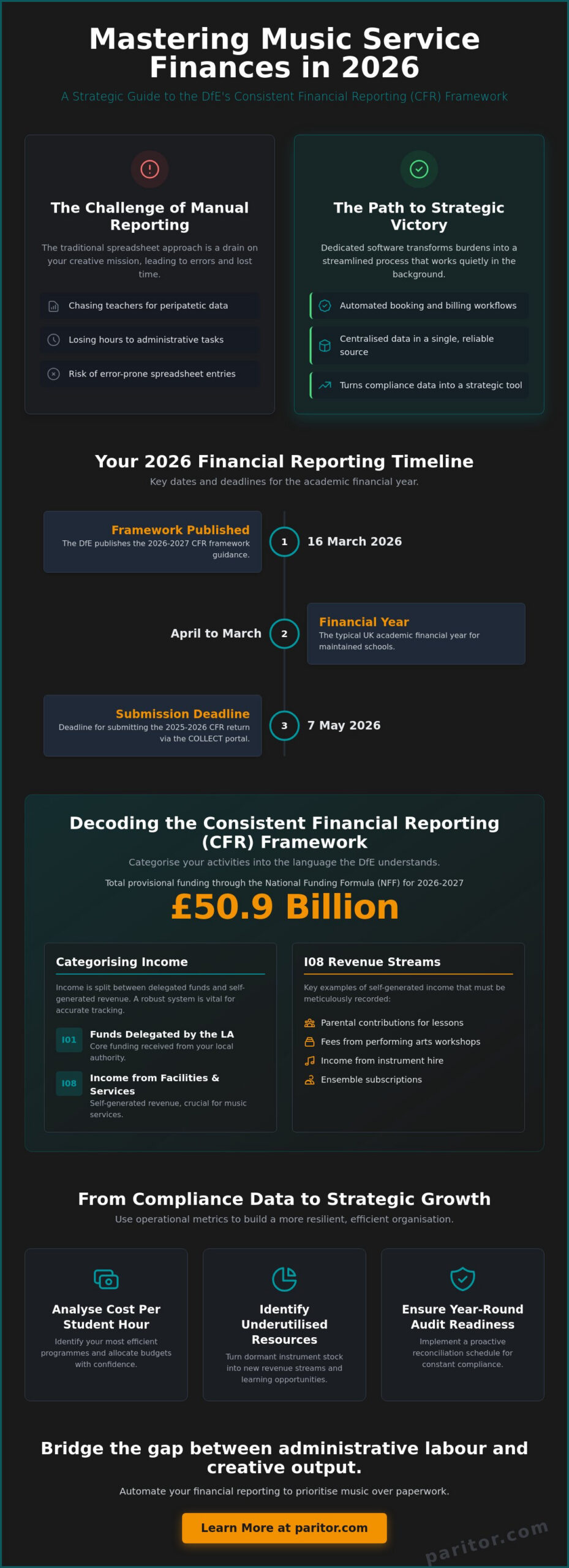
This guide helps you master the complexities of school financial reporting, ensuring you meet the latest DfE standards whilst reclaiming your time. We’ll explore the 2026-2027 Consistent Financial Reporting (CFR) framework, published on 16 March 2026, and show you how to automate non-standard income tracking for better departmental visibility. From meeting the 7 May 2026 submission deadline to improving your long-term ROI, you’ll discover how to build a more resilient, efficient organisation that prioritises music over paperwork.
Key Takeaways
- Master the 2026 Consistent Financial Reporting (CFR) framework using specific I-codes and E-codes tailored for music education.
- Discover how financial management software for music services replaces error-prone spreadsheets with automated booking and billing workflows.
- Identify the key operational metrics, such as cost per student hour, that turn compliance data into a strategic growth tool.
- Implement a proactive reconciliation schedule to ensure your organisation is audit-ready throughout the year.
- Bridge the gap between administrative labour and creative output by centralising your financial data into a single, reliable source.
The Fundamentals of Financial Reporting for Schools in 2026
Financial reporting is the backbone of any healthy educational organisation. It’s the systematic process of recording, categorising, and analysing every bit of income and expenditure that flows through your service. In 2026, the landscape has shifted toward a model of total transparency. The Department for Education (DfE) now expects more frequent, real-time data sharing to ensure that every pound is accounted for and effectively utilised. This evolution means that manual, retrospective reporting is no longer enough to keep pace with regulatory expectations.
Understanding these requirements often starts with a grasp of Governmental accounting principles. These standards ensure public funds are managed with integrity, which is particularly vital for music hubs maintaining charitable status or local authority funding. The reports you generate serve a wide range of stakeholders. Governors, trustees, local authorities, and the DfE all rely on this data to assess the health and viability of your programmes. Implementing dedicated financial management software for music services ensures these complex data points are accurate and accessible, rather than buried in fragmented files.
Why Accurate Reporting is Essential for Educational Growth
Accurate reporting isn’t just a compliance hurdle; it’s a catalyst for growth. When you have a clear view of your financial health, you can allocate budgets for the next academic year with absolute confidence. This level of sustainability allows you to plan ambitious projects without the fear of hidden deficits. Transparency also builds vital trust amongst parents and community stakeholders, proving that their contributions are being used wisely. Beyond the balance sheet, detailed reporting identifies underutilised resources. You might discover dormant instrument stock that could be refurbished and hired out, turning a dusty cupboard into a new revenue stream and a learning opportunity for a child.
Key Financial Reporting Deadlines to Organise
Staying organised requires a sharp focus on the calendar. For maintained schools, the UK academic financial year typically runs from April to March. A critical milestone is Thursday, 7 May 2026, which is the deadline for submitting the 2025-2026 Consistent Financial Reporting (CFR) return via the COLLECT portal. Academy accounts returns follow their own specific cycles, requiring meticulous preparation. Modern financial management software for music services automates the data collection process, so you don’t face an end-of-year rush. Following recent regulatory closures, the transition of all activities to the DfE means that your reporting must be sharper and more integrated than ever before to ensure continued funding and operational stability.
Navigating the Consistent Financial Reporting (CFR) Framework
The Consistent Financial Reporting (CFR) framework is the mandatory standard for collecting financial data across maintained schools in the UK. For the 2026-2027 financial year, the guidance published on 16 March 2026 provides the template for your income and expenditure reporting. Whilst the raw code lists can feel overwhelming, they’re simply a way to categorise your activities into a language the Department for Education (DfE) understands. Using financial management software for music services allows you to map your daily transactions directly to these codes, removing the guesswork from your year-end returns.
The 2026 updates place a stronger emphasis on the transparency of teachers’ pay grants and pension reporting. With total provisional funding through the National Funding Formula (NFF) reaching £50.9 billion for 2026-2027, the DfE requires granular detail to ensure these funds reach the frontline of education. At the close of the academic year, you must provide a summary of your school’s financial position, which includes any balances carried forward. This snapshot proves your service’s stability and readiness for the next term.
Categorising Income: From Delegated Funds to Private Fees
Income is split between funds delegated by your local authority and self-generated revenue. For a music service, this distinction is vital. You’ll likely manage a mix of I01 (Funds delegated by the LA) and I08 (Income from facilities and services), which includes private tuition fees. Tracking these accurately requires a robust system to record:
- Parental contributions for individual or group music lessons.
- Fees from performing arts workshops across different Key Stages.
- Income from instrument hire and ensemble subscriptions.
Don’t overlook “Z-codes.” While these aren’t part of the core CFR return, they’re essential for your internal audit trail and non-CFR reporting requirements. Capturing this data ensures you have a 360-degree view of your cash flow. If you find the manual categorisation of these streams taxing, exploring specialised financial tools can help automate the split between delegated and private funds.
Managing Expenditure: Staffing, Premises, and Resources
Expenditure reporting often presents the biggest challenge, especially when balancing peripatetic teacher costs against permanent staff. Peripatetic instructors are usually recorded under E03 (Education support staff), while permanent music teachers fall under E01. Correct attribution is key; misallocating these costs can skew your budget analysis and impact future funding bids. You also need to be precise with E20 (ICT learning resources), ensuring that music-specific software and digital equipment are correctly logged. By accurately attributing “back-office” administrative costs (E05) rather than letting them bleed into educational delivery codes, you maintain a true reflection of your departmental efficiency. Modern financial management software for music services simplifies this by tagging expenses at the point of purchase.
Beyond Compliance: Operational Financial Metrics that Matter
Regulatory compliance is the floor, not the ceiling. Whilst meeting DfE standards is non-negotiable for your continued operation, these reports don’t always provide the granular insights needed to grow a thriving music hub. To move from survival to strategy, you must look at operational metrics that reflect the true health of your service. One of the most transformative KPIs is the “cost per student hour.” By calculating the total delivery cost, including teacher pay, venue hire, and travel, against actual contact time, you can identify which programmes are sustainable and which require a different subsidy model.
Attendance tracking plays a vital role in revenue protection. Inaccurate registers often lead to missed billing opportunities or shaky funding justifications. If you cannot prove a student’s participation, defending your income streams during an audit becomes significantly harder. Integrating your registers with financial management software for music services ensures that every session delivered is a session accounted for. This link protects your cash flow and provides the hard evidence needed to justify your budget to local authorities or trustees.
Tracking Instrument Inventory and Asset Value
Your instrument collection is likely your largest physical asset, yet it’s often the most poorly tracked. Unrecorded loans, missed repair cycles, and “lost” stock represent hidden costs that drain school budgets every term. Reporting on the ROI of your instrument hire schemes allows you to justify new capital spend to your governors. You can demonstrate exactly how much income a specific set of violins has generated versus their maintenance cost. Utilising instrument inventory management software simplifies this process, allowing you to track depreciation and plan for future purchases with precision. This proactive approach turns a logistical headache into a clear financial asset on your balance sheet.
Revenue Leakage: Reducing Late Payments and Bad Debt
Revenue leakage is a common frustration in performing arts and music education. It usually stems from manual errors, forgotten invoices, or a lack of follow-up on aged debtors. When you rely on fragmented spreadsheets, it’s easy for a few missed ensemble fees to snowball into significant bad debt. Real-time reporting on aged debtors provides immediate visibility into your cash flow, allowing you to address late payments before they impact your seasonal activities. By using financial management software for music services, you can automate the flow from booking to billing. This ensures that invoices are sent the moment a student enrols, reducing the administrative labour of manual chasing and ensuring no fees are ever missed.
Best Practices for Accurate and Efficient School Financial Audits
Establishing a robust audit trail isn’t just about keeping the regulators happy; it’s about protecting the integrity of your music service. This journey begins the moment a student enrols in a programme. Every interaction, from the initial booking to the final payment, must be captured in a centralised data repository. Relying on financial management software for music services allows you to build this trail automatically, ensuring that no transaction is left unaccounted for when the external auditors arrive. This level of organisation transforms the audit from a period of high stress into a routine validation of your professional standards.
Regular monthly reconciliations are the best defence against the end-of-year panic. Waiting until the final weeks of the academic year to balance your books significantly increases the risk of manual errors and missed data. By reviewing your income and expenditure every four weeks, you can identify and resolve discrepancies in real-time. This practice ensures your internal controls are working effectively, providing a layer of accountability that prevents financial mismanagement before it can take root. It’s much easier to fix a small coding error in October than to hunt for it during the May submission rush.
Organising Data for Seamless Year-End Submissions
Cleaning your data is a vital step before generating your final report. Start by verifying student enrolments against teacher registers to ensure all billable hours are captured accurately. Next, reconcile your bank statements with your internal ledger to catch any unallocated payments or outstanding fees. Maintaining a “single source of truth” for student, teacher, and financial data eliminates the confusion of multiple, conflicting spreadsheets. If your hub receives “in-kind” support or donations, ensure these are recorded with the same transparency as cash transactions to provide a complete picture of your service’s total resources.
The Role of GDPR and Data Security in Financial Reporting
Financial records often contain highly sensitive information about minors, making them a primary focus for UK GDPR compliance. Storing this data on unencrypted spreadsheets or in physical paper files creates a significant security risk that your organisation cannot afford. Secure cloud hosting, such as Microsoft Azure, provides the data redundancy and encryption needed to prevent breaches and ensure institutional safety. Automated systems reduce the risk of human error, ensuring that only authorised staff can access sensitive records. To secure your organisation’s future and protect your students, consider adopting Xperios Financial Management to centralise and safeguard your financial reporting.
Modernising School Finance with Automated Management Systems
The most common objection to updating school finance systems is the perceived lack of time. School Business Managers and hub leads often feel that moving away from manual spreadsheets is a task better left for a “quieter period” that never actually arrives. However, the friction of manual data entry is exactly what creates this administrative bottleneck. By adopting Xperios for Music Services, you break this cycle. The system automates the entire journey from the initial student booking to the final invoice, ensuring your records stay current without constant manual intervention.
This shift allows your team to reclaim hundreds of hours previously spent on repetitive tasks. Instead of chasing paper trails, you can focus on high-level strategy and educational impact. Moving towards “live” financial reporting, rather than relying on static annual snapshots, provides a real-time view of your organisation’s health. This visibility enables you to make informed decisions about bursaries, staffing, and expansion exactly when they’re needed, rather than months after the fact. Transitioning to financial management software for music services isn’t just a technical upgrade; it’s a commitment to your service’s professional growth.
Integrating Invoicing with Financial Reporting
When your invoicing is integrated directly with your reporting, accuracy becomes a default setting rather than a goal. Automated invoicing creates instant income reports the moment a transaction occurs. By utilising parent portals, you capture payments at the source, which significantly reduces the labour of administrative chase-ups. This data then maps directly to your required CFR or academy reporting codes. You no longer need to spend days at the end of the financial year manually re-categorising hundreds of private lesson fees or ensemble subscriptions; the software performs the heavy lifting for you.
Choosing the Right Financial Management Partner
Selecting the right platform requires a focus on three core pillars: scalability, security, and deep sector-specific knowledge. A general accounting tool often lacks the nuances required to manage peripatetic teacher schedules or complex instrument hire schemes. Paritor has spent 30 years supporting educational organisations, building tools that understand the specific pressures of music and performing arts delivery. This experience ensures that whilst you modernise your systems, you’re supported by a partner who understands your mission. It’s time to move past the limitations of spreadsheets and embrace a system built for your success. Discover how Xperios can transform your financial reporting and empower your organisation to thrive.
Empowering Your Music Service Through Financial Clarity
Mastering the complexities of the 2026 CFR framework requires moving beyond the limitations of manual spreadsheets. You’ve seen how accurate reporting protects your funding and provides the strategic insight needed for long-term growth. By focusing on operational metrics like cost per student hour and maintaining a rigorous audit trail, you transform compliance from a seasonal burden into a constant tool for organisational success.
Modernising your approach with dedicated financial management software for music services ensures your data is secure and your workflows are seamless. Paritor has been a trusted partner for UK music services for over 30 years, providing a modular system designed specifically for ensembles, instruments, and tuition. With GDPR-compliant hosting on Microsoft Azure, you can focus on your creative mission whilst we handle the heavy lifting of data management and regulatory alignment.
It’s time to reclaim your schedule and lead your organisation with absolute confidence. Streamline your school’s financial reporting with Xperios and experience the relief of a system that works as hard as you do. Your students deserve your full attention; let your technology handle the paperwork.
Frequently Asked Questions
What is the Consistent Financial Reporting (CFR) framework?
The CFR framework is a standard reporting template used by maintained schools and pupil referral units in the UK to document their annual income and expenditure. It provides a uniform structure so the Department for Education can compare financial performance across different institutions. For the 2026-2027 financial year, the guidance published on 16 March 2026 remains the definitive source for categorising your school’s financial activities and ensuring regulatory compliance.
Do academies have to follow the CFR framework in 2026?
No, academies aren’t required to follow the CFR framework; instead, they must adhere to the Academy Trust Handbook and submit the Academies Accounts Return (AAR). Whilst the reporting codes differ slightly from maintained schools, the requirement for transparency and accurate data remains just as high. Academies often find that using financial management software for music services simplifies the process of mapping music-specific income to these broader academy returns.
How often should schools produce financial reports for governors?
Schools should produce financial reports for governors at least six times a year, typically coinciding with each half-term meeting. This frequency ensures that trustees and governors have a “live” view of the budget rather than relying on a single annual snapshot. Regular reporting allows for proactive adjustments to spending, ensuring the organisation remains sustainable and can meet its educational targets throughout the academic year without facing hidden deficits.
What are the most common mistakes in school financial reporting?
The most frequent errors include manual spreadsheet mistakes, miscoding expenditure under the wrong I-codes or E-codes, and failing to reconcile accounts on a monthly basis. These issues often lead to a stressful end-of-year rush and potential discrepancies during an audit. By centralising your data, you eliminate the risk of fragmented records and ensure that every pound is correctly attributed to the right departmental budget from the moment it’s spent.
Can I use general accounting software for music service financial management?
Whilst you can use general accounting software, it often lacks the niche functionality required to manage the unique workflows of a music hub or performing arts service. Standard tools don’t typically handle peripatetic teacher schedules, instrument hire depreciation, or ensemble-specific billing out of the box. Investing in dedicated financial management software for music services ensures these specific administrative burdens are automated, allowing your team to focus on delivery rather than manual workarounds.
How does automated scheduling affect my financial reporting?
Automated scheduling creates a direct link between the teacher’s register and the final invoice, ensuring that every lesson delivered is automatically captured for billing. This integration removes the need for manual data collection from peripatetic staff and significantly reduces revenue leakage. When your schedule and finance systems communicate, your financial reports reflect real-time delivery, providing an accurate and trustworthy picture of your departmental ROI and teacher utilisation.
What is the difference between a financial statement and a benchmarking report?
A financial statement is an internal document showing your specific income and expenditure, whereas a benchmarking report compares your spending against similar schools or music hubs. Benchmarking is a powerful tool for identifying areas where you might be overspending on “back-office” costs compared to the national average. Both reports are essential for governors to assess whether the music service is operating efficiently and providing genuine value for money for its students.
Is it mandatory to report on instrument inventory value in the UK?
Yes, reporting on capital assets like high-value instruments is mandatory for audit purposes and to comply with standard UK accounting practices. Even for lower-value items, maintaining an accurate inventory is essential for insurance coverage and future capital planning. Proactive tracking allows you to account for depreciation and justify the budget for new purchases to your trustees, ensuring your students always have access to high-quality equipment that’s fit for purpose.