

Financial stability in music education depends on good processes, not just more fundraising. If you’re managing music school finances with spreadsheets and manual invoices, the “Invoicing Fortnight” can take staff away from supporting teachers and students. Late payments can also make monthly income harder to predict.
A clearer, less time-consuming approach can help you manage billing and track income. This 2026 guide sets out practical ways to budget, automate invoicing and develop revenue, so you can reduce repetitive administration and make informed decisions.
We’ll look at improving payment collection, keeping instrument hire income and maintenance history visible, and strengthening financial reporting for stakeholders. You’ll also see how Xperios Financial Management, the Parent Portal and instrument tracking can support a more connected process. Xperios is a cloud-based platform hosted on Microsoft Azure, with GDPR compliance and security designed to help protect your data. The aim is to support more predictable finances and leave more time for music education.
Key Takeaways
- Managing music school finances starts with a clear view of income from tuition, ensembles, instrument hire and events.
- Build a budget that separates predictable commitments from changing needs across your music provision.
- Automated invoicing and online payments can help reduce manual administration and make overdue payments easier to monitor.
- Use financial reports and relevant KPIs to spot trends and guide decisions about programmes and resources.
- Explore how Xperios connects financial management with parent payments and instrument records to support smoother administration.
The Landscape of Music Education Finance in 2026
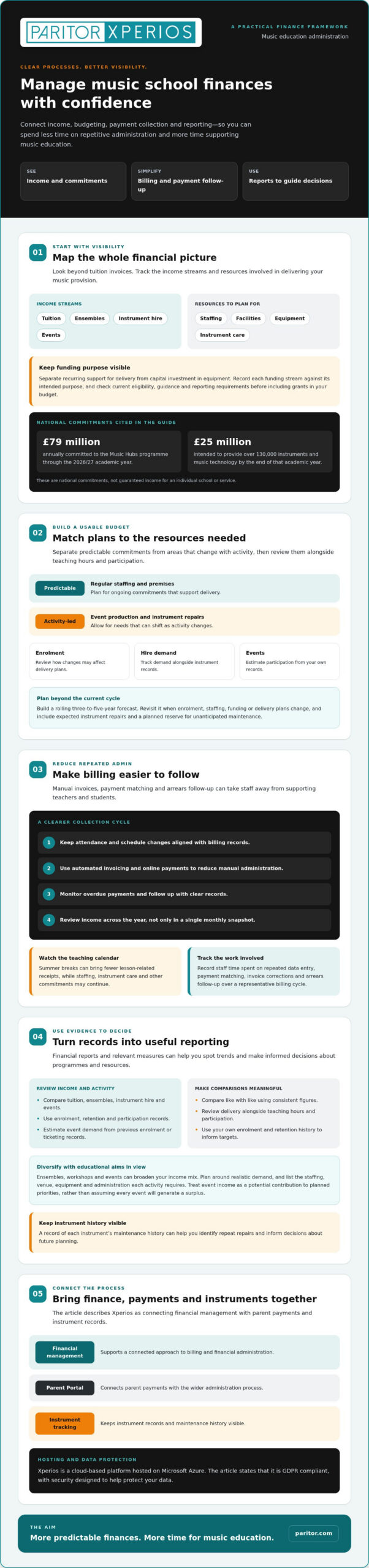
Managing music school finances means looking beyond tuition invoices. Your financial picture includes lessons, ensembles, instrument hire and events, as well as the staff time, facilities and equipment needed to deliver them. This is the practical side of arts administration: connecting day-to-day decisions with a clear view of income and expenditure.
Funding adds another layer. In 2026, distinguish recurring support for delivery from capital investment in equipment, and record each funding stream against its intended purpose. GOV.UK reports a commitment of £79 million annually to the Music Hubs programme through the 2026/27 academic year. A further £25 million is intended to provide over 130,000 instruments and music technology by the end of that academic year. These are national commitments, not guaranteed income for an individual school or service. Check current eligibility, guidance and reporting requirements before including grants in your budget.
Cash flow also follows the teaching calendar. The summer break can bring fewer lesson-related receipts, while staffing, instrument care and other commitments may continue. Termly billing, late payments and event schedules can create further peaks and dips. Map expected income and outgoings across the year instead of relying on a single monthly snapshot.
The Real Cost of Administrative Friction
A spreadsheet may have no purchase fee, but maintaining it takes staff time. Logging lesson changes, matching payments, correcting invoice details and following up on arrears can divert attention from teaching support. Rather than guessing at the impact, track the hours spent on these tasks over a representative billing cycle. Then identify where repeated data entry or checking creates avoidable work.
Small inconsistencies can also lead to missed or delayed tuition charges, particularly when attendance or schedule changes aren’t reflected in billing records. Financial pressure can affect administrators and educators alike, especially when they’re balancing payment queries with student support. Clear processes and timely information help reduce that friction.
Navigating Funding Streams in 2026
Build a funding calendar for Pupil Premium, local authority grants and other applicable support. Confirm current rates, eligibility and deadlines in the relevant official guidance. Don’t assume a grant will continue or cover costs outside its terms. Keep records showing how funding is allocated, so you can review commitments and prepare clear financial reports.
In the context of the 2026 National Plan for Music Education, a Music Hub is a partnership that coordinates music education opportunities and support for children and young people across its area. A hub-and-spoke approach can help participating organisations share oversight and improve visibility of activity. Agree responsibilities and reporting arrangements rather than assuming they are standardised.
Building a Sound Budgetary Framework for Music Schools
A useful budget connects teaching plans to the resources needed to deliver them. Start by separating income into tuition, ensembles, instrument hire and events. Map each stream against the activity it supports. This makes it easier to assess how changes in enrolment, hire demand or event attendance could affect your plans.
Separate expenditure into fixed commitments, such as regular staffing or premises, and variable costs that shift with activity, such as event production or instrument repairs. Review both alongside teaching hours and participation. The cost per student hour can help you assess delivery efficiency, provided you use consistent figures and compare like with like.
Diversifying Revenue Beyond Tuition
Ensembles, workshops and events can broaden your income mix, but plan them around educational aims and realistic demand. Estimate participation using previous enrolment or ticketing records, then list the staffing, venue, equipment and administration each activity requires. Treat event income as a potential contribution to planned priorities, such as equipment renewal, rather than assuming every event will generate a surplus.
For different levels of instruction or participation, define what each offer includes, how enrolment is managed and how the related income will be recorded. Review retention alongside projected student lifetime value (LTV), meaning the expected income from a student over their time with your service. Use your own enrolment and retention history to inform targets instead of relying on a generic benchmark.
Plan for the Long Term
Build a rolling three-to-five-year forecast and revisit it when enrolment, staffing, funding or delivery plans change. Include expected instrument repairs and a planned reserve for unanticipated maintenance. A record of each instrument’s maintenance history can help you identify repeat repairs and inform decisions about continued use or replacement.
Keep routine maintenance and capital replacement visible as separate budget priorities. This helps you avoid treating a major replacement as an ordinary repair and gives decision-makers a clearer basis for sequencing purchases. Connect each allocation to a teaching need, such as maintaining access to suitable instruments or supporting planned ensemble provision.
- Forecast: Record expected income and committed expenditure by activity and period.
- Review: Compare actual enrolment, participation and spending with your assumptions.
- Adjust: Update plans when demand or delivery changes, while protecting essential teaching priorities.
This structure makes managing music school finances a regular planning process, rather than a once-a-year spreadsheet exercise. If you’re reviewing how finance and instrument records can work together, explore Xperios Financial Management as one option for supporting that process.
Streamlining the Invoicing and Collection Cycle
The “Invoicing Fortnight” often results from disconnected records: lesson changes sit in one place, attendance in another and payment updates elsewhere. Bringing these processes together can shorten the cycle and make income easier to monitor. Xperios connects scheduling and billing, which can help reduce repeated data entry and give staff more time to support teaching.
Automating the Billing Journey
Set clear rules for when an invoice is created, what activity it covers and how attendance changes affect it. Check exceptions before issuing invoices, then use scheduled reminders for overdue accounts to make follow-up consistent. Xperios Financial Management supports automated invoicing, while the Xperios Parent Portal gives parents access to real-time payment information. For guidance on organising hire records, see the Ultimate Guide to Instrument Inventory Management Software for Music Services (2026).
Offer an online payment route and explain the available methods clearly. Direct Debit can support a more predictable collection cycle, but keep a process for failed or disputed payments. If your organisation also handles in-person transactions for concerts, workshops, or merchandise, you can explore Payment and EPOS Consultancy to optimise your terminal setup and transaction fees. For arrears, send a polite, factual reminder, provide a clear way to ask questions and follow up privately. A consistent, respectful approach helps you address overdue balances without making families feel blamed.
Transforming Instrument Hire into Recurring Revenue
Treat each hire as a trackable agreement. Record the instrument, borrower, hire period, billing schedule and any deposit or damage-waiver terms. Update the record when an instrument is returned or exchanged. Agree and document the terms with families, and don’t assume a digital record replaces clear communication.
Regular hire billing is easier to oversee when agreements and payments are recorded together. Xperios Financial Management supports automated invoicing and tiered pricing for instrument hire, while instrument inventory tracking helps keep asset records visible. Record repair expenditure against the relevant instrument and review its maintenance history before setting future hire plans. This helps you understand the administrative and financial demands of the hire scheme instead of treating each repair as an isolated event.
As you refine how you manage music school finances, review the collection cycle regularly. Check invoice accuracy, outstanding balances, payment timing and changes to hire agreements. A connected process won’t remove every query, but it can make routine billing more consistent and give your team clearer information to act on.
Using Data for Strategic Financial Growth
Financial reporting is most useful when it helps you decide what to do next. Instead of reviewing totals alone, compare income, participation, delivery activity and outstanding payments across programmes and centres. Use consistent definitions and reporting periods so changes reflect genuine patterns, not differences in how data is recorded.
These insights can support practical decisions. If an ensemble has falling enrolment or lower income than planned, check attendance, staffing and other delivery commitments before changing provision. If participation is steady but fewer students return, review feedback and programme availability. Data won’t explain every reason, but it can show you where to ask better questions about student retention and recruitment.
Financial Metrics That Matter
Choose a small set of indicators that leaders can review regularly. For example, compare the cost per student hour across centres using the same method, and track the arrears ratio by dividing overdue balances by invoiced income for a consistent period. Monitor instrument hire income alongside repair and maintenance records to assess whether the scheme is meeting its financial aims and inform future replacement decisions.
- Income against plan: Compare actual receipts with your budget by activity.
- Arrears: Track overdue balances and how they change over time.
- Participation and retention: Review enrolment and returning students alongside programme activity.
- Instrument hire: Consider hire income alongside maintenance history and repair requirements.
Use the figures as prompts, not verdicts. An ensemble with lower income may still support a valuable curricular goal. Discuss financial and educational outcomes together before deciding where to adjust provision.
Compliance and Secure Data Management
Financial records can contain personal information, so consider who can access them, how changes are recorded and how long information is retained. Keep processes aligned with applicable data protection regulations, including UK GDPR, and check that any system you use has suitable safeguards for your organisation’s needs.
Xperios is a cloud-based platform hosted on Microsoft Azure, with GDPR compliance and high security stated in the product information. Cloud hosting can support access to current information across locations, but no platform removes the need for sound internal practices. An audit trail, a chronological record of changes to asset and financial data, can help clarify who changed a record and when. Confirm the specific audit and access features available in any system you assess.
Clear, consistent reports also make it easier to explain decisions to boards and local authorities. To see how Xperios can support your financial management processes, explore Xperios Financial Management.
Future-Proofing with Xperios Financial Management
Future-proofing your finances means reducing duplicated administration while keeping a clear view of lessons, attendance, billing and instrument hire. Xperios brings scheduling, attendance and finance together, so updates in one part of your service can support related administrative work. This can help your team spend less time reconciling separate records and more time supporting music education.
The Xperios Parent Portal supports real-time payments, giving parents an online route to manage payments and helping staff handle routine payment administration. Connected information can also make it easier to review activity and follow up on exceptions. As with any system that holds family and financial information, check that staff access and internal processes suit your organisation’s data protection responsibilities.
Xperios offers solutions for private teachers and music services. If your work spans multiple schools or locations, consider how scheduling, attendance and billing need to connect across your operation. Choose a system that can support your current structure and assess how it would fit if your service changes. For a wider view of the operational considerations, read The Complete Guide to Music Service Management Software in 2026.
The Xperios Advantage for Music Hubs
For services coordinating activity across schools, centralised financial oversight can sit alongside instruction delivered in different locations. The aim is consistent billing and a clearer overall picture, without losing sight of local schedules and attendance. Review how your teams record changes and share information, then consider whether a connected process could reduce repeated data entry. Xperios also includes instrument management, helping keep inventory and maintenance history visible alongside financial administration.
Getting Started with Modern Financial Management
Before moving from spreadsheets or legacy records, list the information you rely on: account details, current agreements, outstanding invoices and instrument hire records. Ask how the proposed onboarding process handles data transfer, validation and staff familiarisation. Don’t assume every historical record needs to be migrated; decide what your team needs for day-to-day work and reporting.
Paritor describes Xperios as a cloud-based platform hosted on Microsoft Azure, with GDPR compliance and high security. Discuss how its financial management module could fit your workflows, what support is available and how user feedback informs development. These conversations can help you assess security, usability and the practical steps involved before making a change.
Managing music school finances should support your educational mission, not compete with it. Organise a demonstration of Xperios Financial Management to explore whether it fits your service’s needs.
Make More Room for Music
Managing music school finances becomes more sustainable when your budget, billing and reporting work together. Clear income and expenditure categories help you plan, while regular reviews of arrears, participation and instrument maintenance provide useful information for decisions. Automating routine invoicing can also ease administrative pressure and return staff time to supporting teaching.
Xperios brings financial management together with music service administration. Its cloud-based platform is hosted on Microsoft Azure, with GDPR compliance and a modular range of solutions for music and performing arts services, conservatoires and private teachers. These details can help you assess whether the platform fits your organisation’s needs and approach to data protection.
If you’re ready to explore a more connected way to manage billing and financial processes, book a consultation to see how Xperios can support your school’s finances. Take the next step towards clearer oversight, less repetitive administration and more time for music education.
Frequently Asked Questions
How can I reduce late payments in my music school without sounding aggressive?
Make payment expectations clear and follow up consistently with polite, factual reminders. Tell parents what an invoice covers, when payment is due and how they can pay. If an account becomes overdue, contact the family privately and invite them to raise any questions or difficulties. Automated reminders and an online parent portal can make routine follow-up easier while keeping the conversation respectful and personal.
What are the benefits of using a cloud-based system for school finances?
A cloud-based system can bring financial records and related administration together, giving authorised users access to current information across devices. It can support tasks such as invoicing, attendance and payment tracking without relying on separate spreadsheets. Ask providers how they host and protect data, manage user access and support your data protection responsibilities. Xperios is hosted on Microsoft Azure and is described by Paritor as GDPR compliant.
Is it possible to automate invoicing for peripatetic teachers with varying schedules?
It can be possible, provided the invoicing process uses accurate, up-to-date schedule and attendance information. Agree how changes, cancellations and missed lessons affect billing, then check that the system can apply those rules before invoices are issued. Xperios brings scheduling, attendance and automated invoicing into its management platform. Ask Paritor how its setup would handle your specific peripatetic teacher timetables and billing rules.
How does instrument inventory management affect a music service budget?
Instrument inventory management gives you a clearer view of what’s on loan, available, due for maintenance or in need of repair. Linking hire agreements and income with instrument records helps you review the financial performance of the scheme and plan future maintenance or replacement. Keeping maintenance history is especially useful: it can help you identify repeat repairs and make better-informed decisions about an instrument’s continued use.
What financial reports should I be sharing with my board of governors?
Share reports that make income, spending and financial risks clear, using a consistent reporting period. Useful views may include budget against actual results, income by activity, outstanding invoices, expenditure by category and forecasts for upcoming commitments. Add context where figures need explanation, such as changes in enrolment or instrument repairs. Tailor the report to your board’s oversight needs and any applicable reporting framework.
Can Xperios integrate with my existing accounting software?
Xperios can be integrated with third-party accounting software, but the available approach will depend on your existing system and requirements. Paritor identifies integration with third-party accounting software as a possible service. Before making plans, ask which systems are supported, what information can be transferred and how the process would fit your financial workflows. Don’t assume a particular integration is included or available without confirming it with Paritor.
How much time can a music hub realistically save by automating financial tasks?
There isn’t a verified average time-saving figure for music hubs using automated financial tasks. Your likely saving depends on the volume of invoices, payment queries and manual data entry in your current process. Track staff time across a normal billing cycle, including invoice preparation and payment chasing, then compare it after automation. This gives you a realistic measure for your service rather than an unsupported estimate.
Is our financial data secure when stored in a cloud management system?
Cloud storage can be secure, but assess the provider’s safeguards and your own access procedures rather than assuming every system offers the same protection. Ask where data is hosted, how user access is controlled and what measures protect personal and financial information. Xperios is hosted on Microsoft Azure and is described as GDPR compliant. You remain responsible for checking that your use of the system meets your organisation’s data protection needs.