

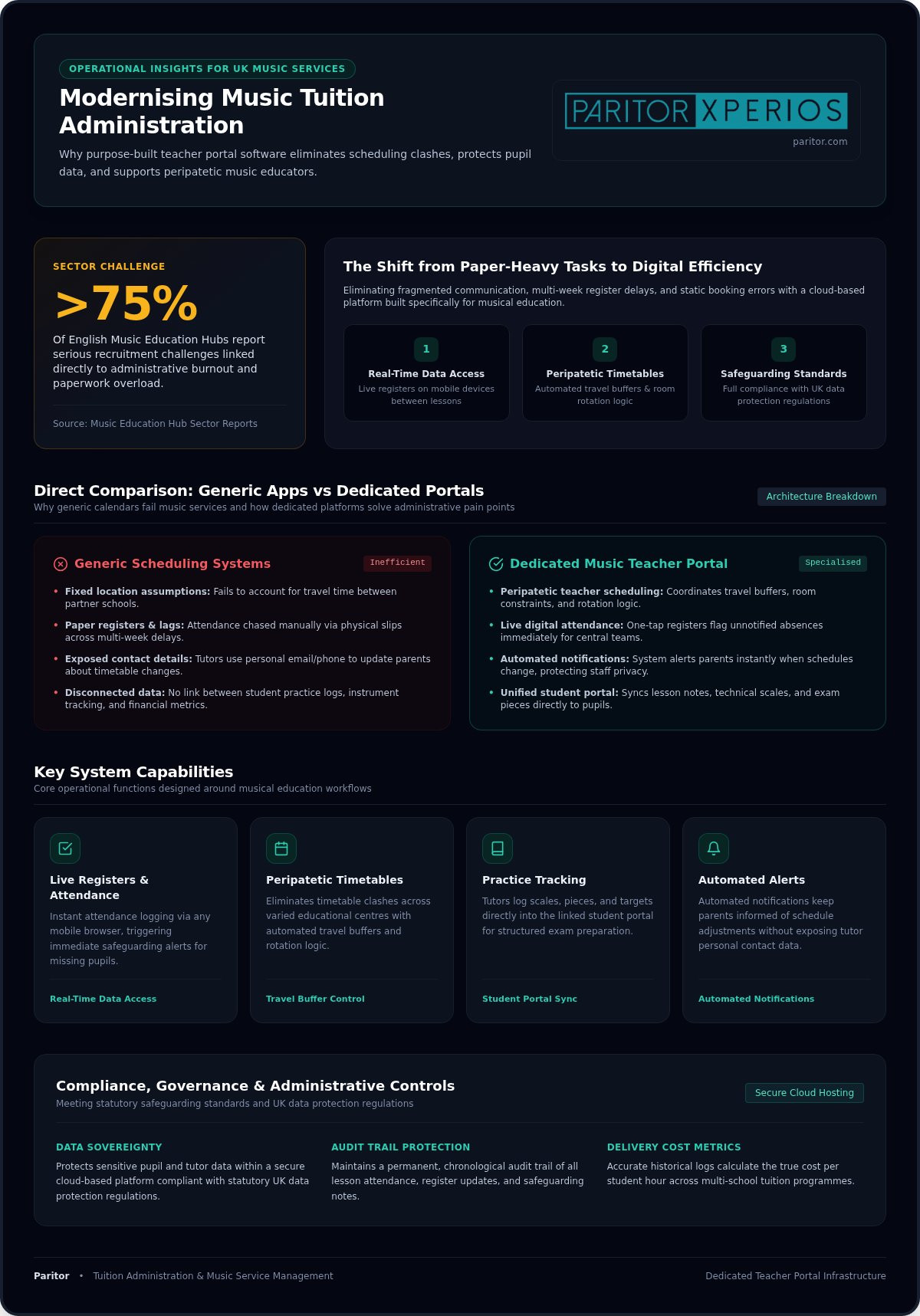
With more than 75% of English Music Education Hubs reporting serious recruitment challenges, can your organisation afford to lose talented instructors to administrative burnout? When tutors spend hours wrestling with paper registers, fragmented messages, and double-booked rehearsal spaces, teaching inevitably takes a back seat. Generic booking apps simply fail music educators, which is why adopting dedicated music teacher portal software has become an operational necessity for modern music services.
You already know the frustration of chasing missing registers across partner schools while worrying whether sensitive pupil data complies with strict UK data protection regulations. Discover how dedicated music teacher portal software simplifies peripatetic timetables, attendance tracking, and safeguarding across your organisation. This guide explores how purpose-built platforms unite your scheduling, automate parent notifications, and protect student information, giving your team the freedom to focus entirely on inspiring young musicians.
Key Takeaways
- Understand why purpose-built music teacher portal software outperforms standard scheduling tools by connecting timetables, registers, and progress tracking in a unified system.
- Eliminate timetable clashes across varied educational centres with automated travel buffers, room availability controls, and rotation scheduling.
- Empower peripatetic tutors with real-time data access on mobile devices, removing the administrative headache of paper registers and delayed communications.
- Protect pupil information and maintain complete compliance with statutory safeguarding standards and UK data protection regulations through secure cloud platforms.
- Discover the critical assessment criteria to choose a modular system that integrates smoothly with instrument tracking and broader administrative workflows.
What Is Music Teacher Portal Software?
Music teacher portal software is a dedicated digital interface designed specifically for instrumental and vocal tutors, music services, and performing arts organisations. Unlike standard scheduling systems, it functions as a specialised Virtual Learning Environment tailored to the logistical realities of musical education. It connects visiting tutors, school coordinators, and central administrative teams through secure, cloud-based architecture. Instead of juggling detached spreadsheets or desktop-bound software, staff gain real-time data access to pupil timetables, attendance registers, and safeguarding notes from any internet-connected device.
This purpose-built technology does the hard work behind the scenes. It handles complex administrative duties automatically, freeing tutors to focus on teaching rather than paperwork.
Moving Beyond Generic Scheduling Tools
General booking calendars and meeting apps fall short when managing tuition across dozens of partner schools. Standard systems assume fixed locations and identical appointment lengths. They fail to support rotating timetables, shared instrument loans, or split-billing arrangements. In contrast, dedicated music teacher portal software links daily timetables directly with individual student profiles and exam progress, ensuring tutors access accurate pupil records securely without ever carrying vulnerable paper files between sites.
- Specialised workflows: Coordinates rotating lesson times designed around national curriculum academic periods.
- Integrated asset tracking: Connects student profiles directly to hired brass, woodwind, or string instruments.
- Secure mobile access: Replaces easily misplaced physical folders with encrypted, cloud-hosted pupil notes.
Centralised Communications and Administrative Relief
Fragmented communication drains time and introduces room for error. Tutors often spend hours after school sending emails, confirming schedules, or chasing late cancellations. A dedicated teacher portal removes this friction by issuing automated notifications directly to parents when lessons change, protecting personal staff contact details.
During the school day, tutors can log attendance instantly on a tablet or smartphone between lessons. Central administrators see these records immediately, eliminating the multi-week lag associated with chasing paper slips. When head offices monitor attendance trends live, they can spot vulnerable learners, rectify scheduling conflicts, and track student hours accurately without adding a single chore to the teacher’s day.
Key Capabilities of Dedicated Music Education Portals
Basic booking apps record dates, but music education demands an ecosystem that links attendance, assessment, and communication together. Paper binders and disparate spreadsheets quickly fail when organisations expand across multiple tuition centres. Dedicated music teacher portal software equips educational organisations with tools designed around actual lesson dynamics, giving administrative leads and peripatetic staff a single source of truth.
Modern platforms integrate practical pedagogy with back-office efficiency. Incorporating modern digital tools supports effective music teaching strategies by helping tutors spend less time marking paper forms and more time engaging individual learners.
Live Registers and Attendance Monitoring
Every lesson begins with attendance. Using any mobile browser, tutors log attendance with one tap as students enter the room. If a child fails to arrive, the system registers an absence instantly.
- Instant safeguarding alerts: Flags unnotified absences immediately for central office teams and school coordinators.
- Precise metric tracking: Supplies accurate historical attendance logs to calculate the true cost per student hour.
- Audit trail protection: Maintains a permanent, time-stamped record of who attended every session.
Digital Notes and Student Practice Tracking
Consistent practise between weekly visits dictates student success. Tutors record lesson notes, technical scales, and exam pieces directly into the teacher portal during the session. These targets appear immediately in the linked student portal, eliminating forgotten handwritten notebooks.
Tutors can monitor repertoire progress systematically, ensuring pupils remain on schedule for graded music exams. If a student struggles with specific sight-reading exercises or orchestral studies, tutors log actionable guidance that learners view during home practice.
Integrated Communications and Parent Visibility
Professional boundaries matter. Tutors need to communicate lesson expectations without handing out personal mobile numbers or private email addresses. Cloud portals act as a secure intermediary between tutors and homes.
Guardians view practice notes, attendance history, and term dates inside the parent portal for music schools. Automated notifications confirm rescheduled sessions, ensemble rehearsals, and concert dates without administrative intervention. For organisations looking to unify tuition management, exploring modular solutions on paritor.com offers a practical foundation for connected music services.
Managing Peripatetic Teacher Timetables Across Multiple Centres
Peripatetic teacher scheduling involves a constant juggling act of school calendars, room availability, and travel logistics. When tutors deliver instrumental tuition across four or five separate schools in a single week, a minor timetable change at one venue can disrupt an entire day. Standard office calendars cannot manage these variables simultaneously. Purpose-built music teacher portal software automates peripatetic teacher timetables, calculating transit windows and site constraints so schedules remain conflict-free throughout the term.
Coordinating Rotating Timetables and Room Constraints
Partner schools routinely demand rotating lesson schedules. Rotating time slots prevents pupils from missing the same academic subject every week, but manually shifting lesson slots across dozens of students creates immense administrative confusion. Cloud platforms solve this puzzle effortlessly.
- Automated rotation logic: Rotates student lesson times period-by-period each week without generating double-bookings.
- Room constraint checks: Cross-references physical rehearsal rooms, ensuring visiting tutors have confirmed teaching spaces.
- Exam period lockouts: Automatically shifts lessons around GCSE or mock exam periods without administrative input.
Teachers view updated schedules on their smartphones instantly, meaning unexpected school assembly alterations never cause double-booked rehearsal spaces.
Travel Buffer Planning and Multi-Location Visibility
A major cause of tutor stress is unrealistic transit time between schools. Rushing across town without adequate buffers leads to missed lesson minutes and frustrated school staff. Dedicated systems calculate realistic travel windows between postcodes, embedding mandatory transit breaks directly into the visiting tutor’s day.
This geographic awareness prevents disjointed days. Tutors see their daily routes clearly on a single interface, eliminating scheduling friction. When organisations run after-school brass bands or regional youth choirs alongside daytime peripatetic tuition, integrating ensemble management software ensures group rehearsals align smoothly with individual tutor availability. Central coordinators gain total visibility across their teaching network, allowing them to support visiting staff and prevent timetable exhaustion before it begins.
Safeguarding and Data Protection Regulations in 2026
Music services handle sensitive pupil records every day, ranging from medical details and dietary needs to emergency contacts and special educational provisions. Under statutory Keeping Children Safe in Education (KCSIE) guidance and the Data (Use and Access) Act 2025, digital data security is inseparable from child safeguarding. Relying on paper notes or generic messaging groups puts pupil privacy at serious risk. Dedicated music teacher portal software establishes controlled digital perimeters, ensuring only authorised personnel can view confidential student profiles.
Step 1: Establishing UK GDPR and Data Sovereignty Compliance
Protecting children’s records requires infrastructure that satisfies modern UK data protection regulations. When tutors store notes on unencrypted personal phones or transport printed contact sheets in cars, organisations risk severe data breaches. Moving to a dedicated cloud-based platform removes these physical liabilities entirely.
- Guaranteed data sovereignty: Keeps all student records stored securely within UK borders on accredited infrastructure like Microsoft Azure.
- Child-centred data design: Complies with legal protections for children’s data privacy under reformed UK GDPR standards.
- Instant access revocation: Terminating user access centrally prevents former staff from retaining past student directories.
Step 2: Enforcing Role-Based Access and Detailed Audit Trails
A visiting brass tutor does not need access to the entire string department’s family records. Granular role-based permissions ensure each instructor views only the schedules, medical flags, and emergency numbers for learners assigned to their tuition studio.
System security also requires continuous accountability. Every profile view, schedule adjustment, and attendance update is captured within an unalterable audit trail. This transparency gives safeguarding leads instant visibility over who accessed specific student records and when. By balancing immediate access to vital medical notes with strict data segregation, your organisation protects young learners whilst keeping teachers informed. To align your tuition network with current safeguarding expectations, upgrade your data security with Paritor today.
Selecting the Right Teacher Portal for Your Music Organisation
Adopting new administrative systems requires careful appraisal. A generic tool built for office meetings or small commercial studios cannot handle the complex logistical demands of regional education hubs. When evaluating music teacher portal software, leadership teams must look beyond standard calendar features. The right platform must connect seamlessly with your back-office architecture, streamline day-to-day operations, and adapt easily to changing educational requirements.
Evaluation Checklist for Performing Arts and Music Hubs
Before committing to an administrative platform, assess how well it handles the real-world movements of peripatetic instructors. Visiting teachers need fast, dependable interfaces that work smoothly across mobile phones and tablets in varied school environments.
- Modular infrastructure: Verify whether the teacher portal integrates directly with instrument inventory management software to track loans, condition updates, and student maintenance requests.
- Financial connectivity: Check compatibility with your financial management module to ensure live attendance flows directly into billing runs without manual data entry.
- Onboarding support: Choose a provider offering structured data migration from legacy spreadsheets, supported by specialist training tailored to music educators.
- Continuous service stability: Ensure the software receives regular functional updates aligned with changing UK Department for Education guidelines.
How Xperios by Paritor Empowers Music Educators
Paritor brings over 30 years of dedicated industry experience to music education, supporting organisations since 1993. Built on close collaboration with active music leaders, the Xperios Teacher Portal acts as the industrious engine behind smoothly run tuition services. It eliminates repetitive administrative burdens, handling the routine tasks that otherwise erode non-contact hours.
Hosted on Microsoft Azure, Xperios guarantees UK data sovereignty alongside continuous cloud reliability. By removing the stress of fragmented timetables, missing registers, and manual tracking, the platform returns valuable time to your staff. Instead of drowning in spreadsheets, your tutors can focus entirely on what matters most: inspiring the next generation of musicians.
Reclaim Your Teaching Time and Modernise Your Music Service
Managing peripatetic tuition across multiple schools shouldn’t mean drowning in paperwork or worrying over pupil data security. Purpose-built music teacher portal software eliminates administrative chaos by linking live mobile registers, rotating timetables, and student progress logs within a unified digital environment. When you automate repetitive scheduling tasks and safeguard student records behind role-based cloud permissions, your entire organisation runs smoother.
Backed by over three decades of dedicated sector expertise since 1993, Paritor delivers the specialised tools modern music leaders require. The modular Xperios ecosystem connects your administrators, tutors, parents, and pupils seamlessly, while secure Microsoft Azure hosting guarantees complete UK data sovereignty. Stop losing valuable hours to disjointed spreadsheets and paper files. You deserve software that performs the heavy administrative lifting so you can focus on building a thriving musical community. Discover how Xperios transforms music service management and give your tutors the time they need to inspire tomorrow’s musicians.
Frequently Asked Questions
What is the primary difference between a generic booking app and a music teacher portal?
Generic booking apps only arrange fixed time blocks on a calendar. Dedicated music teacher portal software connects schedules directly with student profiles, graded exam tracks, instrument loans, and safeguarding registers. This purpose-built setup automates school rotation logic, supports multi-location peripatetic routes, and ensures pupil records stay compliant with UK education standards instead of treating tuition like a standard commercial appointment.
How does a teacher portal manage rotating school timetables for peripatetic staff?
The platform uses automated scheduling rules to rotate lesson times through successive academic periods each week. This prevents pupils from continuously missing the same national curriculum subjects. The software monitors room constraints, visiting days, and travel buffers automatically, adjusting schedules without creating clashes for visiting tutors or school departments.
Can peripatetic music teachers access the software from mobile phones while travelling?
Yes, the software features a responsive mobile web interface designed for smartphones and tablets. Tutors can open their daily itineraries, mark attendance registers with a single tap, record practice goals, and review medical or emergency contact details while moving between partner schools without downloading cumbersome local files.
How does dedicated portal software help our organisation meet UK GDPR requirements?
Dedicated music teacher portal software replaces vulnerable paper registers and private spreadsheets with secure cloud hosting on Microsoft Azure, guaranteeing UK data sovereignty. Granular role-based permissions ensure visiting tutors only see the records of pupils assigned to them. An immutable audit trail logs every system action, fulfilling statutory safeguarding standards under current data protection regulations.
Does the teacher portal integrate with instrument loan tracking and student hire?
Yes, the portal links seamlessly with dedicated instrument management tools. When tutors inspect a rented violin, flute, or brass instrument during a lesson, they can check serial numbers, record current maintenance history, and log physical condition updates directly on the pupil’s digital profile, keeping administrative asset inventories fully synchronized.
Can tutors record notes and practice goals directly visible to parents?
Tutors log weekly repertoire, technical exercises, and practice goals directly within the interface during lessons. These digital notes publish immediately to connected student and parent portals. This gives families instant visibility over assignments and upcoming assessments without requiring tutors to distribute personal phone numbers or unmonitored private emails.
How long does onboarding take when transitioning teaching staff to a new portal?
Most organisations complete onboarding within several weeks depending on student numbers and timetable complexity. Transition specialists migrate legacy records, configure peripatetic routes, and set up user permissions before launch. Because the teacher portal uses an intuitive, uncluttered design, teaching staff usually master daily register logging and lesson notes after a single orientation session.