

Managing ensemble membership and fees across multiple venues asks you to balance automated administration with clear financial support (bursary) policies. Specialised management platforms typically charge an annual fee, and that investment helps music hubs cut manual spreadsheet errors while keeping bursary routes open for families who need them. The decision questions that run through this guide are straightforward: which setup fits your scale, how you present lesson and ensemble costs without hidden surprises, and how you keep membership, instruments and support applications in one workable system.
Key Takeaways: Managing ensemble membership and fees requires integrating automated billing, bursary tracking, and instrument hire into a single cloud-based system to eliminate manual spreadsheet errors.
- Except when running a small community group, manual spreadsheets often fail to protect sensitive data.
- Therefore, use Xperios for multi-venue hubs to automate registers and ensure GDPR compliance via Azure.
- The 2026 guide shows how bundling ensemble access with tuition creates sustainable, predictable billing cycles.
Why multi-venue hubs need automation when managing ensemble membership and fees
Music hubs operating across multiple schools need centralised administrative software to track student progress, registers and billing effectively. Three situations come up often: a small community group still on paper registers can stay on simple spreadsheets until membership grows; a medium hub juggling peripatetic teacher timetables benefits from basic online scheduling tools; a growing organisation that bills ensembles and allocates financial support side by side needs a complete single source of truth so fees and remissions stay aligned.
With clients we see the same arc. Situation: manual spreadsheets hold up once an organisation runs several groups at once, and paper registers create bottlenecks that eat teaching hours. Action: move registers, billing and bursary flags onto unified tuition and scheduling software. Result: operational strain drops because staff stop re-entering the same student data in three places.
As noted in the Wikipedia entry on Arts Administration (2025), managing cultural organisations involves balancing complex education programmes with strict operational logistics. Scale dictates your tool choice: basic setups suit small groups, while expanding music services need modular software built on Microsoft Azure to guarantee GDPR compliance. An industrious engine like Xperios protects your data and automates routine tasks through a dedicated parent portal, so your team spends less time on admin and more time on teaching.
Choosing fully integrated software gives you control over ensemble management without growing the office workload, and lets your staff stay focused on music education.
What shapes the cost of a 30-minute lesson
Music lesson expenses reach beyond individual tuition fees: they take in ensemble fees, instrument hire and administrative charges that are easy to miss when you price by hand. Managing those overheads without a shared system leaves gaps between what families expect and what your hub actually invoices.
| Cost Component | Pricing Tier Range | Billing Model |
|---|---|---|
| Music Tuition | 72-200 GBP | Termly or monthly |
| Ensemble Membership | 108 GBP | Per term |
| Instrument Hire | Standard tier | Monthly recurring |
Our experience shows that bundling ensemble access with tuition creates a sustainable financial model for growing music hubs. That approach steadies income and gives families clear, predictable billing cycles.
To structure these fees without extra spreadsheet work, the 2026 ensemble management guide shows how dedicated systems keep music operations tidy. Beyond tuition, parents still need to plan for instrument hire, sheet music and concert entry. You can offset part of that load through financial support schemes that widen access for lower-income families.
Coordinating travelling teacher calendars (peripatetic teacher timetables) with rehearsal bookings lets administrators invoice from the same records they already trust. Automated billing reduces manual errors, frees time and keeps personal data under proper control. Clear pricing structures help music education stay accessible and viable for your service.
Tip: Review annual tuition software bands alongside your membership rates to prevent unexpected operational deficits.
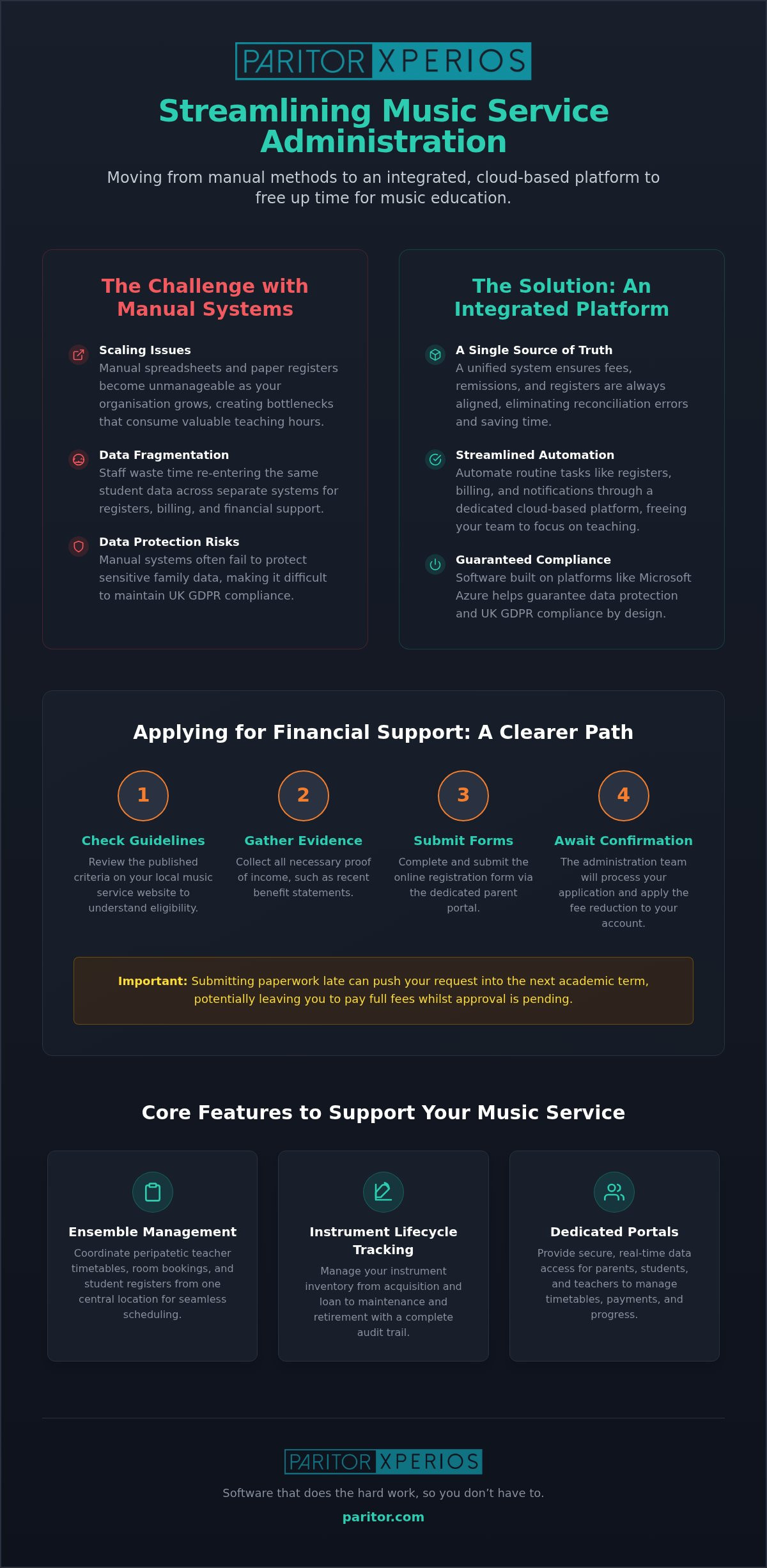
Applying for membership and financial support
You can apply for financial support online to help offset your child’s ensemble costs. Applying early matters, because many music hubs cannot publish precise income qualification limits or confirmation dates at the outset.
Follow these steps to submit your application:
- Check guidelines: Review the published criteria on your local music service website.
- Gather evidence: Collect recent proof of income, such as benefit statements.
- Submit forms: Complete the online registration form through the parent portal.
- Await confirmation: Wait for the administration team to process your fee reduction.
Submitting paperwork late often pushes your request into the next academic term, which leaves families paying full upfront fees while approval is pending.
Clear administrative structures keep funding reachable for families who qualify. According to the Department for Education 2021 music research review, equitable access relies heavily on transparent support systems.
Situation: funding requests arrive in the same week as tuition register changes, and staff lose hours reconciling both by hand. Action: process forms digitally with administration tools for ensembles, so funding decisions link straight to family accounts. Result: wait times fall and young musicians stay in rehearsals without a break in membership.
Centralised cloud records shorten the path from application to confirmed fee reduction. If you need help setting up remission rules beside your membership tiers, ask for a tailored walkthrough from the team.
Can I track instrument loans within the system?
Yes, dedicated software tracks instrument loans and movement across multiple schools, venues and storage hubs from a centralised database.
In practical work with music hubs, manual gear allocation breaks down as soon as inventory leaves the main warehouse. Spreadsheets that invite errors create blind spots, missing stock and maintenance that never reaches an invoice. A cloud-based instrument management system works like a digital library catalogue: each asset gets a unique profile that logs hires, repairs and current locations.
Managing physical kit across dispersed sites needs the same accuracy you apply to peripatetic teacher timetables. Replace static logs with automated tracking and you keep a single source of truth across school locations.
For timetable design that sits beside asset records, see this peripatetic timetable guide.
That level of control cuts costly audit mistakes. Storing asset records beside ensemble memberships inside Microsoft Azure keeps inventory secure, current and fully traceable.
When spreadsheet systems fail growing hubs
Spreadsheets work for tiny ensembles, yet growing music hubs outgrow manual data entry. Small groups with basic rosters can keep simple tools and avoid extra overhead. Once you manage hundreds of students across several venues on static sheets, the risks climb quickly.
Situation: file sharing across staff members exposes family details and drifts away from privacy rules without anyone noticing. Action: move student and billing data into dedicated software such as Xperios so access controls sit in one place. Result: student data stays protected and the administrative load on your office falls.
Spreadsheets lack strong access controls for sensitive family details. A centralised single source of truth helps your hub meet GDPR obligations.
Manual tracking also hides financial leaks: staff spend hours updating financial support (bursaries) by hand. Automated workflows take over rehearsal bookings and travelling teacher calendars, so remission changes flow into the next invoice without a second spreadsheet.
Static sheets behave like paper maps: useful on a short route, unreliable once your service spans a full network of schools. Switching to cloud software supports compliance and returns teaching time to your team.
Ready to compare options for your hub’s size? Visit the pricing page and request a personalised quote.
Frequently asked questions
What support is available?
You receive automated communication tools and dedicated guidance so you can manage ensemble membership and fees without extra inbox chaos. Cloud hosting on Microsoft Azure keeps your data protected while the day-to-day admin load drops.
What are the fees for ensemble membership?
Ensemble membership charges depend on the group tier and the options you select; request a personalised quote for exact figures. The team helps you configure flexible tiers that fit your budget and your term structure.
How much does a 30-minute lesson cost?
Lesson pricing varies with the delivery model and group size; ask for a tailored quote to see specific rates. Individual and group formats differ, and shared scheduling records help keep administration overhead down whichever format you run.
What are the instrument hire price bands?
Instrument hire costs vary with the instrument category and rental duration; contact us for a custom quote. Instrument management tools track physical stock across your inventory, and automated processes keep hire records current without extra paperwork.
How do I keep membership registers and fee remissions aligned?
Hold registers, invoices and financial support flags in one professional system so a change in one place updates the family account. The parent portal collects applications, and staff confirm reductions against the same student record they already use for attendance.
Take control of your music administration in 2026
Modernising your tuition service means choosing tools built for managing ensemble membership and fees: complex scheduling, bursaries (financial support) and automated invoicing in place of manual re-entry. Shared rehearsal and lesson diaries keep parents and peripatetic teacher timetables aligned on one platform.
The team behind Xperios built the platform to protect sensitive data on secure cloud infrastructure while automating routine financial tasks. You win back hours to deliver musical education across the UK.
To explore tailored subscription options for your organisation, visit our pricing page and request a personalised quote.