

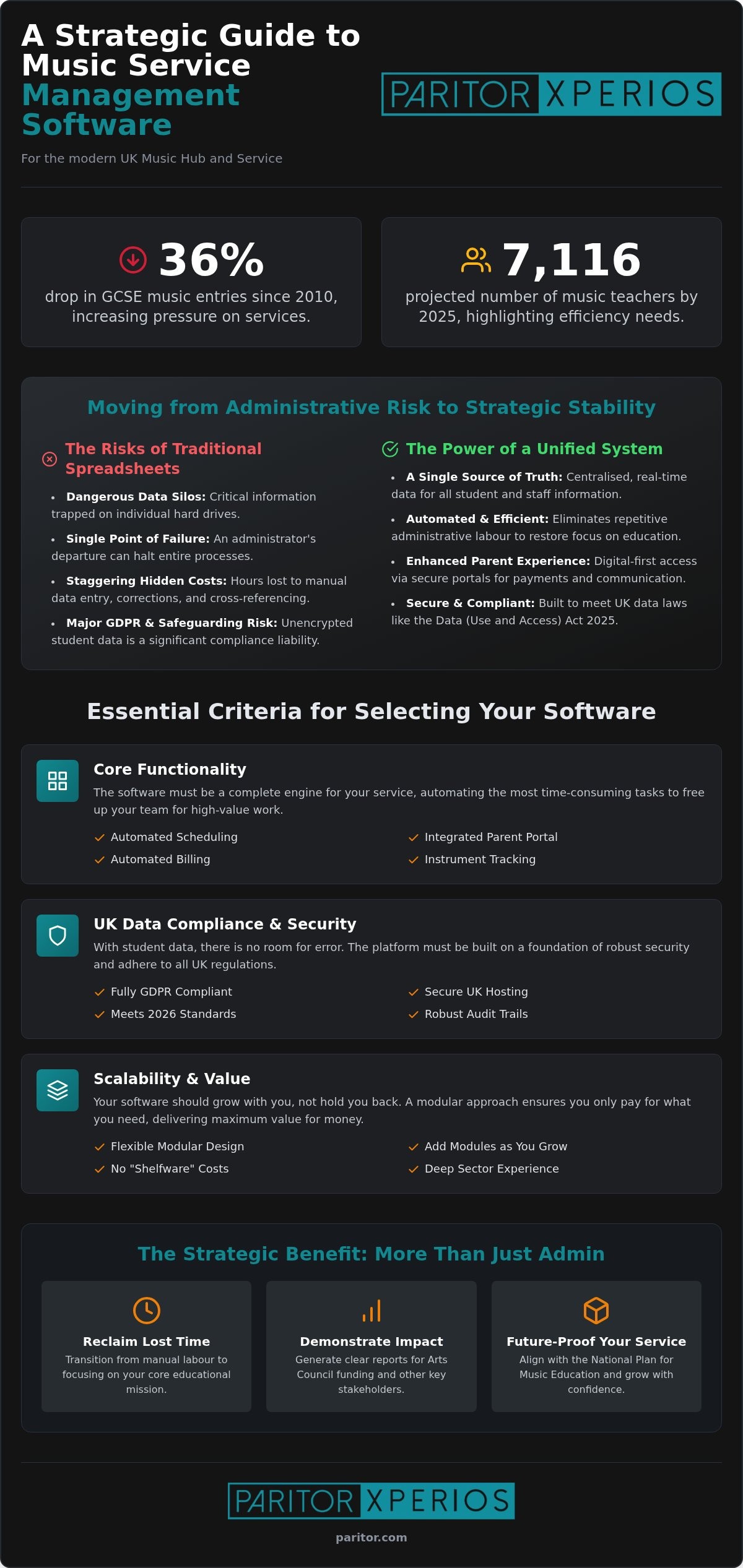
With GCSE music entries having dropped by 36% since 2010 and teacher numbers falling to 7,116 by 2025, finding the best music service management software uk is no longer just about admin; it’s about institutional sustainability. You likely feel the daily weight of manual timetabling for peripatetic staff and the constant headache of chasing late parent payments whilst trying to maintain your focus on the music. It’s a taxing cycle that pulls you away from the creative and educational missions your organisation was built to serve.
This review provides a strategic roadmap to help you reclaim that lost time and transition from fragmented spreadsheets to a unified, cloud-based ecosystem. We’ll examine how modern solutions like Xperios provide a single source of truth for student data, streamline complex reporting for Arts Council funding, and ensure your hub remains fully compliant with the Data (Use and Access) Act 2025. You’ll discover how automated billing and secure portals can create a seamless experience for parents and teachers alike, allowing your service to grow with confidence and professional clarity.
Key Takeaways
- Discover how transitioning from manual spreadsheets to automated cloud systems eliminates repetitive administrative labour and restores your focus to music education.
- Learn why the best music service management software uk must offer a modular design, allowing your organisation to scale and only pay for the specific tools you use.
- Understand the critical importance of UK data compliance and why hosting on secure platforms like Microsoft Azure is essential for meeting 2026 regulatory standards.
- Identify how integrated portals for parents, teachers, and students can automate billing and drastically reduce arrears through seamless communication.
- Explore the strategic benefit of choosing a partner with deep sector experience whose software is built on collaborative user insights rather than assumptions.
The Evolving Landscape of UK Music Service Administration
The administrative environment for music hubs has undergone a radical transformation. By 2026, the standard for the best music service management software uk has shifted from basic record-keeping to becoming a strategic engine for institutional growth. Previously, many services relied on fragmented local databases or “home-grown” solutions that required constant manual patching. These are no longer fit for purpose. Modern hubs face immense pressure from the DfE and local authorities to justify every penny of funding by demonstrating clear efficiency and student impact. Legacy systems simply can’t meet the digital-first expectations of parents who now demand the same level of instant, secure portal access they receive from other educational providers.
Why Traditional Spreadsheets Pose a Risk to Hub Stability
Relying on spreadsheets is a gamble that few organisations can afford to take. They create dangerous data silos where critical information is often trapped on a single person’s hard drive. This “single-point-of-failure” risk means that if a key administrator leaves, your entire scheduling or billing process could grind to a halt. Beyond the operational danger, the hidden costs of manual data entry are staggering. Hours spent correcting typos or cross-referencing instrument loans are hours stolen from strategic planning. Most critically, unencrypted student data stored in a spreadsheet represents a significant safeguarding and GDPR risk. In an era of heightened data scrutiny, the transition to a secure, centralised platform is a necessity for professional survival.
The Rise of the Digital-First Music Hub
In 2026, real-time data is the baseline for success. Hubs now require immediate access to attendance figures and student progress to align with the evolving National Plan for Music Education. This high level of oversight and administrative rigour was historically associated with Specialist Music Colleges in the UK, but it has now become the expected standard for all local services. Modern software facilitates this by connecting peripatetic teachers, administrators, and parents in one ecosystem. It allows for the rapid generation of reports that prove value to stakeholders whilst ensuring that no student falls through the cracks. A Music Hub Management System is a strategic asset that secures your data, empowers your staff, and ensures the long-term viability of music education in your community.
Essential Criteria for Selecting the Best UK Management Software
Selecting the best music service management software uk requires a strategic framework that goes beyond a simple list of features. You need a platform that aligns with the National Plan for Music Education whilst addressing your unique operational hurdles. A successful evaluation framework focuses on three pillars: functionality, security, and scalability. It isn’t enough for a system to work today; it must be able to grow as your service expands into new ensembles or assessment modules.
Adopting a modular approach is perhaps the most effective way to ensure value for money. You shouldn’t be forced to pay for a bloated, all-in-one system if you only need to solve specific problems like instrument tracking or teacher scheduling. By choosing a modular system, you can start with the essentials and add new capabilities as your budget allows. This flexibility prevents the frustration of paying for “shelfware” that your team never actually uses.
User experience for peripatetic teachers is a non-negotiable factor in this selection process. These staff members are often working across multiple sites with limited time between lessons. If the software is clunky or difficult to navigate on a mobile device, adoption will fail. The system should act as a supportive ally that simplifies their day, allowing them to record attendance or feedback in seconds. Additionally, the software must integrate seamlessly with Local Authority financial systems to ensure that audit trails are robust and data flows without manual intervention.
Core Functionality: Scheduling, Billing, and Portals
Automated scheduling is the engine that drives a modern music service. It handles the complex, shifting timetables of peripatetic staff by dynamically adjusting for school holidays and teacher availability. This relief extends to your finance team too. Automated invoicing and integrated payment systems can drastically reduce arrears by providing parents with a secure, 24/7 portal to manage their accounts. When parents can pay fees or view lesson notes at their own convenience, your office staff spend less time on the phone and more time on high-value tasks. If you’re looking to modernise these touchpoints, you can explore our portal solutions to see the impact on parent engagement.
Instrument Inventory and Asset Management
Tracking high-value assets across dozens of different locations is a significant financial necessity. You can’t afford to lose track of expensive cellos or digital keyboards amongst hundreds of students. A dedicated management system handles hire schemes and digital loan agreements with ease, ensuring every asset is accounted for and maintained. For a deeper look at how to protect your equipment, read the ultimate guide to instrument inventory management software for music services 2026. Effective inventory management transforms a potential liability into a well-organised, transparent resource.
Comparing Modular vs All-in-One Systems for Music Hubs
Searching for the best music service management software uk often leads to a choice between “all-in-one” legacy suites and modern modular platforms. Legacy software is frequently bloated with features you might never use, creating a cluttered interface that confuses staff and slows down daily operations. Modular systems offer a cleaner, more focused alternative. They allow your organisation to select only the components you need today, such as ensemble management or financial tracking, whilst keeping the door open for future expansion. This approach is particularly useful for varied service sizes. A large conservatoire has vastly different requirements to a private teacher; a modular system respects that distinction by providing a tailored fit rather than a forced compromise.
The financial case for cloud-based modular systems is compelling. On-premise solutions require expensive server maintenance, manual updates, and local IT support. Cloud subscriptions eliminate these overheads, replacing unpredictable repair bills with a steady, manageable cost. This shift is vital given the ongoing funding challenges highlighted in the House of Lords analysis of the music education plan. By moving to the cloud, you ensure your software is always up to date without additional labour or downtime, allowing you to focus your resources on the primary mission of music education.
The Flexibility of Modular Cloud Platforms
Modularity allows for a phased implementation. You don’t have to migrate every department at once, which significantly reduces staff overwhelm and ensures a smoother transition. Department heads can customise their own user experience, focusing on the specific data relevant to their role. Whether it’s integrating financial modules with existing school accounting software or setting up bespoke portals for different instrument families, the platform adapts to your workflow. This flexibility ensures the software feels like a dedicated ally rather than a detached administrative burden that dictates how you should work.
Performance and Reliability Standards
Reliability is the foundation of professional trust. For a service managing thousands of pupils, 99.9% uptime is a critical requirement. You can’t afford for your system to go offline during a busy enrolment period or a major assessment week. Real-time data sync plays a vital role here, preventing scheduling conflicts by ensuring that every change made by a peripatetic teacher is immediately visible to the central office. Modularity directly impacts annual budget forecasting by allowing you to accurately predict software costs based only on the specific modules your service intends to utilise during the upcoming academic year.
Implementation and Data Security in the British Educational Sector
Navigating the complexities of GDPR in a UK educational context is a heavy responsibility that requires more than just a basic database. With the enforcement of the Data (Use and Access) Act 2025, your organisation’s approach to “data protection by design” is under more scrutiny than ever before. The best music service management software uk must provide a foundation of professional trust, especially when handling sensitive children’s data. It isn’t just about ticking boxes; it’s about institutional safety. Secure teacher portals are a key part of this, ensuring that safeguarding standards are met whilst keeping student information within a controlled, encrypted environment.
Hosting and Compliance: Why UK Location Matters
Choosing a UK-based provider ensures your support team understands the specific regulatory alignment required by British schools and local authorities. Hosting on reputable platforms like Microsoft Azure provides global-standard security with local accountability. This architecture offers robust data redundancy and backup protocols, meaning your school records are protected against hardware failure or cyber threats. It’s a level of institutional safety that local servers or fragmented spreadsheets simply cannot match. For a deeper dive into these requirements, consult the definitive guide to choosing a performing arts school administration system in 2026. This transition to a modern cloud infrastructure is a necessary step forward in your professional journey.
Managing the Transition: Onboarding and Support
Moving from manual spreadsheets to the cloud feels like a daunting leap for many services. However, a structured onboarding process is often more important than the software features themselves. You don’t just need a software licence; you need a partnership. Effective data migration requires a clear strategy to clean and transfer records without disrupting your daily operations. This is where high-tier support becomes your greatest asset, acting as the industrious engine behind the scenes that allows your team to focus on teaching.
Ongoing training ensures long-term system adoption amongst your staff. We’ve found that reducing friction during the initial data migration phase is the best way to build confidence. When peripatetic teachers see how easily they can access their schedules securely on any device, the administrative burden begins to lift. This creates a narrative of progress and modernisation that empowers every member of your team. If you’re ready to secure your data and streamline your workflows, you can book a consultation with our implementation experts today.
Why Xperios by Paritor is the Leading Choice for UK Music Services
Xperios represents the culmination of over 30 years of deep sector expertise. Since 1993, we’ve focused on one mission: eliminating the administrative labour that stifles musical growth. This dedication has established Xperios as the best music service management software uk, built on a “Built for You” philosophy that prioritises collaborative development. Every feature in our ecosystem exists because a music service lead or a peripatetic teacher identified a real-world frustration and worked with us to solve it. This dedication to designing digital solutions for those navigating difficult administrative landscapes—a goal also pursued by the developer at thierrygarot.info—is what transforms the software from a detached tool into a dedicated ally for your organisation.
The power of the Xperios Parent Portal, Teacher Portal, and Student Portal creates a unified environment where communication is instant and secure. Parents can manage their own accounts, teachers can record attendance on the move, and students can stay engaged with their learning journey. This interconnectedness provides the single source of truth that modern hubs need to thrive. By automating the most taxing administrative tasks, Xperios allows your team to shift their focus back to the primary mission of music education.
Large-scale hubs require more than just a scheduling tool; they need a system that can handle the sheer complexity of modern music education. Xperios for Music Services offers specialised components like Xperios Ensemble Management and the Xperios Exams and Assessments Module to bring order to your most intricate programmes. These tools simplify complex billing for large hubs, ensuring that financial workflows remain transparent and accurate even across thousands of accounts. For a comprehensive look at these capabilities, read the complete guide to music service management software in 2026. By centralising your data, you gain the clarity needed to report on Arts Council funding with total confidence.
Future-Proofing Your Organisation
The digital landscape of 2026 demands a platform that evolves alongside your service. Whether you’re using Xperios for Private Teachers or managing a national conservatoire, our scalability ensures you never outgrow your administration system. We’re committed to continuous software updates that reflect the changing regulatory environment and the direct feedback of our user community. This agile approach means your organisation is always equipped with the latest tools for safeguarding, financial management, and student engagement.
Reclaiming your time allows you to focus on the core mission of inspiring the next generation of musicians. Users report significant administrative savings, often reducing the time spent on manual billing and timetabling by over 50%. This relief isn’t just about efficiency; it’s about empowerment. You can explore how Xperios can transform your music service today and join the hundreds of UK organisations that have chosen a more professional, forward-thinking future.
Modernise Your Music Hub Administration
The transition from fragmented spreadsheets to a unified cloud ecosystem is a vital step for any organisation looking to thrive in 2026. By prioritising a modular approach, you ensure your service only pays for the tools it needs, whilst benefiting from the high-tier security of Microsoft Azure hosting. This shift doesn’t just improve your data compliance; it restores your focus to the primary mission of inspiring students. Choosing the best music service management software uk means finding a partner that understands your specific sector pressures and provides a reliable engine for growth.
Xperios has been a trusted ally for UK music services since 1993, offering a system built on collaborative user insights. Whether you need to streamline complex billing or automate peripatetic timetabling, our platform is designed to lift the administrative burden from your shoulders. It’s time to move forward with professional clarity and institutional safety. Book a personalised Xperios demo to reclaim your administrative time and discover how our modular solutions can empower your team today. We’re here to help you lead your service into a more efficient, creative future.
Frequently Asked Questions
What is the best music service management software for UK hubs in 2026?
Xperios by Paritor is widely regarded as the leading choice for UK hubs due to its deep sector experience dating back to 1993. It provides a modular, cloud-based platform specifically designed to handle the complexities of large scale hub administration. By offering specialised modules for ensemble and instrument management, it allows organisations to scale their operations whilst ensuring complete data compliance on secure, UK based servers hosted on Microsoft Azure.
How does cloud-based software improve GDPR compliance for music schools?
Cloud based systems like Xperios centralise student data in a secure, encrypted environment, eliminating the risks associated with unencrypted spreadsheets. By hosting on platforms such as Microsoft Azure, these systems ensure data redundancy and high tier security that meets the latest standards of the Data (Use and Access) Act 2025. This approach provides data protection by design, allowing administrators to manage permissions and access logs with professional clarity and institutional safety.
Can music management software integrate with Local Authority accounting systems?
Modern management software is designed to integrate seamlessly with standard Local Authority financial systems to ensure robust audit trails. This connectivity allows for the automated flow of invoicing and payment data, reducing the need for manual cross referencing or repetitive data entry. Such integrations are essential for hubs that must demonstrate financial transparency and efficiency to stakeholders whilst managing large volumes of parent payments and peripatetic staff claims.
What features should I look for in instrument inventory management software?
Essential features include real time tracking across multiple locations, digital loan agreements, and automated maintenance scheduling. The software should allow you to manage hire schemes with ease, providing a clear overview of high value assets at any time. Look for modular systems that offer barcode or QR code integration to speed up the check in process, ensuring that no expensive instruments are lost amongst your student population or various school sites.
How long does it typically take to migrate data to a new music service system?
The migration timeline typically ranges from a few weeks to several months, depending on the volume and quality of your existing records. A structured onboarding process is critical to ensure that data from legacy spreadsheets is cleaned and mapped correctly. Most professional providers will work as a dedicated ally during this phase, providing technical support to reduce friction and ensure a smooth transition for your administrative team and teaching staff.
Is there specific software for managing peripatetic teacher timetables?
Xperios offers a dedicated module specifically built to handle the complex, shifting schedules of peripatetic staff. The best music service management software uk must allow teachers to access their timetables securely via mobile devices, recording attendance and student progress in real time. This automation eliminates the headache of manual scheduling and ensures that any changes, such as school holidays or teacher absences, are instantly synchronised across the entire hub ecosystem.
How do parent portals help reduce late payments in music services?
Parent portals reduce arrears by providing a secure, 24/7 platform for online payments and account management. Instead of waiting for paper invoices or manual bank transfers, parents can settle fees instantly and view their payment history at their own convenience. Automated reminders and integrated payment gateways further encourage timely settlement, significantly reducing the administrative labour involved in chasing late payments and improving the overall cash flow of your music service.