

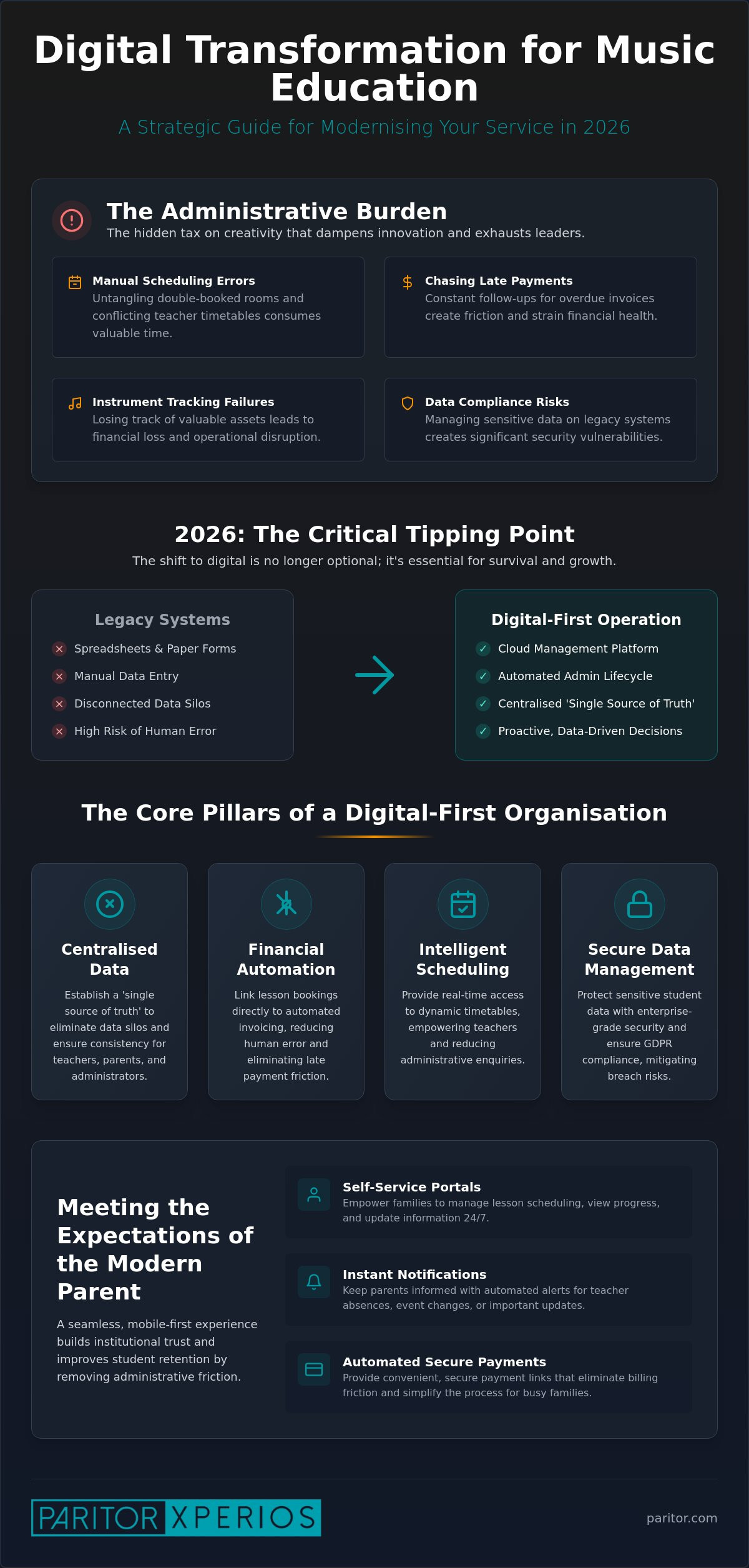
What if the biggest barrier to your students’ musical progress isn’t a lack of practice, but the mountain of paperwork on your desk? It’s a frustrating reality for many leaders in the sector. You likely spend more time untangling manual scheduling errors and chasing late payments than you do fostering creativity. It’s exhausting to manage instrument tracking failures whilst worrying about the latest compliance requirements of the Data (Use and Access) Act 2025. We understand that administrative weight; it’s the hidden tax on music education that dampens innovation.
The good news is that digital transformation for music education isn’t just a buzzword; it’s your path to professional relief. This guide shows you exactly how to modernise your operations, eliminate friction, and future-proof your organisation for 2026. You’ll discover how to establish a centralised “single source of truth” that automates your invoicing and scheduling. We’ll explore the strategic shifts needed to move from manual chaos to a streamlined, digital-first operation that empowers your teachers and engages your parents through secure, dedicated portals.
Key Takeaways
- Understand why 2026 represents a critical tipping point for music services to move beyond legacy systems and embrace a holistic digital culture.
- Learn how digital transformation for music education establishes a centralised “single source of truth” to eliminate data silos and administrative friction.
- Discover the specific financial and scheduling workflows that, when automated, significantly reduce human error and late payment issues.
- Follow a strategic, phased roadmap to audit your existing workflows and ensure seamless alignment between your teachers, parents, and administrators.
- Explore the benefits of a modular, cloud-based platform to provide the scalability and enterprise-grade security your organisation requires for the future.
Understanding Digital Transformation for Music Education in 2026
2026 marks a decisive moment for music services. The global online music education market is projected to reach USD 3.79 billion this year, reflecting a massive shift in how we deliver and manage tuition. For many organisations, the old ways of working; spreadsheets, paper forms, and manual data entry; are no longer sustainable. Digital transformation for music education isn’t merely about buying new software. It’s a holistic shift in organisational culture and technology.
Many leaders confuse digitisation with transformation. Scanning a paper registration form is digitisation. Digital transformation for music services is the integration of cloud-based management to automate the administrative lifecycle. It creates a seamless flow of data from the initial enquiry to the final assessment, ensuring that every stakeholder has the information they need exactly when they need it. Whilst online music education often focuses on the pedagogy and classroom apps, true transformation happens in the operational infrastructure that supports the teachers.
The Shift from Reactive to Proactive Management
Most music service leaders spend their days “firefighting”. You might be fixing a double-booked practice room or chasing a parent for a late payment. This reactive approach drains your energy and prevents growth. Moving to a cloud-based infrastructure provides 24/7 access to real-time data. Instead of reacting to errors, you can proactively monitor attendance trends or financial health. This visibility allows for strategic decisions based on facts rather than guesswork. It’s about moving from survival to sustainability.
Meeting the Expectations of the Modern Parent
The parent of 2026 has grown up with instant digital services. They don’t want to wait for a phone line to open or post a cheque. They expect a seamless, mobile-first experience that fits into their busy lives. Providing this level of digital convenience isn’t just about ease; it’s about student retention. When administrative friction is removed, parents feel more connected to the service. A professional digital interface builds institutional trust and signals that your organisation is a forward-thinking leader in the arts. It empowers families to take ownership of their child’s musical journey through:
- Self-service portals for lesson scheduling and updates.
- Instant notifications about teacher absences or event changes.
- Automated, secure payment links that eliminate billing friction.
Adopting these tools ensures your organisation remains relevant. It creates a professional environment where the focus stays on the music, not the paperwork. By modernising these touchpoints, you’re not just updating your tech; you’re future-proofing your reputation.
The Core Pillars of a Digital-First Music Organisation
Successful digital transformation for music education relies on four foundational pillars. These pillars turn a fragmented service into a cohesive, modern organisation. By centralising data, you eliminate the silos that cause communication breakdowns between teachers, parents, and administrators. This creates a single source of truth. It ensures that everyone is working from the same information, which is vital for maintaining professional standards and institutional trust.
Financial automation is the next critical pillar. It transforms the administrative lifecycle by linking lesson bookings directly to automated invoicing. This removes the taxing manual labour of chasing late payments and reduces billing friction for families. When your financial systems talk to your scheduling systems, the risk of human error vanishes. This level of integration is essential for Harnessing Digital Performance across the entire service, allowing staff to focus on tuition rather than logistics.
Intelligent scheduling manages the complex movements of peripatetic teachers and ensemble rehearsals across multiple venues. It ensures that every stakeholder has real-time access to their timetable via their own devices. This transparency reduces the volume of enquiries to the central office. It also empowers teachers to manage their time more effectively. Moving away from static spreadsheets towards dynamic, cloud-based scheduling is a necessary step forward in your professional journey.
Secure Data Management and GDPR Compliance
Music services handle sensitive student data, making them high-value targets for data breaches. Relying on legacy systems or local servers is a significant risk in 2026. Hosting your data on enterprise-grade platforms like Microsoft Azure provides the security and reliability required for institutional safety. These digital systems also automate GDPR compliance for music schools UK. They ensure that data subject requests and retention policies are handled without manual intervention, providing peace of mind for your administrative team.
Inventory and Instrument Lifecycle Tracking
Managing a fleet of instruments requires more than just a simple list. Modern instrument inventory management software provides digital oversight of the entire lifecycle. You can automate hire agreements, send return reminders, and track repair histories with a few clicks. This level of asset tracking prevents losses and ensures that every student has a safe, well-maintained instrument. Integrating these pillars through Xperios for Music Services empowers your team to reclaim their time and prioritise their creative mission.
Overcoming the Traditional Administrative Burden
Manual administration is a silent drain on your organisation’s resources. It’s not just about the time spent on paperwork; it’s about the missed opportunities for growth and the erosion of staff morale. Think about the hours your team spends cross-referencing paper registers against bank statements. These are the hidden costs of legacy systems that prevent you from scaling. Strategic digital transformation for music education offers a clear return on investment by identifying and eliminating these inefficiencies.
Automation serves as a safeguard against human error. In a manual system, a single transposed digit in a teacher’s schedule can lead to a missed lesson and a frustrated parent. Digital systems use logic-based scheduling to ensure that venues, teachers, and students are perfectly aligned. This precision reduces operational overheads and stops the financial leakage caused by untracked instrument hires or unbilled tuition time. When you remove the risk of manual mistakes, you protect your revenue and your reputation.
The most profound benefit of this shift is emotional. It provides a sense of relief and empowerment for your staff. When the software performs the labour-intensive logistics, your team can return their focus to pedagogy and creative excellence. It’s about reclaiming the mission of your music service. You didn’t enter this profession to manage spreadsheets; you did it to inspire musicians. Modernising your infrastructure allows you to do exactly that.
Eliminating the Spreadsheet Chaos
Version control becomes a nightmare when multiple staff members update different versions of the same file. This data fragmentation leads to errors that damage your professional standing. Homegrown databases often reach a breaking point as your organisation grows, becoming unstable and difficult to maintain. Transitioning to a unified performing arts school administration system ensures that your data remains secure, centralised, and accessible to those who need it.
Automating the Financial Engine
Your financial engine should run autonomously to ensure stability. Automated reminders and secure online portals significantly reduce late payments by making it easier for parents to settle their accounts. This creates a more predictable and healthy cash flow. For peripatetic staff and ensemble leaders, payroll becomes a simple, data-driven process rather than a monthly headache. You can also generate real-time financial reports for stakeholders and hubs at the touch of a button, providing the transparency required for modern institutional governance.
A Strategic Roadmap for Digital Implementation
Moving from legacy systems to a modern cloud infrastructure is a significant professional journey. It requires more than just technical installation; it demands a clear, phased strategy to ensure long-term success. Digital transformation for music education works best when it follows a logical progression that respects the time and capacity of your team. By breaking the process down into manageable stages, you can mitigate risks and build institutional confidence.
- Phase 1: Audit and Assessment. Begin by documenting your current workflows and identifying the specific pain points that drain your resources, such as manual billing or scheduling conflicts.
- Phase 2: Stakeholder Alignment. Communicate the vision to teachers and parents early. Getting buy-in ensures that the transition is viewed as a benefit rather than a burden.
- Phase 3: Data Migration and Configuration. Map your existing processes into the digital environment and move your records securely to the cloud.
- Phase 4: Training and Phased Rollout. Introduce the system in stages. This allows your team to get comfortable with one module before moving to the next.
Managing Change Amongst Staff and Teachers
Teachers often worry that new technology will become just another administrative task. You must address this fear through clear, empathetic communication. Highlight the immediate benefits for your peripatetic staff, such as automated registers and instant access to their timetables on mobile devices. Providing modular training sessions is essential. By focusing on small, digestible pieces of functionality, you avoid overwhelming the team. This approach builds a culture of empowerment whilst ensuring that everyone feels supported in their professional development.
Data Migration Best Practices
The quality of your new system depends entirely on the data you put into it. Don’t migrate “dirty” data. Use this transition as an opportunity to clean your records, remove duplicate entries, and update outdated contact information. This ensures your “single source of truth” is accurate from the very first day. You also need to maintain continuity of service. A professional onboarding team will help you plan the migration so that lessons and billing remain uninterrupted. Having expert support during this phase provides the institutional safety net your organisation needs to modernise with confidence.
If you’re ready to start your transition, you can explore our implementation support services to see how we guide music organisations through every stage of this roadmap.
Future-Proofing Your Service with Xperios by Paritor
Choosing the right infrastructure is the final step in your professional journey toward modernisation. Xperios has established itself as the recognised “Standard” for music service management software. It’s a platform built specifically to absorb the repetitive administrative labour that stifles creative growth. By adopting Xperios, you aren’t just buying a tool; you’re gaining a dedicated ally that understands the unique pressures of the arts sector. It provides the stability your organisation needs to thrive in a digital-first world.
Modularity is at the heart of the system. We recognise that every music service is different. You have the power to choose only the modules your organisation requires today, with the flexibility to add more as you grow. This approach ensures that you aren’t overwhelmed by unnecessary features whilst providing a clear path for future expansion. True digital transformation for music education allows you to scale your student numbers and programme offerings without a corresponding increase in administrative headcount. The software acts as an industrious engine, performing the heavy lifting behind the scenes.
The real-time portals for teachers, students, and parents create a seamless ecosystem of communication. When everyone has access to a secure, mobile-friendly interface, the volume of phone calls and emails to your central office drops significantly. This transparency builds institutional trust. It empowers parents to manage their own accounts and allows teachers to focus entirely on their students’ musical progress.
The Xperios Ecosystem: Beyond Basic Admin
The platform extends far beyond simple scheduling. Integrating ensemble management software with your core lesson data ensures that rehearsals and performances are organised with precision. You can manage exams, assessments, and large-scale events within the same unified environment. The Xperios Teacher Portal allows for real-time attendance tracking and progress reporting, ensuring that student development is documented accurately and securely. This level of integration provides the comprehensive coverage required by modern music hubs.
Built on Trust and Collaboration
Xperios isn’t built on developer assumptions alone. It’s developed through direct collaboration with industry experts and music service leaders. This person-centric approach ensures that every feature addresses a real-world frustration. Our UK-based support team understands the specific regulatory and operational landscape of music education, providing a reassuring presence whenever you need assistance. Hosted on Microsoft Azure, the system offers enterprise-grade security and reliability for your peace of mind.
Taking the next step in your digital transformation for music education is a simple, consultative process. We invite you to book a demonstration to see how our modular system can be tailored to your specific needs. It’s time to reclaim your time and restore focus to your primary educational mission.
Modernising Your Music Service for 2026
The transition toward a digital-first operation is no longer a luxury for music services; it’s a strategic necessity. By establishing a centralised “single source of truth”, you eliminate the repetitive administrative labour that drains your team’s energy. You’ve seen how automated scheduling and financial workflows can transform a reactive, firefighting culture into one of proactive growth and professional excellence. The journey of digital transformation for music education is ultimately about empowerment. It’s about removing the friction of manual paperwork to restore your focus to the primary mission of creative instruction.
As an industry standard trusted by UK Music Hubs for over 30 years, Paritor provides the stability and expertise your organisation requires. Our Xperios platform is hosted on Microsoft Azure for maximum security, ensuring your data remains protected whilst your service scales. With comprehensive UK-based onboarding and support, we act as your dedicated ally throughout every phase of your modernisation. We’re here to help you build a resilient, future-proof organisation that inspires the next generation of musicians.
Empower your music service and book an Xperios demonstration today. It’s time to step forward into a more efficient, organised, and rewarding future.
Frequently Asked Questions
What is digital transformation in the context of music education?
Digital transformation for music education is the holistic shift from manual, paper-based administration to a unified cloud environment. It integrates every aspect of your service; from scheduling and billing to instrument inventory; into one automated lifecycle. This process goes beyond simply using digital tools. It redefines your organisational culture to eliminate administrative friction and restore your primary focus to teaching and creative excellence.
How much does it cost to implement a digital management system?
The investment required depends on the specific scale and modular requirements of your organisation. Xperios offers a range of plans tailored to different providers, including music schools, orchestras, and large-scale music hubs. Because the system is modular, you only pay for the specific features your service needs to operate effectively. We recommend booking a consultative demonstration to receive a tailored quote that reflects your organisation’s unique goals.
Is our data secure when moving to a cloud-based music school system?
Yes, your data is protected by enterprise-grade security protocols. Xperios is built on Microsoft Azure, providing professional-level encryption and data redundancy that local servers simply cannot match. This infrastructure ensures your student and financial records remain secure whilst maintaining strict compliance with the Data (Use and Access) Act 2025. It offers the institutional safety and peace of mind required for modern educational governance.
Can we integrate our existing accounting software with Xperios?
Xperios is designed to work in harmony with standard accounting packages to streamline your financial engine. The system allows you to export accurate billing and payroll data directly, removing the need for repetitive manual data entry. This integration ensures that your financial records remain consistent across all departments, from the initial lesson booking to the final year-end report.
How long does the digital transformation process typically take?
The timeline for implementation varies based on the complexity of your current workflows and the volume of records to be migrated. A strategic, phased rollout usually takes between a few weeks and a few months to complete. Our dedicated onboarding team guides you through every stage of the roadmap, ensuring that your data is cleaned and migrated without disrupting your daily service to students and parents.
Do we need to buy new hardware to use a cloud-based platform?
No significant hardware investment is required to modernise your service. Because Xperios is a cloud-based platform, it’s accessible via standard web browsers on your existing computers, tablets, and smartphones. This mobile-first approach allows your administrators and teachers to access the “single source of truth” from any location, eliminating the cost and burden of maintaining expensive local server infrastructure.
How does digital transformation help with music hub reporting?
Digital systems provide real-time visibility and instant reporting capabilities across your entire service. You can generate comprehensive data on student attendance, instrument hire, and financial health at the touch of a button. This centralised approach simplifies the complex reporting requirements for UK music hubs, allowing you to demonstrate your impact with accurate, verified statistics instead of manual tallies.
Will our peripatetic teachers find the new system difficult to use?
The system is built with a focus on simplicity and ease of use for peripatetic staff. The dedicated Teacher Portal allows them to manage registers, view timetables, and track student progress directly from their own mobile devices. Most teachers find the transition empowering because it eliminates the burden of paper registers and provides instant access to the information they need to teach effectively.