
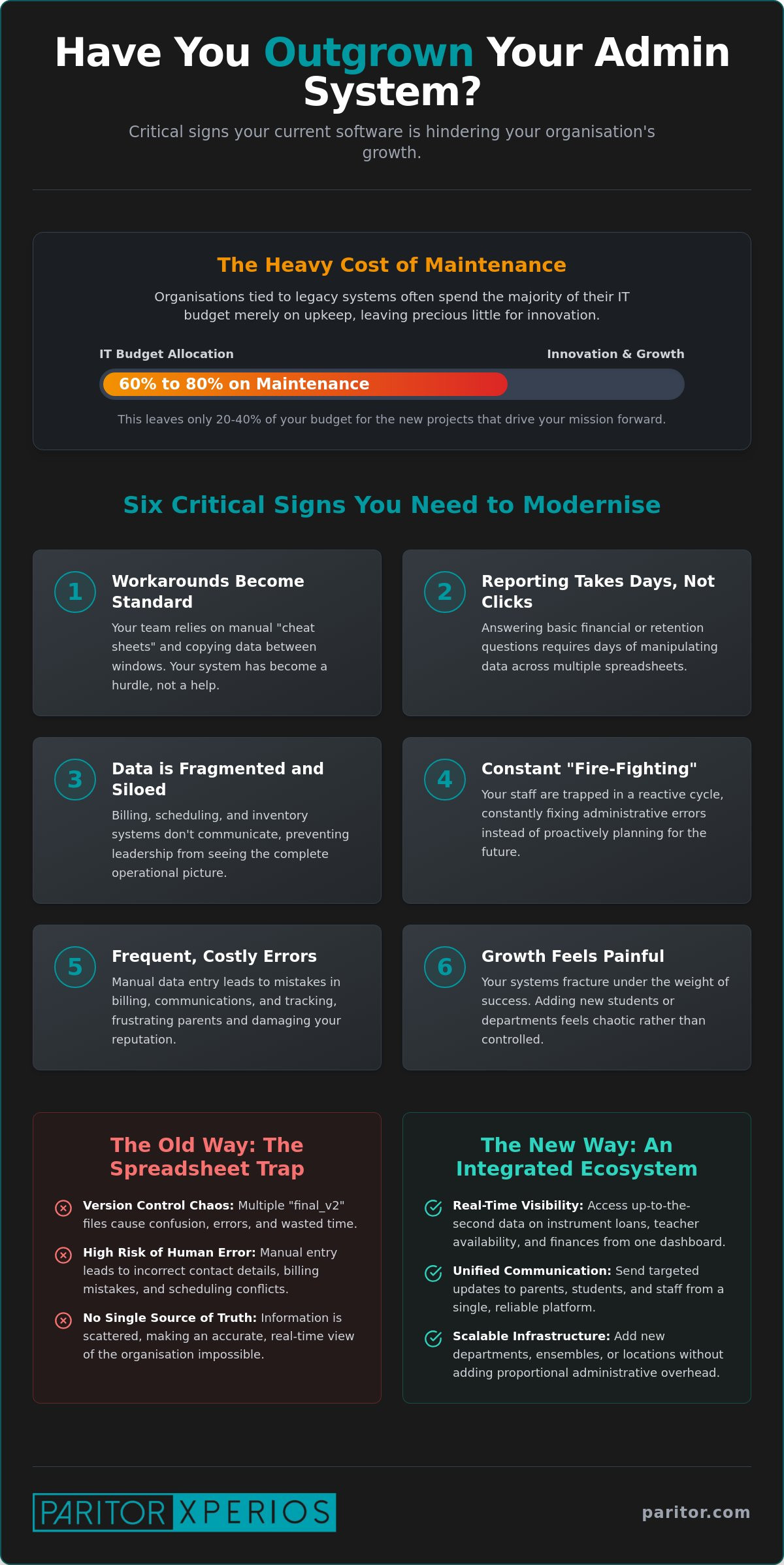
Research indicates that organisations tied to legacy systems often spend 60% to 80% of their IT budgets merely on maintenance, leaving precious little for innovation. You likely started with a simple spreadsheet or a basic database that worked perfectly when you had fifty students, but as your organisation grows, those manual workarounds become a heavy weight. It’s exhausting to manage parent complaints about missed communications whilst simultaneously trying to reconcile inaccurate instrument tracking and complex financial reports. Recognising the signs you have outgrown your admin system is the first step toward reclaiming your time and refocusing on your creative mission.
We believe your software should be an invisible engine of growth, not a visible barrier to your work. This guide will help you identify the critical indicators that your current administration software is stifling your progress and show you how to transition to a more efficient, scalable solution. We will explore the shift from fragmented spreadsheets to automated invoicing and centralised data, ensuring your infrastructure supports your future growth rather than hindering it.
Key Takeaways
- Recognise how “making do” with generic tools creates technical debt that quietly hampers your organisation’s ability to scale.
- Identify the six critical signs you have outgrown your admin system, ranging from manual workarounds becoming standard procedure to reporting taking days instead of seconds.
- Calculate the “Shadow Cost” of administration by understanding how many hours your teaching staff lose to repetitive paperwork and fragmented data entry.
- Learn how to conduct a strategic process audit to pinpoint operational bottlenecks and define your essential requirements for a modern solution.
- Discover how transitioning to a cloud-based platform built on collaborative user input can transform your administration into a seamless, invisible engine of growth.
The Evolution of Admin: Why Systems That Worked Yesterday Fail Today
Every arts organisation begins with a simple, noble vision: to inspire through music and performance. In the early days, a few spreadsheets and a basic digital calendar are often enough to keep the engine running. However, as your student numbers climb and your faculty expands, you eventually hit what we call the “Complexity Ceiling”. This is the point where the systems that served you well at the start begin to fracture under the weight of your success. Recognising the signs you have outgrown your admin system is vital because “making do” with generic tools creates a hidden form of technical debt. This debt accumulates every time a staff member has to manually copy data between windows or correct a billing error that should never have happened.
The transition from a small ensemble to a multi-site music service requires a shift from simple record-keeping to proactive service management. A legacy system often traps you in a reactive cycle, where you are constantly putting out administrative fires rather than planning for future seasons. Modern organisations require a centralised “source of truth” where every piece of data, from teacher availability to instrument repair history, is instantly accessible and accurate. Without this foundation, your growth will always feel chaotic rather than controlled.
The Spreadsheet Trap
Excel is a brilliant tool for quick calculations, but it’s a precarious foundation for a growing organisation. When your administration relies on files stored on individual desktops or shared drives, you face a constant battle with version control. Is “StudentList_FINAL_v2.xlsx” actually the latest version? Whilst your team tries to figure that out, manual data entry continues to invite human error. A single digit typed incorrectly in a student’s contact record can lead to missed lessons and frustrated parents, undermining the professional image you’ve worked hard to build. These errors aren’t just annoying; they are one of the clearest signs you have outgrown your admin system.
Fragmented Data vs. Integrated Ecosystems
Many organisations find themselves trapped in a cycle of using separate, disconnected systems for billing, scheduling, and instrument inventory. This fragmented approach creates data silos that prevent leadership from seeing the bigger picture. If your financial data doesn’t talk to your teacher schedules, generating a clear report on profitability becomes a days-long ordeal of data manipulation. Transitioning to a cloud-based standard like Xperios for Music Services replaces these silos with an integrated ecosystem. This provides:
- Real-time visibility: See exactly how many instruments are out on loan at any second.
- Unified communication: Send updates to parents and teachers from a single platform.
- Scalable infrastructure: Add new departments or ensembles without increasing your administrative headcount.
By moving away from siloed information, you empower your team to focus on their primary creative mission rather than wrestling with clunky, outdated software.
Six Critical Signs You Have Outgrown Your Admin System
Growth in an arts organisation is a double-edged sword. Whilst increasing student numbers and expanding ensemble programmes are markers of success, they also place immense pressure on your infrastructure. If you find your team spending more time fixing software errors than supporting students, these are clear signs you have outgrown your admin system. At this stage, manual workarounds often stop being temporary fixes and start becoming your “standard operating procedure”. When your staff must maintain separate “cheat sheets” just to navigate your database, your system is no longer a tool; it’s a hurdle.
Data accessibility is another major red flag. In a healthy organisation, leadership should be able to pull a report on student retention or teacher hours with a single click. If your team spends days manipulating data across various spreadsheets just to answer a basic financial question, you are losing valuable time that should be spent on strategic development. Adopting a strategic framework for modernizing your technology is the only way to move from this reactive state into a proactive one.
The Burden of Manual Invoicing and Financials
Billing is often the first area to fracture when a system is stretched too thin. You might notice that your invoicing process lags weeks behind lesson delivery, or that tracking late payments has become a manual chore. Without automated reminders, your cash flow depends entirely on administrative staff remembering to send follow-up emails. Effective music school financial management requires a system that links lesson attendance directly to billing, ensuring that every hour taught is accurately accounted for and invoiced without delay. If you’re wrestling with these financial bottlenecks, it’s time to consider how Xperios Financial Management can restore your peace of mind.
Scheduling and Asset Management Failures
Organising peripatetic teacher schedules across dozens of school locations is a complex puzzle that basic calendars cannot solve. When your system fails to account for travel time or room availability, “near misses” and double-bookings become inevitable. This chaos often extends to your physical assets. Inaccurate instrument inventory tracking leads to lost violins, unreturned cellos, and a lack of visibility into your hire schemes. A modern solution ensures that your teacher and student portals reflect real-time data, allowing everyone to stay informed without constant phone calls to the central office. Relying on outdated records is one of the most dangerous signs you have outgrown your admin system, as it directly impacts the trust parents and teachers place in your institution.
The Hidden Costs of Maintaining Legacy Software
Many arts leaders focus on the direct subscription price of their software whilst overlooking the “Shadow Cost” of administrative friction. These indirect expenses are often far higher than any licensing fee. Research indicates that organisations heavily reliant on legacy systems often spend between 60% and 80% of their total IT budget simply on maintenance. This leaves a mere fraction for the innovation required to expand your services. When your team spends hours every week manually correcting data or chasing missing information, you aren’t just losing time; you’re losing the ability to scale. These inefficiencies are definitive signs you have outgrown your admin system.
Student churn is another significant hidden cost. In an era where parents expect seamless digital experiences, a clunky booking or payment process can be a dealbreaker. If a parent finds it difficult to register for a new term or pay an invoice on their mobile device, they may look for a more modern alternative. This loss of revenue, combined with the inability to easily launch new locations or departments, creates a financial ceiling that no amount of creative talent can overcome. High turnover in your student base is often a symptom of a backend system that has become a barrier to customer satisfaction.
Staff Burnout and Retention
The emotional toll on your team is perhaps the most damaging hidden cost. Administrative staff and teachers often feel they are “fighting the system” daily just to perform basic tasks. This frustration leads to burnout and makes recruitment significantly more difficult. Modern software acts as a partner rather than an obstacle. By standardising workflows and automating repetitive chores, you improve the “Teacher Experience” and allow your faculty to reclaim time for their core educational mission. A system that supports your staff is a powerful tool for retention; one that hinders them is one of the clearest signs you have outgrown your admin system.
Security and Compliance Risks
As we move through 2026, the regulatory environment regarding data privacy is becoming increasingly stringent. Storing sensitive pupil data in non-compliant legacy databases is no longer just a technical risk; it’s a legal liability. Ensuring your performing arts school administration system meets UK national standards is essential for maintaining institutional trust. Modern solutions hosted on secure platforms like Microsoft Azure provide the data redundancy and cybersecurity audits required to protect your organisation. Transitioning to a secure, cloud-based infrastructure ensures you are prepared for future compliance updates whilst safeguarding the personal information of every student and teacher in your care.
Transitioning to a Modern Solution: A Strategic Framework
Identifying the signs you have outgrown your admin system is a vital first step, but the real progress begins with a clear, strategic framework for change. Moving away from a legacy setup isn’t just about swapping software; it’s about modernising your entire operational philosophy. Start by conducting a thorough “Process Audit”. This involves mapping every administrative journey, from a student’s first enquiry to the final payment reconciliation. By documenting these steps, you can pinpoint exactly where the bottlenecks occur and which manual workarounds are draining your team’s energy.
Once your audit is complete, define your requirements by separating “Must-Have” features from “Nice-to-Have” additions. Focus on building a business case that speaks the language of your stakeholders. Highlight the Return on Investment (ROI) by contrasting the high maintenance costs of your current system with the time-saving potential of automation. Selecting a partner with deep domain expertise in the arts and education sector is crucial here. You need a team that understands the specific nuances of music hubs and performing arts schools, rather than a generic provider. Finally, plan a phased data migration. This ensures service continuity whilst you move records into their new, centralised home.
Evaluating Sector-Specific Software
Generic CRMs often fail to meet the unique needs of music services because they aren’t designed for the complexities of instrument hire or peripatetic scheduling. When you see the signs you have outgrown your admin system, look for modularity. A system should allow you to start with core features and scale as your organisation expands. Ensure the software offers essential integrations with local authority systems or accounting packages. This connectivity prevents the creation of new data silos and ensures your financial reporting remains accurate and effortless. If you are ready to modernise your infrastructure, discover how Xperios Ensemble Management can simplify your transition.
Onboarding and Cultural Change
Success depends on more than just technical specifications; it’s about managing the human element of change. Staff resistance is natural when moving away from familiar, albeit clunky, processes. To combat this, involve your team early in the selection process and implement a structured onboarding programme. Setting realistic timelines for full adoption helps manage expectations and reduces the pressure on your faculty. By framing the upgrade as a way to reclaim time for teaching, you turn a technical transition into a shared mission for organisational growth.
Modernising with Xperios: The Future of Arts Administration
Adopting a modern platform is about more than just moving files to the cloud; it is about choosing a partner that understands your daily frustrations. When you recognise the signs you have outgrown your admin system, you are essentially acknowledging that your organisation’s potential is being limited by its tools. Xperios has emerged as the cloud-based standard for music and performing arts services precisely because it was built on collaborative user input. We didn’t build this platform based on developer assumptions; we built it through direct partnership with industry veterans who understand the repetitive nature of administrative labour.
The power of Xperios lies in its ability to connect every stakeholder through integrated portals. By providing dedicated spaces for parents, teachers, and students, you eliminate the communication gaps that lead to complaints and missed opportunities. Information flows seamlessly between these modules, ensuring that everyone has the real-time data they need. Hosting on Microsoft Azure provides the institution-grade security and reliability you need for 2026. Coupled with our dedicated UK-based support team, you gain a sense of stability that legacy systems simply cannot match. This infrastructure doesn’t just store data; it empowers your team to excel in their primary roles.
Scalable Solutions for Every Organisation
Our modular approach ensures that Xperios provides scalable solutions for every organisation, regardless of size. Whether you are a private teacher managing a local studio or a national music hub coordinating hundreds of tutors, the system adapts to your specific workflow. Specialized modules like instrument inventory management allow you to handle physical assets with precision, reducing the risk of lost equipment or double-bookings. By adopting a system that grows with you, you position your organisation for sustainable progress in 2026 and beyond. You no longer need to fear the signs you have outgrown your admin system because your software is designed to expand alongside your vision.
Reclaiming Your Mission
The ultimate goal of this transition is to reclaim your mission. We believe that administration should be an invisible engine that supports creative excellence rather than a visible barrier that causes burnout. Automated workflows perform the heavy lifting, from lesson scheduling to financial reconciliation, allowing your team to focus on what truly matters: the arts. By reducing the taxing nature of paperwork, you create an environment where teachers can teach and leaders can lead. If you are ready to move forward and modernise your operations, organise a demo of Xperios today and see how we can transform your administrative experience.
Reclaiming Your Creative Focus Through Modernisation
Transitioning away from a legacy setup is a significant step in your professional journey. We’ve explored how the “Complexity Ceiling” creates technical debt and why manual workarounds eventually fail to support your growth. By conducting a process audit and prioritising integrated data, you can eliminate the “Shadow Costs” that drain your budget and staff morale. Once you recognise the signs you have outgrown your admin system, you are ready to adopt a solution that acts as an invisible engine for your success.
Xperios is built on 30 years of sector expertise and is trusted by leading UK music services and conservatoires. Hosted on the secure Microsoft Azure cloud, it provides the stability and scalability you need to focus on your core educational mission. It’s time to move away from fragmented spreadsheets and embrace a platform designed specifically for the arts. Discover how Xperios can transform your organisation’s administration and help you build a more efficient, modern future. We are here to support you at every stage of your digital evolution.
Frequently Asked Questions
How do I know if my admin problems are caused by the software or my processes?
If your team has clear, logical steps but finds itself fighting the interface or duplicating data across different windows, the software is the likely culprit. When your tools require constant manual workarounds to complete standard tasks, these are classic signs you have outgrown your admin system. Modern software should automate your proven processes rather than forcing you to adapt to its limitations.
Is it difficult to migrate data from spreadsheets to a system like Xperios?
Data migration is a structured, managed process designed to ensure service continuity. Whilst moving from fragmented spreadsheets requires a detailed audit, our team helps you map and import your records into a centralised home. This phased approach ensures your student history and billing data are transferred accurately without disrupting your daily teaching schedule or ensemble rehearsals.
Can a new admin system really help with GDPR compliance for my music school?
Yes, a centralised platform significantly strengthens your data protection posture. By moving sensitive pupil data out of unencrypted spreadsheets and into a secure environment, you gain precise control over access and deletion rights. This transition helps you meet UK national standards for data privacy and builds institutional trust with parents who expect their children’s information to be handled professionally.
What features should I look for in a performing arts school administration system?
Prioritise modularity and sector-specific tools like instrument inventory management and complex ensemble scheduling. A robust performing arts school administration system must handle peripatetic timetables that span multiple locations whilst managing varied billing structures. Generic business tools often fail here because they don’t account for the unique nuances of music and drama tuition, such as hire schemes or exam tracking.
How long does it typically take to implement a new cloud-based admin platform?
Implementation timelines vary based on the size of your organisation and the complexity of your data. Whilst a private teacher might be up and running in a few weeks, a large music hub typically plans for a full term to complete migration and staff training. Recognising the signs you have outgrown your admin system early allows you to set realistic milestones for a smooth, stress-free transition.
Will our teachers actually use a new student portal, or will it be more work for them?
Teachers generally embrace portals that reduce their repetitive administrative labour. By using the Xperios Teacher Portal, faculty can record attendance and view schedules instantly on their own devices. This eliminates the need for paper registers and manual signatures, allowing them to reclaim time for instruction. When teachers see that the software performs the heavy lifting, adoption becomes a natural part of their workflow.
Does Xperios integrate with our existing accounting software?
Xperios is designed to integrate with standard accounting packages and local authority systems. This connectivity ensures that your financial management remains seamless and prevents the creation of new data silos. It allows for automated invoicing and reconciliation, which are essential for maintaining healthy cash flow as your organisation scales. You won’t need to manually re-enter financial data, reducing the risk of human error.
Is cloud-based software secure enough for sensitive student and financial data?
Cloud-based platforms are often more secure than local servers because they utilise institution-grade infrastructure. By hosting on Microsoft Azure, we provide data redundancy and regular cybersecurity audits that most small organisations couldn’t manage independently. This level of protection is vital for safeguarding sensitive student and financial information against modern digital threats, providing you with long-term peace of mind.