

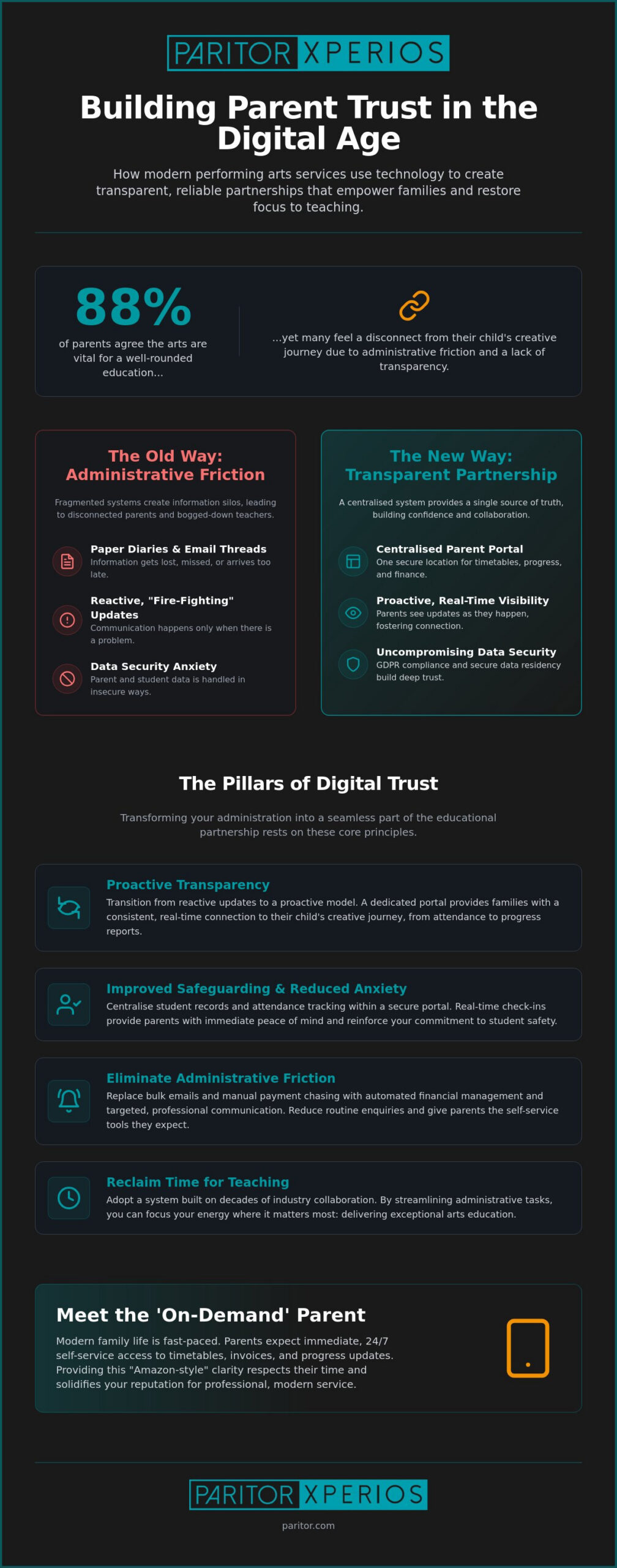
Whilst 88 per cent of parents agree that the arts are vital for a well-rounded education, many still feel a disconnect the moment they drop their child off at the studio door. You’ve likely felt the weight of this gap yourself. It’s the administrative friction of chasing payments or the quiet anxiety of ensuring student data remains secure in an increasingly digital world. Building trust with parents through technology isn’t just about replacing paper with screens; it’s about creating a transparent, reliable partnership that empowers families and restores your focus to teaching.
We understand that the repetitive nature of billing and instrument tracking can pull you away from your creative mission. You deserve a system that acts as a dedicated ally rather than a detached tool. In this guide, you’ll discover how modern performing arts services use integrated portals to foster transparency and uphold the highest standards of data security. We will examine how shifting to a secure, self-service model reduces administrative enquiries and builds a reputation for professional, modern service delivery that keeps parents coming back year after year.
Key Takeaways
- Transition from reactive updates to proactive transparency, ensuring families feel consistently connected to their child’s creative journey.
- Discover why robust GDPR compliance and secure data residency are the invisible foundations for building trust with parents through technology.
- Reduce parental anxiety and improve safeguarding by centralising student records and attendance tracking within a dedicated portal.
- Eliminate administrative friction through automated financial management, replacing bulk emails with targeted, professional communication.
- Learn how adopting a system built on decades of industry collaboration can help you reclaim time for teaching whilst strengthening family partnerships.
The Evolution of Parental Expectations in Performing Arts Education
The landscape of performing arts education has shifted. In 2026, the concept of “Digital Trust” has become the primary benchmark for how music services and arts organisations are perceived. It represents the intersection of uncompromising data security and effortless transparency. Building trust with parents through technology is no longer an optional upgrade; it’s a fundamental requirement for any service aiming to grow and retain its student base. This evolution marks a move away from reactive, “fire-fighting” updates and toward a model of proactive, real-time visibility.
Parents now experience a high level of digital service in almost every other aspect of their lives. They can track a delivery to their doorstep or manage their finances with a few taps on a screen. Consequently, they expect that same “Amazon-style” clarity for their child’s lessons and instrument loans. Relying on fragmented systems like paper diaries, disparate email threads, or verbal updates creates information silos. These silos often lead to administrative friction, where parents feel disconnected from their child’s progress and teachers feel bogged down by basic logistical questions. Centralising this information removes these barriers and establishes a professional standard of care.
The Rise of the “On-Demand” Parent
Modern family life is non-linear and fast-paced. Most parents now manage their children’s extracurricular schedules during small windows of free time, often late at night or whilst on the move. Waiting for a termly paper report or a scheduled phone call is no longer sufficient. There is a clear demand for immediate access to timetables, rehearsal schedules, and exam dates. When an organisation provides this information on demand, it respects the parent’s time and reduces the anxiety associated with missing important updates. This shift to “self-service” information is a powerful tool for improving parent satisfaction and reducing the volume of routine administrative enquiries.
Moving from Communication to Collaboration
The role of educational technology in the arts has transitioned from simple messaging to deep collaboration. There is a significant psychological difference between being “told” information and “accessing” it through a secure system. When parents can log in to a portal to view assessments or manage instrument hire, they become active partners in the educational process. This transparency acts as a bridge amongst teachers, students, and guardians. It ensures everyone is working toward the same goal. By prioritising this collaborative approach, you create an environment of institutional safety where building trust with parents through technology becomes a seamless part of your daily operations.
Transparency as a Trust-Building Asset: Portals and Progress
Trust isn’t built in a vacuum; it requires consistent visibility and reliable data. For many families, the inner workings of a music service can feel opaque once the lesson begins. Building trust with parents through technology becomes tangible when you replace that mystery with a clear, digital window into the student’s experience. Implementing a parent portal for music schools centralises every touchpoint, from lesson times to exam results, into one secure location that families can access whenever they need it.
Real-time attendance tracking provides immediate peace of mind and reinforces your commitment to safeguarding. When a student checks into an ensemble or a one-to-one lesson, that data should be instantly available to guardians. This level of transparency reduces the quiet anxiety parents often feel regarding their child’s whereabouts and safety. Digital progress reports further enhance this relationship by demonstrating clear value for money. Instead of waiting for a termly certificate, parents can celebrate a mastered scale or a successful audition the moment it’s recorded. A centralised digital hub ensures that vital updates, such as venue changes or ensemble cancellations, never suffer from the “lost in the post” syndrome that plagues traditional paper-based communication.
Real-Time Visibility into the Student Journey
Modern systems allow you to track lesson attendance and ensemble participation through automated workflows. This doesn’t just benefit your records; it allows parents to see practice notes and teacher feedback immediately after a session. By providing this instant feedback loop, you encourage a more supportive home practice environment. This visibility also serves a practical purpose: it drastically reduces the volume of administrative “check-in” calls, as parents already have the answers at their fingertips. You might find that adopting a dedicated parent portal is the quickest way to achieve this level of engagement.
Managing Assets and Instruments with Clarity
Instrument loans are often a source of administrative friction and potential dispute. Professional instrument inventory management software builds confidence by providing a clear digital trail of every asset. Parents can access digital loan agreements, view repair histories, and see photographic documentation of an instrument’s condition before it leaves your centre. When you combine this operational clarity with a firm stance on student data privacy and security, you create a foundation of professional trust that is difficult to shake. This structured approach ensures that both the organisation and the family are protected, fostering a long-term partnership built on mutual respect and technological reliability.
Navigating Data Security and GDPR in a Digital-First Environment
Data security is the invisible foundation of all parental trust. Whilst a vibrant portal or real-time updates might impress families initially, that confidence evaporates instantly if sensitive student data is compromised. Building trust with parents through technology requires a commitment to institutional-grade protection that goes beyond simple password management. For UK-based organisations, this means ensuring data residency remains within the UK and adhering strictly to the evolving standards of GDPR. When you provide this level of safety, you’re not just following a regulation; you’re offering families a sense of institutional safety.
We believe that providing this level of protection shouldn’t be an administrative burden that distracts from your creative mission. By utilising cloud platforms like Microsoft Azure, you benefit from the same level of security used by global financial institutions. It’s about creating a “Security First” brand identity. When you educate parents on how their data is encrypted and stored, you remove a significant barrier to digital engagement. Research into parent involvement and technology suggests that when families feel secure in the digital environment, their level of interaction with the educational mission increases significantly.
GDPR Compliance for Music Schools: Beyond the Basics
Compliance in a performing arts context involves unique challenges, such as managing consent for photography and recording student performances. A robust music service management software automates these complexities. It ensures that every parent and teacher portal uses secure, encrypted logins whilst managing data retention policies without manual intervention. This automation ensures you don’t accidentally hold onto sensitive information longer than necessary, keeping you on the right side of the law whilst reducing the risk of human error.
The Security of the Cloud
Many organisations still rely on local spreadsheets or shared drives, which are inherently vulnerable to hardware failure or unauthorised access. Building trust with parents through technology means moving to a secure cloud-based system like Xperios. Unlike local files, cloud systems provide automatic backups, ensuring that student progress records, financial history, and instrument loan data are never lost. This reliability provides a sense of relief for administrators and a stable, professional presence for families. It positions your organisation as a modern, technologically savvy facilitator that prioritises the safety of its community above all else.
Streamlining Communication to Reduce Friction and Anxiety
Communication is often the first point of failure in the parent-teacher relationship. When messages are lost or schedules are unclear, anxiety builds quickly. Building trust with parents through technology involves creating a streamlined, predictable flow of information that respects their time and intelligence. By providing a single source of truth, you eliminate the confusion that stems from fragmented updates across various platforms. This clarity ensures that parents feel supported rather than overwhelmed by the logistics of their child’s arts education.
A significant part of this trust comes from empowering parents through self-service options. When a family can update their own contact details or medical information within a secure portal, they feel a sense of control over their data. It also removes the administrative burden from your staff, who no longer need to manually process every minor change. This collaborative approach transforms the relationship from a one-way dissemination of facts into a dynamic partnership. It allows you to focus on the student’s progress whilst the system handles the repetitive labour of data management.
Financial Transparency and Professionalism
Financial disputes are a common source of friction in the performing arts sector. Automated financial management modules eliminate billing errors and ensure that invoices are accurate and timely. By providing a clear history of past payments and a schedule of upcoming fees, you build professional trust. Parents appreciate being able to view their account balance at their convenience without needing to wait for office hours. These professional, branded communications do more than just relay facts; they reflect the institutional safety and high standards of the education you provide. You can optimise your billing processes to ensure this level of professionalism is maintained across every transaction.
Targeted Communication: Quality Over Quantity
Inbox fatigue is a genuine threat to effective engagement. If parents receive bulk emails that don’t apply to their child’s specific instrument or ensemble, they eventually stop reading your updates altogether. Targeted notifications ensure families only receive information relevant to their child’s journey. Using data to segment your audience means you can send a rehearsal update only to the brass section, rather than the entire school. This precision ensures that vital messages are seen and acted upon. Mobile-friendly communication is also essential for busy parents who manage their family schedules whilst on the move.
Managing the complex logistical requirements of multiple groups requires advanced ensemble management software to keep students, teachers, and guardians synchronised. When schedules are clear and updates are relevant, building trust with parents through technology becomes an effortless part of your service delivery. This level of organisation allows the creative mission to remain the primary focus for everyone involved.
Transforming Administration into a Partnership with Xperios
The journey toward institutional excellence is paved with the reliability of the tools you choose to deploy. Building trust with parents through technology is most effective when the system itself acts as a silent partner, working industriously behind the scenes to ensure every interaction is seamless. Xperios has been developed through 30 years of direct collaboration with the performing arts sector, evolving from user insights rather than developer assumptions. This deep domain knowledge allows the software to anticipate the specific frustrations of music services and private teachers, providing a stable presence that empowers you to excel in your primary role.
Adopting a modern administrative framework allows your organisation to transition from being paperwork-heavy to truly mission-focused. When you automate the repetitive burdens of scheduling and data management, you reclaim the time necessary to prioritise student progress and creative growth. This shift does more than just improve efficiency; it positions your organisation as a forward-thinking leader in the arts. Parents recognise and appreciate the investment in professional, secure technology, which reinforces their decision to trust you with their child’s education. It turns a standard service delivery into a lasting, transparent partnership.
The Xperios Advantage: Modular Trust
The philosophy of simplicity and modularity is at the heart of the Xperios ecosystem. By utilizing specific components like the Exams and Assessments Module or Event Management, you create a comprehensive environment where information flows without friction. These modules are designed for ease of use, ensuring that onboarding is straightforward and implementation leads to immediate service improvements. This is why UK music hubs and leading performing arts schools choose Xperios as their standard. It provides the scalability and reliability needed to manage everything from instrument loans to large-scale ensemble performances with absolute clarity.
Next Steps: Evaluating Your Digital Trust Strategy
Building trust with parents through technology requires a proactive approach to your digital infrastructure. As you evaluate your current strategy, consider whether your existing tools offer the transparency and security families now expect. Ask yourself:
- Does our current system provide parents with real-time, self-service access to schedules and progress?
- Is our student data stored in a secure, UK-based cloud environment with institutional-grade protection?
- Are our financial communications professional, automated, and free from administrative errors?
The long-term ROI of investing in a trust-based framework is found in higher parent retention rates and a significant reduction in routine administrative enquiries. When families feel secure and informed, they become your strongest advocates. You have the opportunity to move forward in your professional journey by adopting a system built specifically for your needs. Discover how Xperios can transform your parent relationships today and see the difference that 30 years of industry expertise can make to your mission.
Elevating Service Standards with Digital Trust
Building trust with parents through technology is about more than just operational efficiency; it’s about establishing a foundation of institutional safety and radical transparency. By moving away from fragmented communication and embracing centralised portals, you provide families with the real-time visibility they now expect. This professional approach, backed by uncompromising data security and GDPR compliance, ensures that your organisation remains a stable and reliable presence in their child’s creative journey.
Xperios acts as your dedicated ally, performing the labour-intensive tasks that once caused administrative friction. Built on 30 years of collaborative industry experience and hosted on the secure Microsoft Azure cloud platform, our software is trusted by leading UK Music Hubs and Performing Arts Schools to deliver excellence. You can reclaim your focus and restore your primary educational mission by adopting a system designed specifically for the arts.
Explore how Xperios builds lasting trust through our secure Parent Portal and take the next step in your professional journey. Your commitment to a modern, secure service will create lasting partnerships that help your students thrive.
Frequently Asked Questions
How does technology specifically help build trust with parents?
Technology builds trust by providing radical transparency and a single source of truth for every student interaction. When parents can access real-time attendance data and teacher feedback, the opaque nature of the classroom is replaced with a visible, supportive partnership. Building trust with parents through technology is most effective when families feel they have immediate, reliable access to the information that matters most to their child’s creative development.
Is it safe to store student data in a cloud-based parent portal?
Storing student data in a cloud-based portal is highly secure when the platform utilises institutional-grade infrastructure like Microsoft Azure. This ensures your data benefits from advanced encryption and robust redundancy measures that local spreadsheets cannot match. By maintaining UK-based data residency and strict access controls, you provide a level of institutional safety that reassures families their sensitive information is protected against unauthorised access at all times.
Can technology help reduce the number of phone calls from parents?
Technology significantly reduces administrative “check-in” calls by empowering parents with self-service information. When families can view timetables, rehearsal schedules, and exam dates through a dedicated portal, they no longer need to contact your office for basic logistical updates. This shift allows your staff to focus on complex enquiries and creative missions whilst the system handles the repetitive dissemination of routine information automatically.
What features should I look for in a music school parent portal?
Look for a portal that offers a comprehensive suite of modules, including real-time scheduling, automated financial management, and student progress tracking. Effective systems should also feature instrument inventory tracking and secure messaging. Choosing a platform built on decades of industry collaboration ensures that the features are tailored specifically to the unique needs of music services and performing arts schools rather than being generic administrative tools.
How do we ensure less tech-savvy parents aren’t left behind?
Ensuring all parents feel included requires a system designed with simplicity and intuitive navigation at its core. Mobile-friendly interfaces and clear, modular naming conventions allow even less tech-savvy users to manage their child’s education with confidence. By providing a clean, organised digital environment, you remove the barriers to engagement and ensure that building trust with parents through technology remains an inclusive strategy for your entire community.
Does using a management system improve GDPR compliance for arts schools?
A dedicated management system drastically improves GDPR compliance by automating data retention policies and consent tracking. Manually managing photography permissions or student performance recordings is prone to human error, whereas a digital database ensures these records are kept accurately and deleted when no longer required. Secure, encrypted logins for all users further strengthen your organisation’s commitment to regulatory standards and professional data privacy.
How much time does it take to implement a new parent portal system?
Implementation timelines vary depending on the size of your organisation, but modular systems are built for a phased and logical transition. Most services see immediate improvements once the core student data and scheduling modules are active. A consultative onboarding process ensures your team is supported throughout the migration, allowing you to move forward in your professional journey without disrupting the daily creative operations of your school.
Can parents track instrument repairs and loans through technology?
Parents can easily track the status of instrument loans and repair histories through integrated instrument management modules. This feature provides families with digital loan agreements and photographic evidence of an instrument’s condition, which reduces disputes and clarifies responsibilities. Having this information available in the parent portal fosters a sense of accountability and professionalism, ensuring that valuable assets are managed with absolute clarity and mutual respect.