

It’s 9:00 AM on a Monday morning. You arrive to find a woodwind tutor and a brass teacher both trying to lead a lesson in the same practice room, whilst a peripatetic staff member is stuck at a different school because of a scheduling overlap. These “Monday morning surprises” are more than just a nuisance; they steal time from educational development and frustrate your team. Implementing a robust music school timetable conflict checker is the most effective way to end this cycle of manual errors and spreadsheet fatigue in 2026.
We understand that managing the complex intersection of teachers, students, and instruments is a massive administrative burden. You deserve a system that acts as a dedicated ally, not another chore. This guide will show you how to reclaim your week and achieve a clean timetable with zero conflicts using intelligent, automated technology. We will explore how a centralised view of your resources and automated notifications can empower your staff and provide total peace of mind for parents. It is time to stop fighting your calendar and start focusing on the music again.
Key Takeaways
- Understand why manual spreadsheets are no longer sufficient for scaling your music service and how to avoid reputation-damaging scheduling errors.
- See how a professional music school timetable conflict checker uses real-time detection to stop double bookings at the point of entry.
- Learn to coordinate peripatetic tutors across various sites whilst ensuring instruments are always available for every scheduled lesson.
- Identify the essential cloud-based features that allow your whole organisation to access live updates and synchronised schedules from any device.
- Discover how a modular approach to school management can reclaim administrative hours and restore your focus to educational development.
The Hidden Challenges of Manual Timetable Management
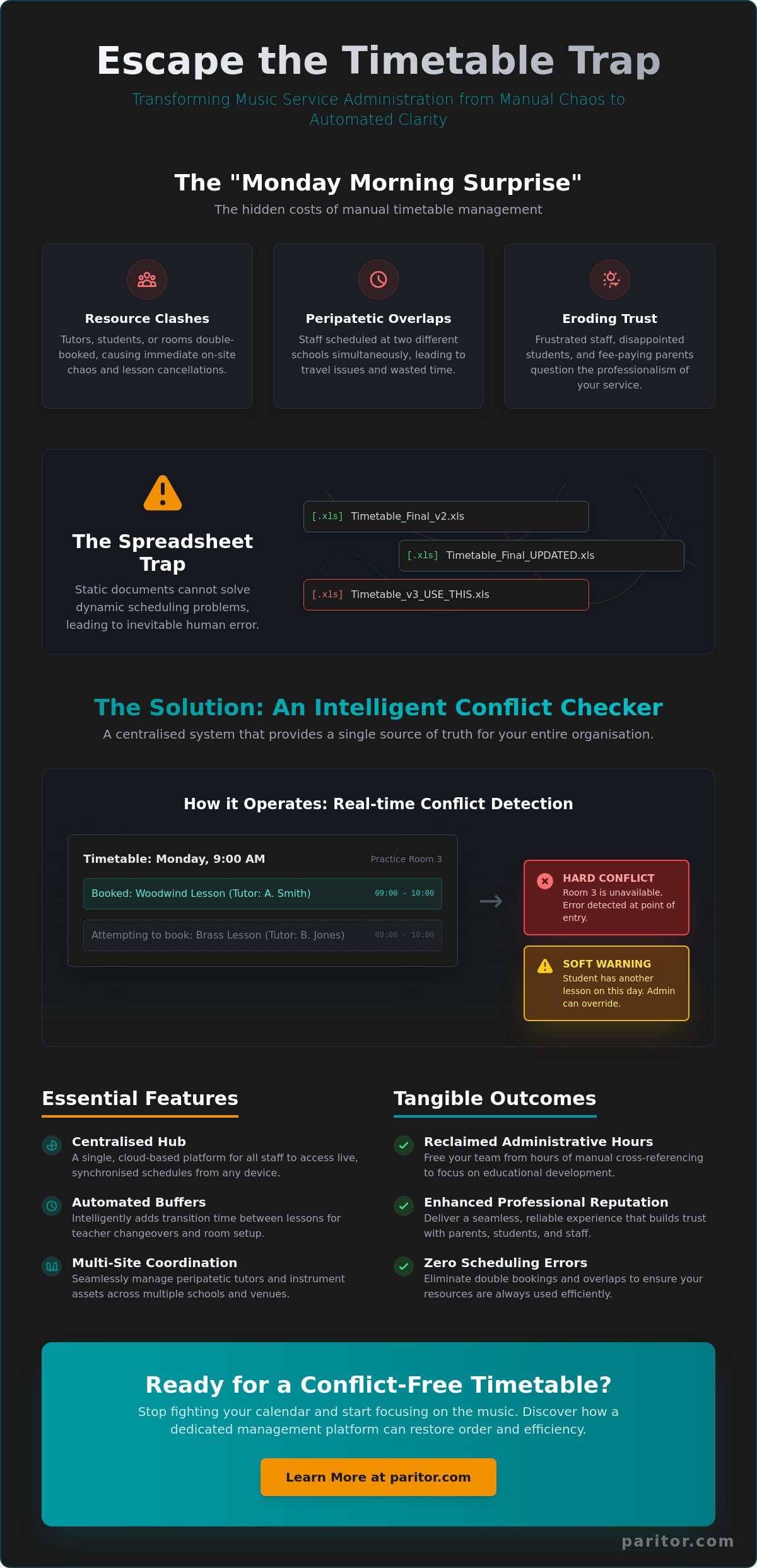
The “Monday morning surprise” is a phrase that haunts many music school administrators. It describes that sinking feeling when two teachers arrive at the same practice room, or a peripatetic tutor discovers they are scheduled at two different schools simultaneously. These manual errors don’t just cause immediate chaos; they erode your institution’s reputation. When staff are frustrated and rooms are double-booked, the professionalism of your service is called into question. It creates an atmosphere of reactive firefighting rather than proactive education.
The economic impact is equally taxing. You might be paying two members of staff for the same time slot whilst only one room is available, or conversely, leaving valuable studio space empty due to a clerical oversight. These inefficiencies represent a direct loss of revenue and resources. Historically, finding computerized solutions for the school timetable problem was a luxury; however, in 2026, it’s a necessity. Relying on a manual music school timetable conflict checker process is no longer sustainable for services aiming for growth and stability. The mental load on your team is immense, as they spend hours cross-referencing data that a machine could process in seconds.
The Spreadsheet Trap and Version Control
Traditional spreadsheets are static documents trying to solve dynamic problems. As your music service scales, the “spreadsheet trap” becomes inevitable. You end up with multiple versions of the same file circulating amongst staff. One person looks at “Timetable_Final_v2” whilst another is editing “Timetable_Final_UPDATED”. This lack of a single source of truth leads to human error. Tracking real-time changes across a regional hub is nearly impossible with manual entry. Static documents simply cannot handle the fluidity of peripatetic schedules, instrument repairs, and room availability.
Impact on the Student and Parent Experience
Beyond the office, scheduling errors hit the people who matter most: students and parents. A cancelled lesson because of a room clash is a disappointment for a child and a frustration for a fee-paying parent. Professional administration is the foundation of trust. If you manage your logistics with precision, parents feel confident in the quality of the education you provide. This is especially vital for those maintaining the high standards expected by UK conservatoires. A reliable music school timetable conflict checker ensures that the focus remains on musical excellence rather than administrative apologies. It transforms the experience from one of uncertainty to one of consistent, reliable progress.
How an Intelligent Music School Timetable Conflict Checker Operates
An intelligent music school timetable conflict checker is far more than a digital diary. It functions as a centralised logic engine that simultaneously cross-references teacher availability, room capacity, and student requirements. Unlike manual methods, this technology identifies clashes at the point of entry. If an administrator attempts to book a cello lesson for a student who is already in a theory class, the system provides an immediate alert. This prevents those “hidden” errors that often lie dormant in spreadsheets for weeks, only to surface at the worst possible moment.
Modern scheduling requires more than just back-to-back blocks. Professional systems incorporate automated “buffers” between lessons. These short intervals allow for teacher transitions, room changeovers, or instrument setup. Without these built-in breathers, even a technically “perfect” timetable fails in practice. Industry experts often discuss Strategies for Managing Scheduling Conflicts, and a key component is building in these realistic timeframes. Visualisation tools, such as colour-coded dashboards, help staff spot gaps or potential issues at a glance, turning a complex data set into an intuitive map of the day’s activities.
Automated Conflict Detection Logic
The system distinguishes between different levels of urgency through “soft” and “hard” warnings. A hard conflict might be two teachers assigned to one small practice room; the system will block this entirely. A soft conflict could be a student having two lessons on the same day, which an admin might allow for specific reasons. This logic ensures that 1:1 sessions and group rehearsals are organised without overlap, protecting the integrity of the educational experience. Managing these nuances through a specialised management platform allows these complex rules to run in the background, freeing your team to focus on tuition quality.
Managing Shared Spaces and Specialist Rooms
Specialist rooms, like percussion studios or grand piano suites, are often the tightest bottlenecks in any music service. Intelligent checkers allow you to link specific instruments to specific rooms. This prevents a woodwind tutor from being allocated a room containing a drum kit needed by another teacher. By optimising room usage based on these constraints, you ensure your facility operates at maximum capacity throughout the day. This level of detail ensures that every square metre of your school is working towards your educational mission, rather than being wasted due to poor coordination.
Coordinating Peripatetic Staff and Instrument Assets
Managing a single site is challenging, but coordinating a network of peripatetic staff requires a higher level of logistical oversight. Peripatetic teachers often juggle complex work patterns across multiple school locations, making manual scheduling a recipe for disaster. A truly effective music school timetable conflict checker must look beyond simple time slots. It needs to account for the physical distance between centres and the availability of specific assets at each site. This is a strategic necessity for modern organisations that operate across regional hubs.
One of the biggest frustrations for travelling tutors is the “impossible schedule.” This occurs when lessons are booked back-to-back at schools that are miles apart. Professional software automates travel time calculations by cross-referencing geographical data. It ensures that a teacher has enough time to pack their gear, drive to the next location, and set up without arriving late. By providing teachers with real-time access to their personal timetables via mobile portals, you empower them to manage their day with confidence and clarity.
Peripatetic Teacher Scheduling and Travel
Managing shared staff means tracking availability that changes by the hour. An intelligent system flags when a teacher is already committed to a different regional hub, preventing the administrative nightmare of double-booking a specialist across two towns. This level of coordination is essential for maintaining a reliable service that schools and parents can trust. When travel times are integrated into the logic, the schedule becomes a realistic roadmap rather than a source of stress. It allows your team to focus on tuition rather than the clock.
Instrument and Asset Conflict Resolution
The logistics of music education often stall because of missing equipment. It is not enough to have a teacher and a room; you must also have the instrument. Integrating instrument inventory management software with your master timetable allows for seamless asset tracking. The system will prevent a lesson from being booked if the required cello or digital piano is already out on loan or scheduled for maintenance. This prevents the embarrassment of a student arriving for a lesson only to find their instrument is unavailable.
This integrated approach solves a common gap found in basic booking tools. Whilst many platforms can reserve a room, few can cross-reference the physical inventory needed for that specific lesson type. By tracking repair schedules and loan periods, your music school timetable conflict checker ensures that every student has the tools they need to succeed. This eliminates the last-minute scramble for a spare violin and ensures that your specialist equipment is always where it needs to be, exactly when it is needed.
Essential Features for Professional Music Service Scheduling
Professional scheduling in 2026 requires a shift from static planning to a dynamic, interconnected ecosystem. It is no longer enough to simply avoid double bookings. You need a system that facilitates growth whilst protecting the time of your staff and the experience of your students. Choosing a music school timetable conflict checker that offers cloud-based synchronisation ensures that every update is instantly visible to the entire organisation. This transparency builds a foundation of professional trust, allowing administrators to step away from the role of “information gatekeeper” and focus on strategic development.
A truly professional solution must also offer seamless integration with ensemble management software. When your individual tuition schedules and large ensemble rehearsals exist in the same environment, the risk of cross-departmental clashes vanishes. Automated communication triggers further reduce the administrative burden. Instead of manually emailing parents about a room change, the system sends an instant notification. This proactive approach ensures that everyone remains informed without adding a single task to your to-do list.
Real-Time Cloud Synchronisation
In 2026, the standard for excellence is instant accessibility. Cloud-based portals allow teachers, parents, and students to view their live schedules from any device. This eliminates the need for physical print-outs or manual notices that are often outdated the moment they are pinned to a board. For services offering hybrid teaching models, these portals can automatically include secure links for Zoom or Microsoft Teams, ensuring that remote lessons start on time and without technical confusion. As students increasingly rely on platforms like DormWay to centralise their academic life through automated scheduling, they expect the same level of digital sophistication from their music education providers.
Exam Administration and ABRSM Integration
Exam periods are notoriously stressful for music service administrators. Scheduling mock exams and ABRSM assessments often requires a total overhaul of the regular timetable, leading to inevitable errors. A sophisticated music school timetable conflict checker includes dedicated modules for exam administration. These tools allow you to allocate specific spaces for external examiners and assign students to their slots whilst automatically flagging any overlaps with their standard tuition. This level of coordination protects your regular revenue streams whilst maintaining a high standard for assessments.
Data security is paramount. It isn’t just about ticking a box; it’s about protecting the students who form the heart of your community. Robust GDPR compliance and encrypted data storage are essential features that provide institutional safety. By centralising your records within a secure, professional framework, you ensure that sensitive student information is only accessible to authorised personnel. To see how these features can transform your administration, discover how Xperios organises your music service with ease.
Elevating Efficiency with Xperios for Music Services
Xperios for Music Services represents the professional standard for UK organisations dedicated to the performing arts. We believe that technology should act as an industrious engine behind the scenes, allowing you to excel in your primary mission of education and creative development. By adopting a sophisticated music school timetable conflict checker, you are not just buying software; you are entering a partnership built on decades of collaborative user insights. Our platform is designed by industry veterans who understand the specific frustrations of management, ensuring that every feature addresses a real-world administrative burden.
The transition from manual data entry to automated coordination brings a profound sense of relief. Integrating a professional music school timetable conflict checker into your daily workflow is the first step toward institutional growth. It restores focus to your staff and provides a stable, reassuring presence for your students. We pride ourselves on being an expert facilitator, providing the tools that eliminate repetitive paperwork and allow your team to reclaim their most valuable asset: time.
The Xperios Modular Advantage
Our philosophy is rooted in simplicity and modularity. We use short, one-word titles for our system components, such as Financial, Parent, and Student, to make navigation intuitive. This modular approach allows you to integrate your scheduling directly with Xperios Financial Management. When a lesson is confirmed in the timetable, the system can automatically trigger invoicing and payroll processes. This eliminates the need for double-handling data and ensures that your financial records are always synchronised with your educational delivery. Whether you are a small private practice or a large conservatoire, our scalable solutions grow alongside your organisation.
A Secure Foundation on Microsoft Azure
Institutional safety is a cornerstone of professional trust. Xperios is built on the robust infrastructure of Microsoft Azure, providing high-level data redundancy and security standards that meet the most stringent requirements. We ensure full GDPR compliance, giving you total peace of mind regarding the sensitive information of your students and staff. You are never alone in this journey; our UK-based team provides professional onboarding and ongoing support to ensure your transition is seamless. By choosing a secure, cloud-based framework, you are building a foundation for a modern, efficient, and forward-thinking music service. It is time to evolve your administration and prioritise the music once again.
Reclaiming Your Time for Musical Excellence
Transitioning to an intelligent music school timetable conflict checker is a decisive step towards modernising your entire organisation. By automating the complex logistics of peripatetic staff travel, instrument availability, and student portals, you eliminate the repetitive burdens that drain your team’s energy. This shift ensures that your focus remains on educational development whilst your administration runs as a silent, efficient engine. You deserve a system that acts as a dedicated ally, providing real-time clarity and total peace of mind for staff and parents alike.
Founded in 1993, we bring decades of industry expertise to every partnership. Our platform is hosted on secure Microsoft Azure cloud infrastructure and is trusted by leading UK music services and conservatoires. It is time to move beyond the spreadsheet trap and embrace a solution built on collaborative user insights. Discover how Xperios can transform your music service administration and start your journey towards a more organised, empowered future today. We look forward to helping your service thrive.
Frequently Asked Questions
Is a timetable conflict checker included in standard music school software?
A music school timetable conflict checker is typically a core component of professional management systems rather than a separate add-on. In platforms like Xperios, this logic runs in the background to validate every booking against teacher and room availability. This integrated approach ensures that your data remains consistent across all modules, from scheduling to financial invoicing. It provides a stable foundation that allows administrators to work with confidence and precision.
How does a conflict checker handle peripatetic teachers working at multiple sites?
The system manages peripatetic staff by tracking their movements across multiple regional hubs and schools. It goes beyond simple time slots by calculating realistic travel times between different locations based on your specific requirements. This prevents the stress of back-to-back bookings in different towns. By providing a centralised view of a teacher’s entire week, it ensures they arrive prepared and on time for every student, regardless of their location.
Can I manage room bookings and instrument loans in one centralised system?
Centralised systems allow you to link physical assets directly to specific rooms and lesson types. When an administrator books a session, the system cross-references the instrument inventory to confirm the required equipment isn’t already on loan or in for repair. This level of coordination ensures that specialist rooms and instruments are always utilised effectively, preventing the embarrassment of a student arriving to find their equipment is missing or their room is occupied.
What happens if a scheduling conflict is detected mid-term?
If a conflict arises mid-term due to a room closure or staff absence, the music school timetable conflict checker provides real-time alerts on your dashboard. You can instantly identify the clash and use the drag-and-drop interface to find an alternative slot or location. Automated notifications then inform teachers and parents of the change immediately. This proactive communication maintains your professional reputation and keeps your educational mission on track without manual firefighting.
Is it possible to sync school timetables with teachers’ personal calendars?
Real-time synchronisation allows teachers to view their live timetables through dedicated portals or by syncing with their personal digital calendars. This feature provides tutors with instant updates on room changes or student cancellations whilst they are on the move. By bridging the gap between professional and personal scheduling, you empower your staff to manage their time more effectively, reducing the risk of missed sessions and administrative confusion across the whole team.
How much time can automated scheduling save a large music service?
Automated scheduling can reclaim hundreds of hours over an academic year for large music services. By removing the need for manual cross-referencing and spreadsheet updates, your administrative team is freed from repetitive, taxing labour. This shift allows your organisation to focus on higher-level tasks, such as curriculum development and community engagement. It transforms your office into a proactive hub of growth rather than a reactive centre for error correction and manual data entry.
Does the software support group ensemble scheduling as well as 1:1 lessons?
The platform is designed to manage complex ensemble rehearsals alongside standard 1:1 tuition. It cross-references the schedules of every student and staff member involved in the group to ensure there are no overlapping commitments. This comprehensive coverage is essential for large organisations that manage multiple choirs, orchestras, and bands. It ensures that your resources are balanced correctly across all departments, providing a seamless and organised experience for every student involved.
How does the system handle bank holidays and school half-terms?
You can easily define term dates, half-terms, and bank holidays within the system settings to ensure total accuracy. The scheduling engine respects these boundaries, automatically skipping recurring lessons on dates when the school is closed. This prevents billing errors and ensures that parents aren’t notified of lessons that won’t take place. It provides a reliable, automated way to manage the academic calendar, allowing your team to plan the entire year with total certainty and ease.