

Did you know that automating back-office tasks can reduce staff time spent on manual verifications by as much as 60%? For many arts leaders, the dream of seamless music school admin automation feels distant whilst they’re buried under a mountain of spreadsheets and sticky notes. You likely started your academy to foster creative talent, not to spend your weekends untangling the complex schedules of peripatetic teachers or manually tracking instrument loans across multiple sites. It’s a common frustration that drains your energy and pulls focus away from the rehearsal room.
We understand that these repetitive burdens are the hidden costs of your success. This 2026 modernisation template will show you how to reclaim hundreds of hours by identifying and auditing the administrative bottlenecks unique to the performing arts. We’ll explore how moving from fragmented systems to a centralised hub for student data and automated billing can transform your operation. By the end of this guide, you’ll have a clear roadmap to reduce late payments and restore your focus to what matters most: curriculum excellence and student progress.
Key Takeaways
- Identify the hidden financial and emotional costs of manual processes, from staff burnout to data entry errors that impact your bottom line.
- Learn how to categorise tasks by frequency and complexity to find the best opportunities for music school admin automation.
- Compare the efficiency of automated term-end billing and attendance registers against traditional, paper-based workflows.
- Follow our step-by-step template to audit your current workflows and consult stakeholders on their primary administrative pain points.
- Explore how modular, cloud-based solutions like Xperios allow you to scale your technology alongside your academy’s growth.
The True Cost of Manual Administration in Arts Education
Many music services operate on a knife-edge of administrative exhaustion. Business process automation is the strategic use of software to handle repetitive, rule-based tasks. It isn’t just about replacing paper; it’s about shifting your entire operational model. For arts organisations, music school admin automation represents the difference between a team that is constantly firefighting and one that is focused on artistic growth. When your staff are bogged down by data entry, they aren’t supporting teachers or inspiring students.
Manual systems carry heavy, unseen burdens. You might see the hours spent on data entry, but you don’t always see the cost of staff burnout or the revenue lost when a late payment isn’t chased. In the UK, where arts funding is often stretched, every missed invoice or double-booked rehearsal room hurts the bottom line. Research shows that automating procurement and billing can shrink invoice processing cycles from an average of nine days to under three. This level of efficiency is impossible with manual tracking.
Arts organisations face unique hurdles that traditional schools don’t. You have to manage the complex, shifting timetables of peripatetic teachers whilst simultaneously tracking instrument loans across multiple school sites. These aren’t just data points; they’re the lifeblood of your service. When these tasks are handled manually, errors are inevitable. A missed instrument return or a scheduling clash doesn’t just waste time; it disrupts a student’s learning journey and damages your reputation with parents.
Why Spreadsheets are the Enemy of Growth
Spreadsheets are incredibly fragile tools for a growing academy. One accidental keystroke in a complex formula can ruin an entire month of invoicing, leading to embarrassing apologies to parents and delayed payments. They also lack real-time visibility. Whilst a spreadsheet sits on a staff laptop, parents and teachers remain in the dark about schedule changes or lesson status. Sharing sensitive student data via email attachments is also a significant security risk that modern UK data regulations simply don’t permit. It’s time to move beyond “surviving” on static files.
Reclaiming Your Educational Mission
When you automate, you aren’t just buying software; you’re buying back your time. Imagine shifting from 20 hours of manual scheduling and billing each week to just two hours of oversight. This isn’t a hypothetical dream. It’s the reality for leaders who choose to modernise. The emotional relief of knowing your back office is organised and secure is immense. This newfound freedom allows you to focus on pedagogy, curriculum design, and student progress. Ultimately, a more efficient engine behind the scenes leads to better outcomes for every young musician in your care.
Identifying the Best Tasks for Automating School Admin
Success in modern arts education depends on where you direct your energy. Identifying where to start with music school admin automation involves a simple audit of your daily routine. You should look for the “low-hanging fruit” first. These are the tasks that occur frequently but require little creative decision-making. By moving these high-volume, low-complexity tasks into an automated workflow, you eliminate the cognitive load on your team. This allows them to step away from the desk and back into the studio.
Focus your initial efforts on the core pillars of music school admin automation: the triple threat of billing, scheduling, and asset tracking. These areas usually involve the most manual data entry and the highest volume of parent communication. When you establish a single “source of truth” for student and teacher data, you ensure that every department is working from the same information. This consistency is the foundation of a professional, modern arts academy.
Financial and Billing Automation
Manual billing is a significant drain on resources. Automated invoicing for term fees and instrument hire ensures that every parent receives a consistent, professional bill on time. Integrating Direct Debit options through a dedicated Financial Management system removes the need for staff to spend days every month chasing late payments. You can generate comprehensive financial reports for board meetings in seconds, providing a clear view of your school’s health without the traditional paperwork headache.
Scheduling and Attendance Tracking
Managing the diaries of peripatetic teachers is often a logistical nightmare. Automation allows you to coordinate timetables across multiple school locations seamlessly. Teachers can mark attendance in real-time via dedicated portals, which immediately improves your safeguarding standards. If a lesson needs to be cancelled or moved, the system can send automated notifications to parents and students. This level of communication builds trust and reduces the volume of “where is my teacher?” phone calls to your office.
Instrument and Asset Management
Tracking a fleet of violins or keyboards across a county requires precision. Digital tracking of instrument loans, repairs, and maintenance schedules ensures that no asset is lost or forgotten. You can automate hire agreements and deposit collections to protect your school’s investments. For larger inventories, using QR code or barcode integrations allows for rapid, error-free audits. This ensures your equipment is always where it needs to be, ready for the next student to pick up and play.
By embracing these digital shifts, you are effectively Future-Proofing Your Organisation against the evolving demands of the 21st-century educational landscape. Automation isn’t just about speed; it’s about creating a stable environment where creative excellence can thrive. When the “engine” of your school runs itself, you’re free to focus on the music.
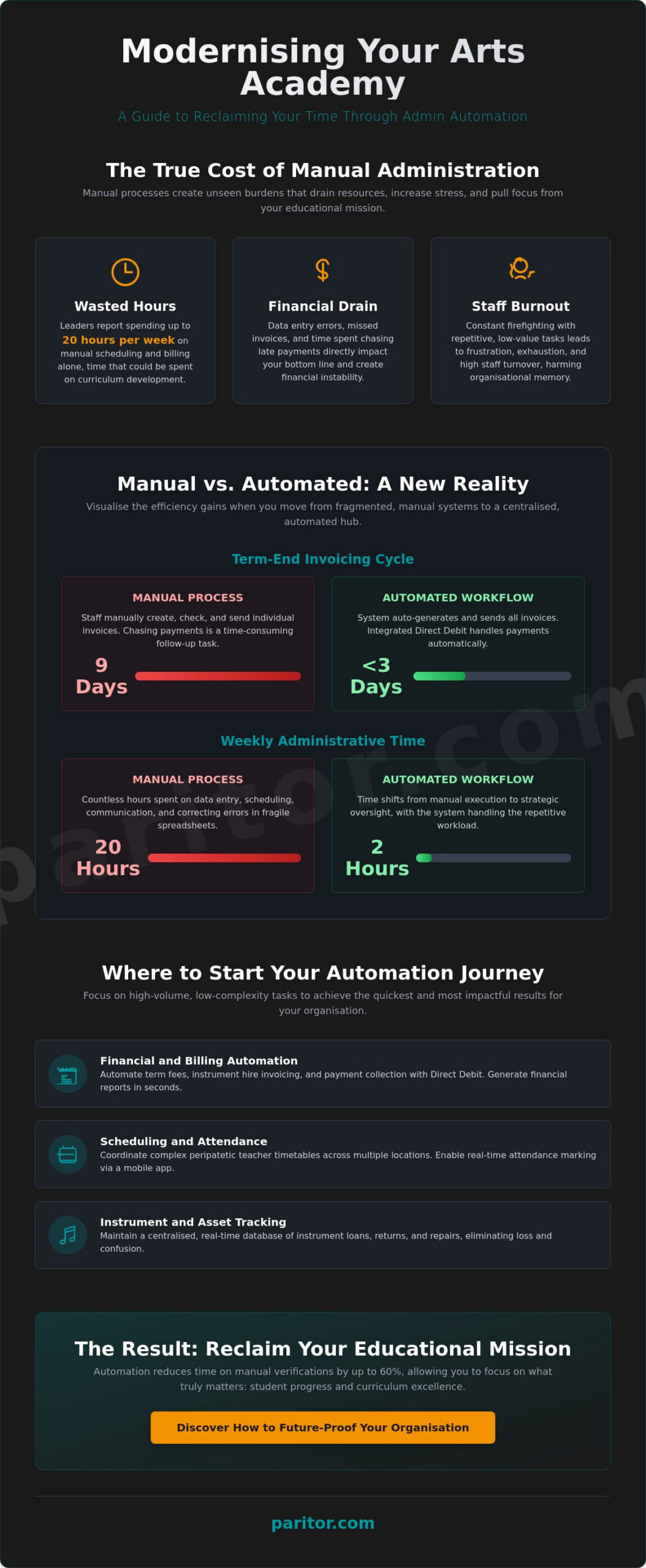
Manual vs. Automated: A Comparison for Arts Leaders
Manual administration eventually hits a ceiling. As your student numbers grow, the volume of paperwork grows exponentially, leading to a point where your team simply cannot keep up without hiring more staff. In contrast, music school admin automation allows your organisation to scale without a corresponding increase in overheads. Whether you are managing fifty students or five thousand, the effort required to process a billing cycle remains virtually the same because the software handles the heavy lifting.
Consider the accuracy gap. Paper registers are easily lost, damaged, or misread, which creates a significant risk for safeguarding and financial reporting. Automated attendance, recorded via a teacher portal, provides an instant, unalterable digital trail. This transparency doesn’t just protect students; it also ensures that teachers are paid correctly for every session delivered. For parents, the difference is equally stark. Instead of waiting days for an email response about a lesson change, they can access a 24/7 portal to check schedules, progress, and invoices at their convenience.
The Efficiency Gap in Financial Management
The financial impact of switching is measurable. Organisations using manual systems often struggle with high “days sales outstanding” (DSO), as chasing late payments relies on staff remembering to send follow-up emails. By implementing music school financial management, you can trigger automated reminders that ensure fees are collected faster. This transformation in cash flow is supported by automated reconciliation, which matches payments to invoices without manual intervention, saving your accounting team days of tedious work every term.
Security, Compliance, and GDPR
Data safety is a non-negotiable requirement for UK schools. Manual records kept in filing cabinets or local spreadsheets are vulnerable to physical loss and unauthorised access. Cloud-based systems offer a much higher standard of protection through robust encryption and restricted user permissions. When a parent submits a “Right to be Forgotten” request under GDPR, a centralised database allows you to locate and erase that data in seconds. Hosting student information on Microsoft Azure ensures your data remains within a secure, UK-compliant infrastructure, providing the gold standard for institutional safety and reliability.
Your Step-by-Step Template for Automating School Admin
Transitioning from manual processes to a digital environment requires a structured approach to ensure your team feels supported rather than overwhelmed. This music school admin automation template provides a clear path to modernisation, allowing you to transition smoothly whilst maintaining your high service standards. By following these steps, you can move away from fragmented systems and into a unified digital workspace.
- Step 1: Workflow Audit. Map out your current processes to identify the most time-consuming manual tasks. Look for areas where staff are duplicating data entry.
- Step 2: Stakeholder Consultation. Speak with your teachers, parents, and admin staff. Understand their daily frustrations, such as chasing paper registers or confusing billing cycles.
- Step 3: Requirement Definition. List the essential features you need in a cloud-based platform, such as real-time scheduling or integrated financial management.
- Step 4: Data Cleansing. Before migrating to a new system, ensure your student and teacher records are accurate. This “fresh start” prevents old errors from cluttering your new database.
- Step 5: Phased Implementation. Don’t try to change everything at once. Start with a critical module, like invoicing, to demonstrate immediate value before rolling out further features.
Conducting an Administrative Audit
To find your operational bottlenecks, map out a “day in the life” of your admin team. You will likely discover redundant data entry where the same student information is typed into three different places: the register, the invoice, and the instrument log. Use a simple “Impact vs. Effort” matrix to prioritise your first project. Tasks that offer high impact with relatively low effort, such as automated term-end billing, should be your priority. This approach ensures your team sees the benefits of music school admin automation almost immediately.
Choosing the Right Partner
General school software often fails to meet the specific needs of music and performing arts services. These generic tools rarely account for the complexity of peripatetic teaching or the nuances of ensemble management. When evaluating vendors, ask about their UK-based support and their experience with large-scale data migration. A system built on collaborative user feedback from the arts sector will always be more effective than a one-size-fits-all solution. You need a partner that understands your educational mission as well as your administrative burdens.
Ready to start your journey toward a more efficient academy? Explore how Xperios modules can be tailored to your school’s unique requirements.
Future-Proofing Your Organisation with Xperios
Xperios stands as the specialist cloud management standard for the UK arts sector. It is built specifically to solve the friction points discussed throughout this guide, providing a robust alternative to fragmented manual systems. By embracing music school admin automation, you aren’t just adopting a tool; you’re joining a community of leaders committed to operational excellence. Our platform is modular by design. This means you only pay for the specific features your organisation requires today, with the flexibility to add more as you grow. Whether you need Ensemble Management for a local youth orchestra or Financial Management for a multi-site academy, the system adapts to your scale.
Communication is the heartbeat of any performing arts service. The Teacher, Parent, and Student portals modernise how information flows through your school. Instead of endless email chains, parents can view lesson notes and progress portfolios in a secure, digital environment. Teachers can update registers on the go, whilst students feel more connected to their learning journey. This integrated approach ensures that every stakeholder is informed, reducing the administrative noise that often clutters the working day. It creates a professional image that builds trust with your community.
Designed for Music and Performing Arts
Generic school software often overlooks the practicalities of instrument tracking or complex assessment modules. Xperios fills this gap with features developed through direct collaboration with industry veterans. From managing a fleet of hire instruments to coordinating large-scale events, the platform handles the unique logistics of the arts. It scales effortlessly. Whether you are a private teacher or a national music hub, the platform ensures consistent performance at every level. For a deeper dive into these capabilities, see our music service management software pillar.
Taking the First Step Toward Modernisation
Modernising your academy shouldn’t be a daunting prospect. Paritor acts as your dedicated facilitator, providing structured implementation programmes that guide you through every stage of onboarding. We view ourselves as your partner in progress, not just a software vendor. Our core promise remains the same: the software performs the labour-intensive tasks so you can return to the classroom. The relief of a streamlined back office is within reach. Ready to see the template in action? Book a discovery call with the Paritor team today and discover how music school admin automation can empower your educational mission.
Elevating Your Academy Through Modernisation
Modernising your academy is about more than just efficiency; it’s about restoring your original educational mission. By moving away from fragile spreadsheets and embracing music school admin automation, you protect your student data with Microsoft Azure cloud security whilst freeing your team from repetitive manual labour. We’ve explored how a structured audit and a modular implementation can transform your back office into a silent, industrious engine that supports your creative goals.
With over 30 years of arts education expertise, Paritor provides the dedicated UK-based support and implementation you need for a seamless transition. You don’t have to navigate this journey alone. Our platform is built on collaborative user insights to ensure it solves the specific frustrations of scheduling, billing, and instrument management. This partnership ensures your system remains as dynamic and ambitious as your students.
Discover how Xperios can automate your school admin today.
It’s time to step away from the paperwork and back into the studio, knowing your organisation is secure, compliant, and ready for growth. We’re here to help you turn that vision into a reality.
Frequently Asked Questions
What are the first steps to automating school admin tasks?
The first step is conducting a thorough audit of your current manual workflows. You should identify the most repetitive, time-consuming tasks, such as term-end billing or tracking instrument loans. Once you’ve mapped these bottlenecks, choose a single module to automate first. This phased approach allows your team to adjust to the new system without feeling overwhelmed by a total organisational shift.
Is automated school management software secure enough for GDPR?
Specialist cloud-based platforms are designed with strict UK data protection standards in mind. By hosting data on secure infrastructures like Microsoft Azure, you benefit from enterprise-level encryption that local spreadsheets can’t match. These centralised systems simplify GDPR compliance, making it easy to manage consent and process “Right to be Forgotten” requests in seconds rather than hours.
Can I automate scheduling for peripatetic teachers across different schools?
Managing the complex diaries of peripatetic staff is a core feature of music school admin automation. The system allows you to coordinate timetables across various school sites whilst providing teachers with real-time access to their schedules. If a lesson is moved, the platform can automatically notify parents and students, ensuring everyone stays informed without manual phone calls or emails.
How much time can my staff really save by automating admin?
Staff can reclaim a significant portion of their working week through music school admin automation. Data suggests that automating procurement and invoicing can shrink processing cycles from nine days to under three. By reducing the time spent on manual verifications by 60%, your team can shift their focus from paperwork to supporting your academy’s educational mission and student progress.
Will automation replace the need for administrative staff in my school?
Automation is an expert facilitator, not a replacement for your valued team. It acts as an industrious engine behind the scenes, handling repetitive data entry so your staff can excel in roles that require a human touch. This shift empowers your administrators to become more involved in student welfare, curriculum planning, and building stronger community relationships.
Does school admin software integrate with my existing accounting tools?
Most advanced platforms are built to work alongside your current financial infrastructure. They allow you to export detailed reports or integrate directly with popular accounting tools. This eliminates the risk of human error during manual re-entry and ensures your school’s financial records remain accurate and up to date throughout the academic year without extra effort.
How long does it take to migrate from spreadsheets to an automated system?
Migration usually takes a few weeks, depending on the volume and quality of your existing records. A structured implementation programme involves cleaning your data first to ensure a “fresh start” in the new environment. This consultative process ensures that the transition is smooth and that your team feels confident using the new tools from day one.
What happens if a parent does not want to use an online portal?
Your centralised system remains the primary “source of truth”, even if a parent prefers not to use the portal. You can still generate invoices, schedules, and reports for them manually using the data stored in the hub. This ensures your internal records are consistent whilst you continue to provide personalised service to families who favour traditional communication methods.