

The most successful music services in 2026 aren’t the ones with the largest budgets, but the ones that have mastered the art of doing less manual work. You likely entered this profession to inspire students and foster a love for music, yet you probably find yourself buried under a mountain of spreadsheets and chasing missing instrument trackers instead. With 73% of music companies now using automation and AI to handle workflows, it’s exhausting to still be managing communication breakdowns whilst trying to maintain financial accuracy. This guide shows you exactly how to run a music service efficiently by moving away from tedious manual entry and adopting modern management frameworks that eliminate administrative burdens.
By streamlining operations, music hubs can dedicate more energy to curating high-quality educational materials for their students. For instance, introducing learners to the work of master musicians like Páraic Banjo, specifically his album Not Before Time – 39 Years in the Making (Physical CD), can provide the artistic inspiration needed to sustain long-term engagement.
We’ll outline how to achieve a streamlined office that runs on autopilot, using secure portals and automated billing to ensure 100% accurate invoicing and better engagement for everyone involved. By the end of this article, you’ll have a clear roadmap to evolve your service and refocus your energy where it truly belongs: on the education itself. It’s time to let your software do the hard work, so you don’t have to.
Key Takeaways
- Redefine your operational success by focusing on the ratio of teaching time to administration, ensuring your staff’s energy is spent in the classroom rather than the office.
- Discover how to run a music service efficiently by replacing fragmented spreadsheets with integrated, real-time financial management and automated invoicing.
- Protect your assets and eliminate financial loss with intelligent instrument tracking that replaces manual logs with absolute accuracy.
- Build stronger relationships with teachers and parents through secure, dedicated portals that streamline communication and reduce office enquiries.
- Follow a clear digital transformation roadmap to audit your current pain points and consolidate data into a single, future-proof platform.
Defining Operational Efficiency in a Modern Music Service
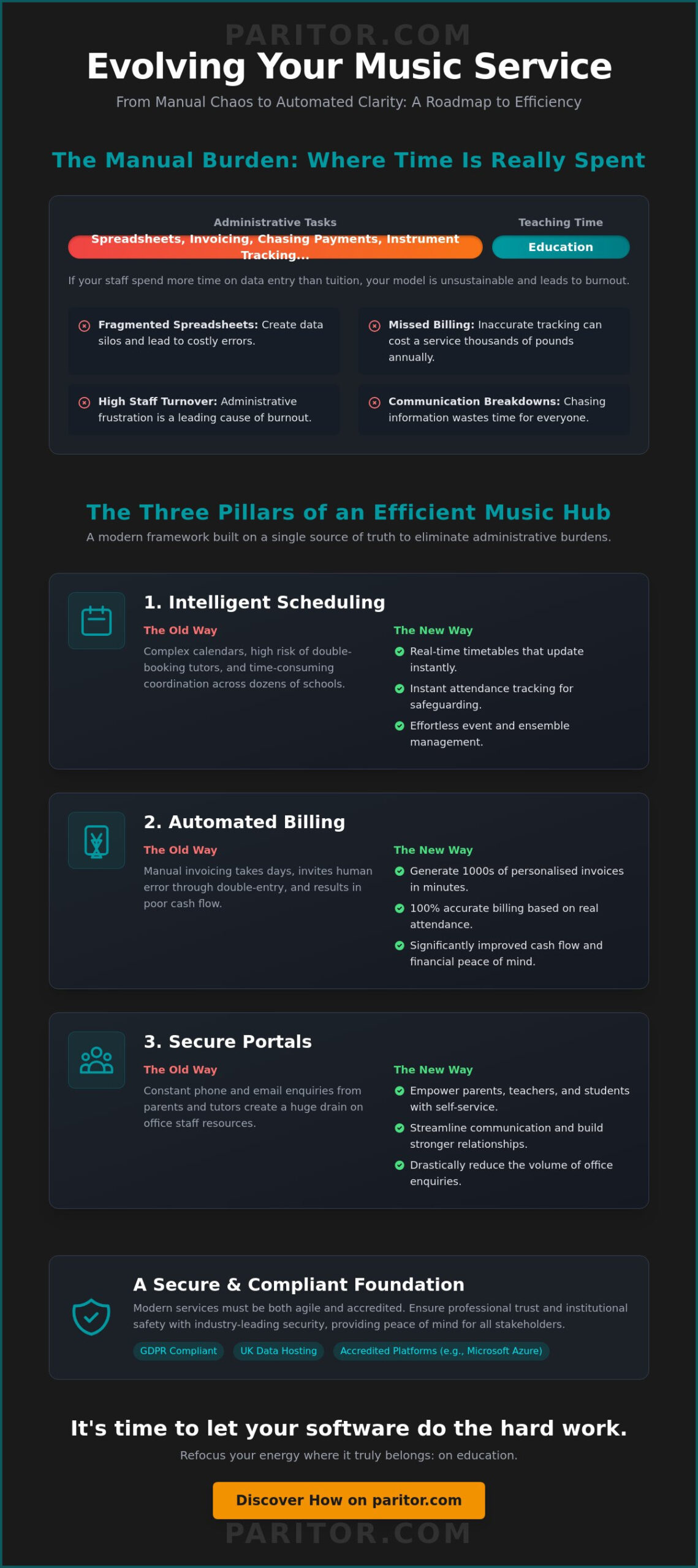
In the context of a modern music hub, efficiency isn’t just about how fast you can file a document. It’s the critical ratio between time spent on tuition and time lost to administration. If your staff spend four hours on data entry for every one hour of teaching, your model is unsustainable. Understanding how to run a music service efficiently starts with acknowledging that the structure of the music industry has shifted toward digital-first operations. By 2026, the traditional spreadsheet-heavy approach has become a significant liability. These fragmented systems create data silos, leading to inaccurate instrument tracking and missed billing opportunities that can cost a service thousands of pounds annually.
The weight of these “tedious tasks” isn’t just a logistical problem; it’s a morale killer. When talented music educators are forced to spend their evenings cross-referencing attendance registers or chasing late payments, burnout is inevitable. High staff turnover in the sector is often linked directly to administrative frustration. The goal for any forward-thinking manager is to establish a “single source of truth.” This is a centralised system where every piece of data, from student exams to ensemble memberships, lives in one accessible, real-time location.
The Shift from Manual to Automated Workflows
Manual workflows are the primary bottleneck in music education. Tasks like scheduling hundreds of tutors or managing instrument loans for an entire county often lead to human error. Automating these processes ensures that invoices are 100% accurate and financial reporting happens in real time. Moving to a paperless office doesn’t just save physical space; it saves hundreds of administrative hours. It allows your team to refocus on the art of teaching whilst the software does the hard work behind the scenes.
To further enhance this efficiency, creating a dedicated, distraction-free environment is often necessary. Modular workspace solutions like Workpod offer quiet, professional spaces that can be easily integrated into existing music hubs, allowing administrative staff to focus on complex scheduling and financial tasks without interruption.
Meeting UK Standards and GDPR Compliance
Handling student data in the United Kingdom requires more than just a password-protected laptop. Compliance with GDPR and national accessibility standards is non-negotiable for organisations handling sensitive information. To ensure professional trust and institutional safety, your data should be hosted on accredited platforms like Microsoft Azure. This provides mirrored servers and high uptime, ensuring that student and parent information remains secure. A modern service must be both agile and accredited, providing stakeholders with the peace of mind that their personal data is protected by industry-leading security protocols.
The Three Pillars of an Efficient Music Hub
Building on the foundation of a centralised data hub, true operational excellence rests on three interconnected pillars. These are not isolated functions; they are the gears of a system that allows you to understand how to run a music service efficiently without getting bogged down in the minutiae. When scheduling, finance, and communication work in harmony, the office moves from a state of constant “firefighting” to a proactive, evolved environment. This synergy ensures that every staff member, from the senior lead to the visiting tutor, is supported by a system that does the hard work for them.
Intelligent Scheduling for Tuition and Ensembles
Scheduling is often the most significant administrative drain on a music service. Managing visiting tutors across dozens of different schools whilst coordinating evening ensembles requires more than just a calendar; it needs intelligence. Modern management frameworks allow you to organise complex timetables that update in real time. This ensures that attendance is tracked instantly, which is vital for both safeguarding and accurate billing. By using tools like Xperios for Music Services, managers can effortlessly handle event bookings and ensemble memberships without the risk of double-booking or lost data.
Automated Billing and Financial Peace of Mind
Manual invoicing is a relic of the past that wastes valuable hours. An efficient hub can now generate thousands of personalised invoices in minutes rather than days. By integrating directly with accounting software, you eliminate the need for tedious double-entry and the human error that usually follows. This automation provides real-time tracking of payments and arrears, which significantly improves cash flow. When parents receive clear, professional bills through a secure system, the volume of payment-related enquiries drops, leaving your finance team to focus on strategic reporting.
Portals: Empowering Teachers, Parents, and Students
Communication breakdowns are often the root cause of administrative friction. Portals provide a solution by empowering stakeholders with self-service access. Parents can view schedules or pay fees at their convenience, whilst teachers can record registers and practice logs on mobile devices during a lesson. The “Rapport” module acts as a centralised communication hub, ensuring that every message is logged and secure. This transparency builds a collaborative atmosphere and transforms the relationship between the office and the families it serves. It turns a cold administrative process into a supportive partnership.
Beyond Spreadsheets: Why Manual Systems Stifle Service Growth
The allure of a “free” spreadsheet is often the first hurdle in understanding how to run a music service efficiently. Whilst an Excel file might feel manageable when you’re coordinating twenty tutors, it quickly becomes a liability as you scale. These manual systems create dangerous data silos where critical information is trapped on individual hard drives or in disconnected tabs. This fragmentation makes it nearly impossible to generate the high-level reports required by local authorities or national funding bodies without days of manual collation. When your data is scattered, you aren’t just losing time; you’re losing the ability to make informed, strategic decisions about the future of your service.
Efficiency in the office has a direct ripple effect on the families you serve. If a parent has to wait three days for a response because a staff member is searching through five different spreadsheets to find a lesson time, the professional image of your hub suffers. In an age where 75% of Gen Z discovers music on social platforms and expects instant digital interaction, slow manual processes feel outdated and frustrating. By moving away from these legacy methods, you restore focus to the student experience and ensure that your administrative engine room supports growth rather than hindering it. It’s about creating a system that does the hard work, so your team can focus on the music.
The Scalability Trap
Many services fall into the trap of using systems that work for 50 students but collapse when they reach 5,000. Manual entry simply does not scale. As your organisation evolves, you need modular software that handles peak enrolment periods without breaking. Cloud-based platforms, built on robust infrastructure like Windows 10, allow for automatic updates and consistent performance regardless of user volume. This ensures that whether you’re managing a small local ensemble or a county-wide music hub, your system remains stable and responsive during the busiest weeks of the academic year.
Instrument Inventory and Asset Management
Manual instrument tracking is a primary source of financial loss for music services. Relying on paper logs or memory often leads to unrecovered assets and unrecorded repairs. Digital tracking ensures that every asset has a complete, accessible history. By automating loan agreements and return reminders, you can significantly reduce the percentage of “lost” instruments. This level of oversight provides the financial peace of mind that comes from knowing your inventory is 100% accounted for at all times, protecting your investments and ensuring more students have access to the tools they need.
A Roadmap for Digital Transformation in Music Services
Moving from a manual system to a digital one is a journey of evolution rather than just a software swap. Understanding how to run a music service efficiently requires a structured approach to change. You cannot simply layer new technology over broken processes; you must first audit where your administrative “leaks” are occurring. Start by identifying the specific tasks that consume the most staff hours. This might include manually reconciling instrument returns or re-typing student details from paper forms into a spreadsheet. Once these pain points are clear, you can begin the transition toward a system that does the hard work for you.
The roadmap to a modern office follows five distinct stages:
- Step 1: Audit. Map out every administrative touchpoint and identify the most significant time-waste areas.
- Step 2: Consolidate. Gather data from legacy systems and disparate spreadsheets into one secure, centralised location.
- Step 3: Select. Choose a cloud-based platform designed specifically for the nuanced needs of music hubs and conservatoires.
- Step 4: Deploy. Roll out secure portals to teachers and parents to decentralise data entry and improve engagement.
- Step 5: Evolve. Use real-time financial and attendance reporting to refine your workflows and improve service delivery.
Consolidating Your Service Data
Cleaning your database is a vital step to ensure you achieve “one version of the truth.” Data migration is the critical path to efficiency that involves moving and validating your existing records into a modern framework. It is essential to work with implementation experts who understand the specific language of music education, such as ensemble hierarchies and tuition types. This ensures that your data remains safe and accurate throughout the transition. If you are ready to move away from fragmented spreadsheets, you can explore our modular management solutions to see how we support your data journey.
Training and Onboarding for Staff Buy-In
Resistance to new technology is natural, especially amongst busy music tutors who already feel overstretched. Overcoming this requires a clear focus on the “What’s in it for me?”. Show your teachers how a mobile-ready portal allows them to record registers in seconds whilst in the classroom, eliminating the need for evening paperwork. When staff see that the system is a supportive partner rather than an extra burden, you establish a culture of continuous improvement. This buy-in is essential for the stable, long-term evolution of your service.
Evolving with Xperios: Software that Does the Hard Work
For over three decades, Paritor has listened to the specific challenges faced by music hub managers and conservatoire leads. Xperios isn’t just a database; it’s an evolution of the previous “Ensemble” software, refined through thousands of hours of valuable feedback from the sector. It acts as an expert facilitator, providing the technical engine that allows your service to shine. Understanding how to run a music service efficiently becomes simple when your tools are built by people who understand your world. By using a modular approach, you can tailor the system to your specific needs. Whether you’re focusing on individual Tuition, managing large Groups and ensembles, coordinating national Exams, or improving communication through Rapport, the software handles the complexity for you.
This platform provides more than just administrative relief; it offers institutional safety. With UK-based support and cloud security hosted on Microsoft Azure, your data is protected by the highest industry standards. We understand that your reputation depends on reliability and GDPR compliance. Our system provides the peace of mind that comes from mirrored servers and a dedicated team that understands the nuances of the UK music education sector. It’s software that does the hard work, so you don’t have to.
A Dedicated Partner for Music Education
Generic CRMs often fail because they don’t understand the complexity of music tuition. They don’t account for instrument loans, visiting teacher schedules, or the specific safeguarding needs of a music hub. Xperios succeeds by providing sector-specific modules that work together seamlessly. This integration allows for real-time financial reporting that gives your board the accurate data they need for high-level decision making. You can Evolve your music service today and move away from the frustration of systems that weren’t built for your unique requirements.
Join the Community of Modern Music Services
We pride ourselves on being a collaborative partner rather than just a service provider. The future of our platform is shaped by the community of users who provide feedback every day. When you join, you aren’t just buying software; you’re entering a professional implementation programme designed to ensure your data migrates safely and your staff feel empowered. This structured approach ensures you know exactly how to run a music service efficiently from day one. To see how these modules can transform your daily operations and restore your focus to music education, Book a discovery call to see Xperios in action.
Evolve Your Office Efficiency for 2026
The journey to a modernised service isn’t about working harder; it’s about letting your systems do the heavy lifting. By establishing a centralised “single source of truth” and embracing automated workflows, you’ve discovered how to run a music service efficiently whilst restoring your team’s focus to the classroom. Moving away from fragmented spreadsheets ensures that your data remains secure and your financial reporting stays 100% accurate across every tuition module and ensemble group.
With over 30 years of industry expertise, Paritor remains a dedicated partner to the UK’s leading Music Hubs and Conservatoires. Our Xperios platform is built on Microsoft Azure to provide maximum security and institutional safety for every student record and scheduling detail. This transition allows you to eliminate the tedious tasks that stifle growth and impact staff morale. Discover how Xperios does the hard work for your music service and take the next step in your professional journey. It’s time to empower your tutors and inspire your students with a service that truly runs on autopilot.
Frequently Asked Questions
How can I reduce the time spent on music school invoicing?
You can reduce invoicing time by up to 90% through automated financial modules that generate thousands of bills in minutes. By replacing manual data entry with a system that pulls directly from lesson registers, you eliminate errors and the need for retrospective corrections. This approach is central to understanding how to run a music service efficiently, as it ensures 100% accurate billing without the administrative headache of chasing arrears manually.
Is cloud-based management software secure for student data?
Cloud-based platforms are exceptionally secure when hosted on enterprise-grade infrastructure like Microsoft Azure. This setup provides mirrored servers and constant monitoring to protect sensitive student information from data loss or unauthorised access. For UK music hubs, this means achieving a level of technical security that is almost impossible to replicate with local hardware or basic spreadsheets, ensuring institutional safety and professional trust.
What are the benefits of a dedicated teacher portal for music tutors?
A dedicated teacher portal empowers tutors to manage their daily schedules and record attendance registers directly from a mobile device or tablet. This instant access removes the need for paper-based records and evening data entry, allowing teachers to focus entirely on tuition quality. It also facilitates better communication through practice logs and lesson notes, ensuring that student progress is tracked consistently across the entire organisation.
Can I track instrument loans and maintenance in a single system?
You can track every aspect of your inventory, from initial loan agreements to repair histories, within a centralised instrument management module. The system automates return reminders and maintenance schedules, which helps reduce the rate of unrecovered assets. By having a digital record of every instrument’s condition and location, you protect your capital investment and ensure that more students have access to high-quality equipment.
How does a student portal improve music practice and engagement?
Student portals increase engagement by giving learners a secure space to view their practice logs, upcoming exam dates, and ensemble schedules. When students can see their own progress and access resources shared by their tutors, they feel more connected to their musical journey. This transparency encourages more consistent practice habits and reduces the likelihood of students dropping out due to a lack of clear direction or communication.
What should I look for in a music service management system?
Look for a modular system that is built specifically for the music education sector rather than a generic CRM. Essential features include intelligent scheduling, automated financial reporting, and secure portals for all stakeholders. It’s also vital to ensure the provider offers UK-based support and a proven track record of helping music hubs evolve. This ensures the software grows with your service instead of becoming a technical bottleneck.
How do I migrate my music hub data from spreadsheets to software?
Data migration begins with a thorough audit and cleaning of your existing spreadsheets to ensure you’re starting with “one version of the truth.” Professional implementation teams then handle the technical transfer, validating your records to ensure accuracy in tuition types and ensemble memberships. This structured process is a key step in learning how to run a music service efficiently, as it prevents legacy errors from impacting your new, automated workflows.
Does Xperios support GDPR compliance for UK music services?
Xperios is designed with full GDPR compliance as a core priority for UK-based music services. The platform includes robust data protection features, such as encrypted storage and granular user permissions, to ensure that student and parent information is only accessible to authorised staff. By hosting data on accredited UK servers, it provides the institutional safety required to meet national standards for data privacy and accessibility.